If I'm playing a Concealed hand... (FAQ 19BD)
>From: kathryn b
>Sent: Thu, September 30, 2010 10:17:35 AM
>Subject: Mah-Jongg Q+A
>I play according to the National Mah Jongg League rules. If I only need one tile (in this case a wind) to complete a Pung in a closed hand, can I call it from a discard for Mah Jongg? My interpretation of the card is that I can, the ladies I play with are in doubt.
>Thanks for your help.
>Kathryn
 Hi Kathryn, Hi Kathryn,
You have asked Frequently Asked Question #19BD.
Please scroll up and look for the blue and yellow flashing arrow (emblazoned "READ 1ST," like this  ). Find the link to FAQ #19 (it's marked with a red, white, and blue flashing arrow, emblazoned "AMERICAN," like this ). Find the link to FAQ #19 (it's marked with a red, white, and blue flashing arrow, emblazoned "AMERICAN," like this  ) and click it. ) and click it.
After you've landed at the FAQ 19 page, please bookmark it so you can easily return to it anytime you have a mah-jongg question. Answers to all of the most frequently-asked questions about American (NMJL) mah-jongg are found in FAQ 19. Please always check the FAQs first, before asking a question. Thanks!
May the tiles be with you.
Tom Sloper
トム·スローパー
湯姆 斯洛珀
Author of "The Red Dragon & The West Wind," the definitive book on Mah-Jongg East & West.
Los Angeles, California, USA
September 30, 2010
How does the "concealed kong" work?
>Date: Wed, 29 Sep 2010 13:43:13 -0700 (PDT)
>From: "J. Yuen - iteachmahjong
>Subject: Chinese MJ Question
>Tom - In Chinese version MJ, how does a player play a concealed (hidden) Kong combination? Are they required to reveal it on the table or do they tell the other players they have it but keep it concealed?
Hi J. Yuen,
I guess I should add this to FAQ 20. When you have a concealed triplet in the hand, and you pick the fourth tile, you are permitted to declare a "concealed kong." You certainly have to MELD it, not just tell the others. They have to see why you've got the right to have an extra tile in the hand. But the way most Chinese variants do it, the meld is face-down.

The players can all see that you have a melded kong, but they can't see what it is. It is "concealed." Once you've made the meld, you are permitted to take a replacement tile from the back end of the wall. Now you have 15 tiles in the hand, and that's OK because you've got a kong.
May the tiles be with you.
Tom Sloper
トム·スローパー
湯姆 斯洛珀
Author of "The Red Dragon & The West Wind," the definitive book on Mah-Jongg East & West.
Los Angeles, California, USA
September 29, 2010
They said I should pay for the table
>From: Barbara W
>Sent: Wed, September 29, 2010 5:31:35 AM
>Subject: Mah-Jongg Q+A
>My mah-jongg question or comment is:
>A player had two exposures and I threw the winning mahjong tile. They said I should pay for the table since that was the third exposure. I disagreed and said third exposure was when three exposures are up on the rack. Who is correct?
>If there were three on the rack and I threw the winning tile how do you pay? would I have to pay for everyone out of my handbag money and not my pie mahjong money?
Hi there Barbara, you wrote:
 A player had two exposures and I threw the winning mahjong tile. They said I should pay for the table A player had two exposures and I threw the winning mahjong tile. They said I should pay for the table
 Had they neglected to inform you of their table rules? It's not nice when people spring table rules on new players without informing them in advance. Read
Frequently Asked Question #14.
Please scroll up and look for the blue and yellow flashing arrow (emblazoned "READ 1ST," like this ). Had they neglected to inform you of their table rules? It's not nice when people spring table rules on new players without informing them in advance. Read
Frequently Asked Question #14.
Please scroll up and look for the blue and yellow flashing arrow (emblazoned "READ 1ST," like this ).
Also read FAQ 19Y. Find the link to FAQ #19 (it's marked with a red, white, and blue flashing arrow, emblazoned "AMERICAN," like this ) and click it.
After you've landed at the FAQ 19 page, please bookmark it so you can easily return to it anytime you have a mah-jongg question. Answers to all of the most frequently-asked questions about American (NMJL) mah-jongg are found in FAQ 19. Please always check the FAQs first, before asking a question. Thanks!
since that was the third exposure. I disagreed and said third exposure was when three exposures are up on the rack. Who is correct?
In a battle over semantics, nobody ever wins. Apparently they don't care how "proper English" would rule over what they call their rule. You can't win this one. Their rule is their rule, and what they call it doesn't matter. How they rule it is what matters, like it says in FAQ 14.
To me (mind you, this is just based on my interpretation of the English language, and please understand that I have zero say over their table rules), throwing "to a third exposure" or throwing "to three exposures" would mean that three exposures are showing prior to the fatal discard. But that's just me (and anybody else who also interprets English that way and is not one of your group).
If there were three on the rack and I threw the winning tile how do you pay?
I can only tell you how it works in the official rules. I cannot tell you how it works at your table. The official rule is stated on the back of the NMJL card (top left). It says "discarder pays the winner double value. All others pay single value." But that information is not of use to you while you are playing with that group! That group is not playing NMJL rules.
would I have to pay for everyone out of my handbag money and not my pie mahjong money?
I have no idea what weird rules your group uses, Barbara. But I describe how "pie" works in FAQ 19W. What good would it be to have a "pie" if you are going to pay money out of your pocket or purse, beyond your "pie" money? That would mean there IS NO PIE.
May the tiles be with you.
Tom Sloper
トム·スローパー
湯姆 斯洛珀
Author of "The Red Dragon & The West Wind," the definitive book on Mah-Jongg East & West.
Los Angeles, California, USA
September 29, 2010
Can't get hold of "Discard Quiz"
>From: fritiof o
>Sent: Wed, September 29, 2010 3:55:52 AM
>Subject: Discard Quiz
>Yo.
>I've been looking to get a copy of the book "Discard Quiz" that you wrote about some two years ago (http://www.sloperama.com/mahjongg/column374j.html).
>Might you possibly have an idea of how to get one?
>So far I've tried the e-mail address mentioned in the column (which didn't get answered), and http://www.dajamahjong.nl/contents/en-uk/p111.html (it seems that they don't ship to South Korea).
>Regards,
>Fritiof O
Hello Fritiof,
I don't know, but I'll see what I can find out. It was a handmade booklet, so could be that it's no longer offered. Keep watching this forum.
Tom Sloper
トム·スローパー
湯姆 斯洛珀
Author of "The Red Dragon & The West Wind," the definitive book on Mah-Jongg East & West.
Los Angeles, California, USA
September 29, 2010
I was interviewed for a newspaper article last week, and the article appeared yesterday. http://www.lohud.com/article/20100928/LIFESTYLE01/9280301/1164/ENTERTAINMENT/Mad%20about%20mah%20jongg
Those confusing joker redemption rules (FAQ 19M)
>From: Karen D
>Sent: Mon, September 27, 2010 6:17:22 PM
>Subject: Question
>American Mah Jong -
>I need a joker or a tile to complete my mah jong.
>I draw a 7 crack and see that another player has two 7 cracks with a joker declared.
>Can I exchange my 7 crack for the other players joker and have a mah jong?
>Or, do I have to discard before I exchange my 7 crack for the joker?
>I have learned that you always have to discard first and then exchange a tile for a joker. Is there an exception to this rule if it is to make a mah jong?
>Thanks, Karen
Hi Karen, you asked:
I draw a 7 crack and see that another player has two 7 cracks with a joker declared.
>Can I exchange my 7 crack for the other players joker
You've asked Frequently Asked Question #19M, "When can I redeem a joker?" Please scroll up and look for the blue and yellow flashing arrow (emblazoned "READ 1ST," like this ). Find the link to FAQ #19 (it's marked with a red, white, and blue flashing arrow, emblazoned "AMERICAN," like this ) and click it.
After you've landed at the FAQ 19 page, please bookmark it so you can easily return to it anytime you have a mah-jongg question. Answers to all of the most frequently-asked questions about American (NMJL) mah-jongg are found in FAQ 19. Please always check the FAQs first, before asking a question. Thanks!
I have learned that you always have to discard first and then exchange a tile for a joker.
Wow. You learned wrong! Read that FAQ, OK?
May the tiles be with you.
Tom Sloper
トム·スローパー
湯姆 斯洛珀
Author of "The Red Dragon & The West Wind," the definitive book on Mah-Jongg East & West.
Los Angeles, California, USA
September 27, 2010
Those confusing joker redemption rules (FAQ 19P)
>From: robert s
>Sent: Mon, September 27, 2010 6:45:20 AM
>Subject: Mah-Jongg Q+A
>My mah-jongg question or comment is: If a player miss plays and reveals his hand can the remaining players exchange a tile for a joker on the miss played hand?
>Barbara S
Hi Barbara,
This question has been asked many times before. You can find the answer to this question, and many other often-asked questions, in the "Frequently Asked Questions" ("FAQs"). You have asked Frequently Asked Question #19P. Please scroll up and find the links to the FAQs, above left (they're indicated by a blue and yellow flashing arrow, emblazoned "READ 1ST," like this ). Find the link to FAQ #19 (it's indicated by a red, white, and blue flashing arrow, emblazoned "AMERICAN," like this ) and click it.
Bookmark the page for your future reference. Scroll down and find the answer to question P. If the wording of the answer is unclear, please let me know what information is missing, so that I can improve the wording of the answer for future askers of this question. Please always check the FAQs first, before asking a question.
May the tiles be with you.
Tom Sloper
Author of "The Red Dragon & The West Wind," the definitive book on Mah-Jongg East & West.
Los Angeles, CA (USA)
September 27, 2010
How old is this set on eBay?
>From: Yvonne R
>Sent: Mon, September 27, 2010 8:14:20 AM
>Subject: MAH JONG SET
>Hi, Tom
>Came across your excellent website and wondered if you would be good enough to take a quick look at the Ebay listing I'm looking at and tell me the approximate age of the set. I think it's probably the 1960's. Can't confirm if there are 4 or 8 Jokers, I have asked but with the listing finishing on 29th September, I don't have much time.
>http://cgi.ebay.co.uk/VINTAGE-MAH-JONG-SET-BOX-IVORINE-BONE-CHINESE-EXPORT-/230528307557?pt=UK_Toys_Games_Games&hash=item35ac8ed165
>We used to own a Mah Jong set in a sliding wooden box that didn't have any jokers and the pieces felt like piano keys. Very smooth and tactile. If this is a 1960's set, did they just recreate the look of the older sliding box sets?
>Kind regards,
>Yvonne R
Hi Yvonne,
Please scroll up and find the links to the Frequently Asked Questions (look for the blue and yellow flashing arrow, emblazoned "READ 1ST," like this ). Find the link to FAQ #7G and read it. I don't follow links for you -- that is not how my free service works. You have to send me photos and information via direct email so I can post it all here. If you are unsure about an eBay set, just don't buy it. Wait for one that you are sure about before you spend money.
May the tiles be with you.
Tom Sloper
Author of "The Red Dragon & The West Wind," the definitive book on Mah-Jongg East & West.
Los Angeles, CA (USA)
September 27, 2010
oops..
>From: Raena sherb
>Subject: column no 468
>Date: Sun, 26 Sep 2010 22:18:47 +0000 (GMT)
>oops..
>no. 13 - hot tiles are 4 and 6 cracks and dots (not bams) and green dragons and flowers
>Love your column,
>Raena
Right you are, Raena. That's what I meant to say, of course. (^_~) It's fixed now, thanx and a hat-tip to you!
May the tiles be with you.
Tom Sloper
トム·スローパー
湯姆 斯洛珀
Author of "The Red Dragon & The West Wind," the definitive book on Mah-Jongg East & West.
Los Angeles, California, USA
September 26, 2010
Just wanna be sure I got this right
>From: Lynn P
>Sent: Sat, September 25, 2010 2:30:15 AM
>Subject: Mah-Jongg Q+A
>My mah-jongg question or comment is: While playing American mah-jongg today a player had no exposures, called a 4 bam, displayed the 4 bam, joker and 4 crak. She was dead and had to rack these tiles but she now had 14 tiles in her rack. Should she have discarded a tile other than the 3 mentioned above so she would have only 13 tiles on her rack? I checked "RD&WW" p.64 #108 which says "A player whose hand had been declared dead does not pick or discard...." but on p.45 it says each player must hold 13 tiles. Since she is dead and thus no longer a player and can't discard, she can keep 14 tiles. Am I reading this correctly?
> Also are the exposures (pungs, kongs, chows) called a "set"? Does a complete MJ "hand" consists of sets and pairs thus the combined "exposures" or sets of 14 tiles found in "RD&WW" p. 164-165. I would like to set the example of using the appropriate terminology when playing the game. I am in the process of compiling a MJ vocabulary list (the teacher in me) and would love to see "RD&WW" be required reading for groups before playing MJ. During a game I am now getting the question from players, "Is it in the MJ book meaning, of course, "RD&WW"? I slipped and asked if a player wanted to borrow my book but quickly said she could refer to it at the game and that it does not leave my possession!! I learned my lesson from my one time loan!!
>Hope the above makes sense. Thank you for your patience with all my questions. It's those Joker tiles that have to be with me! Lynn P.
Hi Lynn, you wrote:
 She was dead ... but she now had 14 tiles in her rack. She was dead ... but she now had 14 tiles in her rack.
So you're saying people should only go dead if they have some other number of tiles, but not 14. Huh.
 Should she have discarded a tile other than the 3 mentioned above so she would have only 13 tiles on her rack? Should she have discarded a tile other than the 3 mentioned above so she would have only 13 tiles on her rack?
Not some other tile, no. I could understand asking if maybe she should return the claimed tile (to which the answer would still be no), but not some other tile. That would be "discarding."
 but on p.45 it says each player must hold 13 tiles. but on p.45 it says each player must hold 13 tiles.
No, it doesn't. My wording there in rule 21 is not stating a forever all the time rule, and the word "must" is not in there (you added that). If no player could ever have 14 tiles, nobody could ever take a turn or win. What it says there in rule 21 is that at the end of the deal, each non-dealer is holding 13 tiles. That's all it says -- words should not be read out of context, stretched to the breaking point, and extended to every other conceivable situation beyond the intended.
 Since she is dead and thus no longer a player and can't discard, she can keep 14 tiles. Am I reading this correctly? Since she is dead and thus no longer a player and can't discard, she can keep 14 tiles. Am I reading this correctly?
It's not so much a matter of reading as of simple math. Since she's holding 14 tiles and can't discard, she's still going to be holding 14 tiles. 14 minus zero equals 14. Each player's hand is normally going to remain at 13 seventy-five percent of the time, and 14 twenty-five percent of the time. When a player goes dead, it often happens that she has 14 tiles rather than 13 (it could be either number). Players can also be declared dead for holding 12 or 15 tiles in the hand. Or 16 or 11 or pretty much any other conceivable number that isn't 13 or 14. There is no rule that says somebody can't be dead and have 14 tiles in her dead hand.
 Also are the exposures (pungs, kongs, chows) called a "set"? Does a complete MJ "hand" consists of sets and pairs thus the combined "exposures" or sets of 14 tiles found in "RD&WW" p. 164-165. I would like to set the example of using the appropriate terminology when playing the game. Also are the exposures (pungs, kongs, chows) called a "set"? Does a complete MJ "hand" consists of sets and pairs thus the combined "exposures" or sets of 14 tiles found in "RD&WW" p. 164-165. I would like to set the example of using the appropriate terminology when playing the game.
Words are context-sensitive. There's no set meaning of the term "set." There are no mah jongg lexicon police governing what words can or can't be used (no matter how much I decry the use of certain words, as I've written in my column). I use the term "set" in my writing to mean pungs, kongs, quints, chows, and I sometimes exclude pairs -- and I sometimes include pairs as sets, depending on what concept I'm trying to explain at the time. As you can see on page 164 (which is where I'm explaining Chinese competition rules, hopefully in a way that works for even players of American mah jongg), that definition excludes pairs "for a moment." Because I said, in the preceding paragraph, that a complete hand is "usually composed of four sets and a pair." I suppose nobody but me uses the term "set" in exactly the way that I do.
 During a game I am now getting the question from players, "Is it in the MJ book During a game I am now getting the question from players, "Is it in the MJ book
Hopefully I got mostly every reasonable thing in there! But it often happens that novices ask weird questions that aren't in there. Like for instance, it probably doesn't say anywhere in the book that you can't have a 4-tile chow or a 5-tile chow or a 6-tile chow (something people sometimes ask me when I'm teaching). It only says you can have a 3-tile chow. It doesn't specifically exclude every possibility one might infer from the stated relation between mah jongg and rummy.
It also doesn't say in the book that giraffes are not allowed to play mah jongg. The book doesn't really need to say that, so "it doesn't say that in the book" isn't always necessarily a valid criticism.
 It's those Joker tiles that have to be with me! It's those Joker tiles that have to be with me!
Okay. May the joker tiles be with you.
Tom Sloper
トム·スローパー
湯姆 斯洛珀
Author of "The Red Dragon & The West Wind," the definitive book on Mah-Jongg East & West.
Los Angeles, California, USA
September 25, 2010
Can a player declare herself dead?
>From: Judith/Tom B
>Sent: Fri, September 24, 2010 9:47:02 AM
>Subject: dead hand
>Can a player declare themselves dead and stop playing?
Hello Judith/Tom,
This question has been asked many times before. You can find the answer to this question, and many other often-asked questions, in the "Frequently Asked Questions" ("FAQs"). You have asked Frequently Asked Question #19AC. Please scroll up and find the links to the FAQs, above left (they're indicated by a blue and yellow flashing arrow, emblazoned "READ 1ST," like this ). Find the link to FAQ #19 (it's indicated by a red, white, and blue flashing arrow, emblazoned "AMERICAN," like this ) and click it.
Bookmark the page for your future reference. Scroll down and find the answer to question AC. If the wording of the answer is unclear, please let me know what information is missing, so that I can improve the wording of the answer for future askers of this question. Please always check the FAQs first, before asking a question. Thanks.
May the tiles be with you.
Tom Sloper
Author of "The Red Dragon & The West Wind," the definitive book on Mah-Jongg East & West.
Los Angeles, CA (USA)
September 24, 2010
Exception to the previous explanation?
>From: Linda Emerald
>Sent: Wed, September 22, 2010 1:52:33 PM
>Subject: Fully Concealed Hand or Closed Tsumo
>I see several sources which reference a one Yaku hand called the Closed Tsumo or the Fully Concealed Hand. I believe that this hand is an exception to the previous explanation and can only be won on a self draw. Is that correct - or am I misunderstanding something here?
>Thanks
>Linda
Hi Linda, you wrote:
I see several sources which reference a one Yaku hand called the Closed Tsumo or the Fully Concealed Hand.
I think you are confusing the terms yaku and fan (or han).
A yaku is a characteristic of the hand that qualifies the hand for going majan (in other words, you are not permitted to declare majan if you do not have a yaku).
Fan are score doublers -- a measure of a hand's worth. Some yaku are worth 1 fan, some are worth 2 fan, some are worth much more.
I don't suppose you've read FAQ 25 yet? I think I explained this in there.
I believe that this hand is an exception to the previous explanation
You mean your previous question? I don't see how the Fully Concealed hand is an exception to what you asked before, or did I misunderstand your questions before?
May the tiles be with you.
Tom Sloper
トム·スローパー
湯姆 斯洛珀
Author of "The Red Dragon & The West Wind," the definitive book on Mah-Jongg East & West.
Los Angeles, California, USA
September 22, 2010
P.S. (Sept. 24) Linda, in your previous question, you asked if any concealed hand could be a riichi hand.
I interpreted that as meaning, "can I declare reach if I'm playing a concealed hand?"
Now you ask about the Fully Concealed yaku. Can I be trying for a Fully Concealed hand and declare reach? Yes. I can. But if somebody discards the tile I need to win, then I don't get the Fully Concealed yaku. I don't know if that clarifies, or if I still misunderstand the original question, or what...
Concealed hands in riichi/dora majan, part 2
>From: Linda Emerald
>Sent: Mon, September 20, 2010 5:44:07 AM
>Subject: Re: Riichi concealed Hand
>You too are a gem - even though you are a Sloper and not an Emerald!
>Thanks for the info!! You may see many more questions from me as my little group moves forward.
Dou itashimashite, Linda. Standing by for more Q's anytime.
May the tiles be with you.
Tom Sloper
トム·スローパー
湯姆 斯洛珀
Author of "The Red Dragon & The West Wind," the definitive book on Mah-Jongg East & West.
Los Angeles, California, USA
September 20, 2010
Concealed hands in riichi/dora majan
>From: Linda E
>Sent: Sun, September 19, 2010 5:35:54 PM
>Subject: Riichi concealed Hand
>Hi Tom,
>I am a novice to Riichi but have played both Chinese and American Mahjong. My question is about playing concealed hands. In American MJ a concealed hand is so designated on the card with a 'c' and those hands have a higher point count - while other hands can be played unexposed but have no bonus points attached for that status. The Riichi Competition Rules lists concealed hands in italics in the list at the end of the document. Can any concealed hand be a Riichi hand? Can any unexposed hand (one that is NOT listed in italics) be a concealed hand and therefore played as a Riichi hand?
>Thanks
>Linda
Kombanwa, Linda. You wrote:
Can any concealed hand be a Riichi hand?
Yes.
Can any unexposed hand (one that is NOT listed in italics) be a concealed hand and therefore played as a Riichi hand?
Yes. I mean, "hai!"
May the tiles be with you.
Tom Sloper
トム·スローパー
湯姆 斯洛珀
Author of "The Red Dragon & The West Wind," the definitive book on Mah-Jongg East & West.
Los Angeles, California, USA
September 19, 2010
When an exposed joker is dead
>From: Lynn P
>Sent: Wed, September 15, 2010 8:11:13 PM
>Subject: Mah-Jongg Q+A
>My mah-jongg question or comment is: Playing American mah-jongg: If a player exposes 3 6 bams and a joker and the 4th 6 bam is dead on the table: 1. does one of the players announce that the exposed joker is dead, 2. does the player with the 3 6 bams and joker turn over the joker, 3. does everyone say nothing; 4. does the joker have to be turned over? The above questions came up at our last mah-jongg game and I could not find mention of the above in "RD&WW". Thanks for all your previous help. Lynn P.
Hi, Lynn! Thanks for numbering your questions for me.
No.
No.
Depends on the players. Most people certainly wouldn't say anything (they'd prefer to keep their knowledge to themselves, rather than give up any possible advantage).
No.
The reason you won't find it in my book is that it never occurred to me to mention it (nobody ever asked me any of these questions before). Although I have thought that it would be a logical thing to do. Just that no such rule was ever issued, and I never heard of any group using that as a table rule. [UPDATE: This topic became the subject of Column #467 -- Click here to read it]
May the tiles be with you.
Tom Sloper
トム·スローパー
湯姆 斯洛珀
Author of "The Red Dragon & The West Wind," the definitive book on Mah-Jongg East & West.
Los Angeles, California, USA
The Ides of September, 2010
Anyone interested in purchasing this? Is there any value? (Part 5)
>Date: Sun, 12 Sep 2010 20:36:47 -0700 (Pacific Daylight Time)
>From: "Mort"
>Subject: Thanks
>Tom, thanks for your assistance. I guess I will put the game back on the shelf for now.
>Mort
The "What is it worth?" question
>Subject: Mahjong Evaluation
>Date: Sun, 12 Sep 2010 17:44:55 -0400
>From: jahouts52
>Tom,
>We have learned so much about our Mahjong pieces from your website. Thanks for your excellent tutorials! Now we are down to the "What is it worth?" question and would really appreciate your opinion. We have attached the Mahjong Evaluation Checklist and photos for your consideration and hope you'll soon share your thoughts about the value of our pieces on the Q and A Bulletin Board. There are numerous pictures; so the attachments will be sent in multiple emails.
>Thanks so much for helping us learn more about this family artifact.
>
>Subject: Mahjong Evaluation
>Date: Sun, 12 Sep 2010 17:44:55 -0400
>From: jahouts52
>Mahjong Evaluation Checklist
>1. List of Contents
>We have 151 tiles, 115 sticks, and 1 container. We do not have any other mahjong-related materials. See attachments for photos.
>Tiles
>One hundred thirty-seven of our tiles appear to be from the same set. Among these 137 tiles are:
> Dots/Circles – Four each of nos. 1,3,4,5,6,7,8,9. Three of no.2.
>Craks – Four each of nos. 1,3,4,5,7,8,9; two each of nos. 2 and 6. The markings on all these craks are the older, simpler style.
>Bams – Four each of nos. 1,2,6,7,8,9; three each of nos. 3,4,5.
>Winds – Four each of E,W,N,S
>Dragons – Four each of red and green; six of white. Reds are cross/sword-like. Greens are criss-crossed little green lines. Whites are blanks.
> Flowers – 7. Four flowers numbered 1-4 in green. Three flowers numbered 1,2,4, in red.
> (Jokers – 0)
>Seven of our tiles appear to be from other sets. These include:
> Dots/Circles – One no.8. This tile is a different size from the others.
> Craks - One no.2, one no.6. These tiles are a different size from the others, and the markings are
> the newer, more-elaborate style.
>Bams – One no.3, one no.4, one no.5. These tiles are a different size from the others, and the
>numerals have different characteristics from the others. (The numerals on the 3 and 4 are
>smaller; the numeral on the 5 is in a different location.)
>Flowers – One no.1, green. This tile is a different size from the others and is numbered on the
>left instead of the right.
>Seven of our tiles are "mysteries." They appear to be wooden blocks that have been cut in the size and shape of the 137 tiles. Each tile has a slightly rounded bottom surface and a flat top surface. The top surface of two of the seven has been painted a light bone color.
>Sticks
>We have 115 sticks. There are 30 sticks with one dot, 44 sticks with two dots, 7 sticks with five dots, and 34 sticks with ten dots.
>Container
>Our container is a rectangular prism-shaped wooden box with two brass handles on top. There are brass embellishments on the top and sides. The front has a sliding panel with a Chinese character painted in green and a brass "pull" for lifting up the panel. When the front panel is removed five drawers are revealed, each with a brass pull. The bottom drawer is deeper than the others; all the drawers are unlined. The back side of the box has a paper label that says "MADE IN CHINA."
>2. Condition
>Our tiles, sticks, and container are in good condition. The tiles show wear and grime, but are still usable and attractive. The ink is smeared on one of the west winds, and there is a sizable chip in one of the white dragons. The sticks, too, are grimy, but very usable. The container has a crack in the wood on the back surface, and the bottom drawer appears to be missing dividers. The brass handle, embellishments, and pulls are intact.
>3. Composition of Tiles
>We believe that all of our tiles are made of bone with the exception of the seven mystery tiles that appear to be blocks of wood. There is evidence of the Haversion system on many of the tiles.
>4. History of Set
>Our mahjong set belonged to our grandmother. She is deceased, as are her husband and child (our mother), but other family members recall hearing that Grandmother received the mahjong set as a gift from our Grandfather and that Grandfather purchased it from a Chinese laundry owner. Family members also recall hearing that our mother played with the set as a girl, which would have been in the 1920's. (Mother was born in 1915.)
>5. Dimensions of Tiles
>The dimensions of the 137 tiles that we believe belong to the same set are 30mm high by 21mm wide by 11mm deep. The bone portion is 4mm deep. The dimensions of the seven extra tiles are 33mm by 22mm by 14mm. On these tiles the bone portion is 7mm deep. The seven tiles that appear to be made from blocks of wood measure the same as the group of 137 tiles (composed of wood only).
>6. Number of Tiles
>We have 137 tiles that appear to come from the same set plus 7 extra tiles that appear to come from other sets plus 7 tiles that appear to be made from blocks of wood. See #1.
>7. Other Pieces – See #1.
>8. Type of Container - See #1.
>9. Condition of Container - See #2.
>10. Paper Materials/Condition
>The only paper material is a label on the back side of the container. The label is deteriorating, but clearly says "MADE IN CHINA."
>11. Craks
>The craks in the group of 137 tiles are all of the older, simpler style. The two craks that come from other sets have the newer, more-elaborate style of markings. See attachments.
>12. Picture of One Bams – See attachments.
>13. Picture of dragons – See attachments.
>14. Picture of flowers – See attachments.
>15. Jokers
>We don't have any jokers.


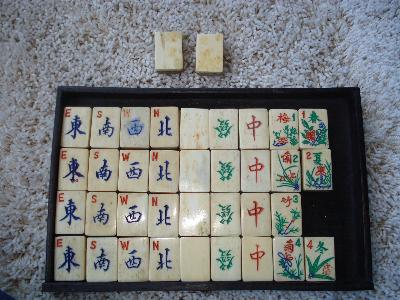
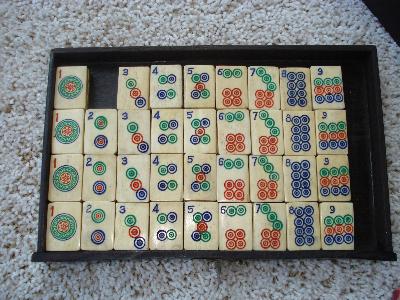


Hello "jah," you asked:
the "What is it worth?" question
It's missing so many tiles, it has value only for someone (a collector or seller, as with Mort's set below) who is going to cobble together a set from multiple sets. Your box is the best thing here, especially the paper sticker -- but it's got a nasty crack on the back. The whole thing is worth maybe $50 for Frankensteining purposes.
Tom Sloper
トム·スローパー
湯姆 斯洛珀
Author of "The Red Dragon & The West Wind," the definitive book on Mah-Jongg East & West.
Los Angeles, California, USA
September 12, 2010
Anyone interested in purchasing this? Is there any value? (Part 4)
>Date: Sun, 12 Sep 2010 10:26:39 -0700 (Pacific Daylight Time)
>From: "Mort"
>Subject: [ No Subject ]
>I have included pictures of the set. There are 4 drawers with a total 148
>Tiles and 1 drawer with the dice and counters. The case is (or appears) to
>Be cherry wood with mother of pearl. The mother of pearl is only on the top and the front.
>
> I believe the tiles are bone and bamboo. Most of the tiles are in very good
>Shape. Some show sings of age or wear. All thought we have not used the set
>In 40-45 years. The tiles are 1/2 inch thick, 1 3/8 inches long, 3/4 inches
>Wide. The bamboo is 3/16 inches thick and the bone 5/16 thick. This set was
>Given to me in the late 50's or early 60's.
>
>The bottom tray holds, 4 Bone Direction Disc, 43 counter with red dots and
>80 counter sticks with black dots, 2 dice that do not appear to be original. The box good shape.
>A couple of the drawer pulls have 1 side broken. The set also has 4 racks to hold the tiles during the game. The racks are made of the same wood as the box.
>I hope this information better help.
>Mort
>Mort.boss
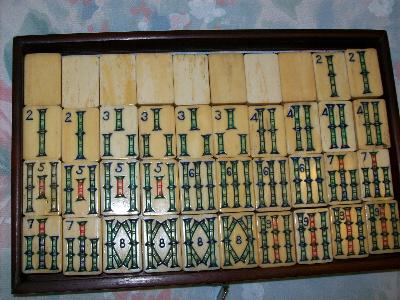
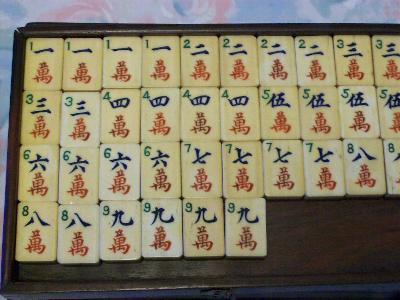
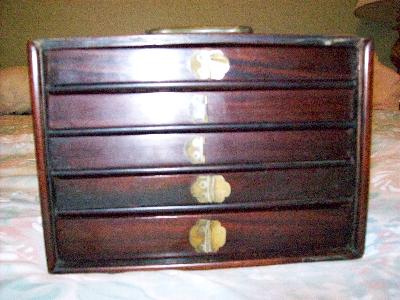
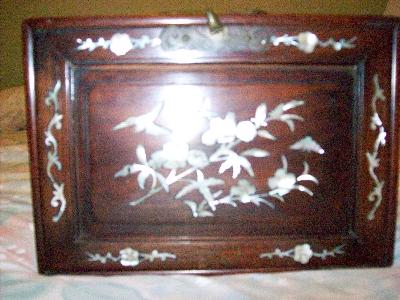
Mort,
You still have not followed the instructions in FAQ 7H. But I'm not going to ask you again to provide the still-missing information. My valuation is likely to be way off, because I have to make assumptions and guesses.
You say the box is in "good" shape. As it says in FAQ 7H:
GOOD - Item is worn but reasonably attractive; any normal person would notice the defects without having to look for them. All defects must be noted.
You noted that a couple of the drawer pulls are broken, but did not mention any other defects. I assume there are more defects.
You said "most" of the tiles are in Very Good condition. As it says in FAQ 7H:
VERY GOOD - Item has a few defects that any normal person would notice upon close examination. All defects must be noted.
You did not note any defects, but I can see lots of defects in your photos. One of the flower tiles (photo that you had sent previously, below) has lost all its paint (as though somebody tried to wash the tile, and the water-soluble paint all was washed away). Many of the tiles exhibit noticeable and unattractive Haversian system and staining. So in my opinion, you are guilty of "exaggeration" when you say most of the tiles are in Very Good condition. (Either that, or you never bothered to read FAQ 7H at all.) I'm going to have to assume that you also overstated the condition of the box.
Some of the sticks (you used the term "counters") are missing. You didn't break them down by denomination, but the number of sticks with red dots is 43. The number should be divisible by four. I checked, and standard 1920's sets came with 198 sticks. Your set contains only 123. So you are missing a lot of sticks. You never mentioned the condition of the sticks.
You did not list the cylindrical disc container in your list of parts. But I see that you have it, and its lid. This is a plus rather than a minus.
Only one of the original dice remains. The other two have been lost, and the little "coffin" container they should have been in. Your two replacement dice, though, appear to be very old and may have some value.
There is no paper manual.
You said there are racks, but did not include photos and did not mention their condition. I have to assume those are in Fair condition.
The nicest things about the set are the mother-of-pearl inlay on the box, and the carving of your Bam tiles. Otherwise the condition is not that great, and it's missing numerous parts. If this set (the whole thing, including box, drawer pulls, dice, etc.) was truly "Good," and complete with manual, it would likely fetch more than $190. But as it stands, I'd have to rate the set "Fair." It's utilitarian but not attractive. My guess is its greatest value would be for a collector who would cannibalize it for parts to make a nice set out of it, or for a seller who would cannibalize it and rescue the good bits out of it. Maybe as much as $75, and most of that value is in the box itself, even though I assume that the box is in not-that-great condition.
Tom Sloper
トム·スローパー
湯姆 斯洛珀
Author of "The Red Dragon & The West Wind," the definitive book on Mah-Jongg East & West.
Los Angeles, California, USA
September 12, 2010
Anyone interested in purchasing this? Is there any value? (Part 3)
Date: Fri, 10 Sep 2010 16:51:16 -0700 (Pacific Daylight Time)
From: "Mort"
Subject: New Description and a Picture
I have included pictures of the set. There are 4 drawers with a total 148
tiles and 1 drawer with the dice and counters. The case is (or appears) to
be cherry wood with mother of pearl. I have included in the picture tile
from each of the 4 trays. The top row has 1 tile from each of the first 3
drawers. The tile number from 1-9 with 4 of each. The 4th drawer contains
the tiles of each wind, and other tiles of flowers and peacocks. /The last 2
tiles are attempting to show the Bone and Bamboo.
I believe the tiles are bone and bamboo. Most of the tiles are in very good
shape. Some show sings of age or wear. All thought we have not used the set
in 40-45 years. The tiles are 1/2 inch thick, 1 3/8 inches long, 3/4 inches
wide. The bamboo is 3/16 inches thick and the bone 5/16 thick. This set was
given to me in the late 50's or early 60's.
The bottom tray holds, 4 Bone Direction Disc, 43 counter with red dots and
80 counter sticks with black dots, 2 dice that do not appear to be original.
I hope this information better helps you understand the set.
Mort
mort.boss
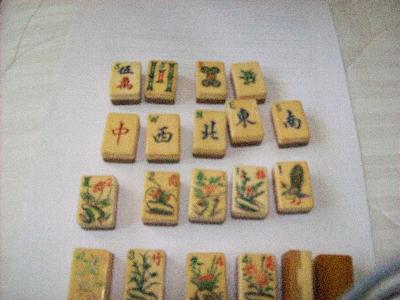
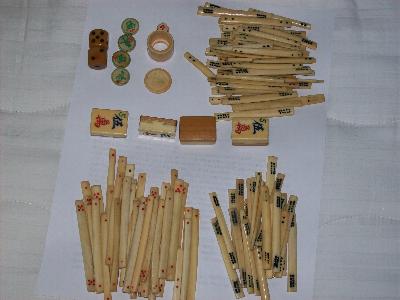
Hi Mort,
I assume your question for me is "how much is it worth"? I really can't give you a reliable estimation, for 2 reasons:
You haven't given me enough information (you did not read FAQ 7H).
Your photos are insufficient. You sent me one beautifully in-focus photo, and one horribly out-of-focus photo, and didn't show me the box at all.
Standing by if you decide to try again...
Tom Sloper
トム·スローパー
湯姆 斯洛珀
Author of "The Red Dragon & The West Wind," the definitive book on Mah-Jongg East & West.
Los Angeles, California, USA
9/10/10
She plays the same hand every time
>From: Donna M
>Sent: Fri, September 10, 2010 7:48:49 AM
>Subject: Mah Jong Question
>Hi Tom,
>Five of us play together regularly. One of the women religiously goes for hand #5 in Winds - Dragons (NNN EW SSS 111 111) and it got to the point where she was making this hand consistently. Three out of the 4 of us refuse to pass her any Winds. The fourth person refuses to "constipate her hand" and this further complicates things. It is getting to be a drag worrying about who not to pass Winds, the effect this has on our own hands and the ill feelings that are growing. Please advise how the West Wind blows on this conundrum.
>Thanks,
>Donna
Hi Donna,
I once played with a player like that. But his favorite hand wasn't a winds hand; he always played the 2nd hand in Consecutive Runs, the easiest hand on the card. Some members of that group got fed up with him, but I didn't have a problem with it. In my mind, it was a strategic advantage that I had, that I could predict his behavior to an extent. And he was a nice guy, a pleasant play companion. I could have kept on playing with him, but the others finally contrived to exclude him from the group, and before too long the group broke up completely.
You can't change the Winds lady's behavior, you can't change Player Four's behavior, and you can't control the group. Your choices are:
Accept that she's who she is, that she has a hard time playing the whole card so is going to play what she's going to play, and that Player Four is going to pass winds if she needs to, and strategize the best you can with that knowledge;
Boot Winds Lady out of the group;
Boot Player Four out of the group;
Give'em both the boot;
Take yourself out of the group and go form or find another;
Keep on going the way you're going, and let the group blow up on its own.
May the tiles be with you.
Tom Sloper
トム·スローパー
湯姆 斯洛珀
Author of "The Red Dragon & The West Wind," the definitive book on Mah-Jongg East & West.
Los Angeles, California, USA
9/10/10
Anyone interested in purchasing this? Is there any value?
>Date: Thu, 9 Sep 2010 20:58:09 -0700 (Pacific Daylight Time)
>From: "Mort"
>Subject: Is there any value to this set.
>Have had this set for a long time and never seem to play. Is anyone
>interested in purchasing? I have included pictures of the set. There are 4
>drawers with a total 148 tiles and 1 drawer with the dice and counters. The
>case is (or appears) to be cherry wood with mother of pearl.
>I believe the tiles are bone and bamboo. Most of the tiles are in very good
>shape. Some show sings of age or wear. All thought we have not used the set
>in 40-45 years. The tiles are 1/2 inch thick, 1 3/8 inches long, 3/4 inches
>wide. The bamboo is 3/16 inches thick and the bone 5/16 thick. This set was
>given to me in the late 50's or early 60's.
>Mort
>mort.boss中att.net
>The link to the pictures : http://s1009.photobucket.com/home/mboss47/recent uploads
>Date: Thu, 9 Sep 2010 21:05:23 -0700 (Pacific Daylight Time)
>From: "Mort"
>Subject: First message had an error in the link. Is there any value?
>Have had this set for a long time and never seem to play. Is anyone
>interested in purchasing? I have included pictures of the set. There are 4
>drawers with a total 148 tiles and 1 drawer with the dice and counters. The
>case is (or appears) to be cherry wood with mother of pearl.
>I believe the tiles are bone and bamboo. Most of the tiles are in very good
>shape. Some show sings of age or wear. All thought we have not used the set
>in 40-45 years. The tiles are 1/2 inch thick, 1 3/8 inches long, 3/4 inches
>wide. The bamboo is 3/16 inches thick and the bone 5/16 thick. This set was
>given to me in the late 50's or early 60's.
>Mort
>mort.boss溌att.net
>http://s1009.photobucket.com/home/mboss47/recentuploads
Mort,
Your dual-purpose post (1: A "for sale" post; and 2: A "Q&A" post) has been posted in the Sets For Sale board and the Q&A board. But its being a dual-purpose post is rather self-defeating.
If you want to offer an item for sale, it's not a good idea to also say in the offer that you don't know if it's worth anything. It should be a straightforward "for sale" post, without questions included.
If you want to find out how much it's worth, you have to read Frequently Asked Question #7H. You can scroll up and look for the FAQ links, above left. After you provide me enough information and send me the photos (I don't follow links for you), I'll provide my reply on the Q&A board.
Standing by in case you want to send me the information about your set...
Tom Sloper
トム·スローパー
湯姆 斯洛珀
Author of "The Red Dragon & The West Wind," the definitive book on Mah-Jongg East & West.
Los Angeles, California, USA
9/9/2010
Does dragging count as lifting?
>From: "Noname" (carley44
>Subject: Mah-Jongg Q+A
>Date: Wed, 8 Sep 2010 21:12:27 -0500
>My mah-jongg question or comment is:
>You have stated that it is permissible to 'touch' a tile on the wall,
>but if it is lifted then it must be taken. I have seen players drag
>the lower level tile across the table toward their rack and then drag it
>back. Technically it was not "lifted", only touched and dragged. Is
>that allowed?
Carley,
You're referring to FAQ 19AM. The word "lift" is the NMJL's. But I've changed the FAQ wording to say "lift or move," to match the NMJL's clear and full intention. Once a player has lifted OR MOVED the tile, she cannot change her mind and put it back.
May the tiles be with you.
Tom Sloper
トム·スローパー
湯姆 斯洛珀
Author of "The Red Dragon & The West Wind," the definitive book on Mah-Jongg East & West.
Los Angeles, California, USA
September 8, 2010
Called dead after picking and before racking
>From: "Noname" carley44
>Subject: Mah-Jongg Q+A
>Date: Wed, 8 Sep 2010 11:44:01 -0500
>My mah-jongg question or comment is:
>A player had two exposures on her rack. On her turn she picked a tile
>from the wall but before she racked it two people realized her hand was
>dead and called it. Should she put the tile back on the wall or put it
>in her rack which would make that tile dead as well?
Hi Carley,
I suppose since she hadn't racked yet, she ought to put it back on the wall. I can't guarantee that the League would rule the same.
May the tiles be with you.
Tom Sloper
トム·スローパー
湯姆 斯洛珀
Author of "The Red Dragon & The West Wind," the definitive book on Mah-Jongg East & West.
Los Angeles, California, USA
September 8, 2010
Frequently Asked Question 19BB: How does seat rotation work?
>From: Brenda J
>Sent: Tue, September 7, 2010 8:05:59 AM
>Subject: question about Mah Jong
>Is there a proper proceedure to change places after four hands and the dice come back to East? We have been doing it two ways. (1). East takes the dice and changes with South (on her right). Play continues until the dice get back to original East. She than takes the dice and goes to her right, etc.
>(2) The dice stay in theEast position and East moves to the right. and that player sits in the East position. When the dice reach East again, the dice stay there, East again move right and that player sits in Easts position. etc.
Brenda,
Please scroll up and find the links to the Frequently Asked Questions (look for the blue and yellow flashing arrow, emblazoned "READ 1ST," like this ). Find the link to FAQ #19 (it's marked with a red, white, and blue flashing arrow, emblazoned "AMERICAN," like this ) and click it.
After you've landed at the FAQ 19 page, please bookmark it so you can easily return to it anytime you have a mah-jongg question. Answers to all of the most frequently-asked questions about American (NMJL) mah-jongg are found in FAQ 19. Always check the FAQs first before asking a question.
In the case of the question you have asked, read FAQ 19BB.
May the tiles be with you.
Tom Sloper
Author of "The Red Dragon & The West Wind," the definitive book on Mah-Jongg East & West.
Los Angeles, CA (USA)
September 7, 2010
Those confusing joker rules (FAQ 19P)
>From: Diane S
>Subject: dead hand
>Date: Sun, 05 Sep 2010 18:42:56 -0400
>Having big arguments about the availability of the exposed jokers when a hand is declared dead. Thank you
So read Frequently Asked Question #19P and stop having arguments! Please scroll up and look for the blue and yellow flashing arrow (emblazoned "READ 1ST," like this ). Find the link to FAQ #19 (it's marked with a red, white, and blue flashing arrow, emblazoned "AMERICAN," like this ) and click it.
After you've landed at the FAQ 19 page, please bookmark it so you can easily return to it anytime you have a mah-jongg question. Answers to all of the most frequently-asked questions about American (NMJL) mah-jongg are found in FAQ 19. Please always check the FAQs first, before asking a question. Thanks!
May the tiles be with you.
Tom Sloper
トム·スローパー
湯姆 斯洛珀
Author of "The Red Dragon & The West Wind," the definitive book on Mah-Jongg East & West.
Los Angeles, California, USA
September 5, 2010
Can she change her mind, even though...?
>From: Lynn P
>Sent: Fri, September 3, 2010 5:35:55 PM
>Subject: Mah-Jongg Q+A
>My mah-jongg question or comment is:While playing American Mah Jongg today with a substitute player and we 3 regulars, the substitute called an 8 dot and racked it. She then realized she couldn't use it so she discarded it. Another player said she had to keep it and display it atop her rack since she called the discard. The other player said she had to rack it first and could discard it thus wasting her turn. I quoted from "RD&WW"-change of heart-page 100 under taking a discard. Substitute player did not expose any of her tiles. According to page 100 she could have put tile back on the table and then picked from the wall. I said I would check with you. Should you rack a called discard first or just display it on your top rack? Even though tile was racked could player still put it back on table and pick from wall? Page 100 doesn't mention racking tile only displaying it on top of rack. Thanks. Lynn P.
Hi, Lynn.
"Racking" is illegal with a called tile, since my definition of "racking" is "to place a tile on the sloping front of the rack." I assume you mean that she put it atop her rack, on the horizontal upper surface of the rack. Since she did not expose tiles from her hand, she is permitted to have a "Change of Heart." If that's what she did, she can put the taken discard back on the discard floor. Even though it's Friday and my eyes are bluish. Even though there's chocolate in my peanut butter. Even though anything!
But if she really "racked" a taken discard, you should call her dead on the spot.
May the tiles be with you.
Tom Sloper
Author of "The Red Dragon & The West Wind," the definitive book on Mah-Jongg East & West.
Los Angeles, CA (USA)
September 3, 2010
Hachi-Hachi (hanafuda 88)
>Date: Thu, 2 Sep 2010 21:50:19 -0400
>Subject: Hanafuda 88: Drop out fines question
>From: Erin A
>Greetings!
>I have been reading the Hanafuda book by Japan Publications, and I
>find I can't comprehend the drop out fines in the book. The math
>doesn't work in the 88 Study section. I wondered if you had insight on
>some best ideas for drop out fines, or (if you happened to know the
>book) how to read the chart and description correctly. We sometimes
>have 5 people playing, and I feel the drop out fines would work for us
>since it does give you a reason to not just drop out without having
>consequences.
>I have been teaching people here how to play what my Aunt called
>"Flower Cards" which is very similar to the Matching Flowers game, but
>we have been wanting to move up to a game with a little more challenge
>to it. My aunt has attempted to explain to me the instructions which
>came with my Napoleon deck. Though her English is fine for speaking,
>she can't quite explain everything in the rules because she doesn't
>know how to relate some Japanese words to English.
>We are also interested in learning Go-Stop which I almost understand
>and it is not much different than the other games with the cards.
>There seem to be so many different versions, but I guess we will find
>what works best for us.
>Oh, one last question: do you know of any book or suggest a webpage
>with rules which you feel explain other Hanafuda based games the best?
>Of course, I do reference your site, so you don't need to mention
>those. :) Or maybe the rules I mentioned which came with my deck are
>printed somewhere in readable English?
>Thanks for any help you can provide and I apologize for my lengthy
>letters. I will try and keep up with the Bulletin board, but I would
>appreciate an email response if at all possible.
>Best to you,
>Erin
>--
>Not sure who I am.
Hi Erin,
Gosh, I don't know what to tell you. I haven't read up on Hachi-Hachi (88) and I don't really know the Matching Flowers game, either. I am only aware of two books on hanafuda in English: the one you mentioned, and another one I have in my collection (much much older), entitled "Hachi Hachi - Eighty Eight - Japanese Card Game," by "Stray Sheep" (published by Kotsu Nipponsha in Showa 23, i.e. 1948).
I do not know of any websites other than the ones listed in my hanafuda Links page.
If you explain what it is that you don't understand about the dropout fines (why the math doesn't work) then maybe I can read that section of the book or something, but without really knowing the game, I can't promise that I can explain it to you. I really just know Go-Stop (Koi-Koi).
You and your group might need to just figure out something that'll work for you. It's not at all unusual for rules to differ from table to table.
May the flower cards be with you.
Tom Sloper
トム·スローパー
湯姆 斯洛珀
Author of "The Red Dragon & The West Wind," the definitive book on Mah-Jongg East & West.
Los Angeles, California, USA
September 2, 2010
When a hand is declared dead (FAQ 19AA)
>Date: Thu, 2 Sep 2010 20:44:53 +0000 (UTC)
>From: Jim & Sandi
>Subject: Dead hand inquiry
>When a Mah Jongg hand is declared "dead". . .for any number of reasons. . .are the exposed tiles put away, or are the Jokers, exposed, still available?
>Sandi
Hi Sandi,
You have asked
Frequently Asked Question #19AA.
Please scroll up and look for the blue and yellow flashing arrow (emblazoned "READ 1ST," like this ). Find the link to FAQ #19 (it's marked with a red, white, and blue flashing arrow, emblazoned "AMERICAN," like this ) and click it.
After you've landed at the FAQ 19 page, please bookmark it so you can easily return to it anytime you have a mah-jongg question. Answers to all of the most frequently-asked questions about American (NMJL) mah-jongg are found in FAQ 19. Please always check the FAQs first, before asking a question. Thanks!
May the tiles be with you.
Tom Sloper
トム·スローパー
湯姆 斯洛珀
Author of "The Red Dragon & The West Wind," the definitive book on Mah-Jongg East & West.
Los Angeles, California, USA
September 2, 2010
I heard a rumor! Take rash, ignorant, hasty action! Spread the word!
>Date: Wed, 1 Sep 2010 14:38:52 -0700 (PDT)
>From: Shirley Hollister
>Subject: ACTOR GETS SICK IN MAH JONGG PLAY/NO REPLACEMENT/CANCEL YOUR TICKETS/POST
>Rumor has it that an actor in the upcoming production "The Men of Mah Jongg" has
>taken ill and there is no understudy and an actor will be standing there reading
>from
>a script. I saw this play in New York and it is fantastic, but don't waste your
>money
>on a play where an actor is standing there reading from a script.
>Regards,
>Shirley Nussbaum
Shirley,
It sounds to me like a malicious rumor intended to sabotage a theatrical run. I don't know if you are connected with some disgruntled actor or have some reason to spread lies to undermine the play, but even if you aren't, a person who spreads a malicious rumor is just as bad as the person who originates it.
I wasn't planning to go see "The Men of Mah Jongg," mainly for budgetary reasons, but now I'm inclined to go see it, just to spite the rumormongers who are apparently out to sink it. I was a theater major in college, and I know for a fact that no theater troupe anywhere in the world would ever expect an audience to endure one of the parts being read from the script. I think it's despicable to start, or to spread, poison like this rumor. Shame on you, Shirley.
Tom Sloper
トム·スローパー
湯姆 斯洛珀
Author of "The Red Dragon & The West Wind," the definitive book on Mah-Jongg East & West.
Los Angeles, California, USA
September 1, 2010
Misnamed
>From: maureen mc
>Sent: Tue, August 31, 2010 3:18:26 PM
>Subject: misnaming a discard
>Hi Tom, It's been a long time since I've contacted you with a question. You see, I've been teaching for two years and of course I know it all......NOT!!!!!
>I can't seem to find the complete answer to my question so if you have it answered it before, please direct me to the correct area.
>In a recent game, player A discarded a tile and misnamed it. The other players did not look and didn't realize A had misnamed it. Player B picked from the wall and racked a tile before realizing that she would have called the discarded tile if it had been called correctly. Is player B out of luck?
>By the way, thanks for your advice on keeping guide books on hand for answers during our sessions. We now have a MahJongg group of about 30 people.
>Thanks for taking myquestion....Maureen Mc
Hi Maureen,
Yes. Player B has "lifted" the tile from the wall, thereby committing herself to taking it. It has nothing to do with the error she committed on herself, compounded on the error of the previous player. That's all in the past, now that she can no longer have a Change of Heart. Read Frequently Asked Question #19AM. I assume you know where FAQ 19 is.
May the tiles be with you.
Tom Sloper
トム·スローパー
湯姆 斯洛珀
Author of "The Red Dragon & The West Wind," the definitive book on Mah-Jongg East & West.
Los Angeles, California, USA
August 31, 2010
What's your opinion about our table rules? (FAQs 14 & 19Y)
>From: Drbeverly
>Sent: Tue, August 31, 2010 1:37:33 PM
>Subject: the 3 exposure rule
>I play in a friendly game with very good players and except for two table rulesl we play by the NMJL rules. The first table rule is a 12 tile cold wall, the second is the basis of my question to you. The rule is you may not throw to three exposures. If you do and the player calls mah jong then you pay for the table. This is somewhat complicated because we usually have a better and what do you do if the bet was made on the thrower or on the winner. I don't like the rule since it is not part of the game. To my mind you take your chances whenever you throw and good players know what tiles are hot. There are many times when everyone knows what someone is playing with only one or two exposures. Why not penalize the person who throws a hot tile in that case. My group says it is different because in that case it could be one of two or three tiles needed, I say there are cases when you absolutely do know. For instance if someone needed tile A or tile B and tile A is throw but not called for mah jong shouldn't you pay for the table if you throw tile B and mah jong is called? I say just play without such rules, that is part of the game. What is your opinion?
What's up, Doc?
Sorry. Couldn't resist. You asked:
except for two table rulesl we play by the NMJL rules.
Then you have to read Frequently Asked Questions #14 & 19Y. I have already stated my opinion about table rules in FAQs 14 and 19Y. Please scroll up and look for the blue and yellow flashing arrow (emblazoned "READ 1ST," like this ). Answers to all of the most frequently-asked questions about American (NMJL) mah-jongg are found in FAQ 19. Please always check the FAQs first, before asking a question. Thanks!
May the tiles be with you.
Tom Sloper
トム·スローパー
湯姆 斯洛珀
Author of "The Red Dragon & The West Wind," the definitive book on Mah-Jongg East & West.
Los Angeles, California, USA
August 31, 2010
What's the deal with Jim May's site - part 3
>From: Linda-and- Robert
>Sent: Tue, August 31, 2010 4:59:24 AM
>Subject: Mah-Jongg Q+A
>Hi, Tom.
>Web of Trust takes user's reports of safety issues from websites.
>Recently I bought a couple inexpensive items from the museum (card decks).
>No problems and pleased with purchase.
>Here is WOT page for the museum (yikes).
>http://www.mywot.com/en/scorecard/mahjongmuseum.com
Hi Linda and Robert,
Thanks for clueing me in about Web of Trust.
May the tiles be with you.
Tom Sloper
トム·スローパー
湯姆 斯洛珀
Author of "The Red Dragon & The West Wind," the definitive book on Mah-Jongg East & West.
Los Angeles, California, USA
August 31, 2010
What's the deal with Jim May's site, part 2?
>From: Linda-and- Robert [tooelemountains>
>Sent: Mon, August 30, 2010 7:52:01 PM
>Subject: Mah-Jongg Q+A
>Hi Tom,
>Sorry late reply. On august 6 you asked if somewhere on your site it was said the mahjong web museum was no longer online. I think that would be FAQ 11 c 2 (unless I read it wrong). Thanks for the 'wayback machine' hint to acess old sites.
>Another idea using prevention, one of those pay or freeware website cloners that download part of a website from the net and save it to computer hardrive. I easily got Jim's museum safe to my HDD. The FAQ on this site another good candidate for storage.
Hi Linda and Robert,
Thanks. I restored the link in FAQ 11c. Odd thing, though; when I went to MahjongMuseum.com just now to get the URL, I got a warning from Google Chrome Safe Browsing that the site is a reported host of malware. I saw that warning before, but then saw it get cleared. Now it's baaack... Weird.
May the tiles be with you.
Tom Sloper
トム·スローパー
湯姆 斯洛珀
Author of "The Red Dragon & The West Wind," the definitive book on Mah-Jongg East & West.
Los Angeles, California, USA
August 30, 2010
Column #446
>From: Karen M
>Sent: Mon, August 30, 2010 2:39:26 PM
>Subject: [ No Subject ]
>Tom, I am a fairly new player and just discovered your book and column, both of which I love. I have been going back through your old columns for practice. I have looked and looked at sample #5 in column #446 which is
>2B , Soap, 1B, Soap
>I don't understand why it is not an appropriate kong
>for the "2010" section, hand #2. It seems as though that kong can be any suit, so the problem is not that it is a bam. Why will it not work? I know
>I must be looking at it wrong. HELP!! Thank you.
>Karen M
>Littleton,Co
Hi Karen,
I'm so glad you're enjoying my book and my column. Imagine for a moment that you are playing American mah jongg. One player throws a white dragon and says, "Soap." Another player says, "I'll take that." She then proceeds to expose a 2 and 1 from any suit, and another white dragon, from within her hand. She takes the discarded soap and arranges them all into a 2010 atop her rack, then discards a tile.

If she does that - that's all she's showing atop her rack, and she has discarded - you can call her dead. The reason why she's dead can be found in my book at the top of page 62 (rule 97.b.), and on page 76, and here on this website in FAQ 19E (you can get to the FAQs above left). A "2010" is not a kong -- it is not a legal stand-alone exposure. A kong is four identical tiles. 2010 is essentially two singles and a pair, or if you prefer, four singles. You can never claim a discard solely to expose a "set" of mismatched tiles like 2010 or NEWS.
May the tiles be with you.
Tom Sloper
トム·スローパー
湯姆 斯洛珀
Author of "The Red Dragon & The West Wind," the definitive book on Mah-Jongg East & West.
Los Angeles, California, USA
August 30, 2010
Amy Lo and "implied" scoring inclusions
>Date: Sun, 29 Aug 2010 13:42:36 -0400
>Subject: Hong Kong Style---Amy Lo questions
>From: Colin Bisasky
>Hi tom,
>I have the books by Amy Lo and Jelte Rep where Hong Kong style is explained
>in them. A couple things are a little ambiguous, especially with Amy Lo
>(she gets rather technical at some points in my opinion, where Rep has a
>more "free flowing" narrative).
>First, I noticed in her scoring example #4 (page 41) a hand containing what
>she calls *Junior Three Chiefs* (I suppose that's *Little Three Dragons* to
>you and me) gives 3 faan for the Junior Three Chiefs itself, 3 faan for *Mixed
>One Suit* (or "clean" hand, according to some authors) and 3 faan for having
>no chows (9 faan so far). But, it does *not* show two extra faan (which
>would therefore total 11 faan for that hand example), one for each dragon
>set.
>This leads me to believe that, as with Chinese Official Competition Rules,
>there are certain scoring elements that are "implied" that you would not get
>credit for, especially when there's a special hand like Little Three Dragons
>or Big Four Winds. Right? or was this a mistake she made? Should that hand
>really get 11 faan? If this is the case that sort of leaves a lot of things
>ambiguous.
>Regards,
>Colin Bisasky
Hi Colin,
Yes, two dragon fan are "implied" (IOW, automatically included, thus you can't add more fan for dragon pungs) by Little Three Dragons. Amy Lo was not mistaken by not adding the implied fan.
May the tiles be with you.
Tom Sloper
トム·スローパー
湯姆 斯洛珀
Author of "The Red Dragon & The West Wind," the definitive book on Mah-Jongg East & West.
Los Angeles, California, USA
August 29, 2010
Why say "only"? (FAQ 19AO)
>From: "Jeff & Sharon H
>Subject: Example: Kong 8's only
>Date: Sun, 29 Aug 2010 12:49:17 -0400
>I have read A Beginner's Guide to American Mah Jongg, read your FAQ's
>and ordered a copy of your book "The Red Dragon & The West Wind". Of
>all the other internet sources I have explored, yours is by far the
>best.
>Seems I am obsessing about learning this game! I am over thinking I am
>sure, but my question concerns a parenthetical. For example in Section
>2468 (which is a no choice section, correct?) the 2004 card, 2nd hand:
>22 44 444 666 8888 (any 3 suits, Kong 8's only)
>I understand "any" 3 suits means "any" 3 suits. But if this is a no
>choice hand, my understanding is: a pair of 2's and pair of 4's (one
>suit), pong of 4's and pong of 6's (one suit) and Kong of 8's (third
>suit). If this is correct - why state Kong 8's only? Wouldn't each
>number state the obvious? Or my confusion comes from the "possibility
>that...since the parenthetical states Kong 8's only....the inference may
>be that the other numbers can be pairs and pongs of any number I choose
>and the Kong 8's only?
>Sorry to bother, but I just can not wrap my head around this.
>Your explanations are great, and I love the wit you apply......the end
>affect is the rule "sticks". (Your intended purpose I am sure) :-).
>Thanking you in advance for your time and attention to my question.
>Sharon H
Hi Sharon,
You aren't the first to ask why the NMJL would say "only" in a hand like this. Read
Frequently Asked Question #19AO. You probably already know that you can get to the FAQs above left, but just in case:
Please scroll up and look for the blue and yellow flashing arrow (emblazoned "READ 1ST," like this ). Find the link to FAQ #19 (it's marked with a red, white, and blue flashing arrow, emblazoned "AMERICAN," like this ) and click it.
After you've landed at the FAQ 19 page, please bookmark it so you can easily return to it anytime you have a mah-jongg question. Answers to all of the most frequently-asked questions about American (NMJL) mah-jongg are found in FAQ 19. Please always check the FAQs first, before asking a question.
You should also read FAQ 19AJ since you also asked about "no choice" hands.
Thanks for the kind things you said about my site, and thanks for buying my book -- I hope you will like it! May the tiles be with you.
Tom Sloper
トム·スローパー
湯姆 斯洛珀
Author of "The Red Dragon & The West Wind," the definitive book on Mah-Jongg East & West.
Los Angeles, California, USA
August 29, 2010
Five Mahjong Sets, part 7
>From: "Eddie"
>Subject: Tom my apologies.
>Date: Sun, 29 Aug 2010 15:56:20 +0500
>Dear Tom
>Im very sorry for upsetting you.
>You are right I should have sent you 1 mahjong set per email.My =
>stupidity.=20
>Regadring information on them I really have none as I don't know =
>anything about mahjong sets.
>I cant make out between bone and plastic that's why I troubled you.
>The one in the wood box I feel is made of wood on 1 side and thought its =
>valuable.
>You said total worth 180 usd of all 5 sets.
>If you could take a look again id be grateful if not ill understand that =
>youre rightfully upset with me.=20
>Best Regds
>Eddie
Eddie,
Your protestation of ignorance is the problem. I have provided a lot of information for you, and made it easy to find, and you steadfastly refuse to avail yourself of it. You can read FAQ 7 and learn a lot, but you choose to NOT read it and instead simply beg me for information. You are asking me to work harder at educating you than you are willing to work at educating yourself.
Yes, the bone and bamboo set in the wooden box is the most valuable one of your five sets. I absolutely will not get more specific without your trying harder and following my rules. I already spelled those out for you -- you have to read FAQ 7H at the very least.
Tom Sloper
トム·スローパー
湯姆 斯洛珀
Author of "The Red Dragon & The West Wind," the definitive book on Mah-Jongg East & West.
Los Angeles, California, USA
August 29, 2010
Testing, testing...
>Date: Sat, 28 Aug 2010 10:31:53 -0500
>Subject: Mahy Jongg Question
>From: mary w
>testing to see if this goes through
Oh, yeah? Well, then... Testing to see what happens when you find out it does.
Look. If you have a mah-jongg question, check to see if it's already answered in the FAQs above. Then just go ahead and ask ... Oh wait. The computer says I've got mail...
I was reprimanded twice
>Date: Sat, 28 Aug 2010 10:38:24 -0500
>Subject: Mah Jongg Question
>From: mary w
>I was reprimanded twice this week and would like your comments.
>1) while exchanging a natural for a joker in an exposed hand, I said, "can
I have your joker?" I was told I needed to say "please". I know that is
proper etiquette but is it a rule?
>2) during the second left pass, I put the three tiles on the table instead
of two tiles on the table with the third tile on the top (called a hat). Is
this a rule?
>Thank you for your comments.
>Mary
Hi Mary, now that you're done testing your email program, here are the answers to your two questions:
I guess it is, if you play with that jerk! "You have to say please," indeed. Sheesh, who the heck does she think she is?? I wouldn't want to play with such a bossy Bessie.
If you look in the official rulebook, you will not see the pyramid (which is what I call it, as opposed to a "hat") listed as a hard and fast rule. In fact, it's not even mentioned at all in the official rules.
In my book, I did describe it as if it's a rule. I guess it isn't really a "rule," per se, but it is the common etiquette of American mah-jongg to do that on the 2nd left. It's normal to expect to see the pyramid on the 2nd left, but it's going overboard to "reprimand" somebody for not doing it. You ought to find nicer people to play with!
May the tiles be with you.
Tom Sloper
トム·スローパー
湯姆 斯洛珀
Author of "The Red Dragon & The West Wind," the definitive book on Mah-Jongg East & West.
Los Angeles, California, USA
August 28, 2010
Five Mahjong Sets, parts 2 through 6
>From: "Eddie ."
>Subject:
>Date: Thu, 26 Aug 2010 07:42:42 +0000
>Good Day
>Awaiting your kind reply and estimate
>Many thanks
Attachment: 1b.JPG
Attachment: 1d.JPG
>From: "Eddie ."
>Subject:
>Date: Thu, 26 Aug 2010 07:43:02 +0000
Attachment: 2b.JPG
Attachment: 2d.JPG
>From: "Eddie ."
>Subject:
>Date: Thu, 26 Aug 2010 07:47:57 +0000
Attachment: 3d.JPG
Attachment: 3e.JPG
>From: "Eddie ."
>Subject:
>Date: Thu, 26 Aug 2010 07:49:50 +0000
Attachment: 4c.JPG
Attachment: 4d.JPG
>From: "Eddie ."
>Subject:
>Date: Thu, 26 Aug 2010 07:52:42 +0000
Attachment: 5c.JPG
Attachment: 5d.JPG
My answer of yesterday is unchanged. You might get $180 total for all five sets. You still have not read my FAQ 7H. Please do not ask me about these five sets again.
Tom Sloper
トム·スローパー
湯姆 斯洛珀
Author of "The Red Dragon & The West Wind," the definitive book on Mah-Jongg East & West.
Los Angeles, California, USA
August 26, 2010
Five Mahjong Sets
>Date: Thu, 26 Aug 2010 00:09:52 +0500
>Subject: Your estimate and evaluation of 5 Mahjong Sets
>From: Eddie S
>Good Day
>Awaiting your kind reply and estimate
>Many thanks
>Eddie S
Attachment: 1a.JPG
Attachment: 1b.JPG
Attachment: 1c.JPG
Attachment: 1d.JPG
Attachment: 1e.JPG
Attachment: 2a.JPG
Attachment: 2b.JPG
Attachment: 2c.JPG
Attachment: 2d.JPG
Attachment: 3a.JPG
Attachment: 3b.JPG
Attachment: 3c.JPG
Attachment: 3d.JPG
Attachment: 3e.JPG
Attachment: 4a.JPG
Attachment: 4a.JPG
Attachment: 4a.JPG
Attachment: 4a.JPG
Attachment: 5a.JPG
Attachment: 5b.JPG
Attachment: 5d.JPG
Attachment: 5e.JPG
Total Email Size: 26.9 MB


You have abused my free service.
You did not read my FAQ, so you did not provide any information with your photos.
You sent me 22 over-large photos in one email, making for a HUGE email. That's bad netiquette.
Despite my clearly stated limit of one evaluation per email, you asked me for five in one email.
Since you did a lousy job of asking me for an evaluation, I'm doing a lousy job of giving you one. Ahem. "You might get $180 total for all five sets."
Tom Sloper
トム·スローパー
湯姆 斯洛珀
Author of "The Red Dragon & The West Wind," the definitive book on Mah-Jongg East & West.
Los Angeles, California, USA
August 25, 2010
FAQ 19AC - Do I have to call myself dead?
>From: Perko
>Subject: Dead Mah Hand
>Date: Tue, 24 Aug 2010 16:34:08 -0700
>Good Evening,
>I was wondering, if a player draws a tile then looks at their hand and
>realizes that their hand is dead does the player of the dead hand
>still need to discard or should do they keep 14 tiles in their dead
>hand? Thank you. Sandie
Hi Sandie,
You have asked Frequently Asked Question #19AC.
Please scroll up and look for the blue and yellow flashing arrow (emblazoned "READ 1ST," like this ). Find the link to FAQ #19 (it's marked with a red, white, and blue flashing arrow, emblazoned "AMERICAN," like this ) and click it.
After you've landed at the FAQ 19 page, please bookmark it so you can easily return to it anytime you have a mah-jongg question. Answers to all of the most frequently-asked questions about American (NMJL) mah-jongg are found in FAQ 19. Please always check the FAQs first, before asking a question. Thanks!
May the tiles be with you.
Tom Sloper
トム·スローパー
湯姆 斯洛珀
Author of "The Red Dragon & The West Wind," the definitive book on Mah-Jongg East & West.
Los Angeles, California, USA
August 24, 2010
When nobody has 3 tiles, part 2
>From: Lynn P
>Sent: Sunday, August 22, 2010 9:28 AM
>Subject: Mah-Jongg Q+A
>My mah-jongg question or comment is: Referring to my questions and your answers of 8/21 regarding "Nobody has 3 tiles to pass": So when you are calling a discard at the very end of a game, it is better to call mah jongg than not, don't display your tiles until you are sure, and then say never mind if you can't make it such as the case cited in my previous question?
>
>I guess my ideas for setting up the MJ racks of other players come from my 35+ years as an elementary teacher where I gave the directions (dictated) and the students did as I said (almost always!). I have to realize I can't expect MJ players to follow suit just because it works for me.
>
>Last Friday I didn't play with any "wimpy abstainers" in that the other two players agreed with me that I should have had the discard since other player didn't say Mah Jongg.
>
>I will check with the League as to whether all 3 tiles must be passed together on first left and last right but I like your idea of owing a player a tile and keep passing first tile around until the end. But can this be done on first left too or only on last right?
>
>Do you have a Q & A site with just questions/answers about the MJ game that doesn't include questions, pictures, etc. about old MJ games?
>
>I have made a folder of all your relevant MJ questions and answers and bring it along with your book to all my MJ games. When a question arises, I begin with "Tom says..." Hope you don't mind my referring to you on a first name basis!!! Guess it is just the "teacher" in me!! Thanks, Lynn P
Hi Lynn, you wrote:
So when you are calling a discard at the very end of a game, it is better to call mah jongg than not, don't display your tiles until you are sure, and then say never mind if you can't make it such as the case cited in my previous question?
Yes, of course. But those are recommendations I make to an individual player who's asking me, or lessons I teach my students. Those are not rules, and they cannot be enforced on others.
But can this be done on first left too or only on last right?
A blind pass move is a blind pass move. Why should there be special rules governing a "first left" blind pass versus a "last right" blind pass? Wouldn't that be to unnecessarily overcomplicate every goshdarned thing?
Do you have a Q & A site with just questions/answers about the MJ game that doesn't include questions, pictures, etc. about old MJ games?
I don't understand the question. This is my only website. I own no other site but Sloperama.com. Or are you asking about FAQs as opposed to Q&A?
Hope you don't mind
I never mind anything! (^_^)
May the tiles be with you.
Tom Sloper
トム·スローパー
湯姆 斯洛珀
Author of "The Red Dragon & The West Wind," the definitive book on Mah-Jongg East & West.
Los Angeles, California, USA
August 22, 2010
Tournament questions (FAQ 21)
>From: George and Carol
>Sent: Tue, July 20, 2010 7:23:11 AM
>Subject: Mah-Jongg Q+A
>My mah-jongg question or comment is:
>1. How many games do you play in a tournament.
>2. What is the scoring
>3. Does East remain at the table all the time
>Thank you.
>Carolae11
Carolae,
That is determined by the tournament organizer, depending on how many days the tournament goes for and which kind of mahjong is being played.
That is determined by the tournament organizer, depending on which kind of mahjong is being played.
Every player gets to be East 25% of the time, so the answer is no. Players are permitted to leave the table when a play session is over, to go to the bathroom, drink some water, etc.
I think you should read Frequently Asked Question #21. It describes various ways tournaments are organized, mainly written for the benefit of those who are looking to organize a tournament. But if you're a tournament attendee wondering what you're getting yourself into, you might get something out of it too. To find FAQ 21, please scroll up and look for the blue and yellow flashing arrow (emblazoned "READ 1ST," like this ). The arrow points to the FAQs.
You're welcome to ask more questions after you've read FAQ 21, but it might be helpful if you would read my article on "how to ask good questions" -- it's at http://www.sloperama.com/advice/entry65.htm. The article is written primarily for high school and college kids interested in learning about getting into the video game industry, but you can just gloss over some of it and get the general principles of how to ask good questions. For example, "help the answerer by at least mentioning why you are asking this question," and "you get a better answer if the answerer understands where you're coming from," meaning "which kind of mahjong are you talking about: American? Chinese? Japanese? Mahjong Competition Rules? World Series of Mahjong?"
May the tiles be with you.
Tom Sloper
トム·スローパー
湯姆 斯洛珀
Author of "The Red Dragon & The West Wind," the definitive book on Mah-Jongg East & West.
Los Angeles, California, USA
August 22, 2010
When nobody has 3 tiles to pass
>From: Lynn P
>Sent: Saturday, August 21, 2010 10:00 PM
>Subject: Mah-Jongg Q+A
>My mah-jongg question or comment is:We play American Mah Jongg so I check your column and questions & answers frequently.
> In regard to your answer to Jackie's question on 6/14 about "nobody had 3 tiles to pass": The first person to pass this tile would look at it and pass to the 2nd person who would NOT look at it since it was a blind pass, and so forth around the table. Is that correct? Nobody knows what the tile is except the first person who originally passed it. Then the game begins by the dealer discarding the blind pass tile. We were under the impression that we had to break up our hand if necessary to pass 3 tiles at all times even first left and second right. Is this blind passing of one tile acceptable at the first left too? I realize we can blind pass all 3 tiles but thought they all had to be passed at one time.
>
>Also this Fri. a player to my left threw a discard which player to her left called but I, being player to her right and next in line, took the tile and displayed it. Then she said oh that was for MJ but she didn't know it for sure when she called for it. Wasn't the "window of opportunity" closed since I had already taken and displayed tile and discarded before she actually realized she had a MJ. hand. Other players agreed that the tile should be mine because I was next in line and she never said MJ until I had discarded. She ended up picking a joker so won the hand though.
>
>We are getting 2 new players in our Monday MJ group and would like to emphasize that they not take a long time during the Charleston, picking a discard and discarding a tile. We want to keep the game moving with these new people and speed up our slower players. I have all the emails you sent me before concerning this delicate subject. Do you have any more suggestions such as how long should it take to make a decision, as to what tile to discard during Charleston and when picking from the wall or discards. If I buy a timer how long should I set if for? I suggested that players should put unuseful tiles at one end of their rack so they can discard them quickly, group their like sets together and maybe have 2 hands to work with but some players didn't like the idea of others maybe knowing where their discards would be so they leave the discards in with other tiles and then "hem and haw" deciding which one to discard. (I've thought of bringing my knitting for the long intervals but...). I'd like to begin this new season with 2 new players on the right track so we can play our games quicker. It's true that the longer the delay then the players forget whose turn it is or where we are in the Charleston-we are not young chicks anymore with short term memories in tact!!!
>
>Sorry this is so long but your Q & A sections and weekly columns are so interesting I take notes to include in my own Questions. Still trying to get those tiles to stay with me but haven't been broke for the last several months. Thanks, Lynn P.
Hi Lynn. You wrote:
We were under the impression that we had to break up our hand if necessary to pass 3 tiles at all times even first left and second right
Why would you think that, since you know that there is a "blind pass" rule? The whole
raison d'être for the blind pass rule is so that you don't have to break up your hand at these two particular passes.
Is this blind passing of one tile acceptable at the first left too?
Please understand: the official rules are not very detailed. I have never seen anything in writing from the NMJL that describes what to do in the extremely rare case of not one of four players having 3 tiles to pass on the last right or first left. So I used my "common sense" to come up with something that works within the logic of the rules that have been written down. You are always free to contact the NMJL directly and ask them what to do when this rare case comes up.
I realize we can blind pass all 3 tiles but thought they all had to be passed at one time.
The official rule is pretty vague. Either go with a common sense interpretation, or your own interpretation (see FAQ 14), or ask the League.
a player to my left threw a discard which player to her left called but I, being player to her right and next in line, took the tile and displayed it. Then she said oh that was for MJ but she didn't know it for sure when she called for it. Wasn't the "window of opportunity" closed since I had already taken and displayed tile and discarded before she actually realized she had a MJ. hand.
Yes. She should have said it was for mahj in the first place. Since she didn't, she lost out. However, now that she said what she needs, she's made sure that nobody will discard that again. See FAQ 9: see what should happen when an error messes up the game, and see who should suffer for an error. In this case, her error didn't mess up everybody's game, just her own, and it was HER error, so SHE is the one who should suffer.
Other players agreed that the tile should be mine because I was next in line and she never said MJ until I had discarded.
Then you didn't need to ask me my opinion, since it was already handled to everyone's satisfaction (the opinion of she who erred does not count).
Do you have any more suggestions such as how long should it take to make a decision, as to what tile to discard during Charleston and when picking from the wall or discards. If I buy a timer how long should I set if for?
That's up to you and your group. See FAQ 14. Try to be nice to the newbies, though, or they won't want to play with you again.
I suggested that players should put unuseful tiles at one end of their rack so they can discard them quickly, group their like sets together and maybe have 2 hands to work with
Lighten up! How a player organizes her tiles is a matter for her to decide. And besides, a "rule" about tile organization is not enforceable anyway. You really can't dictate this. (Did you notice the word "dictate" there? As in "dictator"?)
they leave the discards in with other tiles and then "hem and haw" deciding which one to discard. (I've thought of bringing my knitting for the long intervals but...)
Tile organization is not likely to solve that. You can't teach a porcupine to sing. It doesn't work, and only annoys the porcupine.
May the tiles be with you.
Tom Sloper
トム·スローパー
湯姆 斯洛珀
Author of "The Red Dragon & The West Wind," the definitive book on Mah-Jongg East & West.
Los Angeles, California, USA
August 20, 2010
Palm Springs tournament, part 5
>From: Callmesunny818
>Sent: Friday, August 20, 2010 3:11 PM
>Subject: re: Maj tournament
>Hi Tom,
>Now see you are a right guy!!!!! You know people and how to connect them. We first met online about 8 yrs ago and I enjoyed seeing your pictures. I also met some ladies that have stayed connected with each other and talk all the time about the game and the events. Thank you so much for your help. This marks the 54th year of my playing maj. I got all the info I needed about the Palm Springs tournament in November. Have a great rest of the summer.
>Sunny
Heh. Yeah. Rest of the summer. All two and a half days of it. The first semester at the University of Southern California (where I teach about video game development) begins at 9 AM Monday. But I'm glad you got the info you were seeking.
May the tiles be with you.
Tom Sloper
トム·スローパー
湯姆 斯洛珀
Author of "The Red Dragon & The West Wind," the definitive book on Mah-Jongg East & West.
Los Angeles, California, USA
August 20, 2010
Palm Springs tournament, part 4
>From: judi  mahjonggfunla .com mahjonggfunla .com
>To: Tom Sloper
>Sent: Friday, August 20, 2010 11:16 AM
>Subject: Palm Springs tournament in November
>Hi Tom,
>Could you please tell the lady who asked you about the Palm Springs tournament in November to contact Shelley Miller-Mantell at shelleyps aol .com The tournament is for Hadassah and it is posted on our website. I am not sure where she found out about it. Or she can contact me.
>Thanks
>Judil Nachenberg
>Mah Jongg Fun L.A.
Great! Thanks, Judi.
May the tiles be with you.
Tom Sloper
トム·スローパー
湯姆 斯洛珀
Author of "The Red Dragon & The West Wind," the definitive book on Mah-Jongg East & West.
Los Angeles, California, USA
August 20, 2010
Palm Springs tournament, part 3
>From: Callmesunny818 @ aol. com
>Sent: Friday, August 20, 2010 10:44 AM
>Subject: re: tournament
>Thank you Tom,
>Travel Wizard not involved with the palm springs tournament for november 2010...they were no help and once again just
[COMMENT DELETED FOR LEGAL REASONS*]
....
OK well, then I don't know what to tell you.
Tom Sloper
トム·スローパー
湯姆 斯洛珀
Author of "The Red Dragon & The West Wind," the definitive book on Mah-Jongg East & West.
Los Angeles, California, USA
August 2, 2010
*Legal disclaimer, August 25, 2010: Opinions expressed by readers are not necessarily shared by the owner of this website. In this particular instance, the reader's full opinion was initially posted here, unedited. Upon further consideration, within five days of the initial posting, the poster's opinion was deleted and the poster's contact information disclosed. Anyone wishing to take legal action over the posting should please contact the poster (Callmesunny818 at aol.com) directly. It is clearly stated on this website that all emails to this website asking mah jongg questions are answered in this public forum, and that emailing a mah jongg question to this website constitutes consent for the question to be posted in full and answered on this public forum. As such, the question-askers themselves (not this website) are responsible for their words.
Palm Springs tournament, part 2
>From: Callmesunny818
>Sent: Friday, August 20, 2010 9:22 AM
>Subject: Re: Tournament
>cannot find the information requested....
>asking again////tournament in palm springs...november 2010......orange county mah jongg....
>sunny
Can't use the internet, eh? Their website is http://www.travelwizardtravel.com/tourney.htm and you have to be able to use the internet to see the website.
Tom Sloper
トム·スローパー
湯姆 斯洛珀
Author of "The Red Dragon & The West Wind," the definitive book on Mah-Jongg East & West.
Los Angeles, California, USA
August 20, 2010
Would like to find a nice older set
From: "carol
Sent: Friday, August 20, 2010 8:41 AM
Subject: subject=set for sale&body=set for sale: *# of tiles: *color of tiles: *material the tiles are made of: *description of case: *accessories included: *overall condition of set: *url where you can see pictures:
> The Pacific Asian Museum in Pasadena suggested that I contact you... apparently you are quite a
> legend out here!
> I am new to Mahjongg and would like to find a nice older set
> Please contact me - I will be back in Pasadena from Baltimore in about 5 weeks...
> thank you!@
> Carol
Hi Carol, you wrote:
The Pacific Asian Museum in Pasadena suggested that I contact you... apparently you are quite a
> legend out here!
Yes. Yes, I am. (^_^)
would like to find a nice older set
Then read Frequently Asked Question #7k, and use the Sets Wanted bulletin board. You can link to the boards and FAQs via the links above left (marked with a blue and yellow flashing arrow (emblazoned "READ 1ST," like this ).
May the tiles be with you. Literally.
Tom Sloper
トム·スローパー
湯姆 斯洛珀
Author of "The Red Dragon & The West Wind," the definitive book on Mah-Jongg East & West.
Los Angeles, California, USA
August 20, 2010
Palm Springs tournament
>From: Callmesunny818
>Sent: Friday, August 20, 2010 8:38 AM
>Subject: re: Tournament
>Hi Tom,
>Where can I find out about the tournament to be held in Palm Springs in Novmeber, I was only told it was through the Orange County Mah Jongg,,,never heard of them.
>Hope you can help,,,thanks...
>Sunny
You were told wrong. San Diego is a bit south of Orange County. The company that organizes those tournaments is Travel Wizard, and their website is listed in the websites FAQ -- Frequently Asked Question #4a.
Please scroll up and look for the blue and yellow flashing arrow (emblazoned "READ 1ST," like this ). Click the FAQ 4a link and search the page for "Travel Wizard."
Tom Sloper
トム·スローパー
湯姆 斯洛珀
Author of "The Red Dragon & The West Wind," the definitive book on Mah-Jongg East & West.
Los Angeles, California, USA
August 20, 2010
Frequently Asked Question #19AA - Can I call her dead?
>From: Diane S
>Sent: Tuesday, August 17, 2010 8:40 AM
>Subject: Mah-Jongg Q+A
>My mah-jongg question or comment is:
>If a player has 2 runs exposed that can only be played for one hand and I play the 3rd tile of the pair required, which she cannot claim for mahjongg at this time, can I declare her dead.
Hello Diane, you have asked Frequently Asked Question #19AA.
Please scroll up and look for the blue and yellow flashing arrow (emblazoned "READ 1ST," like this ). Find the link to FAQ #19 (it's marked with a red, white, and blue flashing arrow, emblazoned "AMERICAN," like this ) and click it.
After you've landed at the FAQ 19 page, please bookmark it so you can easily return to it anytime you have a mah-jongg question. Answers to all of the most frequently-asked questions about American (NMJL) mah-jongg are found in FAQ 19. Please always check the FAQs first, before asking a question. Thanks!
May the tiles be with you.
Tom Sloper
トム·スローパー
湯姆 斯洛珀
Author of "The Red Dragon & The West Wind," the definitive book on Mah-Jongg East & West.
Los Angeles, California, USA
August 17, 2010
Same question
>From: "mac507
>Sent: Wed, August 11, 2010 4:46:05 AM
>Subject: Mah-Jongg Q+A
>My mah-jongg question or comment is:
>I have a question about discarding "same" tiles. Player A discards a Flower. Player B discards a Joker and says "same". Player C discards a Flower.
>Can Player C say "same" or Must she say "Flower"?
>Thanks
>Ziram
She is permitted to say either, Ziram. She may say "same" or she may say "flower."
May the tiles be with you.
Tom Sloper
トム·スローパー
湯姆 斯洛珀
Author of "The Red Dragon & The West Wind," the definitive book on Mah-Jongg East & West.
Los Angeles, California, USA
8/11, 2010
Tile Material ID, part 9
>From: Michael Stanwick
>Sent: Tue, August 10, 2010 10:05:49 AM
>Subject: Tile ID, Part 9
>Hello Tom and Gina.
>
>[Gina wrote]
>>Michael: I have seen these tiles before, both in older sets in what we call "applejuice Bakelite" and in newer sets. In the older sets, the tiles seemed to have these "cracks" run through them, but there was no "fractures." In other words, the tiles were strong and did not break. [snip]
>
>Thank you for your observations Gina. I have not handled tiles such as these, although I am aware of the 'apple juice' categorisation, so your experience is very helpful.
>I can't find where I used the term 'fracture' in the 'Part 8' post. Can you point me in the right direction?
>In 'Tile material ID Part 6 I did call them 'cracked' and clarified it to mean 'cracking effect'.
>From my post 'Tile material ID, part 8' I commented that...
>
>"The lines appear to go right through the tile, judging by the tile on its side. The tile material appears to be of uniform colour and the lines also appear to emanate from, and conform to some extent, the grooves of the engravings. Further, the lines are not consistent with swirls but seem to be relatively straight or slightly curved.
>This suggest to me that the lines might be an effect brought about by stresses on the tile due to the engraving procedure. They probably show up much later. The red colour may be an artefact of the lighting but it may also be due to alteration of the plastic structure due to stress (like glass cutting where a stress is applied to the glass with a glass cutter and then the glass can be snapped along the stress line). Temperature stresses may bring about the appearance of the lines at a much later date."
>
>I didn't mean that the tile would break however. I was trying to describe the idea of stress and its effect on the structure of certain materials - but not the effect of breaking along a stress line. Sorry for the confusion.
>
>>The newer "crackle" sets had "cracks" that did affect the integrity of the tile in several cases. The tiles were not as thick and sometimes were engraved with Arabic numbers. The colors were usually lighter in color where the older sets were a darker richer color and were heavier.
>>Your first set I would call Chinese Bakelite, which I think we all agreed would be called casein. Your second set we called applejuice bakelite and does test positive with simichrome as well as "touch".
>
>Can you elaborate? What is 'simichome' and what is its effect and what do you get with 'touch'? I presume these are to do with bakelite identification?
>Regards
>Michael
Hi Michael,
I'm pretty sure Gina is referring to simichrome, a polish mentioned in FAQ 7.o -- and "touch" is the same thing as "feel," to lay a finger and thumb on a tile and deduce certain facts about it thereby.
Cheers!
May the tiles be with you.
Tom Sloper
トム·スローパー
湯姆 斯洛珀
Author of "The Red Dragon & The West Wind," the definitive book on Mah-Jongg East & West.
Los Angeles, California, USA
August 10, 2010
How does seat rotation work?
>From: "Bobarbtoo2
>Sent: Tue, August 10, 2010 7:37:24 AM
>Subject: Mah-Jongg Q+A
>My mah-jongg question or comment is:
>RE: 3 players and FAQ 13A
>What is the seat rotation?
>Does East always remain the same and the players rotate to the right after two hands?
>Thanks in advance,
>Bobby
Bobby, seat rotation is described in FAQ 19BB. The process described for 4 players can work the same for 3 players.
May the tiles be with you.
Tom Sloper
トム·スローパー
湯姆 斯洛珀
Author of "The Red Dragon & The West Wind," the definitive book on Mah-Jongg East & West.
Los Angeles, California, USA
August 10, 2010
Tile material ID and Metro
>From: gina smith
>Sent: Monday, August 09, 2010 6:40 PM
>Subject: from Gina
>Hi Tom:
>
>re: >From: Michael Stanwick
>>Sent: Thursday, August 05, 2010 5:42 AM
>>Subject: tile Material ID Part 8
>
>Michael: I have seen these tiles before, both in older sets in what we call "applejuice Bakelite" and in newer sets. In the older sets, the tiles seemed to have these "cracks" run through them, but there was no "fractures." In other words, the tiles were strong and did not break. Interestingly enough, the 4 blank tiles that came with the different sets did not have the "cracks". I refer to these sets as "crackle" sets for no really good reason and they sold surprisingly well. The ones that passed through my hands didn't have Arabic numbers so I am assuming them were made for the Asian markets. The tiles were usually quite thick (up to 1") and the sets didn't come with racks.
>The newer "crackle" sets had "cracks" that did affect the integrity of the tile in several cases. The tiles were not as thick and sometimes were engraved with Arabic numbers. The colors were usually lighter in color where the older sets were a darker richer color and were heavier.
>
>to From: Jan M
>Sent: Saturday, August 07, 2010 6:37 PM
>Subject: METRO LOGO
>
>There was a company called METRO Games that put out a set with a soaring sparrow one bam c 1940's. It originally came with 146 tiles (144 plus two blanks). The bamboo tiles had a design that is unique to this company. Don't confuse METRO games with MET Games - they are two completely different companies. Hope this all helps. Gina
>From: gina smith
>Sent: Monday, August 09, 2010 6:47 PM
>Subject: from Gina
>PS:
>Sorry, I didn't read down far enough before responding:
>RE; Michael: Tile Material ID Part 6
>Your first set I would call Chinese Bakelite, which I think we all agreed would be called casein. Your second set we called applejuice bakelite and does test positive with simichrome as well as "touch". Gina
Shanghai Second Dynasty
>From: mac
>Sent: Sunday, August 08, 2010 7:13 PM
>Subject: Shanghai Second Dynasty
>Tom-
>I have bought many copies as gifts for friends, and now I have an issue. I recently upgraded to Win 7 and the program will not work. Have you recoded the program since Win 95? Suggestions?
>Thanks,
>Mac
Mac,
I am no longer employed by Activision, and I am not a programmer. There is nothing I can do. For all I know, when I upgrade my operating system, I too will no longer be able to play my copy of the game. Or, for all I know, Activision customer support might have a solution for you.
May the tiles be with you.
Tom Sloper
トム·スローパー
湯姆 斯洛珀
Author of "The Red Dragon & The West Wind," the definitive book on Mah-Jongg East & West.
Los Angeles, California, USA
8/8, 2010
How do I get added to your list of teachers?
>From: Hellster
>Sent: Sunday, August 08, 2010 4:49 PM
>Subject: Teachers of Mah Jongg
>Hi Tom,
>I have been playing American Mah Jongg (NMJL) for 12+ years and have taught many others in Albuquerque and CA (probably about 100) to play. How can I get added to your site as an instructor?
>State
>NM
> City/Area
>Albuquerque
> Type of M.J.
>NMJL - American
> Name
>Cyndi Heller
> Email and/or phone
>hellster@comcast.net 505.858.1136
> Website
>n/a
>Thanks!
>Cyndi
>As my hero Gumby says, "Be Flexible".
By emailing me and saying, "please add me to your list of teachers." Take another look at FAQ 4a now, Gumby. (^_^)
May the tiles be with you.
Tom Sloper
トム·スローパー
湯姆 斯洛珀
Author of "The Red Dragon & The West Wind," the definitive book on Mah-Jongg East & West.
Los Angeles, California, USA
8/8, 2010
You rock, "vintage" style
>From: Jan M
>Sent: Sunday, August 08, 2010 10:06 AM
>Subject: No Virginia..Vintage Is Not A Nation
>Tom:
>Thanks for the answer. Here is my definition of Western vintage....
>1920-1980
>I loathe the modern sets on the market today.
>They are cheap, gaudy, and boring.
>My first set was a Cardinal 1965...laugh to realize its now vintage and pulling down big dollars on the resale market.
>I do not deal in Asian Sets so do not have an idea what vintage means to that group....COULD BE HUNDREDS OF YEARS....
>One of my friends: Catwoman (a dealer)"was not very rare...but worth $35.-45.00 " and agreed w/you to not cover the lithographic logo with clear polish....could destroy it. Years: 1935-45
>I so appreciate your taking the time to answer.
>Good Luck and keep informing us....so that we do not dilute the wonderful world of Mah Jong.
>Jan M
Hi Jan,
my definition of Western vintage....
>1920-1980
I see. So in your opinion, "vintage" means "30 years old or older."
I do not deal in Asian Sets so do not have an idea what vintage means to that group....COULD BE HUNDREDS OF YEARS....
No. Absolutely not. Mahjong itself is no older than 150 years or thereabouts. "Hundreds" would have to be at least "two hundred," and mahjong did not yet exist 200 years ago. Read FAQ 11 if you didn't know that.
May the tiles be with you.
Tom Sloper
トム·スローパー
湯姆 斯洛珀
Author of "The Red Dragon & The West Wind," the definitive book on Mah-Jongg East & West.
Los Angeles, California, USA
8/8, 2010
What kind of set?
>From: H Su
>Sent: Saturday, August 07, 2010 10:47 PM
>Subject: Question About Mahjong Set
>Dear Mr.Sloper,
> I was wondering about what kind of mahjong set I have. I tried using the Faqs that you have on your website but not enough pictures still confuse me. I was wondering if you can help me out. The attachments are pictures of the mahjong set.
> Sincerly,
>H. Su


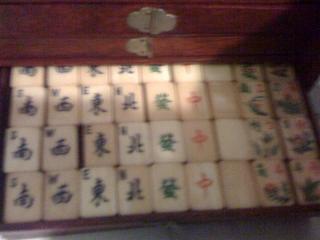

Hello H.,
It's a common bone and bamboo set made in China for export to the West in the 1920's. Just like the set described in FAQ 7a.
Tom Sloper
トム·スローパー
湯姆 斯洛珀
Author of "The Red Dragon & The West Wind," the definitive book on Mah-Jongg East & West.
Los Angeles, California, USA
8/8, 2010
You rock, Metro
From: Jan M
Sent: Saturday, August 07, 2010 6:37 PM
Subject: METRO LOGO
Hi Tom:
First ...you Rock..I use your site for my education and needs. I am a small time buyer and seller of "vintage" MJ sets..
I am also a player and started a MJ club in our town...we play Wright Patterson rules..(I am a retired military wife)..
I recently bought a messy set. It had been in storage 30 yrs and had inches of dirt on it..it is a Mah Lowe. When I finally got the case cleaned I was surprised to find on the lower side of the upper lid.in the middle....a logo.....1/2 " high by 1 3/4" long : green with a red frame and it says: METRO and below that New York. It is stamped.
I have never seen one before. Have you? Do you know what the year would be for that logo? Is it rare to see one? Would I ruin the value by using clear nail polish to protect it?
I cannot send a picture as my camera is broken. Do I check your column daily to see if you have answered this? Thank you for your informed time.
I look forward to hearing the answers...and yes, you own this email..
Regards
Jan M
Hi Jan, you wrote:
First ...you Rock.
Yes. Yes, I do. (^_^)
I am a small time buyer and seller of "vintage" MJ sets..
Then let me ask you. What is your definition of "vintage"? Gina Smith gave us her definition, below. Is "vintage" a date? (Is there a dividing line between "old enough to be vintage" and "not old enough to be vintage"?) Or is "vintage" a material and country of origin?
METRO and below that New York. It is stamped.
I have never seen one before. Have you? Do you know what the year would be for that logo?
No. I'm not an expert on manufacturers. I recommend you check out CHarli's site. And Jim May's, too. Look at FAQ 4a if you don't already have their sites bookmarked.
Is it rare to see one?
I have no idea.
Would I ruin the value by using clear nail polish to protect it?
Yes. Absolutely never do that.
Do I check your column daily to see if you have answered this?
You check this bulletin board (NOT my column) daily, not to see if I have answered it, but to see if anybody else has commented.
May the tiles be with you.
Tom Sloper
トム·スローパー
湯姆 斯洛珀
Author of "The Red Dragon & The West Wind," the definitive book on Mah-Jongg East & West.
Los Angeles, California, USA
August 7, 2010
Repairing Crisloid tiles
From: "Dorothy H
Sent: Saturday, August 07, 2010 11:44 AM
Subject: Repairing cracked Crisloid tiles
> Hello.
> I have Crisloid tiles that are cracking and have puncture type damage,
> probably from remaining in the original cellophane for years. Is
> there a way to repair them (fill the punctures and cracks)?
> Also, the link to www.arkayengravers.com on your cleaning section of
> the site does not work.
> Thank you.
> D
Hi D,
Thanks for the broken link report. Weird that when you go to a nonexistent page on arkayengravers, it sends you to a completely unrelated page. I fixed the link, thanks to you.
I looked in FAQ 7c3 and found Crisloid -- that's the name of a manufacturer. The key is to know what kind of plastic we're talking about. So my advice for you is "figure out what kind of plastic they are." Maybe take them to a plastic store, see if they have any advice for you. Look in your local yellow pages under P for plastics.
Tom Sloper
トム·スローパー
湯姆 斯洛珀
Author of "The Red Dragon & The West Wind," the definitive book on Mah-Jongg East & West.
Los Angeles, California, USA
August 7, 2010
Joker redemption strategy, part 5
>From: Lynn P
>Sent: Sat, August 7, 2010 6:11:17 AM
>Subject: Mah-Jongg Q+A
>My mah-jongg question or comment is: About question #2 of my 8/6 email: Whom are you referring to when you say "YOUR" responsiblity to play according to official rules-mine or the player who didn't rack? As I mentioned in a previous email I am known as the "RD&WW expert" so I know the official rules. The rest of the players have agreed to abide by them except that most do NOT "rack" when they pick their tile. They tap, wave, and/or hold their tile and then most times discard but they do realize another player can call the previous discard (except for previous mentioned player) and they would have to put back their tile. Guess a new player should be given a quick course on the official rules, be referred to your site, and /or encouraged to buy your book.
>Regarding question #3 of same email the word "opinion" was a poor choice. I should have asked what you recommend to encourage players to rack their tiles even when they don't need the tile or are redeeming it for a joker? I am not looking at my picked tile until I actually rack it but it does add a few seconds to my playing time but it beats putting back a joker!!
>Many thanks for your informative emails which I save and share. Lynn P
Hi Lynn,
When I said "YOUR" yesterday, I meant "each player's." In Japan, when a new player joins a group, they tell him their rules. In my weekly American game, when a new player joins us, we tell her or him our rules.
As for your players who tap, you are right -- tapping does not close the window of opportunity (unless the tap is on the sloping front of the rack, next to the concealed tiles). Waving and holding (I've never seen anybody wave the picked tile) also do not close the window of opportunity. Therefore players who do that are not hurting anybody. I was asked this question before. It's either below or on a previous (archived) page of this board (accessible by scrolling to the bottom and clicking the link).
As for my recommendation? I myself often hold the picked tile while I decide what to do with it. When I pick a joker, I can usually tell (my thumb can tell if it's a joker), depending on the set. Stickered jokers are easy to discern even with an uneducated thumb. When I know it to be a joker, I don't look, I rack. I do not advocate over-speedy "pickandrack," but yes, for those who don't want to have to endure a putback, after waiting a beat, reach and pick, and rack it. Then discard.
May the tiles be with you.
Tom Sloper
トム·スローパー
湯姆 斯洛珀
Author of "The Red Dragon & The West Wind," the definitive book on Mah-Jongg East & West.
Los Angeles, California, USA
August 7, 2010
Joker redemption strategy, part 4
>From: Lynn P
>Sent: Friday, August 06, 2010 10:31 PM
>Subject: Mah-Jongg Q+A
>My mah-jongg question or comment is: Concerning American mah jongg: Thank you for part 3 email about redeeming jokers. I see the key word is completed. However in RD & WW #60f, p.53: " Player is permitted to change the size of her exposure (adding or subtracting tiles) up to the time she discards." Thus calling the 8 dot will give me 14 tiles in hand so I should be able to redeem joker (adding a tile) to my exposure and then discard ending my turn.
>These 8 dots are haunting me. Today I needed four 8 dots and the player on my right threw one but before I could call it, the player across from me picked a tile from the table. She clicked it on top of her rack but kept it in her hand waving it and as I called for and took the 8 dot she started to redeem her tile for a joker in another player's hand. I told her I still had the opportunity to call the discard since she didn't rack her tile but she said she didn't need to because she was redeeming it. She did not learn to play mah jongg from the same teacher as most of us in my group did. I maintained that I should be able to call the discard and she had to return the tile she took to the table. However, she insisted she could redeem her tile for mah jongg which she did and meant everyone had to pay her $.50. (She never RACKED the tile-just clicked it once and kept it in her hand!). I thought she should have returned the tile and the game should have continued since the tile that let her call mah jongg should not have been taken. I should have gotten the 8 dot for my four 8 dot exposure. I did email her your definition of racking and page on Window of Opportunity. What are your comments on above?
>What is your opinion of players who take a tile from the wall, look at it, do not rack it, and then discard or redeem a joker? They do sometimes have to put it back when another player call the discard. We have a few players who automatically take tile, rack it and then look at it but the majority don't bother racking tile. Thanks for your expertise, Lynn P.
Hi Lynn, you wrote:
I see the key word is completed. However in RD & WW #60f, p.53: " Player is permitted to change the size of her exposure (adding or subtracting tiles) up to the time she discards." Thus calling the 8 dot will give me 14 tiles in hand so I should be able to redeem joker (adding a tile) to my exposure and then discard ending my turn.
I understand. But that's the way the NMJL rules this question. When you call for the discard, you are required to already have, already in your hand, all the tiles to make the final exposure. In this case, changing the exposure prior to discarding is not permitted. You don't like it? Write to the NMJL (and include a SASE, a self-addressed stamped envelope).
I thought she should have returned the tile and the game should have continued since the tile that let her call mah jongg should not have been taken. I should have gotten the 8 dot for my four 8 dot exposure. I did email her your definition of racking and page on Window of Opportunity. What are your comments on above?
I agree that you should have had the tile. Her tapping the tile atop the rack is not in accordance with official rules. But in a home game, it's YOUR responsibility to know, before the game begins, that your group is playing in accordance with official rules. If the other members of the group vote her way, then she wins. If the other members of the group are wimpy abstainers, then again you're outta luck.
What is your opinion of players who take a tile from the wall, look at it, do not rack it, and then discard or redeem a joker?
What is my opinion of Thursdays? What is my opinion of wood versus metal? (In other words, what are you asking me, "what is your opinion"?)
May the tiles be with you.
Tom Sloper
トム·スローパー
湯姆 斯洛珀
Author of "The Red Dragon & The West Wind," the definitive book on Mah-Jongg East & West.
Los Angeles, California, USA
August 6, 2010
Joker redemption strategy, part 3
Apologies to you, Lynn. This morning I misread the question in part 2 of this thread. You weren't asking "can I take that discarded redeemable tile to use it to get a joker?" You were asking:
Could I have called
>the discarded 8 dot tile thus having 14 tiles and then redeemed the joker for the 3 crak I had in my hand and displayed the three 8 dots plus the joker I just redeemed?
You are asking, "can I call the discard and make a pung with the discard, then redeem a joker from a redeemable tile in my hand, then add the joker to the pung? This is answered in FAQ 19M. You know where the FAQs are.
This is also clarified in the RDWW errata file for page 91. The exposure made with the discard has to be COMPLETE when you first make it with the discard -- you can't first make a partial exposure, then redeem, then add to the exposure. You can download the RDWW errata file by clicking any of the RDWW links on this page.
May the tiles be with you.
Tom Sloper
トム·スローパー
湯姆 斯洛珀
탐 슬로퍼
Author of "The Red Dragon & The West Wind," the definitive book on mah-jongg East & West.
Los Angeles, CA
August 6, 2010
Can you tell me more (tile material ID)
>From: Bob
>Sent: Fri, August 6, 2010 9:10:13 AM
>Subject: Mah-Jongg Q+A
>My mah-jongg question or comment is:
>Can you tell me more about the material of the pieces in my mah-jong set. They have 3 layers of material, a white top layer, a black bottom layer, and a clear layer in between. I have had the set for 50 years but the set is older as my mother had it before me.
>Thank you
>Bob C
Hi Bob,
The clear layer is probably acrylic. The black layer too, I suppose. But I really can't say much based on the skimpy information you've given me.
Please scroll up and find the links to the Frequently Asked Questions (there's a blue and yellow flashing arrow, emblazoned "READ 1ST," like this , pointing to them). Find the link to FAQ #7c3 and click it. Also read FAQ 7c (nothing in your email suggests that you've read any of my tile material FAQs).
May the tiles be with you.
Tom Sloper
トム·スローパー
湯姆 斯洛珀
탐 슬로퍼
Author of "The Red Dragon & The West Wind," the definitive book on mah-jongg East & West.
Los Angeles, CA
August 6, 2010
Joker redemption strategy, part 2
>From: Lynn P
>Sent: Fri, August 6, 2010 5:59:10 AM
>Subject: Mah-Jongg Q+A
>My mah-jongg question or comment is:Regarding my email of 8/5 "Joker Redemption Strategy": Could I have called
>the discarded 8 dot tile thus having 14 tiles and then redeemed the joker for the 3 crak I had in my hand and displayed the three 8 dots plus the joker I just redeemed? Aren't I still in the "Window of Opportunity" since I hadn't discarded so I could add to my exposure with the redeemed joker? Sorry about the mistake of p.16 for p.116 in "RD & WW". I am known in my MJ groups as the "Expert RD & WW Lady" - all thanks to you and your wonderful book! Lynn P.
Hello Lynn,
I just answered this question yesterday. Scroll down and read the post "Calling a discard" >From: "dbender8 >Sent: Thu, August 5, 2010 2:06:48 PM. It's directly below your previous question and answer.
AND read page 92 of RDWW (3rd paragraph).
AND read FAQ 19G2.
By the way, I loved your comment about being the Expert RD&WW Lady! (^_^) Way to go, girl!
Tom Sloper
トム·スローパー
湯姆 斯洛珀
탐 슬로퍼
Author of "The Red Dragon & The West Wind," the definitive book on mah-jongg East & West.
Los Angeles, CA
August 6, 2010
What's the deal with Jim May's site?
>From: Linda an d Robert tooelemountains
>Sent: Fri, August 6, 2010 12:15:06 AM
>Subject: Mah-Jongg Q+A
>My mah-jongg question or comment is:
>Several spots on the internet, even sloperama, says the Mahjong Cyber Museum of Jim May is no longer available online.
>But Jim's Mahjong Museum certainly is still on the internet. Yesterday I used one of those freeware website
>copy software progams to download it for storing and reading offline just in case that it might dissapear from the net soon.
>So obviously I'm confused about the situation of what is or what was unavailable.
>Rob K
Hello Rob,
It is not my purpose on this board to discuss websites and the weirdnesses of the Internet, so I'll keep this brief. There was a brief window of time (I think about a year ago, I don't remember exactly) when Jim's site was listed as a disseminator of malware. When you'd try to visit his site (during that window of time) your browser might display a warning that you shouldn't go there. When that happened, I modified the numerous links to his site from my site. After a while, his site was removed from that list, and I reinstated a few links to his site. As far as I know, I do not still have any warnings on my site about his site. I searched just now and could not find it. If you see something on my site saying his site is gone, please tell me where it is so I can change it.
Jim announced since then that he is selling his collection of mahjong sets. Nobody knows what will happen to his site when the sets are all gone, and Jim is notoriously reclusive (very choosy as to which emails he responds to). Even after he removes it, it'll probably still be visible via The Wayback Machine website.
May the tiles be with you.
Tom Sloper
トム·スローパー
湯姆 斯洛珀
탐 슬로퍼
Author of "The Red Dragon & The West Wind," the definitive book on mah-jongg East & West.
Los Angeles, CA
August 6, 2010
Joker redemption strategy
>From: Lynn P
>Sent: Thu, August 5, 2010 6:46:52 PM
>Subject: Mah-Jongg Q+A
>My mah-jongg question or comment is: While playing American mah jongg I have been following your advice of redeeming a joker in a kong and pung exposure (RD & WW p.16) but it didn't work today. Player had 3 craks and a joker exposed. I had the 4th 3 crak and two 8 dots. I needed four 8 dots but when an 8 dot was discarded I could not call it because I needed a joker. Could I have redeemed the joker with my 3 crak and then called for the 8 dot discard? I know what (p. 91 #1 RD & WW) says but is there ever an exception like my case today? The "tiles were with me today" since I won $7.50 plus kept my original $3.00! Lynn P.
Hello Lynn,
I guess the point I was making on page 116 (not page 16) was: "don't be in a panic to redeem that tile and do something silly or against the rules because you're worried somebody else might get it first." When you are ready for mah-jongg except for your redeemable tile, you should redeem it one turn ago! (^_^)
And as for page 91, number 1, why would I say a thing if it wasn't true? And why would I say a thing without mentioning all its exceptions, if there are any? (In other words: "page 91, number 1 applies even on Thursdays, even when there's peanut butter on your chocolate, and even when your eyes are a little bit red."
For those who don't have The Red Dragon & The West Wind, here's what it says on page 116:
Remember that if someone's kong exposure has three naturals and one joker, there's only one tile that can be used to redeem it. If you pick that tile, you can take your time to redeem it (nobody else is going to get that joker; it's safely yours). Likewise, if someone has a pung exposure with a joker, and the other naturals belonging to that set lie dead on the discard floor.
And here's what it says on page 91:
1. A joker may be redeemed during a player's turn, after first bringing a 14th tile into the hand, either by using a discard to make an exposure or by picking a tile from the wall. After redeeming the joker, if the player cannot claim mah-jongg, the player must discard a tile. A player may not redeem a joker before bringing in the 14th tile or after discarding.
You're right about page 116, Lynn -- I need to clearly state that point. May the tiles be with you.
Tom Sloper
トム·スローパー
湯姆 斯洛珀
탐 슬로퍼
Author of "The Red Dragon & The West Wind," the definitive book on mah-jongg East & West.
Los Angeles, CA
August 5, 2010
Calling a discard
>From: "dbender8
>Sent: Thu, August 5, 2010 2:06:48 PM
>Subject: picking up a discard in mah jongg
> Dear Webmaster,
> I am a fairly new player and this question has recently come up and I can't find an answer anywhere I've looked.
> The player on my left discarded a flower. I had an exposure of 3 flowers and a joker. She said she didn't want the joker and wanted to deny me a pure hand. I needed that flower to mah jongg, I would substitute the flower for the joker and use it elsewhere. The authority at our table said I couldn't do that and the person next to me called for the flower and then mah jongged. Is this right?
> Thanks a bunch
>Elaine
Hello Elaine, you wrote:
I needed that flower to mah jongg, I would substitute the flower for the joker and use it elsewhere. The authority at our table said I couldn't do that
She's right. Your teacher never taught you that a discarded redeemable tile cannot be taken to use for redemption? Read
Frequently Asked Question 19G.
There's a blue and yellow flashing arrow, emblazoned "READ 1ST," like this , pointing to the FAQs. Find the link to FAQ #19 (there's a red, white, and blue flashing arrow, emblazoned "AMERICAN," like this , pointing to FAQs 16 and 19) and click it.
After you've landed at the FAQ 19 page, please bookmark it so you can easily return to it anytime you have a mah-jongg question. Answers to all of the most frequently-asked questions about American (NMJL) mah-jongg are found in FAQ 19.
the person next to me called for the flower and then mah jongged. Is this right?
I guess so, but you haven't painted a clear picture for me. I assume she had a hand like this for instance:
F 2222 8888 DDDD
and that the new flower was her missing maj tile (that she did NOT want to do what YOU wanted to do with the discarded flower, i.e. redeem it for a joker). Read FAQ 19E3.
May the tiles be with you.
Tom Sloper
トム·スローパー
湯姆 斯洛珀
탐 슬로퍼
Author of "The Red Dragon & The West Wind," the definitive book on mah-jongg East & West.
Los Angeles, CA
August 5, 2010
Death challenges in a tournament, part 2
>From: GretchenJane
>To: Tom Sloper
>Sent: Thu, August 5, 2010 12:33:00 PM
>Subject: Re: tournament question
>Thank you for the quick reply. Your answer is what I expected (and wanted) it to be...but I needed it from an "authority"...YOU! I've printed it out in case the situation arises and needs a decision.
>Gretchen
You're welcome, Gretchen.
Hope the tournament goes well!
May the tiles be with you.
Tom Sloper
トム·スローパー
湯姆 斯洛珀
탐 슬로퍼
Author of "The Red Dragon & The West Wind," the definitive book on mah-jongg East & West.
Los Angeles, CA
August 5, 2010
Death challenges in a tournament
>From: GretchenJane
>Sent: Thursday, August 05, 2010 10:39 AM
>Subject: tournament question
>I am running a small (20 people) local tournament in 2 weeks. This is the 4th year for our tournament. We have established "tournament rules" based on your book and the NMJL book, but there is one thing I've not been able to find. Your book is very clear on the "death penalty" during regular play; but what should we do if a player is called "dead" during a tournament game, she denies it, and, at the end of that hand, it is determined that the player was NOT dead? Should there just be a penalty to the declarer? How would that affect, if at all, the scoring for the other players?
>Thanks for your help,
>Gretchen
Hi Gretchen,
I have never run a tournament myself. I can only tell you what I know about how I've seen death challenges handled in a tournament, and fill in gaps in my knowledge based on how I would do it if I ran a tournament.
Tournament rules are necessarily harder (more firm) than the loose rules used in a home game. In a tournament, if someone calls another player dead (or even hints that another player might be dead), the penalty for being wrong in the death challenge is usually that the challenger is dead.
I've not seen a death challenge issued during tournament play, but in my opinion, if a death challenge is issued and the challenged player denies that she's dead, the players shouldn't simply continue playing and determine later if the challenge is correct. In my opinion, a judge should be called over at that moment. Somebody is going to be dead; the judge will determine if it's the challenger or the challengee.
You also asked about the scoring. I wrote about tournament scoring in FAQ 21, above left. Tournament scoring is necessarily different from home scoring; it's points that score up from 0, not an exchange of coins. When someone is dead, she won't be winning the hand, so her score is 0 for that hand. No impact on the other players' scores.
May the tiles be with you.
Tom Sloper
トム·スローパー
湯姆 斯洛珀
Author of "The Red Dragon & The West Wind," the definitive book on Mah-Jongg East & West.
Los Angeles, California, USA
August 5, 2010
What the heck are these disc things?
>From: "CS
>Sent: Thursday, August 05, 2010 10:02 AM
>Subject: A question
>Hi Tom: I have been given a old Parker Bros mah jong set of bamboo only tiles--very old and very pretty in a tin box with many accessories and small pieces. One of them is a very small round wooden box with 4 tiny discs in it, each with a different Chinese character on one side. There is a hole in the bottom of the box where the character on the disc shows through. I assume this has something to do with betting or scoring but my research turns up nothing. Do you know what it is? Can you direct me where I might research this>
>Thanks so much, CS
Hi CS,
The 4 discs are "wind indicators." You can learn a little about those on my website, FAQ 7D.
If you really want to know how they're used in the Chinese Classical game, you can find websites in FAQ 4B and you can find books in FAQ 3. The FAQs are above left.
May the tiles be with you.
Tom Sloper
トム·スローパー
湯姆 斯洛珀
Author of "The Red Dragon & The West Wind," the definitive book on Mah-Jongg East & West.
Los Angeles, California, USA
August 5, 2010
Tile Material ID, part 8
>From: Michael Stanwick
>Sent: Thursday, August 05, 2010 5:42 AM
>Subject: tile Material ID Part 8
>Hi Tom.
>Thanks for your clarification. I noticed that the lines on these tiles are a slightly red colour. On the ebay page there is a close-up pic of some tiles plus one tile on its side. The lines appear to go right through the tile, judging by the tile on its side. The tile material appears to be of uniform colour and the lines also appear to emanate from, and conform to some extent, the grooves of the engravings. Further, the lines are not consistent with swirls but seem to be relatively straight or slightly curved.
>This suggest to me that the lines might be an effect brought about by stresses on the tile due to the engraving procedure. They probably show up much later. The red colour may be an artefact of the lighting but it may also be due to alteration of the plastic structure due to stress (like glass cutting where a stress is applied to the glass with a glass cutter and then the glass can be snapped along the stress line). Temperature stresses may bring about the appearance of the lines at a much later date.
>What do you think?
>Cheers
>Michael
Hi Michael,
I think it's hard to tell from a photo whether those lines are cracks or marbling.
The emanation of lines from carved or engraved details would definitely, as you say, suggest cracks. The orange color of the lines or cracks, without grayish or brownish dirt, suggests marbling. I suppose you could email the eBay seller and inquire.
May the tiles be with you.
Tom Sloper
トム·スローパー
湯姆 斯洛珀
Author of "The Red Dragon & The West Wind," the definitive book on Mah-Jongg East & West.
Los Angeles, California, USA
August 5, 2010
Tile Material ID, part 7
>From: Michael Stanwick
>Sent: Wednesday, August 04, 2010 2:26 PM
>Subject: tile ID
>Hi Tom.
>I am afraid I do not understand what you are referring to Tom. The 'cracks' I am referring to are visible in the 2nd pic that shows an assortment of circle tiles. The 'cracks' are visible on the #7 (in the top left of the tile) and #8 circles tiles. They look like stress fractures to me. Are those the lines/'cracks' that you can see?
>I don't know what your "opaque plastic clouds" are.
>I agree that these tiles resemble your "applejuice" material that I have seen described many times on ebay. It seems to be very translucent.
>Cheers
>Michael
Hi Michael,
I see the lines you are talking about, in all the tiles (not only the dots). They are maybe even more noticeable in the flower tiles. Imagine you have a thick clear goop in a large pot (not filling the pot), and a thick muddy (cloudy/translucent) goop in a second, smaller, pot. Pour the muddy goop into the larger pot. You can see clouds of translucent goop in the clear goop. Now reach in with a stick and smear it around just a little. Now you have clear goop and cloudy goop all interspersed -- but not thoroughly mixed. Now harden. That's what I see, and that's what I've seen before in other applejuice tiles.
Or maybe what happened is that the slurry was well mixed before, but during the hardening process, some of the clear goop coalesced in layers between clouds of muddy goop, like bubbles of foam, or bubbles separating galactic strings in the universe.

I HAVE seen some of these tiles actually crack, even crumble. And I had to tell a reader, years back, that there was no fix that I knew of. But those tiles look solid enough to me.
May the tiles be with you.
Tom Sloper
トム·スローパー
湯姆 斯洛珀
Author of "The Red Dragon & The West Wind," the definitive book on Mah-Jongg East & West.
Los Angeles, California, USA
August 4, 2010
111DDD
>From: JOMIDOFLA
>Sent: Wednesday, August 04, 2010 12:19 PM
>Subject: Mah-Jongg Q+A
>My mah-jongg question or comment is:
>On this years card, is the like numbers 111 DDD to be played as one unit?
Hello Jomid of Louisiana or Los Angeles, as the case may be! Welcome to my website.
You can search this page (this one that you're looking at right now) for the phrase "11DD 111DDD" to find previous Q&A's about that hand.
(Hint: see the post entitled "How should this be interpreted?" >From: Rhfranke
>Sent: Thursday, April 01, 2010 4:54 PM, AND the post entitled "Subject: 11DD 111DDD 1111 (Any like Nos. Matching Dragons) again" >From: OrderAck@nationalmahjonggleague...
>Sent: Thursday, April 01, 2010 1:49 PM.)
You can also read
Frequently Asked Question #16, where this question is answered in detail.
You can also read column #444, which discusses this hand at length as well.
To access the FAQs, scroll up and look for the blue and yellow flashing arrow (emblazoned "READ 1ST," like this ).
Answers to all of the most frequently-asked questions about mah-jongg are found in the FAQs. Please always check the FAQs first, before asking a question. Thanks!
You can access the columns by scrolling up to the top and clicking the purple banner.
May the tiles be with you.
Tom Sloper
トム·スローパー
湯姆 斯洛珀
Author of "The Red Dragon & The West Wind," the definitive book on Mah-Jongg East & West.
Los Angeles, California, USA
August 4, 2010
Tile Material ID, part 6
>From: Michael Stanwick
>Sent: Wednesday, August 04, 2010 2:09 AM
>Subject: What are these tile plastics?
>Hello Tom. Here is a a classic example of plastic tiles identification. Both these sets are listed on ebay UK.
>The tiles in the 1st pic are from a set in a wooden box with five drawers etc. I think this set is of more recent origin - 1950's or so. IMO, I would identify them as casein plastic with a light dye applied. Their 'milky' opacity also suggest casein to me. Further larger pics at here;
>http://cgi.ebay.co.uk/GENUINE-VINTAGE-CARVED-CASE-MAH-JONG-SET_W0QQitemZ320570676861QQcategoryZ2556QQcmdZViewItemQQ_trksidZp3286.m7QQ_trkparmsZalgo%3D
LVI%26itu%3DUCI%26otn%3D3%2
6po%3DLVI%26ps%3D63%26clkid%3D6645711150049477016


>The second [set of] pic[s below] is labelled by the seller as 'bakelite' and comes in a leather case - what I assume to be of the attaché case style. What is noticeable about these tiles is that they are somewhat translucent with engraved figures on them. They are also cracked. I would have put these as catalin but I am not aware of catalin being engraved? The engraving and the cracking effect do point to casein plastic. It is reported by one source that casein is prone to cracking due to environmental stresses. Further larger pics here;
>http://cgi.ebay.co.uk/OLD-BAKELITE-MAH-JONG-SET_W0QQitemZ250674241066QQcategoryZ2556QQcmdZViewItemQQ_trksidZp3286.m7QQ_trkparmsZalgo%3D
LVI%26itu%3DUCI%26otn%3D3%26po%3DLVI%26ps%3D63%26clkid%3D6645930946861491596
>I would be interested if you or any of your BB readers would like to take a stab at identifying the material of the tiles in each of these two pics?
>Have fun!
>Cheers
>Michael


Hi Michael,
I too would like clarification from a plastics expert as to whether the first of your two examples is casein. As for the second example, those tiles are not cracked. Those clear lines visible between the opaque plastic "clouds" are solid plastic. This type of tile is usually referred to on eBay as "applejuice Bakelite." Clearly formed by a type of plastic that started out as a liquid, in which the opaquing material was an emulsion that left those visible clear intervening spaces. I don't know enough about the chemistry of plastics to say for certain that they're really Bakelite. If these tiles are casein, then the first ones aren't. The feel of the first type of tiles is more akin to polystyrene, which is usually white (see FAQ 7c3).
May the tiles be with you.
Tom Sloper
トム·スローパー
湯姆 斯洛珀
Author of "The Red Dragon & The West Wind," the definitive book on Mah-Jongg East & West.
Los Angeles, California, USA
August 4, 2010
Is there a rule?
From: "Corrie and Mary Ann
Sent: Tuesday, August 03, 2010 5:44 PM
Subject: Redeeming tiles
> Is there an NMJL rule about not redeeming a tile for a joker and then
> discarding that joker? I know it probably isn't very smart to give
> another player an opportunity to be 'jokerless' but is it against the
> rules? It certainly makes sense if you can make your own hand
> jokerless. This issue came up at our senior center recently.
> Mary Ann
Hi Mary Ann,
There's no rule. It's a strategy matter, not a rule. Perfectly legal to do that if one wants. You can kvetch about it if someone does it, but I don't recommend carrying the kvetching over the line into the land of bad group vibes. Harmony, harmony, harmony...
May the tiles be with you.
Tom Sloper
トム·スローパー
湯姆 斯洛珀
Author of "The Red Dragon & The West Wind," the definitive book on Mah-Jongg East & West.
Los Angeles, California, USA
August 3, 2010
When claims conflict (FAQ 19H)
>From: Rhfranke
>Sent: Tuesday, August 03, 2010 5:29 PM
>Subject: Mah-Jongg Q+A
>My mah-jongg question or comment is:
>If two people call a discarded tile, and the person who calls it first is not the person next in turn to the discarder, which player gets the tile- the person next in turn to the discarder who called it slightly after the the person who is not next in turn or the person who called it first?
Hello Mr. or Ms. Franke, as the case may be.
You have asked Frequently Asked Question #19H.
You're a repeat visitor -- you know where the FAQs are. Please always check the FAQs first, before asking a question. Thanks!
May the tiles be with you.
Tom Sloper
トム·スローパー
湯姆 斯洛珀
Author of "The Red Dragon & The West Wind," the definitive book on Mah-Jongg East & West.
Los Angeles, California, USA
August 3, 2010
How do I find a teacher and players, part 2
>From: "Carrie Ann
>Sent: Monday, August 02, 2010 11:39 PM
>Subject: Re: Teacher
>Thank you for your quick response. I did read what you suggested before I sent my email, but could not find the information that I wanted. However, I now realize after visiting your website the multi-faceted nature of the game. As I stated, I was looking for someone who could teach me "Classical Chinese" style of Mah Jong. I learned from people who played in the 20s and 30s when the game was popular. In addition, I played with people from Europe who seemed to play a similar version to the one that I learned originally. Recently, I began playing again, but it was the American version and I do not like playing with a card. I live in Los Angeles and would like to re-learn the "parlor game" version and have friends who would be interested to learn, as well. Any recommendations or did I miss something on your website?
>Carrie Ann
Carrie Ann, like it says in FAQ 4a and on the Find Players Bulletin Board, I can teach you since you live in Los Angeles.
Tom Sloper
トム·スローパー
湯姆 斯洛珀
Author of "The Red Dragon & The West Wind," the definitive book on Mah-Jongg East & West.
Los Angeles, California, USA
August 3, 2010
How do I find a teacher and players?
>From: "Carrie Ann
>Sent: Monday, August 02, 2010 9:25 PM
>Subject: Teacher
>I am looking for a teacher and a group that plays Classical Chinese Mah Jong. Do you have any recommendations?
>C.A.
Yes, Carrie Ann.
Scroll up and look for the blue and yellow flashing arrow (emblazoned "READ 1ST," like this ).
Those links you see there are the Frequently Asked Questions (FAQs). You should read FAQ 15, see the list of teachers in FAQ 4a, and then look on the Find Players Bulletin Board to see if anybody from your area is listed. You can also email me to post your own information on that bulletin board. People need to know what city you live in and how to contact you and what kind of mahjong you play.
Tom Sloper
トム·スローパー
湯姆 斯洛珀
Author of "The Red Dragon & The West Wind," the definitive book on Mah-Jongg East & West.
Los Angeles, California, USA
August 2, 2010
Tile Material ID, part 5
>From: Michael Stanwick
>Sent: Monday, August 02, 2010 11:03 AM
>Subject: Tile ID
>Hello Tom and Gina.
> [Gina] I agree with you completely when you infer that the term "vintage" is used loosely when referring to mah jong sets. I guess when I say "vintage" bone and bamboo sets, I think of age, but more of the design and quality of the set.[snip]
>I tend to stay well clear of the terms 'vintage' and 'antique'. This is more of a prosaic response since my involvement tends to be from a historical research perspective that requires a less loose set of terms. The way round this problem, for my purposes, is just to use a set of dates. Of course, when assigning dates we often end up with a date range - based on whatever evidence we have and then attach all the usual cautionary caveats, so in some respects we end up with a loose set of dates!
>I think we are onto something here when we are talking about "casein plastic with a surface dye applied". When you speak of casein plastics, perhaps that is what I am referring to as Chinese Bakelite? The pictures you show on 7/28 on what I would refer to as Chinese Bakelite. These tiles, by weight, are lighter, and seem more friable to me than Bakelite or Catalin.[snip]
>I would agree with you here Gina. Also, I have had 'casein' tile sets in which some of the tiles have lost their paint. The exposed engraved grooves are also the same colour as the rest of the tile. This would suggest to me that if the material had a dye applied, it would have to be on each individual tile. This could be done in bulk I suppose.
>[snip] I am sorry that I did not refer to these tiles as casein Michael, but I learned them as Chinese Bakelite and sold sets as such. Everyone I know in the mah jong connections here also refer to those tiles as Chinese Bakelite.
>Absolutely no need to apologise Gina. I just found the terms confusing.
>Most of the sets I have seen have been found in the type of cases you described with counting sticks or coins (in plastic in the newer sets). The "older" CB sets had more intricate carvings, especially the flowers, and some sets were known by the bird bams (the owl set or the hawk on the world set, for example). The "newer" CB sets had much simpler designs and the tiles seemed to be smaller in size.
>This is true.
>[[snip] In most of the Chinese Bakelite sets I have seen, there were 4 blank tiles. Whether they were used for substitutes for lost tiles, extra flower tiles, joker tiles, or for a style of play I am not familiar with, I don't know.
>Thanks for the additional comments Gina.
>All my 'attache-style case sets are 'casein' plastic. Of these, I have eight that have 16 'Flowers/Seasons' tiles. These tend to depict scenes from Chinese operas, historical events such as the Three Kingdoms saga and scenes from the Japanese invasion of parts of China. In these sets there are no blank tiles.
>The four tiles directly under the four animal tiles are what I refer to as Chinese Bakelite tiles.
>Yes, I agree.
>Hope this helps. Gina.
>Yes, thanks.
>Regards
>Michael
Tile Material ID, part 4
>From: gina smith
>Sent: Sun, August 1, 2010 12:53:30 PM
>Subject: RE: from Gina Smith
>
>[IN RESPONSE TO THE POST] From: Michael Stanwick
>>Sent: Wednesday, July 28, 2010 6:54 AM
>>Subject: tile material ID
>
>Hello Tom:
>I agree with you completely when you infer that the term "vintage" is used loosely when referring to mah jong sets. I guess when I say "vintage" bone and bamboo sets, I think of age, but more of the design and quality of the set. I think of the sets made not with composite fish bone, certainly not associated with any plastic components. So probably the ones imported into the US by Babcock (c 1920's) through 1940s are the prime examples. I am sure there were some dazzling ones in the 1950s too. I think of the ones with more detailed carvings, although Babcock produced a lot of inexpensive sets for the craze of the 1920's so more people could play. For me, it is one of those – "I know it when it see it" things.
>
>I think we are onto something here when we are talking about "casein plastic with a surface dye applied". When you speak of casein plastics, perhaps that is what I am referring to as Chinese Bakelite? The pictures you show on 7/28 on what I would refer to as Chinese Bakelite. These tiles, by weight, are lighter, and seem more friable to me than Bakelite or Catalin. I found this site which I thought was interesting: http://www.americanartplastics.com/casein.shtml. I am sorry that I did not refer to these tiles as casein Michael, but I learned them as Chinese Bakelite and sold sets as such. Everyone I know in the mah jong connections here also refer to those tiles as Chinese Bakelite. Most of the sets I have seen have been found in the type of cases you described with counting sticks or coins (in plastic in the newer sets). The "older" CB sets had more intricate carvings, especially the flowers, and some sets were known by the bird bams (the owl set or the hawk on the world set, for example). The "newer" CB sets had much simpler designs and the tiles seemed to be smaller in size.
>In most of the Chinese Bakelite sets I have seen, there were 4 blank tiles. Whether they were used for substitutes for lost tiles, extra flower tiles, joker tiles, or for a style of play I am not familiar with, I don't know. In my CB sets in my collection, I have managed to find four more matching tiles from broken sets and have stickered them for 8 jokers since I play NMJL style!
>I am not sure what tiles Michael is referring to either, so I will try to cover what I can:
>
>[REGARDING] 1. From: "Susan
> Sent: Thursday, June 24, 2010 11:18 AM
> Subject: questions about Mah Jong sets
>
>If this is the CB set you are referring to, it is a waferback set, probably from the 1960's. See what I mean about the simpler design? And lots of flowers, so I don't know what style this was made for. I would assume an Asian one as there are no Arabic numerals for Western play. You would have to ask Tom what style uses a lot of flowers here. I also see two blanks, which I also would assume would be for substitutes, although Tom would be able to tell you if they were used for jokers in a particular Asian style that used a lot of flowers and jokers.
>I haven't come across the designs in her second set.
>
>[REGARDING] 2. From: Michael Stanwick
> Sent: Wednesday, July 28, 2010 6:54 AM
> Subject: tile material ID
>
>There is a picture of two rows of tiles.
>The first row has four "animal" tiles that I know is used in a particular style that I don't play. The tile following them is a catalin tile from an ES Lowe set.
>The four tiles directly under the four animal tiles are what I refer to as Chinese Bakelite tiles.
>The gray tile following them is a joke tile I have seen in a MET games set.
>Hope this helps. Gina
I inserted the brackets in the above.
May the tiles be with you.
Tom Sloper
トム·スローパー
湯姆 斯洛珀
Author of "The Red Dragon & The West Wind," the definitive book on Mah-Jongg East & West.
Los Angeles, California, USA
August 1, 2010
Age & type of set, part 2
>From: shawna l
>Sent: Friday, July 30, 2010 3:33 PM
>Subject: RE: age & type of set
>Hello again Tom,
> Thank you very much for your help. The reason it was so confusing is my set came with a 1955-56 " That's It " How to Play MahJonng with playing cards and chinese tiles by Dorthy S. Meyerson and when I tried to find out about my set I was searching for 1955-56 set. Again Thank You
> p.s ( no I did not spend alot, they were givin to me. )
Hi Shawna, you wrote:
The reason it was so confusing is my set came with a 1955-56 " That's It "
And you couldn't have mentioned that before?? Regardless, as I wrote to Gina on July 26 (scroll down to see it), "I never give much weight to the inclusion of an NMJL card in a set." The "That's It" books are essentially NMJL cards with multiple pages. The inclusion of a card or book with a set is not a sure indication of the origin of the set.
when I tried to find out about my set I was searching for 1955-56 set.
Okay, now I'm the one who's confused. I have no idea what you just said.
May the tiles be with you.
Tom Sloper
トム·スローパー
湯姆 斯洛珀
Author of "The Red Dragon & The West Wind," the definitive book on Mah-Jongg East & West.
Los Angeles, California, USA
July 30, 2010
$$$$$!!!!!, part 2
>From: Renee K
>Sent: Thursday, July 29, 2010 9:32 AM
>Subject: Getting Paid
>Hi, again - No, your answer is very clear - my real question was in paying for the table "$$$$$" I thought you may of had an opinion or heard it before. Sorry for the $$$$$ I was just being cute - I don't know much about email etiquette - anyway, I guess I'm too old to be cute. HAHA!!!
>It's amazing how many rules just appear that are not official. I "fill in" in a # of groups and it does get confusing. SO MUCH FUN!!!!
>Thank you for your speedy response.
>Regards
>Renee K
Hi Renee, you wrote:
my real question was in paying for the table "$$$$$" I thought you may of had an opinion or heard it before.
Well, since you had already read what I wrote in FAQ 19Y, you already knew I'd heard of it and what I thought of it.
Sorry for the $$$$$ I was just being cute - I don't know much about email etiquette
It's not a matter of etiquette. I guess you must be one of those lucky people who almost never gets spam emails. If you'd gotten as many spams as I have, you'd know that it was a suspicious subject line.
It's amazing how many rules just appear that are not official.
Have you read FAQ 14 yet?
it does get confusing.
It wouldn't be confusing if you would just read the official rules. Books are listed in FAQ 3. Every group should have a rulebook.
May the tiles be with you.
Tom Sloper
トム·スローパー
湯姆 斯洛珀
Author of "The Red Dragon & The West Wind," the definitive book on Mah-Jongg East & West.
Los Angeles, California, USA
July 29, 2010
Tile material ID, part 3
>From: Michael Stanwick
>Sent: Thursday, July 29, 2010 10:25 AM
>Subject: tile material ID, part 3
>Hello Tom.
[T]In her July 26, 2010 2:33 PM dual-topic post, she said "These sets did not come with blanks." I believe she was talking about all 3 types of 1940's sets that had jokers. I can't find any words of hers that imply that the so-called "Chinese Bakelite" set with jokers had any blank tiles. (And of course "blank joker tiles" would be a misnomer, if someone did say that.)
>Yes. I agree. I had come to that interpretation as well. But in that post she says "... a couple of sets..." which to me means two, and she does go on to mention two sets and then she goes on to mention another set (the CB set) after which she says that "these sets did not come with blanks." But I am not sure which sets she means by 'these' - the couple or all three, in light of other comments she made in her replies.
>So, I am hoping Gina could clarify for me what she meant?
>However, I don't think 'blank joker tiles' would be a misnomer - if I understand your meaning correctly.
>If you look up Wilkinson's descriptions from Culin's book (unless it is in his account from the British Museum book) you will find that he mentions that blank tiles were used as 'jokers' in some tile games - although he does not mention them in connection with Ma Que (MJ).
>The Glover sets have eight blank tiles and no so-called 'Dragons', so another question is what were four of those used for (assuming four were used as replacements if others were lost)? The Himly set has four 'Inner Flowers' (that we postulated from our analysis) that function like Jokers for concealed melds and hence was there a reflection of this function in the Glover sets if that set's four blanks were used.
>I would really like to clear up this problem with idying the tile material in these attache style case tile sets.
>Best Regards
>Michael
Hi Michael, you wrote:
 he mentions that blank tiles were used as 'jokers' in some tile games he mentions that blank tiles were used as 'jokers' in some tile games
 Oh? If I read that before, I'd completely forgotten it. Oh? If I read that before, I'd completely forgotten it.
Cheers,
Tom Sloper
トム·スローパー
湯姆 斯洛珀
Author of "The Red Dragon & The West Wind," the definitive book on Mah-Jongg East & West.
Los Angeles, California, USA
July 29, 2010
$$$$$!!!!!
>From: Renee K
>Sent: Thursday, July 29, 2010 3:30 AM
>Subject: $$$$$
>Hi - If you give another player Maj in the Hot Wall and cannot account for 3 tiles - the player who discarded the Maj tile has to pay for the table. I thought this was a Maj rule, but after reading your FAQ's it sounds like a table rule??? Question - Does the player pay double for
>giving Maj and then just single for the other players - or do they have to pay double for everyone? Your opinion?
>Thank you
>Renee
My opinion is that you should be more careful about your email subject lines, Renee. When I saw the email entitled "$$$$$" in my inbox, I had my finger on the DELETE key. An obvious spam, right? But then I thought, if it's spam, why didn't my spam filter catch it? So I peeked in, finger still ready to hit DELETE, and found out it was a mah jongg question:
If you give another player Maj in the Hot Wall and cannot account for 3 tiles
I gather you are talking about some sort of "hot tile" table rule. If you look on the back of your NMJL card, you'll see no mention of any such rule. If you read the official rulebook, you'll see no mention of any such rule. You yourself said that you read my FAQs, and found something in there that makes it "sound like" a table rule. I'm assuming you read FAQ 19Y. If you think FAQ 19Y is ambiguously worded, please help me fix it -- please tell me which words in FAQ 19Y aren't clear, and I'll change them.
But just because I say it's not an official rule doesn't mean you should go back to your group and try to tell them they're doing it wrong. That would probably just start an argument. Read FAQ 14. If the rest of the group likes it that way, then you have to play it that way when you play with them.
Now to see if your email program will refuse my reply email because it has five dollar signs in the subject line... (^_^)
May the tiles be with you.
Tom Sloper
トム·スローパー
湯姆 斯洛珀
Author of "The Red Dragon & The West Wind," the definitive book on Mah-Jongg East & West.
Los Angeles, California, USA
July 29, 2010
Age of my sets, part 2
>From: Dan B
>To: Tom Sloper
>Sent: Wednesday, July 28, 2010 5:42 PM
>Subject: Re: age of my mahjong sets
>here are some better pics of the small pics same set but mine are much better shape
>nam-yeh 1.gif (48 bytes)
>nam-yeh 2.gif (48 bytes)
>nam-yeh 3.gif (48 bytes)
>nam-yeh 4.gif (48 bytes)
Um... Dan... two problems:
1. Your pictures are non-functional (they measure 1 pixel by 1 pixel)
2. You didn't read what I wrote you before (scroll down), and therefore didn't do what I said you need to do. If you want me to help you, you have to do more than send pictures.
Tom Sloper
トム·スローパー
湯姆 斯洛珀
Author of "The Red Dragon & The West Wind," the definitive book on Mah-Jongg East & West.
Los Angeles, California, USA
July 28, 2010
Tile material ID, part 2
>From: Michael Stanwick
>Sent: Wednesday, July 28, 2010 2:41 PM
>Subject: tile material ID part 2
>Hello Tom. I want to know what material these tiles are made of.

> I have been attempting to identify the material/plastic/polymer that the attache style case sets' tiles are made of. The attache style case tiles are very much like those in the pic above, with similar hand engravings. My current assessment is that they might be made of casein plastic.
>[M]Do you mean the two tiles are totally blank?
>[T]In Gina's defense, she never implied or said that...she was saying she can't provide pictures because she doesn't have access to the set.
>[M]But in my defense (^_^) I took her statements to mean that she appeared to be implying that the CB set has two blank joker tiles - hence why I put the question to her. (I have explained my reasoning below.)
>And Gina did say this; "And Michael – I don't own that particular CB set. A friend of mine long past has this set and I know that the tiles were not carved or added. I will see if I can find a picture of those joker tiles for you. It is not Bakelite and I don't believe it is Casein – I believe it is Chinese Bakelite. And I think I am pretty good at IDing those materials."
>You can see from your quote that there are two CB tiles. You can see from the quote I provided that Gina mentions "those Joker tiles" and that phrase is in a sentence immediately after the sentence in which she says that "the tiles were not carved or added." In light of this I came to two possible interpretations - that the entire tile set was not carved or added or that the two CB joker tiles were not carved or added. To see which interpretation was accurate I asked Gina to clarify whether the two tiles were carved or not - hence my initial question.
>Also, Gina didn't say she can't provide pictures. She said, very kindly, that she will see if she can find a picture of those CB joker tiles for me.
>Cheers
>Michael
Hi Michael, you wrote:
My current assessment is that they might be made of casein plastic.
Yes, that's my current thinking as well. If I could just get some "Chinese Bakelite" and casein and Catalin and Bakelite tiles (even lone tiles) then I might well adjust my thinking, and FAQs 7c and 7c3.
she appeared to be implying that the CB set has two blank joker tiles
In her July 26, 2010 2:33 PM dual-topic post, she said "These sets did not come with blanks." I believe she was talking about all 3 types of 1940's sets that had jokers. I can't find any words of hers that imply that the so-called "Chinese Bakelite" set with jokers had any blank tiles. (And of course "blank joker tiles" would be a misnomer, if someone did say that.)
Also, Gina didn't say she can't provide pictures. She said, very kindly, that she will see if she can find a picture of those CB joker tiles for me.
Yep, I sit corrected.
Cheers!
Tom Sloper
トム·スローパー
湯姆 斯洛珀
Author of "The Red Dragon & The West Wind," the definitive book on Mah-Jongg East & West.
Los Angeles, California, USA
July 28, 2010
Tile material ID
>From: Michael Stanwick
>Sent: Wednesday, July 28, 2010 6:54 AM
>Subject: tile material ID
>Hello Tom.
>Gina, thank you for replying to my query and for the information regarding the material 'casein'.
>>And Michael – I don't own that particular CB set. A friend of mine long past has this set and I know that the tiles were not carved or added. I will see if I can find a picture of those joker tiles for you. It is not Bakelite and I don't believe it is Casein – I believe it is Chinese Bakelite. And I think I am pretty good at IDing those materials.
>Do you mean the two tiles are totally blank? I look forward to seeing a pic of those tiles.
>I was somewhat perplexed with the term 'Chinese Bakelite' until I read another post of yours(reproduced below);
>>Sent: Sunday, March 11, 2007 9:39 AM
>>OK, Chinese Bakelite vs "real" bakelite. If you break a Chinese Bakelite tile in half, the interior is stark white and fractures kind of like a charcol briguette. When tested for bakelite, the white plastic (and I have no idea what it is) doesn't test positive. It seems that there is some kind of matte paint finish on it. I can remove it with nail polish remover. You won't get any of this on a "true" bakelite tile. You may get some color change of the exterior of a "true" bakelite tile due to oxidation (?) or age, but the interior is still the same color as the day it was made. Can't find any other information about Chinese Bakelite tiles. The carvings in the older sets are usually highly detailed. Most likely hand done.
>At the web site http://www.caseino.internet-today.co.uk/degradat.htm it says
"CAUTION some casein has been coloured using a surface dye .and sometimes this may run, so work carefully and test using a moist white tissue on an inconspicuous part of the object to see if any colour is removed."
>I cannot verify the accuracy of this information, but if I assume it to be true then I wonder whether your "some kind of matte paint finish" may perhaps be an example of this surface dye that is prone to removal by certain solvents. If this is the case, then the Chinese Bakelite could in fact be Casein Plastic.
>I much prefer the latter term, to avoid ambiguity, but if the former term is used then may I suggest the term Bakelite be bounded - thus 'Bakelite' and hence Chinese 'Bakelite'.
>The tile sets I am interested in, with reference to the tile material are those from the 1930s, in attache style leather cases with four felt covered tile trays and one thin felt tray for spare tiles, sticks etc.
>The tiles are very similar in appearance and quality of engraving to four tiles, in the 12 tiled picture Tom provided in a previous post titled "When jokers were first made, part 2
>Please identify vintage set, part 4".
>Best Regards
>Michael Stanwick
Hi Michael, you wrote:
Do you mean the two tiles are totally blank?
In Gina's defense, she never implied or said that. She was specifically talking about three 1940's sets that contained jokers:
MET games was one with the Buddha jokers (2) and Ten Flowers sets (with the Happy face and Kibitzer joker - one of each) was another that comes to mind. There was a Chinese Bakelite set that also had two jokers,
So she was clearly not talking about blank tiles. She was talking about one of the following:
a. Buddha jokers (pictured in FAQ 7e and in the little image I posted below with various flower/joker tiles);
b. Happy Face & Kibitzer tiles;
c. Jokers made of so-called "Chinese Bakelite."
Probably the latter, since we are now talking about so-called "Chinese Bakelite." And she was saying she can't provide pictures because she doesn't have access to the set.
the Chinese Bakelite could in fact be Casein Plastic [with surface dye applied]
Nice info. Pieces appearing in the puzzle!
The tile sets I am interested in, with reference to the tile material are those from the 1930s, in attache style leather cases with four felt covered tile trays and one thin felt tray for spare tiles, sticks etc.
>The tiles are very similar in appearance and quality of engraving to four tiles, in the 12 tiled picture Tom provided in a previous post titled "When jokers were first made, part 2
I assume you are referring to these tiles:
Michael, when you say "The tile sets I am interested in, with reference to the tile material,"
are you saying you want to know what material these tiles are, or that you want to discuss this material...? I've become lost...
May the tiles be with you.
Tom Sloper
トム·スローパー
湯姆 斯洛珀
Author of "The Red Dragon & The West Wind," the definitive book on Mah-Jongg East & West.
Los Angeles, California, USA
July 28, 2010
When jokers were first made, part 4
>From: gina smith
>To: Tom Sloper
>Sent: Tuesday, July 27, 2010 2:48 PM
>Subject: RE: from Gina Smith
>Hi Tom:
>I didn't mean to imply that some other style of MJ didn't use those joker tiles. I was directly referring to NMJL and assumed that it would be implied - I guess I wasn't clear enough and should have been more explicit. Some people from what I do understand did use those two extra jokers as flower tiles, but so few manufacturers had them, that I am sure it wasn't a super common practice. Again, I was generalizing. I would guess that people wouldn't probably assume that they were automatically flower tiles as their design wasn't in sync with the rest of the flower tiles in the sets I mentioned, mainly the MET games and Ten Flowers.
>There are some reproduction sets coming out of China that do use some of the old patterns and are identified as such. I know of two companies that do exquisite hand carving and am in awe of their work. I just wanted to make the point that there are also a lot of other sets that hit the market that are not correctly identified as reproductions and are sold as "antiques" that are specifically designed to fool the buyer.
>Yes, I did mean NMJL playing cards. I don't know of any vintage bone and bamboo sets that were produced with enough tiles for NMJL play. However, a huge number of Bakelite and Catalin sets were produced with the considerations of the NMJL tile numbers in mind. I have quite a few Bakelite sets that started with 144 or 146 or 148 tiles and then had to scramble for those last tiles for jokers!
>And Michael – I don't own that particular CB set. A friend of mine long past has this set and I know that the tiles were not carved or added. I will see if I can find a picture of those joker tiles for you. It is not Bakelite and I don't believe it is Casein – I believe it is Chinese Bakelite. And I think I am pretty good at IDing those materials.
>Gina
Hi Gina, you wrote:
I just wanted to make the point that there are also a lot of other sets that hit the market that are not correctly identified as reproductions and are sold as "antiques" that are specifically designed to fool the buyer.
Sure. That's a well-known fact that's clearly stated in my FAQs.
I don't know of any vintage bone and bamboo sets that were produced with enough tiles for NMJL play.
My only problem with that sentence is the word "vintage." It's an eBay term that's supposed to mean "old and valuable," but I have no idea how old a set has to be to qualify as "vintage." Twenty-five years? Thirty? Fifty? Eighty? And of course, no set made before 1971 has enough manufactured flowers and manufactured jokers to support NMJL's 1971-to-present configuration. So maybe "vintage" means "before 1971"?
I believe it is Chinese Bakelite.
I keep forgetting about that. You gave me information about that before, and it's in FAQ 7c3. I'd dearly love to have side-by-side Bakelite, Casein, and "Chinese Bakelite" tiles so I could see the difference, touch the difference, feel the difference, and ultimately describe the difference in a way that doesn't require cutting, melting, or otherwise damaging them.
May the tiles be with you.
Tom Sloper
トム·スローパー
湯姆 斯洛珀
Author of "The Red Dragon & The West Wind," the definitive book on Mah-Jongg East & West.
Los Angeles, California, USA
July 27, 2010
Age & type of set
From: shawna l
Sent: Tuesday, July 27, 2010 5:25 PM
Subject: age & type of set
Hello Tom,
I have to say before I found your website I knew nothing about mah jong. Now I can say I know something about it. Thank You.
After going thourgh FAQ's 7h I'm still not sure as to the age of my set. Can you tell me? I have looked at FAQ's 7a and my set seems simiular to the one you have marked the antique one, Is mine antique? Here are as many details that I can give you:
Looking at FAQ's 7c tiles are made of bone/bamboo
There are a total of 142 tiles:
35 bams, 36 craks, 36 dots, 11 dragons, 13 winds, 8 flowers, 3 blanks, set also includes 121 sticks, 2 dice & 4 wind indicators w/cylindrical container.
I hope you have enough info & that the pictures are helpful.
Thanks for your time,
Shawna


Hello Shawna, you asked:
Is mine antique?
I don't know what "antique" means, Shawna. Your set is (as Michael Stanwick said on Friday, June 04, in regards to Fedor's set) a "bog standard circa 1920's set." You tell me. Does that mean it's "antique?"
It's missing a number of pieces, unfortunately. I hope you didn't pay a lot of money for it.
Tom Sloper
トム·スローパー
湯姆 斯洛珀
Author of "The Red Dragon & The West Wind," the definitive book on Mah-Jongg East & West.
Los Angeles, California, USA
July 27, 2010
About column 459
>From: SACohen
>Sent: Tuesday, July 27, 2010 4:52 PM
>Subject: Column #459 Exposure #4
>I just started playing Mah Jongg. I don't understand why Exposure number 4 in column #459 has to be "Like Numbers #2." Couldn't she also be making "Consecutive Run #3"? It has a "number" Kong with an "opposite Dragon" Pung.
>Thanks,
>Sarah
Good catch, Sarah. You're quite right. Fixed.
May the tiles be with you.
Tom Sloper
トム·スローパー
湯姆 斯洛珀
Author of "The Red Dragon & The West Wind," the definitive book on
Mah-Jongg East & West.
Los Angeles, California, USA
July 27, 2010
When jokers were first made, part 3
>From: Michael Stanwick
>Sent: Tuesday, July 27, 2010 5:33 AM
>Subject: When jokers were first made, part 3
>Hello Tom.
>Gina Smith wrote;
>"There was a Chinese Bakelite set that also had two jokers, but of course we don't know the manufacturer on those."
>This is a new piece of information to me. Could Gina provide any pictures of these two Jokers?
>Also, is the tile material actually Bakelite or could it perhaps be Casein?
>Regards
>Michael Stanwick
Age of my sets
>From: Dan B
>Sent: Monday, July 26, 2010 11:06 PM
>Subject: age of my mahjong sets
>Hi i just purchased two vintage mahjong sets off of ebay just wanted to know the approx age? Thanks


Hi Dan,
I'm sorry but you're going to have to work harder than that. If you really want information, you have to provide me more information than you've given me, and better photographs, in two separate emails, and with different code names for the two sets.
Just for right now, I'm naming them "the slide-top wooden box set" and "the teeny-tiny pictures set."
1. The slide-top set. If you scroll down you can read posts by Michael Stanwick on June 23 and 24 in which he states that he believes these sets to be from the late fifties or sixties.
2. The teeny-tiny pictures are much too teeny-tiny to be able to tell anything from them. You have to provide better images, and you also have to describe the set in words. See FAQ 7g (above left) for what kind of details are necessary. What kind of case are the tiles in, what's the deal with that paper booklet, what are the tiles made of (see FAQ 7c). FAQ 7d will help you identify the pieces that aren't tiles, and FAQ 7b & 7e will help you identify the tiles.
Standing by to help after you've provided the necessary info.
Tom Sloper
トム·スローパー
湯姆 斯洛珀
Author of "The Red Dragon & The West Wind," the definitive book on Mah-Jongg East & West.
Los Angeles, California, USA
July 27, 2010
When jokers were first made, part 2
Please identify vintage set, part 4
>From: gina smith
>Sent: Monday, July 26, 2010 2:33 PM
>Subject: from Gina Smith
>RE: When jokers were first made
>>From: Pat H
>>Sent: Friday, July 23, 2010 10:19 AM
>>Subject: jokers
>Hello Tom:
>To just stick in my two cents here: There were a couple of sets that had two jokers in their tile set in the 1940's. MET games was one with the Buddha jokers (2) and Ten Flowers sets (with the Happy face and Kibitzer joker - one of each) was another that comes to mind. There was a Chinese Bakelite set that also had two jokers, but of course we don't know the manufacturer on those.
>These sets did not come with blanks. These jokers were also not used in play. I believe that they were used to replace a tile that was lost.
>In Rosemary L's pagoda box, I do believe that it was custom made. A really nice job. The front was either cannibalized or copied and reproduced.
>In response to Michael, there ARE alot of sets coming out of China today that are being touted as antique, which they are not, and "aged" with dirt and tea. I see them all over the place. One person I know bought one of these sets from a dealer who sold it to her as ivory! He had "papers" and everything stating that it was antique. I showed her the difference between ivory, an older bone set, and the bone and quality of this set and how it was a newly made example. She did go back to the dealer and got refunded.
> I know of jewlers and antiques dealers who can't discern between bone and ivory. Of course, when you deal in a field as large as "antiques", you can't know everything about everything and Mah Jongg sets are such a subspecialty. Many times, dealers will see a similar example on the internet, of course, the most expensive one they can find, think that theirs is "close enough" in appearance, and then try to sell it as the more expensive item. And this isn't limited to MJ sets. I don't think that 99% of them are trying to be deliberately deceptive; it's just that in many cases there are no discerning marks so they are making an educated guess.
>In MJ sets, I see many mistakes as to age and manufacturer because over the years, tiles are placed in other cases, paperwork is added or taken away, playing cards are switched around, family history gets mixed up, racks change, etc, so that there is actually alot of "married" sets out there. Just adds to the confusion.
>Gina
Hi Gina,
To respond to a few things you said:
 These jokers were also not used in play. These jokers were also not used in play.
I wouldn't make a statement like that; yes, the NMJL didn't require jokers until 1960-61, but nobody can categorically say that people who had joker tiles prior to that time did not use them in play somehow.
I believe that they were used to replace a tile that was lost.
Without something in writing from the manufacturer, we can't know how the manufacturer intended those joker tiles to be used. Regardless of how the manufacturer intended them to be used, I don't see why some players couldn't have used them as extra flower tiles.
If someone had a set with these 12 tiles, prior to the NMJL requiring jokers (and without their saying the word "joker" on them, and without any literature describing joker usage), why wouldn't the player simply assume they were all "flower" tiles?
In response to Michael, there ARE alot of sets coming out of China today that are being touted as antique, which they are not, and "aged" with dirt and tea.
In Michael's defense, I know that he is well aware of this fact. He is not saying otherwise. Reread what he wrote [brackets added by me for clarity]: "there are sets made in China that do copy old tile set patterns but these sets are clearly modern and [these particular sets] have NOT been artificially aged. They are beautifully produced modern versions of old tile set patterns." I'm pretty sure he's talking about ornate old tile set patterns, pre-NMJL tiles.
In MJ sets, I see many mistakes as to age... because... playing cards are switched around
What do you mean by "playing cards"? Do you mean NMJL cards? Most of the traffic in old sets that I see are sets that predate NMJL. To focus solely on sets supporting NMJL play, without consideration to the vast variety of un-NMJL sets, is to too narrowly limit one's view. In my opinion. And I never give much weight to the inclusion of an NMJL card in a set.
that there is actually alot of "married" sets out there. Just adds to the confusion.
"Married" is nicer than what I call them: I usually call them "cannibalized" or "Frankensteined" or, when I'm in a charitable mood, "rescued." By the way, I like your story of the lady who got ripped off by the Chinese seller of a misrepresented set and managed to get a refund. I've seen those sellers offer "certificates of authenticity." Pretty funny. Like a certificate would be difficult to create out of whole paper. (^_^)
May the tiles be with you.
Tom Sloper
トム·スローパー
湯姆 斯洛珀
Author of "The Red Dragon & The West Wind," the definitive book on Mah-Jongg East & West.
Los Angeles, California, USA
July 26, 2010
How does the color-coding work?
>From: Sharon B
>Sent: Monday, July 26, 2010 10:39 AM
>Subject: Mah-Jongg Q+A
>My mah-jongg question or comment is:
>On the 2010 card under "2468" , 3rd line, far right:
>FF 2222 8888 DDDD
>Do the 2's have to be bam's and the 8's craks?
>Thank you,
>Sharon Book
Read
Frequently Asked Questions 16 & 19AK.
Please scroll up and look for the blue and yellow flashing arrow (emblazoned "READ 1ST," like this ). Find the link to FAQs 16 & 19 (marked with a red, white, and blue flashing arrow, emblazoned "AMERICAN," like this ) and click it.
After you've landed at the FAQ 19 page, please bookmark it so you can easily return to it anytime you have a mah-jongg question. Answers to all of the most frequently-asked questions about American (NMJL) mah-jongg are found in FAQ 19.
Please always check the FAQs first, before asking a question!! Thanks.
May the tiles be with you.
Tom Sloper
トム·スローパー
湯姆 斯洛珀
Author of "The Red Dragon & The West Wind," the definitive book on Mah-Jongg East & West.
Los Angeles, California, USA
July 6, 2010
FAQ 19L
>From: Sue H
>Sent: Monday, July 26, 2010 10:06 AM
>Subject: joker question
>Can you use all jokers to make a group or do you need one natural tile in Mah Jongg.
>thank you
You have asked
Frequently Asked Question #19L.
Please scroll up and look for the blue and yellow flashing arrow (emblazoned "READ 1ST," like this ). Find the link to FAQ #19 (it's marked with a red, white, and blue flashing arrow, emblazoned "AMERICAN," like this ) and click it.
After you've landed at the FAQ 19 page, please bookmark it so you can easily return to it anytime you have a mah-jongg question. Answers to all of the most frequently-asked questions about American (NMJL) mah-jongg are found in FAQ 19.
Please always check the FAQs first, before asking a question! Thanks!
May the tiles be with you.
Tom Sloper
トム·スローパー
湯姆 斯洛珀
Author of "The Red Dragon & The West Wind," the definitive book on Mah-Jongg East & West.
Los Angeles, California, USA
July 26, 2010
One bams, part 2
>From: Michael Stanwick
>Sent: Monday, July 26, 2010 9:50 AM
>Subject: one bams part 1
>Tom is absolutely correct about how information regarding tile sets should be acquired. Apart from the general knowledge of tile sets that can be gleaned from forums such as this, there is also additional information that should only be acquired through certain channels - books and journal articles devoted to this subject area (card games in this instance) so that it is harder for unscrupulous manufacturers to copy old sets and label them as 'antiques'. Of course no-one can halt them seeing the info if they are persistent. Having the info disseminated in journal form so it can be read by students of the game's history and also by interested buyers/collectors is a good way to protect them from unscrupulous purveyors of faked sets.
>
>I would also like to point out that there are sets made in China that do copy old tile set patterns but these sets are clearly modern and have NOT been artificially aged. They are beautifully produced modern versions of old tile set patterns.
>
>There are a few articles from the 1920's that discuss the manufacturing process and hence the locale of the factories at that time and these can be provided upon request.
>
>The Japanese MJ Museum book (1st Edition) attempts to identify where particular sets come from. Unfortunately this book is out of print.
>
>Interested parties should be aware that research is ongoing into many areas of MJ history. We have substantially scratched the surface of the history of this fascinating game and in so doing have made very good progress, but there are still areas we know little about.
>Regards
>Michael Stanwick
Please identify vintage set, part 3
>From: Michael Stanwick
>Sent: Monday, July 26, 2010 9:21 AM
>Subject: Please identify vintage set part 3
>Tom. I agree with you regarding the age of the tiles etc.
>I am more intrigued by the box however. I agree with the owner that it is oak. It is very reminiscent of Oak boxes used by the MJ Sales Co., of America, although I have never seen a 'Pagoda' box in any of their catalogues.
>I am inclined to think that this is either one of their boxes that has been cannibalized and turned into a 'Pagoda' box or that it is a custom made box of very good craftsmanship.
>A giveaway that it is perhaps not a genuine MJ box produced by a MJ manufacturer is that there are no handles. MJ boxes and the 'cubic' style leather cases all had handles on the top - either brass or heavily carved wooden ones or ones made of leather straps.
>Could the owner provide us with a more close-up set of pics of different angles of the box?
>This box could be an important addition to our info regarding MJ sets, if we could establish it is the genuine article.
>Regards
>Michael
Hi Michael,
I didn't publish all the photos Rosemary sent. Here are more that she already provided of the box. Not sure what you're looking for...


Cheers!
Tom Sloper
トム·スローパー
湯姆 斯洛珀
Author of "The Red Dragon & The West Wind," the definitive book on Mah-Jongg East & West.
Los Angeles, California, USA
July 26, 2010
One bams
>From: Daniel B
>Sent: Sunday, July 25, 2010 11:51 AM
>Subject: 12. Provide a picture of the One Bams . These tiles can sometimes tell a lot about which part of China the set came from.
>I would like to know more about the history of Mahjong tiles. Specifically if it is possible to learn about who manufactured bone and bamboo tiles and where they were manufactured, based on the types of carvings. Based on "12. Provide a picture of the One Bams . These tiles can sometimes tell a lot about which part of China the set came from." could you provide me with some more detail on how this can be determined? Are there any writtings or sources you know of that detail this type of information?
>Thanks,
>Daniel
Hello Daniel, you asked:
I would like to know more about the history of Mahjong tiles... Are there any writtings or sources you know of that detail this type of information?
You should try very hard to get the books of the mahjong museums in Ningbo, China, and Chiba, Japan (listed in FAQs 3 & 11), and "Asian Games: The Art of Contest." And the back issues of the journal of the International Playing Card Society containing mahjong articles by Michael Stanwick and Andrew Lo.
Specifically if it is possible to learn about who manufactured bone and bamboo tiles and where they were manufactured, based on the types of carvings.
Look up Jim May's and CHarli's websites (listed in FAQ 4a).
Based on "12. Provide a picture of the One Bams .
You are referring to either FAQ 7g or 7h.
These tiles can sometimes tell a lot about which part of China the set came from." could you provide me with some more detail on how this can be determined?
No, I can't. And even if I could, I'm not sure I would want to. One big concern is the faking of antique sets. The more information we provide about how to tell fakes from genuine antiques, the harder our job becomes, because then the fakers know what to do.
Tom Sloper
トム·スローパー
湯姆 斯洛珀
Author of "The Red Dragon & The West Wind," the definitive book on Mah-Jongg East & West.
Los Angeles, California, USA
July 25, 2010
Couldn't find this in the Q&A's
>From: Bonnie M
>Sent: Sunday, July 25, 2010 8:22 AM
>Subject: Mah Jongg question
>Hi:
>I looked through all the Q&A's and didn't see this one:
>If a hand is declared dead as the player made an error (e.g. was doing a closed hand but had exposures), does that players hand remain exposed and can the remaining players use the jokers in that hand?
>Thanks for your answer.
>Bonnie M
It's not in the Q&A's below because it's in the FAQs above left.
Frequently Asked Question #19M.
Please scroll up and look for the blue and yellow flashing arrow, emblazoned "READ 1ST," like this . Find the link to FAQ #19 (it's marked with a red, white, and blue flashing arrow, emblazoned "AMERICAN," like this ) and click it.
After you've landed at the FAQ 19 page, please bookmark it so you can easily return to it anytime you have a mah-jongg question. Answers to all of the most frequently-asked questions about American (NMJL) mah-jongg are found in FAQ 19. Please always check the FAQs first, before asking a question. Thanks!
May the tiles be with you.
Tom Sloper
トム·スローパー
湯姆 斯洛珀
Author of "The Red Dragon & The West Wind," the definitive book on Mah-Jongg East & West.
Los Angeles, California, USA
July 25, 2010
Please identify vintage set, part 2
I just re-read Rosemary's original email and noticed a problem. The apocryphal ship captain (who owned a made-for-export mahjong set possibly made in 1923) caught malaria before 1918 and checked himself out of hospital, right? And then he died? Well. Problem is, when did he die? Before or after 1923? The telling of the story is problematic in that it hints that he died before 1920, which means he couldn't possibly have owned this particular set.
Tom Sloper
Author of "The Red Dragon & The West Wind," the definitive book on Mah-Jongg East & West.
Los Angeles, California, USA
July 23, 2010
Please identify vintage set
>From: ROSEMARY L
>Sent: Friday, July 23, 2010 4:50 PM
>Subject: Please Identify vintage set -17 photos
>Hi, Tom- I was recently given a Mahjong set by a ninety-eight year old lady. I would be so grateful if you would be able to tell me the approximate age of the set and, just as important, where it might have been "manufactured", and what I should insure it for, if possible. Tom, her dates don't add up, so set may be post 1923. She inherited it from the Scottish family of a ship's Captain. He was born about 1877 in Glasgow, Scotland. During World War 1 (1914-1918), while at sea, his malaria worsened and the ship put into port in India. (port unknown) After two weeks in hospital there, against the doctor's orders, he discharged himself and he and his ship left port. He died of malaria onboard ship and was buried at sea in the Indian Ocean. His Mahjong set, with which he had played with his crew during voyages, was sent back to his family in Glasgow along with his other belongings. The older lady, my friend, then gave the set to me.
>Specifics:
>1. The container chest is made of oak, I think, and quite heavy. It measures 41 cm high total . The base is 30 cm wide and 24 cm deep, while the centre
> "column" is 25cm wide and 19cm deep. The underside of the box has torn grren felt with some of the wood showing. No smell of mildew anywhere.
>2. The door is hinged and swings out and down. The symbol on the door is the East wind and is painted(?) a pale green.
>3. There are 5 drawers. All hardware is metal
>4. small, red, tattered book (6 pages, numbered 1-12) reading "Rules for Playing the Genuine Chinese Game of Mah-Jongg- copyright 1920 by J.P.Babcock
> and copyright 1923 by Parker Bros." (Could the family have added the booklet later in order to learn the rules of play?)
>5. the tiles are bone and bamboo in good condition as are their backs which are unmarked and all uniform in color.
>6. there are 144 tiles including flowers, plus four blanks, all are 28mm high, 21mm wide and 12mm deep with a bone thickness of 4 mm.
>7. four Flowers have red numerals, and four have green numerals.
>8. 36 Characters (older style), 36 Circles and 36 Bamboos which have leaves as symbols and not sticks or rods or stalks.
>9. 4 of each Dragon: Green, Red and blank for White, and 4 of each Wind: East, South, West and North.
>10. a bone Ming box with four Wind discs: East, South, West and North-all somewhat worn.
>11. 2 bone dice, each 9mm by 9mm by 9mm.
>12. 4 tiny bone dice, each 5mm by 5mm by 5mm, worn. The "one" is a blank and indented, the "four" is red dots and all other sides are black dots.
>13. There is no dice box, and no triangle. (pivot)
>14. 8 long bone counters, (90 mm each) with 5 red dots at each end., 36 medium counters (78 mm each) with 1 red dot at each end, 36 shorter counters
> (70 mm each) with 10 black dots at each end, and 40 short counters (60 mm) with 2 black dots at each end.
>Tom, thank you so much for taking the time to help me with this. It really means a lot to me.
>Rose


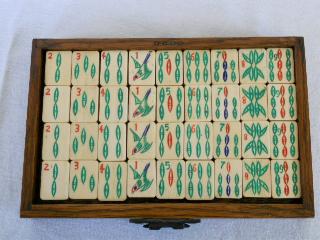


Hello Rose, you asked:
approximate age of the set
Sure looks like 1920's to me.
where it might have been "manufactured"
My guess is "China."
and what I should insure it for
The box is most unusual (to me). The story about the sea captain sounds highly suspicious and "apocryphal." It doesn't tell me anything useful. Since you didn't give me a very complete accounting of the condition of all components of the set as requested in FAQ 7h, I'll say you should insure it for $500. But that does NOT mean that you could sell it for $500. Maybe you could -- or maybe the box is a recent creation by Chinese craftsmen expert in faking antique items.
(Could the family have added the booklet later in order to learn the rules of play?)
Anything is possible. But those booklets were only shipped with sets, not sold separately. Maybe this special "pagoda" box was a Parker Brothers product, I don't know. You might want to check Jim May's site and CHarli's site (both are listed in FAQ 4a).
May the tiles be with you.
Tom Sloper
Author of "The Red Dragon & The West Wind," the definitive book on Mah-Jongg East & West.
Los Angeles, California, USA
July 23, 2010
When jokers were first made
>From: Pat H
>Sent: Friday, July 23, 2010 10:19 AM
>Subject: jokers
>I read in your on-line column that Mah Jongg sets did not com with jokers until 1960. I have my mother's set that she purchased in the late 1940s. It has 10 flowers and 2 jokers. There is also a National Mah Jongg card in the case from 1947.
Hi Pat,
There's an exception to everything (including this sentence).
I did have a statement like that in column #311 (I assume that's the one you're talking about) but based on your email, the statement did seem a bit sweeping, so I reworded the column.
May the tiles be with you.
Tom Sloper
Author of "The Red Dragon & The West Wind," the definitive book on Mah-Jongg East & West.
Los Angeles, California, USA
July 23, 2010
Does joker redemption make a hand jokerless?
>From: Mona
>Sent: Thu, July 22, 2010 6:27:14 PM
>Subject: Mah-Jongg Q+A
>My mah-jongg question or comment is:
>If the jokers in an exposed hand are replaced by natural tiles and the player makes maj, with no other jokers in her hand, is she paid for a jokerless hand?
>Thank you
Mona, it says on the back of your NMJL card that there's a bonus if the hand contains no jokers at the time of maj declaration. Since that's what it says on the card, that is the rule. That's the rule on all seven days of the week, and on Leap Year Day, and if the player's eyes are blue, and if the player had jokers in her hand previous to the maj declaration.
May the tiles be with you.
Tom Sloper
Author of "The Red Dragon & The West Wind," the definitive book on Mah-Jongg East & West.
Los Angeles, California, USA
July 22, 2010
Is 2010 a kong?
>From: "joeswein
>Sent: Thu, July 22, 2010 5:41:53 PM
>Subject: [no subject]
>Does the 2010 on the card have to be completed as singles, in other words can you use a joker?
Joe, this is
Frequently Asked Question #19E.
Please scroll up and look for the blue and yellow flashing arrow, emblazoned "READ 1ST," like this ). Find the link to FAQ #19 (it's marked with a red, white, and blue flashing arrow, emblazoned "AMERICAN," like this ) and click it.
After you've landed at the FAQ 19 page, please bookmark it so you can easily return to it anytime you have a mah-jongg question. Answers to all of the most frequently-asked questions about American (NMJL) mah-jongg are found in FAQ 19. Please always check the FAQs first, before asking a question. Thanks!
May the tiles be with you.
Tom Sloper
Author of "The Red Dragon & The West Wind," the definitive book on Mah-Jongg East & West.
Los Angeles, California, USA
July 22, 2010
Steve Willoughby's Taiwanese Mahjong Site
From: "Amy
Sent: Wednesday, July 21, 2010 2:28 PM
Subject: Steve Willoughby's Taiwanese Mahjong Site
> While I haven't found Steve Willoughby's site alive and well as
> requested, I did find it preserved by the Wayback Machine:
> http://web.archive.org/web/20050406080238/www.rag.com/~steve/mahjong/
> Amy
Great, Amy, thanks. I put that link in FAQ 4b, thanks to you.
May the tiles be with you.
Tom Sloper
Author of "The Red Dragon & The West Wind," the definitive book on Mah-Jongg East & West.
Los Angeles, California, USA
July 21, 2010
Flower tiles identification, part 6
>From: Michael Stanwick
>Sent: Wednesday, July 21, 2010 2:32 AM
>Subject: Woods Identification
>Hello Tom. Thanks for the additional info.
>Actually, I misspelt the name - it is Padauk.
>Apparantly Padauk is related to Rosewood. However, examination of Rosewood shows that it has a superficially similar grain but is much more refined and shows 'feathering' and has a lustre to it- a kind of gloss- when held obliquely.
>If you go to google and type in the name 'Padauk', there is a site that shows many images of the wood. Similarly for Rosewood. Close examination of the many images points directly to Padauk IMO, as the commonest wood used to make the mass-produced five drawer chests.
>Of course, other woods were used on occasions - for example, Elm, Mahogany and Rosewood and, I suspect, some form of soft Pine. The latter was used for boxes that were covered in a very thick layer of lacquer into which scenes and pictures were engraved and then painted, once the lacquer was dry.
>The MJ Sales Co., of America had boxes made of Mahogany and, I think, Oak.
>Regards
>Michael
Flower tiles identification, part 5
>From: Edwin Phua
>To: Tom Sloper
>Sent: Tuesday, July 20, 2010 1:46 PM
>Subject: Re: Chinese characters and instruction booklet
>Dear Tom,
>I refer to the recent query by Tom W on the Chinese characters on the mahjong case.
>Actually, the characters in red, 上海 永安公司製, are read as Shànghǎi Yǒng’ān Gōngsī Zhì, which approximately means 'Manufactured by the Shanghai Yong An Company' (永安 Yong An can be translated as 'Everlasting Peace'). So, the company name is Yong An, and not Yue Chong Ziang.
>Also, I must mention that Hanyu Pinyin (i.e. the standard Chinese romanisation system) was developed in the 1950s, but many romanisation schemes and/or their approximations were already in use before that (an example being Wades–Giles). The name "Yue Chong Ziang" contains the syllable 'ziang' which is not a standard syllable spelling in Hanyu Pinyin, which leads me to suspect the romanisation of all three characters.
>"Yue" could be 'yue' (e.g. 月 yuè) or 'yu' (e.g. 鱼 yú or 玉 yù); "Chong" could be 'chong' (e.g. 重 chóng) or 'zhong' (e.g. 中 zhōng); and "Ziang" would possibly be either 'jiang' (e.g. 江 jiāng) or even 'xiang' (e.g. 象 xiàng). I am curious though, to know if Chinese characters turn up within the instruction booklet ("Directions for Playing Ma-Jong"), that might help identify the company. However, it seems most likely that the instruction booklet and the mahjong case are manufactured by different companies.
>Cheers!
>Edwin Phua
>Singapore
Hi Edwin, you wrote:
I am curious though, to know if Chinese characters turn up within the instruction booklet ("Directions for Playing Ma-Jong"), that might help identify the company. However, it seems most likely that the instruction booklet and the mahjong case are manufactured by different companies.
There are no Chinese characters for the company name in the booklet -- only for names of tiles and such. I can post the scans if you like (in the folder where I offer documents like Vietnamese rules).
May the tiles be with you.
Tom Sloper
Author of "The Red Dragon & The West Wind," the definitive book on Mah-Jongg East & West.
Los Angeles, California, USA
July 21, 2010
Atomic
>From: Lunachik1
>Sent: Tuesday, July 20, 2010 5:52 AM
>Subject: Mah-Jongg Q+A
>My mah-jongg question or comment is: What is considered an atomic hand? thank you
Read
Frequently Asked Questions 19AZ & 14.
Please scroll up and look for the blue and yellow flashing arrow, emblazoned "READ 1ST," like this ). Find the link to FAQ #19 (it's marked with a red, white, and blue flashing arrow, emblazoned "AMERICAN," like this ) and click it.
After you've landed at the FAQ 19 page, please bookmark it so you can easily return to it anytime you have a mah-jongg question. Answers to all of the most frequently-asked questions about American (NMJL) mah-jongg are found in FAQ 19. Please always check the FAQs first, before asking a question. Thanks!
May the tiles be with you.
Tom Sloper
Author of "The Red Dragon & The West Wind," the definitive book on Mah-Jongg East & West.
Los Angeles, California, USA
July 20, 2010
Flower tiles identification, part 4
>From: Tom W
>Sent: Monday, July 19, 2010 11:57 AM
>Subject: Re: Flower tile identification
>Given the quality and value of the information I've gotten from you, scanning the instructions volume is a very small payment that I'm glad to make!
>Enclosed are scans of the pages, probably a bit big for reproducing on the discussion list (though you could probably link them to your "1920s instruction manuals" page). The printing is obviously from metal type -- there's a definite "bite" into the page with the letters. There are 3 blank pages at the end, including the back cover -- figured you didn't really need those scanned. If any of the text isn't legible, I can scan at a higher resolution which might help -- but the pages were not generally well inked and there's a fair amount of drop-out on the letter-forms.
>Given that the first red character says "Shanghai", I wouldn't be surprised if the remainder say "Yue Chong Ziang Ivory Company", though I'm not certain whether the directions were associated with this set or the set the person sold shortly before I got there. Now you make me wish I'd purchased the other set of directions at the same time so I could send you one!
>Cheers,
>Tom
mjdir2.jpg
mjdir3.jpg
mjdir4.jpg
mjdir5.jpg
mjdir6.jpg
mjdir7.jpg
>From: Tom W
>Sent: Monday, July 19, 2010 1:23 PM
>Subject: Re: Flower tile identification
>To answer Mr. Stanwick's question -- the rosewood identification was made by friends of mine who do some woodworking but probably don't know padouk as a wood. I'd think your identification may well be more accurate. They turned away from a mahogany identification because of the wider grain than is found in most mahoganies; their thought was based on looking at the unstained portion of the wood on the inside of the drawer supports. I realize that a photograph is unlikely to help with identification, but I can try to get one if you'd like -- it's cramped quarters in there, and I don't know what I'm looking for.
>Cheers,
>Tom
Hi Tom, you wrote:
Enclosed are scans of the pages, probably a bit big for reproducing on the discussion list (though you could probably link them to your "1920s instruction manuals" page).
Thanks, Tom. No need to reproduce them on the site. That goes beyond what I offer here. If somebody wants them, they can ask.
Given that the first red character says "Shanghai", I wouldn't be surprised if the remainder say "Yue Chong Ziang Ivory Company",
That would be my guess too.
though I'm not certain whether the directions were associated with this set or the set the person sold shortly before I got there.
That statement confused me for a few minutes, until I realized you were using the word "directions" to mean "instructions" instead of "wind tiles." Anyway, one way to find out if that's what those characters mean is to go on zhongwen.com or that site Michael likes -- oh yeah, mandarintools.com -- and input "yue" and "chong" and "ziang" and see if those characters come up. You can also go on igoogle.com and translate "ivory" and "company" into Chinese. Be advised, though, that "simplified Chinese" has largely overtaken "traditional Chinese" since the 1920's.
May the tiles be with you.
Tom Sloper
Author of "The Red Dragon & The West Wind," the definitive book on Mah-Jongg East & West.
Los Angeles, California, USA
July 19, 2010
Flower tiles identification part 3
>From: Michael Stanwick
>Sent: Monday, July 19, 2010 11:24 AM
>Subject: Flower tiles identification part 3
>Hello Toms! I am intrigued as to why the box is described as 'rosewood'. I have about 30 of these brass decorated five drawer chests with a sliding front cover.
>Quite a few were in dire need of some restoration due to the slight shrinkage of the wooden panels. I have an excellent antique restorer locally and together we attempted an identification of the woods used in their construction. My antique restorer immediately identified most of them as being made from Padouk. He has a very large illustrated volume for identifying most woods used in furniture construction and according to this volume, the appearance of the woods most closely resembles Padouk.
>Padouk has a very dark purplish banding or grain, usually connected with knots. Of course, I cannot be 100% sure of this identification as teak also is of a simialr appearance. Rosewood was used in MJ boxes - and i own two sets in such boxes - but the tile sets are of exceptional quality.
>I would be very interested in other peoples observations on this topic.
>Regards
>Michael Stanwick
Flower tile identification, part 2
>From: Tom W
>To: Tom Sloper
>Sent: Monday, July 19, 2010 9:22 AM
>Subject: Re: Flower tile identification
>Thank you for your prompt response!
>I realized from reading the earlier discussion you pointed me to that a scan of the front of the rosewood box they were in might be of interest as well. The red characters along the left are not as clear as I'd like, but should be legible; and the big green characters are quite easy to read. I enclose that scan, as well as the scan of the front cover of the "how to play" booklet (which calls the game "Sparrow" at the beginning of the text). Both are scanned at 100 dpi; if you want more detail, it's available.
>Let me know if you want more of the booklet.
>Cheers,
>Tom W.


Hi Tom,
Of course, the big green characters say "mahjong." The first 2 red characters say "Shanghai." I would like to see a scan of the text of the booklet, since it's one I haven't seen before. But I don't want to put you to a lot of trouble. Thanks.
May the tiles be with you.
Tom Sloper
Author of "The Red Dragon & The West Wind," the definitive book on Mah-Jongg East & West.
Los Angeles, California, USA
July 19, 2010
Flower tile identification
>From: Tom W
>Sent: Sunday, July 18, 2010 9:15 PM
>Subject: Flower tile identification
>First, thank you so much for your informative website! It allowed me to determine that the set I just found at a garage sale is bone and bamboo, probably from the 1920s -- most of the tiles look exactly like the ones in the demonstration "antique" set on FAQ 7a. They're clearly hand-carved, in a nice brass-chased rosewood chest with a front panel and five drawers, a batch of counters, some bone dice and other accessories, and a full set of the time at 148 tiles. I'd know much less about them without your help!
>Of course, the flowers look nothing like any of the sets you show or list, so I'm interested to find out what they represent. Enclosed is a jpg of the 8 tiles. Thanks in advance if you can help me on these.
>Sincerely,
>Tom W. in Seattle

>From: Tom W
>Sent: Sunday, July 18, 2010 10:01 PM
>Subject: Re: Flower tile identification
>Oh yes, an addendum -- with the set was a small booklet (10 pages text, 1 page illustration, saddle-stapled) fro the Yue Ghong Ziang Ivory Co. of Shanghai, "Directions for Playing 'Ma-Jong'" which claims that all their materials are made of ivory. Looking at the design, I'd guess 1920s on this as well. If you'd like a jpg of the text, I would be glad to send it. It has no credited author, no date, and the booklet has not been proofread by an English speaker ("There are one or two sets of 'Flower Cards' ... Their nominations sometimes are 'Spring', 'Summer', 'Autumn'. and 'Winter'; or 'Wind', 'Flower', 'Snow', and 'Moon'; or 'Fisher', 'Woodcutter', 'Farmer', and 'Scholar'. The playing of these cards, however, has been recently obsolete.").
>It's an interesting artifact on its own.
>Cheers,
>Tom
Hello Tom, you wrote:
Of course, the flowers look nothing like any of the sets you show or list
Scroll down to the post entitled "Anticipating its history, age and approximate value (part 3)," From: William, Sent: Thursday, May 27, 2010 4:39 AM. William's tiles look exactly like yours, and there was a lengthy 12-part discussion about them. (Note: this page is getting large, and I will soon have to roll off the older posts, but to see those, you can click the link at the bottom.)
with the set was a small booklet... If you'd like a jpg of the text, I would be glad to send it.
I'd need to see the cover to know if it's one I've already seen or have in my collection. Thanks.
May the tiles be with you.
Tom Sloper
Author of "The Red Dragon & The West Wind," the definitive book on Mah-Jongg East & West.
Los Angeles, California, USA
July 19, 2010
An announcement
From: iamjoyoous
To: "Billie; "Caroline"; "CBiener"; "fscher"; "Gabrielle"; "Joy Weiser"; "Julie"; "Marion"; "Michele"; "Nancy"; "Shirley"; "Tom"; "Zena"
Sent: Sunday, July 18, 2010 10:21 PM
Subject: Mahj
> Guess what! I won the tournament today! Joyce
Congratulations, Joyce. Way to go.
May the tiles be with you.
Tom Sloper
Author of "The Red Dragon & The West Wind," the definitive book on Mah-Jongg East & West.
Los Angeles, California, USA
July 19, 2010
Unable to find out anything about this set
>From: "HisSeraphim
>Sent: Sat, July 17, 2010 2:08:01 AM
>Subject: Mah-Jongg Q+A
> My mah-jongg question or comment is: We have inherited a mah-jongg set of Catalin tiles in a green, alligator-look case with two locks on the front and the key to go with it. I know the tiles are Catalin because there is a manufacturer's paper in it that says it is from "TYL MANUFACTURING CO. , 128 West 26th Street, between 6th and 7th Aves., New York 1, N.Y., Tel. WAtkins 4-1241. The paper specifies that the tiles are genuine Catalin. " There are 168 tiles, 5 trays, 2 dice (no instructions or any other paperwork).
> I don't know how to identify the tiles as I know nothing about Mah-Jong. This set belonged to my husband's grand-mother (my husband is 64 years old) so I'm sure it is quite old. I am unable to find out anything about
>TYL Manufacturing so I have no way of determining the age or value of my set. I will provide whatever you ask me for but I'm really in the dark about what to give you. Thanks for any assistance you can offer.
>Faith S
Hello Faith, you wrote:
the age
If you want me to help you figure out how old your set is, read Frequently Asked Question #7G.
Please scroll up and look for the blue and yellow flashing arrow, emblazoned "READ 1ST," like this ). Find the link to FAQ #7G and click it.
or value
That's FAQ 7H.
There are 168 tiles,
Read column 311. You can access the columns by clicking the purple banner above.
5 trays,
You probably mean "racks." Read FAQ 7D.
If all you want me to help you with is the set's age and value, read those FAQs and send me what I need. If there's anything else you want to know about mah-jongg, and it isn't answered in an FAQ, just ask.
Tom Sloper
Author of "The Red Dragon & The West Wind," the definitive book on Mah-Jongg East & West.
Los Angeles, California, USA
July 17, 2010
How does betting work with a "pie"?
>From: Anita
>Sent: Thursday, July 15, 2010 5:59 PM
>Subject: Mah jongg Q+A
>A player gets mah jongg and has been bet on by the better. The value of the hand is $1. One of the players only has $1.60 left in her pot so that she cannot pay the winner of the hand AND the better each $1. Does she divide the amount of money she has between the two of them ($0.80 each) or does she pay the winning player $1 and then pay the better the remaining $0.60 ?
>This situation came up in a recent game and we were not sure of the correct way to handle it. I would appreciate your input.
>Thank you.
>Anita R
Hi Anita,
Playing with a limited "pie" or "pot" is not part of the official rules. Since you are using an unofficial rule, you can just decide among yourselves how it ought to be handled. For more about this, read FAQ 14. You can link to the FAQs above left.
May the tiles be with you.
Tom Sloper
Author of "The Red Dragon & The West Wind," the definitive book on Mah-Jongg East & West.
Los Angeles, California, USA
The Ides of July, 2010
I need odd vintage tiles
>From: Billie E
>To: Tom Sloper
>Sent: Wednesday, July 14, 2010 3:56 PM
>Subject: Re: Racking a tile
>Hi, Tom,
>The NMJL was unable to hook me up with tiles I need to complete Granny's 1930's set. Do you have a way to reach out to your readers to see if anyone knows another source for odd vintage tiles?
>Thanks,
>Billie
Yes, Billie. I call it my "Tiles Wanted Bulletin Board" (or BB for short). Also read FAQs 7Q & 7R. Look above left.
May the tiles be with you.
Tom Sloper
Author of "The Red Dragon & The West Wind," the definitive book on Mah-Jongg East & West.
Los Angeles, California, USA
July 14, 2010
Frequently Asked Question 19G
>From: bevie1556
>Sent: Tuesday, July 13, 2010 6:23 AM
>Subject: question about jokers
>Hi - can you please answer this question we are in debate about in my group. A tile is thrown let's call it a two crack. The next person puts out a joker and says "same". Can the next person pick up the joker and use it as a two crack?
>Thanks in advance for your answer.
>Bev W
Bev, you have asked
Frequently Asked Question #19G.
Please scroll up and look for the blue and yellow flashing arrow, emblazoned "READ 1ST," like this ). Find the link to FAQ #19 (it's marked with a red, white, and blue flashing arrow, emblazoned "AMERICAN," like this ) and click it.
After you've landed at the FAQ 19 page, please bookmark it so you can easily return to it anytime you have a mah-jongg question. Answers to all of the most frequently-asked questions about American (NMJL) mah-jongg are found in FAQ 19. Please always check the FAQs first, before asking a question. Thanks!
May the tiles be with you.
Tom Sloper
Author of "The Red Dragon & The West Wind," the definitive book on Mah-Jongg East & West.
Los Angeles, California, USA
July 13, 2010
Should a player give strategic advice, part 2
>From: Sushila Singh
>Sent: Monday, July 12, 2010 8:10 PM
>Subject: There is a time to speak and a time to keep quiet!
>Dear Gurujee,
>Your Q & A has hit the nail on the head for me. I was plagued with questions in the middle of the game in spite of explaining [that] my teaching and playing are two different things. My solution is a new Table Rule....if anyone asks anyone a question in the middle of the game the person is dead, after the game has ended they are most welcome to ask "what should I have done" as it not fair to the other player who is waiting to MJ on a beautiful hand. It has worked for me and harmony is restored in the groups. The players learn from their mistakes instead of being bailed out of thinking for themselves; the standard of the game rises.
>Take care,
>Sushila
Namaste, Sushila.
I just started teaching a new group last week, and I already started to refuse to give advice on which tile to discard. I teach strategic principles; the specific decision has to be up to the player. But to do what Carla said, and advise someone to switch to defense, is to "give information," something strictly forbidden in the Chinese Official rules (MCR).
May the tiles be with you.
Tom Sloper
Author of "The Red Dragon & The West Wind," the definitive book on Mah-Jongg East & West.
Los Angeles, California, USA
July 12, 2010
How to play zi pai
>From: Corina P
>Sent: Monday, July 12, 2010 11:06 AM
>Subject: zi pai playing instructions
>Hi Mr Sloper-
>I was recently in China and saw people playing a card game which i believe is called zi pai. it looked like fun and i managed to acquire a set of playing cards but i don't have any playing instructions. I've been hunting online and thus far have been unsuccessful. I just started reading your book on Mah-jongg and thought you might be able to give me a suggestion as to where i might find playing instructions for zi pai in english? i realize you are probably very busy, but any help would be greatly appreciated.
>thank you-
>corina p
Hi Corina,
Have you looked at pagat.com?
http://www.pagat.com Is this what your cards look like? Pagat calls these cards "se si pai."

You can also try the playing cards newsgroup.
http://groups.google.com/group/rec.games.playing-cards/topics?lnk At newsgroups, you post your question and maybe people answer.
May the tiles be with you.
Tom Sloper
Author of "The Red Dragon & The West Wind," the definitive book on Mah-Jongg East & West.
Los Angeles, California, USA
July 12, 2010
Should a player give strategic advice to others during the game?
>From: "Carla B
>Sent: Sunday, July 11, 2010 9:10 PM
>Subject: Mah-Jongg Q+A
>My mah-jongg question or comment is: Should you encourage others to dump their hand to prevent some one from getting mah jongg? Thanks.
Hello Carla,
If you're a mah jongg teacher and the players expect you to be teaching them about strategy, then of course you should teach them about dogging. Otherwise, you should keep your strategic advice to yourself, especially during the play of a game. If you want to teach a novice player about defensive play, then you could do that between games, but you have to choose your words and tone carefully. People can get a mite touchy about such things. And you have to realize that each player is completely free to take a risk with a hot tile when she's close to mah jongg herself.
May the tiles be with you.
Tom Sloper
Author of "The Red Dragon & The West Wind," the definitive book on Mah-Jongg East & West.
Los Angeles, California, USA
July 12, 2010
Article in the NY Times last Friday
>From: Molly A
>Sent: Monday, July 12, 2010 6:09 AM
>Subject: FW: Check out Summer Rituals - Mah-Jongg - At These Cabanas, 'the Tiles That Bind
>Hi Tom, I hope you are having a great summer. Did anyone forward you this article from the New York Times? Kinda fun. Molly
>Click here: Summer Rituals - Mah-Jongg - At These Cabanas, ‘the Tiles That Bind' - NYTimes.com
Thanks for the link, Molly!
May the tiles be with you.
Tom Sloper
Author of "The Red Dragon & The West Wind," the definitive book on Mah-Jongg East & West.
Los Angeles, California, USA
July 12, 2010
Looking for a Mah Jong teacher
From: "Joyce L
Sent: Sunday, July 11, 2010 3:12 PM
Subject: Mah Jong
> Please forgive me if you have aleady received this question from
> me. I am in Los Angeles for the next two months and am looking for
> a Mah Jong teacher - American game. Any information you can give
> me would be greatly appreciated.
> Thank You,
> Joyce L
Hi Joyce, I'm a teacher in L.A. but I do not keep a waiting list (I teach groups, not individuals). Other teachers in the area might do things differently. You can find then listed in Frequently Asked Question #4a.
Please scroll up and look for the blue and yellow flashing arrow, emblazoned "READ 1ST," like this ). Find the link to FAQ #4a and click it.
May the tiles be with you.
Tom Sloper
Author of "The Red Dragon & The West Wind," the definitive book on Mah-Jongg East & West.
Los Angeles, California, USA
July 12, 2010
More about how to keep tiles from going all over the place inside the case
>From: Lynn P
>Sent: Saturday, July 10, 2010 9:16 PM
>Subject: Mah-Jongg Q+A
>My mah-jongg question or comment is: a suggestion for Sandy on 7/6 about storing tiles in case to prevent them from flying around when carrying case. Some of the ladies in my mah jongg group slide each case into individual narrow plastic bags, knee high stockings or white elastic hospital stockings (my favorite) and all the tiles stay put. Glad you answered the question about touching and sliding a tile from the wall and then deciding to take the discard instead. That same situation came up last week and I checked my RD&WW book which comes to each game with me. Great reading! Thanks, Lynn
Hi Lynn,
Thanks for the suggestion. Personally, I've never had a problem with tiles getting loose inside the case, since the trays in all my cases contain the tiles just fine. And I'm so glad the column and the book have been helpful. I'm taking a break from the column this week. Just can't muster up the concentration due to the death of my dear old friend
Norman, so I hope the readers will forgive me for the lapse.
May the tiles be with you.
Tom Sloper
Author of "The Red Dragon & The West Wind," the definitive book on Mah-Jongg East & West.
Los Angeles, California, USA
7/11, 2010
Thanks for your great site!
>From: Donna Miller-Small
>Sent: Saturday, July 10, 2010 6:14 PM
>Subject: Thanks for your great site!
>Hi Tom,
>Thanks for such a wonderful, informative site. I'm a recent Mah Jongg player (after growing up as a kid of a Mahj mom who must be qvelling in heaven).
>I found two wonderful players on your site. This week I began reading your columns and love them! The most recent one about the window of opportunity, was timely
>as this happened in our game last week and the group ruled incorrectly ( I called the league the next day to ask and they were closed for vacation).
>I am going to be teaching Mah Jongg and will recommend your book and web site.
>Mahjly,
>Donna Miller-Small
>Oceanside, NY
>FYI - the Mahj exhibit at the Museum of Jewish Heritage is a colossal disappointment
Hi Donna,
Nice to hear from you! Glad last week's column has been helpful for you and other readers. I'm seriously thinking of taking a break from the column this week because the wind was taken out of my sails by the sudden death of my cherished high school friend, Norm Gauch. I wrote about him in my "I was at Woodstock" story.
When you start teaching, I can add you to the teachers list atop FAQ 4a. And sorry to hear about the "mahj exhibit" but I hear the museum has a spectacular view.
May the tiles be with you.
Tom Sloper
Author of "The Red Dragon & The West Wind," the definitive book on Mah-Jongg East & West.
Los Angeles, California, USA
7/11, 2010
Are table rules an accepted way to play, part 2
>From: Tom & Dorothy O
>To: Jongg Questions Mah
>Sent: Friday, July 09, 2010 10:24 AM
>Subject: Fw: Mah Jongg Question
>Thanks for you answer--and the Substitute east was just meant to indicate it was not one of our REGULAR players--so it was just my own lingo.
> Tick in AZ
Oh, okay. Well, you'll find all kinds of players with weird little things that they do, that they were taught, that they picked up somewhere.
I assume she only did this when she was the dealer. If she tried that at our table, her hands would be bumping into ours all the time, and she probably wouldn't be able to finish dealing all the tiles for us. Lots of folks don't like anybody else touching their tiles.
May the tiles be with you.
Tom Sloper
Author of "The Red Dragon & The West Wind," the definitive book on Mah-Jongg East & West.
Los Angeles, California, USA
July 9, 2010
Are table rules an accepted way to play? (FAQ 14)
>From: Tom & Dorothy O
>To: Jongg Questions Mah
>Sent: Friday, July 09, 2010 9:35 AM
>Subject: Mah Jongg Question
>Our MJ group has encountered various subs who distribute the tiles to all the players. Once the dice have been shaken, the substitute East player pushes her remaining wall out and then the other 3 players sit there while the substitute East player deals all the tiles out. When her wall is eliminated and the next person pushes her wall out, the substitute East player continues to the deal the remaining tiles.
>We finally questioned the sub as to where she learned this technique and she said in our local community Mah Jongg lessons. Is this a new and accepted technique?
> Tick in AZ
Tom & Dorothy, I'm giving you the same answer I gave Gayann on July 1 (below). Read FAQ 14. You can link to the FAQs above left. By the way, I never heard the terms "sub" and "substitute East" before. I have no idea where you got that terminology.
May the tiles be with you.
Tom Sloper
Author of "The Red Dragon & The West Wind," the definitive book on Mah-Jongg East & West.
Los Angeles, California, USA
July 9, 2010
I am trying to get joker tiles for my 2 old mah jongg sets.
From: "Ann Inman"
Email: ancinmanatt.net
Sent: Friday, July 09, 2010 8:49 AM
Subject: Set Wanted
> Set Wanted:
> Minimum # of tiles needed:
> Preferred color of tiles:
> Material
> the tiles should be made of:
> Type of case desired:
> Accessories that must
> be included:
> I am trying to get joker tiles for my 2 old mah jongg sets.
> I need 12 tiles that are: BNB . They should measure: 19/16 x 13/16 x 7/16
> Both sets are Bamboo backed and bone colored. One set is BNB-002 and
> the other BNB-009. I have studied the Mah Jongg Tiles website to figure
> this out. Mah Jongg Maven suggested that I contact you. I am trying to
> give my son one of these sets for a birthday in a couple of weeks. Can
> you help?
> Ann Inman
> 3 Bluff Ridge Court
> Greensboro, NC 27455
> 336-288-3153
> ASAP
Ann, read FAQ 7R. The FAQs are above left.
May the tiles be with you.
Tom Sloper
Author of "The Red Dragon & The West Wind," the definitive book on Mah-Jongg East & West.
Los Angeles, California, USA
July 9, 2010
mah-jongg set age question
>From: "Sandofski
>Sent: Tue, July 6, 2010 6:32:45 PM
>Subject: mah-jongg set age question
>I'm very new to mah-jongg. I bought a set today and would appreciate some information about it. I know it's not "antique" and I'm not looking to make money on it, just to play with it. It was only $60.
>Just have a few questions because the set I'm learning on looks pretty much the same, but this one came with extra flowers and jokers and blanks.
>I've answered the questions on the checklist to the best of my ability. I understand by emailing you this information it is now yours.
>Thanks,
>Sandy,
>Cincinnati, OH
>ps. One dumb question. How do I store the tiles in the case to prevent them from flying around when carrying the case?
>Here's the checklist and below are the pictures.
>1. Write a factual detailed list of all the contents of your set. Describe all the contents, listing all dice, chips, racks, etc. If you do not know what to call the pieces, see our FAQ 7d.
>My set has 4 plastic racks (yellow, red, green, blue)
>A number of chips with the holes in the middle, three small dice, and one cylindrical wind indicator. (pic attached)
>2. If the set contains any paper materials, like an instruction booklet or scoring card, write the title, author's name (if any), and date (if any) of those materials.
>It has a booklet with the title "How to play Mah-Jongg) but no date or author. (scanned pic attached)
>3. What are the tiles made of? (See our FAQ 7c.)
>I think it's Catalin (because after heating the tiles, there is no smell)
>4. Describe what you know about when the set was made or purchased, if you know. Describe the history of the set to the best of your knowledge. See our FAQ 11 before you make any unsupportable claims (such as "this set is over a hundred years old!" or "this set is from the Qing Dynasty!"); the knowledgeable collectors can see through claims that are ignorant of the actual history of the game.
>Bought it an an antique mall (I know that it's not an antique, and was only $60)
>5. What are the dimensions of the tiles? Use either inches or metric (one or the other, not both - doesn't matter which; just be precise). Height, width, depth. If the tiles are bone & bamboo, give thickness of the bone portion. (Same goes for ivory & bamboo tiles.)
>1 1/8" tall. 7/8" wide, 1/2" deep
>6. How many tiles are there in the set? Your best bet is to lay out the tiles on a table in 4 rows of identical tiles (as is done in our FAQ 7a), then you can just multiply and arrive at the number. And take a picture while you're at it. Tell potential buyers or appraisers an exact breakdown (you can't just say "all the tiles" or "it's complete" or "148 tiles" or "156 tiles" - you have to break it down. How many flowers, how many jokers, and are the basic 136 - suits, winds, dragons - all present?).
>There are the basic 1-9 of craks, bams and dots (108 total)
>16 winds
>4 green dragons, 4 red dragons and 4 soaps
>10 jokers
>16 flowers (including 4 seasons) (pic attached)
>4 blanks
>7. What kind of container does the set come in? If it's wood, is it one of those flat boxes with a sliding top, or is it one of those squarish boxes with drawers, and if so how many drawers? Does the container have any clear signs of age?
>A regular leather rectangular case (looks new) with green felt on the inside. (pic attached)
>8. Which kind of craks are in this set -- the older kind or the later kind? Take a picture to provide to the appraiser.
>Later type craks (see pic)
>9. Provide a picture of the One Bams. These tiles can sometimes tell a lot about which part of China the set came from.
> (see pic)
>10. Provide a picture of the dragons too. These tiles can sometimes tell a lot about which era of mah-jongg history the set came from.
> (see pic)
>11. And provide a picture of the flowers/seasons. These tiles are sometimes exotic and can provide information about the age of a set. And you need to tell me how many flowers/seasons there are. Note: You can just call them all "flowers," I don't care how many of them are "seasons" vs. "flowers" (seasons = flowers - they're the same thing, functionally. I just need a number). This is especially important for American-style sets, since the NMJL required differing amounts of flowers and jokers for a number of years.
> (see pic)
>12. How many jokers (if any) does the set have? Are the jokers manufactured, with the design carved or embossed into the surface - or are they stickered? If there are stickers, do they appear old and worn, are they coming detached? If the set has jokers, and if the jokers are manufactured/carved/embossed (not stickered), then count how many natural (not stickered, and not nail-polished) jokers the set contains (and how many flowers it contains).
>10 jokers, carved (see pic)

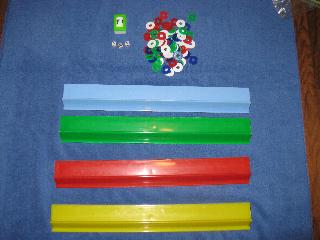
Hello Sandy, you asked:
mah-jongg set age question
It's a quite modern (1980's or 90's or early 2000's) American-style set, very common. See FAQ 7a.
I think it's Catalin
No. See FAQ 7c3. They're polystyrene.
ps. One dumb question. How do I store the tiles in the case to prevent them from flying around when carrying the case?
Put tiles in trays. Stack trays in case. Store racks laid on their backs (the flat part opposite the sloping part), sort of nested/spooned top-to-bottom with each other. If that doesn't fit into the case that way, you can buy a new case (see vendors in FAQ 4a & Accessories For Sale Bulletin Board).
Tom Sloper
Author of "The Red Dragon & The West Wind," the definitive book on Mah-Jongg East & West.
Los Angeles, California, USA
July 6, 2010
This site has been helpful for me!
>From: gail donovan
>Sent: Tuesday, July 06, 2010 5:01 AM
>Subject: posting
>Hello Tom,
>I would like to thank both you and Edwin Phua for the information about tournament table rotation, which I plan on implementing next week.
>Also, I am pleased to say that both the mah jong sets, which I requested you to post for sale have sold.
>Thanks you,
>Gail
Awesome, Gail! Glad to hear it.
May the tiles be with you.
Tom Sloper
Author of "The Red Dragon & The West Wind," the definitive book on Mah-Jongg East & West.
Los Angeles, California, USA
July 6, 2010
Frequently Asked Question #19H
>From: King
>Sent: Tuesday, July 06, 2010 1:29 AM
>Subject: mahjong question
>Hi...just wondering if 2 people need the same tile for Mah jong at the exact same time...who gets it? Is it the first person who calls out Mah Jong or is it in order of the next player?
>thanks, jodie
Hello Jodie,
You have asked
Frequently Asked Question #19H.
Please scroll up and look for the blue and yellow flashing arrow, emblazoned "READ 1ST," like this ). Find the link to FAQ #19 (it's marked with a red, white, and blue flashing arrow, emblazoned "AMERICAN," like this ) and click it.
After you've landed at the FAQ 19 page, please bookmark it so you can easily return to it anytime you have a mah-jongg question. Answers to all of the most frequently-asked questions about American (NMJL) mah-jongg are found in FAQ 19.
You can find books about mah jongg in FAQ 3, websites in FAQ 4, and teachers in FAQ 4 and the Find Players bulletin board.
Please always check the FAQs first, before asking a question. Thanks!
May the tiles be with you.
Tom Sloper
Author of "The Red Dragon & The West Wind," the definitive book on Mah-Jongg East & West.
Los Angeles, California, USA
July 6, 2010
Picker said mah jongg but someone called for the discard and the window was still open
>From: Sharon K
>Sent: Saturday, July 03, 2010 4:49 AM
>Subject: Mah-Jongg Q+A
>My mah-jongg question or comment is: We have a rule that if your tile has not been racked and your fingers are still touching the tile the last tile thrown can be called for.------- This being said a tile was drawn from the wall and the player declared Mah Jongg however her fingers were holding the tile when the other player called for the discarded tile.------Question: should the player who called for the thrown tile get it or would the player who drew the tile from the wall and called Mah Jongg get to keep the tile she had drawn? Does calling for Mah Jongg rule out the fingers touching the tile. I hope this makes sense to you. Sharon.
Hi Sharon,
Sometimes a rule has to be trumped by another rule. Sometimes a rule has to go out the window due to a special circumstance. This email is such a circumstance; I'm going to break one of my own rules. My rule, the one I'm breaking today, is: "when somebody asks a Frequently Asked Question, don't just give her a fish -- instead, teach her how to catch her own fish (point her to the relevant FAQ)."
But today, I'm going to throw fish at you for some of the things you said:
We have a rule that if your tile has not been racked and your fingers are still touching the tile the last tile thrown can be called for
The rule on the rules is, "if you make up your own rules, you can't ask anybody else (like me, for instance) to tell you what to do when a problem comes up involving your rules." This is Frequently Asked Question #14. There's more than that to FAQ 14, so you should read it. You can link to the FAQs above left.
Your rule is slightly different from the official rule. Not by much, but enough that serious discord can result. The official rule is the rule I call "the window of opportunity." It's FAQ 19C:
 Q: When is it too late to claim a discard? Q: When is it too late to claim a discard?
A: The "window of opportunity" (during which a player may claim a discard) opens when a tile is "down" [FAQ 19A], and closes when next player either racks*, discards, or declares mah-jongg. If you're wondering, "does that mean I have to put my picked tile back on the wall," click here* to read answer #AT. For a detailed discussion on the very important "window of opportunity" rule, click here* or scroll down past the last numbered answer.
For further reading:
RDWW - p. 51 (rule 48), p. 88
NMJL - p. 18
*If you want to click the clickable links in the above, you have to go to FAQ 19. Link above left.
a tile was drawn from the wall and the player declared Mah Jongg however her fingers were holding the tile when the other player called for the discarded tile... Does calling for Mah Jongg rule out the fingers touching the tile.
Mah jongg trumps everything. This is FAQ 9, Philosophy 5f. You should read FAQs 9, 14, & 19. You should bookmark FAQ 19. EVERY group should shell out the shekels and buy a rulebook. (In my opinion, every player should, but I know times are tough, and that there are a lot of cheapskates out there.)
Let's do this: let's walk through how this should have happened, step by step. And let's even have the call occur before the maj declaration, just to make it even more obvious how maj trumps everything.
Player A discards tile, saying its name.
Player B picks tile from wall, looks at it.
Just as player B is starting to say "m...", player C jumps in and says "I want that."
Player B says, "No. It's mah jongg."
Player B puts up her tiles.
Player B announces which hand it is and how much she is owed.
All players pay her. Everybody recognizes the rightness of Player B's self-picked maj trumping Player C's call for mere exposure -- including Player C.
It should be obvious from the above that if player C didn't call for the discard until after player B said "maj," player C would be out of luck -- no matter that player B hadn't yet let go of the picked tile, because mah jongg trumps the "letting go" thing. Also, note that the way I worded the Window of Opportunity rule specifically includes the maj call as one of the three window-closers.
Note also that my wording of the Window of Opportunity rule goes beyond the wording used by the NMJL in its official rulebook, but in my defense, my wording is based on deep research into the NMJL rules, not only as stated in the rulebook but also NMJL rule refinements and updates as dished out piecemeal in the yearly bulletins. If you don't accept my wording or interpretation of the rules, you are always encouraged to send a self-addressed, stamped envelope to the NMJL to get their ruling in writing. Their address is on the card.
The reason I threw my usual "just tell'em the FAQ" rule out the window is that the Window of Opportunity rule is probably one of The Most Important Rules of All. The moment of claiming mah jongg, even just the moment of claiming a discard, is a highly charged, emotion-filled moment. Highly charged emotions are the primary source of discord. The better everyone understands the Window of Opportunity rule, the more harmony. The more harmony, the more togetherness, the more enjoyment.
May the tiles be with you.
Tom Sloper
Author of "The Red Dragon & The West Wind," the definitive book on Mah-Jongg East & West.
Los Angeles, California, USA
July 3, 2010
Are table rules an accepted way to play? (FAQ 14)
>From: Gayann
>Sent: Thursday, July 01, 2010 10:58 PM
>Subject: question
>i have been playing MJ for quite a while and tonight I played with some gals from out of town. after the charleston and after the optional they did something called mish or mish mosh. Is this an accepted way to play??
Hello, Gayann. You have asked
Frequently Asked Question #14.
Please scroll up and look for the blue and yellow flashing arrow, emblazoned "READ 1ST," like this ).
Answers to all of the most frequently-asked questions about mah-jongg are found in the FAQs. Please always check the FAQs first, before asking a question. Thanks!
If, after reading the FAQ, if you still have a question (that isn't already answered in the FAQs), you are welcome to come back and ask that new question.
May the tiles be with you.
Tom Sloper
Author of "The Red Dragon & The West Wind," the definitive book on Mah-Jongg East & West.
Los Angeles, California, USA
July 2, 2010
Can a winner claim double jokerless payment for a Singles & Pairs hand?
>From: Irene Z
>Sent: Thursday, July 01, 2010 3:17 PM
>Subject: question
>Hi Tom,
>Today while playing Mah Jongg one of the players made Mah Jongg with a concealed hand- 11 22 33 44 55 66 77. Now this is a jokerless hand with all double numbers. One player threw out 1 2 that she needed to call Mah Jongg. This person pays double because she gave her the Mah Jongg. Can the winner also ask for double payments because it is jokerless?
>Thanks,
>Irene
Irene, you will find the answer to this question on the back of your NMJL card. When you have a question about American mah jongg, please always check the back of your card first. If you don't find the answer there, then check the FAQs. Then, if you still can't find the answer, you can email the question to me and I will try to answer nicely. Thanks!
May the tiles be with you.
Tom Sloper
Author of "The Red Dragon & The West Wind," the definitive book on Mah-Jongg East & West.
Los Angeles, California, USA
July 1, 2010
Winning on a pair (FAQ 19.E.3)
>From: Pat H
>Sent: Thursday, July 01, 2010 8:04 AM
>Subject: question
>I did the near impossible yesterday. I won the Closed hand of 7 consecutive pairs, lower right hand of the card, worth 50 points.
>After my joyous win, when i got home, i realized it may not have been legit. i picked a discarded tile for the Mah Jongg win. (our group allows us to pick a tile for a pair ONLY to MJ---however, since this was a closed hand , i wondered if it was a righteous win.
>Pat H
Hello Pat, you wrote:
i picked a discarded tile
I think it's confusing when the word "pick" is used that way. To me, "picking" means "from the wall." For discards, I use the word "take" or (even better) "call."
our group allows us to pick a tile for a pair ONLY to MJ
That sentence confused me even more. You made it sound like your group uses some non-standard rule. But since I understand from your previous words what "pick" means to you, that's not the case. It is indeed the official rule that you can not "take" or "call" a discard for a pair, except for mahj. Anybody who uses any other rule is doing it wrong. Read
Frequently Asked Question #19.E.3.
Please scroll up and look for the blue and yellow flashing arrow, emblazoned "READ 1ST," like this ). Find the link to FAQ #19 (it's marked with a red, white, and blue flashing arrow, emblazoned "AMERICAN," like this ) and click it.
After you've landed at the FAQ 19 page, please bookmark it so you can easily return to it anytime you have a mah-jongg question. Answers to all of the most frequently-asked questions about American (NMJL) mah-jongg are found in FAQ 19. Please always check the FAQs first, before asking a question. Thanks!
May the tiles be with you.
Tom Sloper
トム·スローパー
/
湯姆 斯洛珀 / 탐 슬로퍼
Author of "The Red Dragon & The West Wind," the definitive book on Mah-Jongg East & West.
Los Angeles, California, USA
July 1, 2010
Redeeming multiple jokers at a time (FAQ 19N)
From: "Tony <william
Sent: Wednesday, June 30, 2010 1:59 PM
Subject: Mah-Jongg Q+A
> My mah-jongg question or comment is: If a person has more than one tile in her hand that she wants to use to claim a joker that has been played on a call, can she do all of them at once on her turn, or can she only do one at a time?
From: "Tony <william
Sent: Wednesday, June 30, 2010 2:01 PM
Subject: Mah-Jongg Q+A
> My mah-jongg question or comment is: If a player has two or more tiles that she wished to use to claim a joker that another player has shown on a call, can she do so all in one turn? Or can she only claim one joker at a time on each turn?
Hello Tony or William (as the case may be),
Either way you word it, you have asked Frequently Asked Question #19N.
Please scroll up and look for the blue and yellow flashing arrow, emblazoned "READ 1ST," like this ). Find the link to FAQ #19 (it's marked with a red, white, and blue flashing arrow, emblazoned "AMERICAN," like this ) and click it.
After you've landed at the FAQ 19 page, please bookmark it so you can easily return to it anytime you have a mah-jongg question. Answers to all of the most frequently-asked questions about American (NMJL) mah-jongg are found in FAQ 19. Please always check the FAQs first, before asking a question. Thanks!
May the tiles be with you.
Tom Sloper
Author of "The Red Dragon & The West Wind," the definitive book on Mah-Jongg East & West.
Los Angeles, California, USA
June 30, 2010
The etiquette around giving information at the table, part 2
>From: btayvice
>Sent: Wednesday, June 30, 2010 10:04 AM
>Subject: Re: ediquette re talking about others game
>Thankyou
>Bev
How is this not 8 points? I ask you!
>From: "Melanie
>Sent: Tuesday, June 29, 2010 12:19 PM
>Subject: Mah-Jongg Q+A
>My mah-jongg question or comment is:
>If a hand consists of 1-9 dots, pung of 9 bamboos, and a pair of 1 bamboos, how does that not constitute Mahjong in an 8 pt game? What am I doing wrong? What would have made that hand an official complete Mahjong hand?
>Thanks for your time and consideration.....I really appreciate any feedback you can give me.
>Sincerely,
>Melanie=
Hello Melanie,
I'm going out on a limb and guessing that you play MCR (official Chinese, Mahjong Competition Rules). You say your hand is:

But you didn't say how you made the hand (was it by discard or by self-pick, and were there any exposures prior to saying hu), and you didn't say why you're asking this question. Did somebody tell you it wasn't 8 points? Were you playing a computer game and it didn't give you the win? Or what?
And before I go out on other limbs and add up how I see the score, why didn't you tell me how YOU see it? Tell me how you think the hand should have been scored. I'd rather do that than start making assumptions all over the place.
May the tiles be with you.
Tom Sloper
Author of "The Red Dragon & The West Wind," the definitive book on Mah-Jongg East & West.
Los Angeles, California, USA
June 29, 2010
The etiquette around giving information at the table
>From: btayvice
>Sent: Tuesday, June 29, 2010 10:50 AM
>Subject: ediquette re talking about others game
>Hi I am a beginner, but have picked up quickly. Is it proper to announce to the rest of the players that one person will win if you disgard a certian tile, thus alerting all, that one player is very close? The player next to me said I know you need this tile and I'm not passing it on. Would this make my hand dead?
>I can not find anything in my rule book about this.
>Thankyou Bev
Hello Bev,
In Official Chinese Mahjong, it's a punishable offense to give information about a player's hand. But I'm going out on a limb (don't worry, even though I'm a little overweight, it's a very strong limb) and guessing that you do not play that variant. My out-on-a-limb guess is that you play American mahjong instead.
In American mahjong, there is no rule against giving information. That's probably why you didn't find anything in your rulebook. By the way, you never said what your rulebook is...
The only "information" rule in American mahj is the one regarding a player whose hand is dead (or whose hand someone suspects to be dead). But that's not what we're talking about here.
You asked if it's "proper." I would say it's "in bad form" to divulge information about another player's hand while the game is on. I would say that a GOOD player (one with skill and experience) would never do that, because divulging information could reduce one's own edge. If I know something about a player's hand, I want to keep that information to myself so only I act according to that information -- it's fine by me if other players at the table don't know the information. Sounds to me like the player next to you has some sort of compulsive need for people to think she's smart or something.
And no, you can't be called "dead" just because some twit revealed information about what tile you need. It might reduce your chances of making the hand, but if the other players are smart, it doesn't change your chances.
I think I'm going to have to add this "providing information" issue to FAQ 9.
May the tiles be with you.
Tom Sloper
Author of "The Red Dragon & The West Wind," the definitive book on Mah-Jongg East & West.
Los Angeles, California, USA
June 29, 2010
There is a computer program or formula for tournament table rotation
>From: Edwin Phua
>Sent: Tuesday, June 29, 2010 3:53 AM
>Subject: Re: Tournament scheduling
>Dear Tom,
>I refer to the recent question on tournament scheduling and table rotation by Gail.
>There are solutions for the problem(s) posed by Gail, within constraints set (20 to 28 players, 6 rounds). Some solutions may not be ideal, due to mathematical impossibilities. All solutions here been trawled from the Round Robin Tournament Scheduling forum (
http://www.devenezia.com/round-robin/forum/YaBB.pl) (credit to Ian Wakeling).
>For 20 players:
>Round One: (1, 2, 3, 4) (5, 6, 7, 8) (9, 10, 11, 12) (13, 14, 15, 16) (17, 18, 19, 20)
>Round Two: (1, 12, 15, 18) (2, 5, 10, 20) (3, 6, 11, 16) (4, 8, 13, 17) (7, 9, 14, 19)
>Round Three: (1, 2, 8, 17) (3, 5, 15, 19) (4, 9, 16, 20) (6, 10, 13, 18) (7, 11, 12, 14)
>Round Four: (1, 6, 14, 20) (2, 11, 13, 19) (3, 8, 9, 18) (4, 7, 10, 15) (5, 12, 16, 17)
>Round Five: (1, 5, 9, 13) (2, 7, 16, 18) (3, 10, 14 17 ) (4, 6, 12, 19) (8, 11, 15, 20)
>Round Six: (1, 7, 11, 17) (2, 6, 9, 15) (3, 12, 13, 20) (4, 5, 14, 18) (8, 10, 16, 19)
>For six rounds, there will be some instances of repetition. Four players (Players 1, 7, 11, and 17) will meet one repeat opponent twice, while four players (Players 2, 8, 12, and 14) will meet one repeat opponent once. The other twelve players will play against all opponents once and will thus meet eighteen different players over six rounds.
>It is not possible for any player to play against all other players in a 20-player field. Since mahjong is a four-player game, and one gets to meet 3 opponents at any one time, all best solutions involved a field where the opponents are in multiples of 3 (e.g. for 16 players, where the opponents are numbered 15, a multiple of 3; 5 rounds is needed for all players to play one another once).
>For 24 players:
>Round One: (1, 2, 3, 4) (5, 6, 7, 8) (9, 10, 11, 12) (13, 14, 15, 16) (17, 18, 19, 20) (21, 22, 23, 24)
>Round Two: (1, 9, 18, 24) (2, 11, 19, 23) (3, 5, 12, 16) (4, 6, 10, 14) (7, 13, 17, 21) (8, 15, 20 22)
>Round Three: (1, 12, 15, 19) (2, 5, 20 24) (3, 11, 14, 17) (4, 8, 18, 21) (6, 9, 13, 22) (7, 10, 16, 23)
>Round Four: (1, 6, 17, 23) (2, 10, 13, 18) (3, 7, 19, 22) (4, 9, 16, 20) (5, 11, 15, 21) (8, 12, 14, 24)
>Round Five: (1, 5, 10, 22) (2, 8, 16, 17) (3, 6, 15, 18) (4, 7, 11, 24) (9, 14, 19, 21) (12, 13, 20, 23)
>Round Six: (1, 8, 11, 13) (2, 7, 9 15) (3, 10, 20, 21) (4, 12, 17, 22) (5, 14, 18, 23) (6, 16, 19, 24)
>Round Seven: (1, 7, 14, 20) (2, 6, 12, 21) (3, 8, 9, 23) (4, 5, 13, 19) (10, 15, 17, 24) (11, 16, 18, 22)
>For a field of 24 players, there is no repetition for seven rounds, and every player will meet 21 other opponents, and will not meet only 2 opponents. For a tournament of six rounds, any one round can be dropped.
>For 28 players:
>Round One: (1, 2, 3, 4) (5, 6, 7, 8) (9, 10, 11, 12) (13, 14, 15, 16) (17, 18, 19, 20) (21, 22, 23, 24) (25, 26, 27, 28)
>Round Two: (1, 5, 21, 25) (2, 6, 13, 17) (3, 11, 16, 28) (4, 12, 20, 24) (7, 9, 19, 27) (8, 10, 15, 23) (14, 18, 22, 26)
>Round Three: (1, 6, 24, 28) (2, 5, 15, 19) (3, 9, 14, 25) (4, 10, 18, 21) (7, 12, 13, 22) (16, 20, 23, 27) (8, 11, 17, 26)
>Round Four: (1, 9, 17, 23) (2, 10, 14, 28) (3, 7, 15, 20) (4, 8, 22, 25) (5, 11, 13, 24) (6, 12, 18, 27) (16, 19, 21, 26)
>Round Five: (1, 7, 16, 18) (2, 8, 21, 27) (3, 10, 19, 24) (4, 9, 13, 26) (5, 12, 14, 23) (6, 11, 20, 25) (15, 17, 22, 28)
>Round Six: (1, 11, 19, 22) (2, 12, 16, 25) (3, 8, 13, 18) (4, 7, 23, 28) (5, 10, 20, 26) (6, 9, 15, 21) (14, 17, 24, 27)
>Round Seven: (1, 8, 14, 20) (2, 7, 24, 26) (3, 12, 17, 21) (4, 11, 15, 27) (5, 9, 18, 28) (6, 10, 16, 22) (13, 19, 23, 25)
>Round Eight: (1, 12, 15, 26) (2, 11, 18, 23) (3, 5, 22, 27) (4, 6, 14, 19) (7, 10, 17, 25) (8, 9, 16, 24) (13, 20, 21, 28)
>Round Nine: (1, 10, 13, 27) (2, 9, 20, 22) (3, 6, 23, 26) (4, 5, 16, 17) (7, 11, 14, 21) (8, 12, 19, 28) (15, 18, 24, 25)
>This is one of the best solutions: a field of 28 players allows a full round-robin of nine rounds, where every player will meet every other player (27 of them) exactly once. For a tournament of six rounds, any three rounds can be dropped.
>As for computer programs, there may indeed be some programs written for handling tournaments, but these programs may not be easy to use, and/or are not usually specifically written to handle table movement/rotation. As far as I know, Mahjong Denmark has a Mahjong Tournament Organiser program (which includes a function for scheduling and creating table/seat arrangements).
>Best regards,
>Edwin
Edwin,
This is all fantastic information. I'll add it to the tournament FAQ. Thank you!
P.S. - I'd completely forgotten that you and Andrew had already responded to a similar question previously.
May the tiles be with you.
Tom Sloper
Author of "The Red Dragon & The West Wind," the definitive book on Mah-Jongg East & West.
Los Angeles, California, USA
June 29, 2010
From: Tom Sloper
To: Gail D
Sent: Tuesday, June 29, 2010 8:21
Subject: Re: Tournament scheduling
Gail, I was wrong in my previous response. There is information about how to organize your round robin tournament. Revisit http://www.sloperama.com/majexchange/bulletinbd.htm and http://www.sloperama.com/mjfaq/mjfaq21.htm to read it.
As always, all questions are answered on the bulletin board.
Tom
Joker redemption
>From: Marjan
>Sent: Monday, June 28, 2010 7:47 AM
>Subject: Redeeming jokers from my own rack -- variation of AMJ FAQ M3
>Yes, I have read the FAQ's -- but this is a variation (AMJ FAQ M3) that engendered a lot of discussion during last evening's game.
>From the 2010 NMJL card, I was playing 11DD(dots) 111 DDD(carks) 1111(bams). With 3 jokers from my hand, I mistakenly called a discarded 1dot, properly exposed 1JJJ(dots), and properly discarded. As the round proceeded I caught my error and, of course, had to change my hand so so that dots would be my kong. So at my next turn, I properly took a tile from the wall and then exchanged the two 1(dots) that were already in my hand for two jokers from my rack (and strongly reminded myself to look more closely before I leap).
>While all players agreed that I could exchange a joker from my own rack, two of the players strongly believed that the exchanged natural tile had to be pulled from the wall first and could not have already been in my hand when I displayed the kong originally.
>So that's the ultimate question -- can a natural tile be exchanged for a joker on your own rack if said natural was already in your hand when the kong (or pung) was displayed?
>BTW, I was told about your website during last evening's discussion, and am very impressed. I will definitely be using it in the future.
>Thanks,
>Jan
Hello Jan, you wrote:
two of the players strongly believed that the exchanged natural tile had to be pulled from the wall first and could not have already been in my hand when I displayed the kong originally.
Where did they get that idea? They are wrong.
can a natural tile be exchanged for a joker on your own rack if said natural was already in your hand when the kong (or pung) was displayed?
Of course. Why not? Sounds like there's a group that needs to have a copy of the official rules. The rules say nothing like what those two players are saying -- it is not in the rules anywhere, therefore it is not a rule.
May the tiles be with you.
Tom Sloper
Author of "The Red Dragon & The West Wind," the definitive book on Mah-Jongg East & West.
Los Angeles, California, USA
June 28, 2010
How should our made-up rules work?
>From: Sharon
>Sent: Sunday, June 27, 2010 3:10 PM
>Subject: Mah-Jongg Q+A
>My mah-jongg question or comment is:
>My group plays penalty for throwing to a hot hand, paying out of pocket.
>Scenerio….
>2 exposures/ midway through the game.
>There is a possibility it could be one of two hands…neither need a pair.
>She throws out a tile that she would need for one of the hands…One the floor there are now 3 of that tile, in addition to 3 of another tile.
>I feel this obviously eliminates one of the hands. A player throws a tile for the "other" hand…MahJongg is declared.
>The thrower felt it wasn't hot since jokers play. Why would someone throw out their own tile, having 3 on the floor, and 3 of a complimenting tile on the floor.
>The other hand was the only one she could have been playing and not seeing those tiles on the table made it that more obvious.
>Please answer
Hello Sharon, you wrote:
My group plays penalty for throwing to a hot hand
That doesn't tell me very much. I don't know how your group defines "hot hand." If you make up your own rules, you have to figure out how to solve problems that might arise. Read Frequently Asked Question #14 -- you can link to the FAQs above left.
2 exposures/ midway through the game.
>There is a possibility it could be one of two hands…neither need a pair.
Your scenario is totally unclear. I don't know how you think I can help you if you aren't more specific than that (not that I can help you anyway, since you're using a made-up rule).
The thrower felt it wasn't hot since jokers play.
I have no idea what you just said!
Why would someone throw out their own tile, having 3 on the floor, and 3 of a complimenting tile on the floor.
Maybe she made a mistake. How should I know? I have no idea what hand she was making, what tile she threw. The National Mah Jongg League rules do not include any prohibitions against winning on a tile you had previously thrown (or that would be hinted against, based on your previous throws) -- Japanese mah jongg does have a rule against that, but not NMJL.
Please answer
I ALWAYS answer. You don't need to ask me to. Read FAQ 14 and work with your group to decide how your group is going to deal with this same situation going forward.
May the tiles be with you.
Tom Sloper
Author of "The Red Dragon & The West Wind," the definitive book on Mah-Jongg East & West.
Los Angeles, California, USA
June 27, 2010
Cut her some slack since she's hard of hearing?
>From: "Gmail"
>Sent: Sunday, June 27, 2010 6:01 AM
>Subject: Honest mistake rule
>Hi, Tom.
>I've been fielding questions from my rules site and had one recently about change of heart which I gave the rule on. However I thought of a scenario which wasn't quite change of heart but more honest error. I'm pretty sure the answer is the same but want to be ready in case I'm asked
>"Betty" is hard of hearing. "Rita" throws a south. Betty says "I want that" and exposes three norths. Dead?
>Linda=
Hi Linda,
I have a rule. I call it "look, don't just listen." I do not have much patience for a player who never looks at the action. The American practice of naming the discard makes for lazy playing habits, and it's a player's own fault if she doesn't keep her eyes on the action. If she's not only hard of hearing but also her eyesight is failing or she needs to renew her optical prescription, then what she can do when a tile goes out that she might want is to say "wait a second while I squint at that," before committing herself to a possible fatal error.
May the tiles be with you.
Tom Sloper
Author of "The Red Dragon & The West Wind," the definitive book on Mah-Jongg East & West.
Los Angeles, California, USA
June 27, 2010
Is there a computer program or formula for tournament table rotation?
>From: gail d
>Sent: Sunday, June 27, 2010 4:40 AM
>Subject: mah jongg tournament question
>Hello Tom,
>I volunteer in organizing a small American (NMJL) tournament of 20-28 players (5-7 tables) for 6 rounds. I would be interested to know if there is some formula or computer program, which might help with the table rotation in order to avoid a lot repetition in the arrangement. The traditional method of 'A' moves up 1 table number, 'B' moves down 1 table number, 'C' moves up 2 table numbers, 'D' moves down 2 table numbers, doesn't seem to be ideal. I often hear complaints about having played with the same person(s) repeatedly. Any suggestions you may offer are appreciated.
>Thanks,
>Gail
Hello Gail, you wrote:
if there is some formula
Not that I know of.
or computer program
In all the years I have been doing this and going to tournaments, I have never heard of one. Lynn asked me the same thing last February (http://www.sloperama.com/majexchange/bulletinbd-archive13.htm) and I've been asked it before. If I knew of such a program or formula I would definitely have listed it in the FAQ. In fact, I just added your question to the FAQ, it's been asked so often.
'A' moves up 1 table number, 'B' moves down 1 table number, 'C' moves up 2 table numbers, 'D' moves down 2 table numbers, doesn't seem to be ideal.
I only have your word for that.
I often hear complaints
Yes, well. You are dealing with mah-jongg players. Complaining is one of their favorite activities. Getting complaints is just a fact of life if you're going to run a mah-jongg tournament. Get used to it.
about having played with the same person(s) repeatedly.
Have you considered that maybe with the small size of your crowd, some player repetition is unavoidable? In fact, I am pretty sure it is. With 28 people playing 6 rounds, I don't see how you can guarantee there won't be some repetition.
May the tiles be with you.
Tom Sloper
Author of "The Red Dragon & The West Wind," the definitive book on Mah-Jongg East & West.
Los Angeles, California, USA
June 27, 2010
Re the Interview with CHarli on CollectorsWeekly
>From: Michael Stanwick
>Sent: Friday, June 25, 2010 6:17 AM
>Subject: collectors weekly interview
>Hello Tom. Interesting interview. Carol Ann Harper talks eloquently about her collecting passion. My only comment is that she seems to be unaware of the great deal of research that myself and others have done in recent years. She seems very good when talking about the American experience after 1920 though.
>I hope we can direct interested players and collectors to The Playing-card journal publications in which the research appears (including Dr Andrew Lo's articles).
>Also of special importance is Lo's chapter in Asian games; the art of contest, the catalogue of the also named exhibition. I urge readers to acquire this beautiful book.
>Michael
Hi Michael,
she seems to be unaware of the great deal of research that myself and others have done in recent years.
Sadly, the vast majority of Americans who are interested in matters of mah-jongg seem totally uninterested in matters of mah-jongg outside America.
I hope we can direct interested players and collectors to The Playing-card journal publications
Too bad the IPCS doesn't have a better website -- people have to want back issues of the journal pretty badly, because they have to jump through some hoops to get them. http://i-p-c-s.org/
Also of special importance is Lo's chapter in Asian games; The Art of Contest,
I see that this book is available (used copies recommended) at Amazon.com (http://www.amazon.com/Asian-Games-Arthur-Sackler-Gallery/dp/0878480994) -- If you know of another source, I'll add it to FAQ 3.
May the tiles be with you.
Tom Sloper
Author of "The Red Dragon & The West Wind," the definitive book on Mah-Jongg East & West.
Los Angeles, California, USA
June 25, 2010
Color key
Blue = an FAQ, a question that's been asked frequently.
Purple = an angry email from a disgruntled reader.
Green = a happy email from a grateful reader.
Red = a technical support question about a computer game.
Orange = a weird or off-topic email.
Black = none of the above. Regular question or comment.
MORE Q&A!!
 CLICK HERE to read older Q&A postings! CLICK HERE to read older Q&A postings!
 CLICK HERE to return to the present and see the latest Mah-Jongg Q&A postings! CLICK HERE to return to the present and see the latest Mah-Jongg Q&A postings!
|


 SITE LINKS


