Tell me anything, part 5
From: "Susan
Sent: Thursday, June 24, 2010 8:07 PM
Subject: Re: questions about Mah Jong sets
> Hello Tom,
> I greatly appreciate the information your readers have posted about my
> sets. I
> do feel silly not to have have the leather case sent, but I couldn't
> afford the
> postage.
> Thank you very much for providing help even to us Mahjong naives!
> Susan
 You're welcome, Susan. Sorry if I was a bit hard on you. You're welcome, Susan. Sorry if I was a bit hard on you.
May the tiles be with you.
Tom Sloper
Author of "The Red Dragon & The West Wind," the definitive book on Mah-Jongg East & West.
Los Angeles, California, USA
June 24, 2010
Tell me anything, part 4
From: "Susan
Sent: Thursday, June 24, 2010 3:12 PM
Subject: Re: questions about Mah Jong sets
> Thank you for taking the trouble of looking at my photos.
> Susan
You're welcome, Susan. More has been written in response to your photos, and you should return to the bulletin board and read it. You should continue watching the board; there may be further commentary, and I might not write you to let you know.
May the tiles be with you.
Tom Sloper
Author of "The Red Dragon & The West Wind," the definitive book on Mah-Jongg East & West.
Los Angeles, California, USA
June 24, 2010
Tell me anything, parts 2 & 3
>From: Michael Stanwick
>Sent: Thursday, June 24, 2010 2:47 PM
>Subject: Tell me Anything
>Tom, both sets were made in China. The top set of pictures is most likely from the 1930's. I suspect the 'red' case with satin/felt lining was an attache style case - something the questioner should be able to tell us. But the tiles themselves appear to be classic 1930's tiles engraved on our old friend, casein.
>The 2nd set is most interesting. These type of tiles have appeared in bone and bamboo. Usually these sets(b/b) are poorly engraved with very 'primitive' type engravings. The b/b tiles usually have their dovetails missing as well. I don't know where they originate in Asia or China and I don't know what date. My suspicion is the 1970's or earlier (1960's). The so-called'bamboos' are in fact stylised/conventionalised coin strings from which the bamboo suit most probably originated. These tiles represent another style or group of engravings. These sets also sport 'Flowers/Seasons' consisting of two sets of human figures - each tile in a set of four being identical.
>Another hallmark of these sets is that they are made with inferior materials - I have owned a very nice b/b set only to find that it spawned wood boring beetles that created holes in the sides of the bamboo bases. This usually arises from bamboo harvested at the wrong period of the borer beetles reproductive cycle and hence ends up with their eggs or larvae attached. The tiles here may be casein but it is very difficult to tell. Was casein made in the late 20th century?
>Again, these observations of the latter set are provisional as evidence is scarce or non existent as to their origin.
>I hope someday someone can verify these sets sufficiently to allow us to make more definitive statements about them.
>Michael
>From: Michael Stanwick
>Sent: Thursday, June 24, 2010 3:01 PM
>Subject: addendum to last post
>Tom, rereading your poster about the 2 ebay sets, I recall now actually looking at the 1st set on ebay UK (since I live there) and indeed, the case was an attache-style one. I do wish collectors or buyers would pay special attention to these cases since they can tell a great deal about the origin of a set, apart from the fact that they were almost entirely hand made and stitched and are an integral part of the set. They are quite easy to repair and a good saddle wax brings their leather exterior to life.
>The red wafer bases are probably catalin plastic and the tops are casein and the set is definitely from the 1930's IMO.
>However, caution should be paid to the booklet since players can often lose them if they came with the set and hence replace them with a younger booklet.
>I think your poster has purchased two nice sets - even if one has missing wafer backs.
>Michael
Michael,
I can't say what years casein was used in mahjong set manufacture. As for the thing about cases, yes I agree that folks should include that information when asking for answers (my FAQs 7g and 7h both mention the case). It's a bit odd to request to have the tiles sent without the case, if that's what Susan really did. I'll close this now and open her email -- she wrote it without yet having seen your emails.
Cheers!
May the tiles be with you.
Tom Sloper
Author of "The Red Dragon & The West Wind," the definitive book on Mah-Jongg East & West.
Los Angeles, California, USA
June 24, 2010
What is its vintage and origin? - Part 4
>From: Michael Stanwick
>Sent: Thursday, June 24, 2010 1:17 PM
>Subject: what is its vintage and origin?
>Hello Tom.
>>These slide-top wooden boxed sets are very difficult to date...
>>It is my contention, based on documents and owner testimony, that these sets were made in China between circa 1955 and 1970
>Interesting. I recall previous conversations we have had about bone and bamboo slide-top boxed sets, that those were from the thirties (and your next comment seems to reinforce that). So are you only referring to casein slide-top boxed sets as being from 55-70?
>Actually I don't remember saying that. I may have ... I just don't remember. Based on the evidence I have seen, my view is that these sets appear to come from the period I outlined - namely, circa 1955 to circa 1970. That applies to slide-top wooden boxed sets with either engraved lettering on the lid or no lettering on the lid. They may have bone/bamboo tiles or plastic/polymer tiles (I have only seen one of the latter and it was casein tiles).
>I have seen no evidence to suggest these boxed sets came prior to that period.
>As I said, I saw a standing one-legged 'Peacock' bird in a casein set but that was in an 'attache-style case'(and these cases have specific design criteria) set which had all the indicators that it was from the 1930's. So all that shows is that the earliest appearance of that type of bird can be dated to the 1930's - unless someone else has evidence of an earlier date.
>I should also point out that the engravings on the tiles of these 1955 - 1970 sets appears to have been done with an engraving blade with a 'V' shaped configuration, rather than a hand held engraving machine tool. However, *some* of the sinograms on the 'Flower/Season' tiles of the 2 sets in question may have been done with such a tool. So, for example, the 8 tiles of the casein set on your bulletin board appear to be 'blade' engraved as the sinograms are uneven but appear to have sharp tapering ends to the'V' shaped strokes or gouges. On the other hand, the b/b set's 8 tiles are even looking and appear to be rounded rather than having the 'V' shaped gouge found with a bladed tool.
>These are cursory and hence very provisional observations since the pictures are not close ups of individual tiles.
>Michael
OK, thanks, Michael. I appreciate your insights (especially on the matter of the slide-top sets). I was out of the house for several hours today; in addition to the two emails below, and this one, I see that I also have two more from you, and one from Susan (the owner of the "Anything" sets)
May the tiles be with you.
Tom Sloper
Author of "The Red Dragon & The West Wind," the definitive book on Mah-Jongg East & West.
Los Angeles, California, USA
June 24, 2010
Interview with CHarli on CollectorsWeekly
>From: Melissa Crago
>Sent: Thursday, June 24, 2010 12:51 PM
>Subject: Great New In-Depth Interview with Antique Mah Jong Set Collector Carol Ann Harper from Collectors Weekly
>Hi Tom, hope you are doing well.
>I was visiting your The Sloperama Mahjong site, and thought you would enjoy our recently published interview with Antique Mah Jong Set Collector Carol Ann Harper.
>http://www.collectorsweekly.com/articles/an-interview-with-antique-mahjong-set-collector-carol-ann-harper/
>Let me know what you think of the interview and please feel free to share this link with other collectors.
>Thanks, and have a great weekend.
>Melissa
>-- -- -- -- -- -- --
>Melissa Crago
>The Collectors Weekly
>http://www.collectorsweekly.com
>[EMAIL ADDRESS DELETED]
>[PHONE NUMBER DELETED]
OK, cool. They know about it now.
May the tiles be with you.
Tom Sloper
Author of "The Red Dragon & The West Wind," the definitive book on Mah-Jongg East & West.
Los Angeles, California, USA
June 24, 2010
She never "lifted" the tile, so that doesn't count, right?
>From: "Ginny
>Sent: Thursday, June 24, 2010 12:13 PM
>Subject: MJ Question
>Hi Tom:
>I've read your "Window of Opportunity" article and have a brief question. One of the members of our group played at a community center a couple of weeks ago. It was her turn to draw from the wall. She touched the next tile in line on the wall, slid it ahead a bit, decided she wanted to call the tile discarded by the previous player and returned the tile she touched to the wall without having picked it up or looked at it. At this point, one of the women told her she would have to pick up the tile she had touched and would of course be unable to call the previous tile. Our group discussed this and decided that since she did not actually pick up the tile or look at it, she should have been able to call for the discard (we are really nice to play with!). What are your thoughts?
>Thanks for your time. We love your column and look forward to hearing from you.
>Ginny
Hi Ginny,
This has nothing to do with the Window of Opportunity rule. This is a Change of Heart question. Read FAQ 19AM. Saying "I never lifted it -- I slid it" is to play the "It depends on what your definition of Is is" game. She clearly communicated her intent when she slid the tile, and the Change of Heart rule takes effect.
May the tiles be with you.
Tom Sloper
Author of "The Red Dragon & The West Wind," the definitive book on Mah-Jongg East & West.
Los Angeles, California, USA
June 24, 2010
Tell me anything
From: "Susan
Sent: Thursday, June 24, 2010 11:18 AM
Subject: questions about Mah Jong sets
> Hello,
> This is probably the kind of email you stash in the "annoying" file, but I
> wonder if you could tell me ANYTHING about two mah jong sets I just bought.
> They were both very inexpensive. I bought one on ebay.uk. It is a
> bakelite-type set with no Western characters. It's enrobed but about half of
> the tiles have lost the red backs. (I've labeled the ones missing their backs
> "non-intact--or non-attached.") I have a pile of the red backs that I will
> probably attempt to re-attach to some of the now-naked tiles. I don't care
> about the value of the set. I collect them because they are pretty. (I have a
> good, unremarkable Rottgames intact set that I'm using to learn to play.) I've
> looked around a good deal online and haven't seen anything resembling the
> enrobed set's flowers. Wondered if you had any idea about where it came from
> (uh--China) or had seen a set like it before. The 1 bam looks like the Chinese
> bakelite "Turkey" bam on mahjongmahjong.com, but the flowers are completely
> different. It came in an old red leather case with red satin lining--but I
> didn't want to pay to have that shipped from England. I just wanted those
> beautiful tiles. The booklet that came with it is pinkish and states "Standard
> Rules for the Chinese Domino Game of Mah Jong" on the front. Some effort has
> been made to identify what the Chinese tiles might be called in English (a
> penciled in "W," for example. The booklet is old and yellowed and hand-stamped
> with the name of a shop: "The Old Capital/Peking Arts & Carpets/31 Stamford
> Road/Singapore."


> The second set was sold to me on ebay as Vietnamese. I believe it is bone.
> Again, the flowers are some I haven't been able to find on the internet. I
> don't think the set is artificially aged, especially since the eau de mildew
> was overpowering (although that would be a good con). They don't have bamboo
> backs. I think the tiles are cute and am happy with them no matter what they
> are. I would think that they go at least as far back as the 1970s.


> I have violated most of your protocols for asking about sets. I just wanted you
> to give a glance at these photos and tell me if you have seen similar sets and
> what you know about them. As you say, you do know that they are mine--and you
> don't *really* know that, eh?
> Many thanks -- and sorry to clog up your inbox!
> Susan
Susan, you wrote:
 This is probably the kind of email you stash in the "annoying" file This is probably the kind of email you stash in the "annoying" file
 Yes. On several counts. You know I don't like "anything" questions, yet you asked one. You sent photos of two different sets in one email. You photographed the tiles in the first set in random order and the second set grouped by symbol but the symbol groups in random order. Tiles should ideally be laid
out like this: Yes. On several counts. You know I don't like "anything" questions, yet you asked one. You sent photos of two different sets in one email. You photographed the tiles in the first set in random order and the second set grouped by symbol but the symbol groups in random order. Tiles should ideally be laid
out like this:

And you didn't give me the information requested in FAQ 7g.
wonder if you could tell me ANYTHING about two mah jong sets I just bought.
Yes. I can.
enrobed
No. They're not. They're "two-tone." The backs are a different color; there is no enrobing (the sides are not encased in that 2nd color plastic).
Wondered if you had any idea about where [the plastic tiles] came from
> (uh--China)
My guess is those tiles were probably made in America.
or had seen a set like [the plastic set] before.
Yes.
It came in an old red leather case with red satin lining--but I
> didn't want to pay to have that shipped from England.
You're saying you bought the tiles and asked the seller to keep the case (if I understand you correctly). And I don't know why you're telling me this.
I have violated most of your protocols for asking about sets.
Yes. It's very annoying.
tell me if you have seen similar sets
No (I assume this question is about the second set).
and what you know about them.
What is your question for me? I can't answer a question you haven't asked.
May the tiles be with you.
Tom Sloper
Author of "The Red Dragon & The West Wind," the definitive book on Mah-Jongg East & West.
Los Angeles, California, USA
June 24, 2010
Do people play Uno Mahjong?
>From: Robert Kalin
>Sent: Wednesday, June 23, 2010 8:00 AM
>Subject: Mah-Jongg Q+A kards
>My mah-jongg question or comment is:
>Are there any 'cheater' cards out there for use with mahjong?
>Explanation:
>Recently I've had the joy of watching various Hong Kong 'Mahjong' movies.
>In them the characters employ various exagerated styles of cheating reminescent of kung fu action movies.
>Such styles include superhuman speed to swap tiles, xray vision etc.
>Now the game of mahjong is wonderful in itself with its various forms around the world.
>On the other hand there are many of us players who do not have super speed and the greatest of memories to employ such fancy slight of hand acts.
>The real question:
>Do you know of any card sets out there that are used in conjunction with regular mahjong to in effect allow limited cheating during the game.
>The purpose of course is to allow an exagerated style of playing in hopes of captureing the silly and enjoyable style of gameplay seen in the movies.
>I could imagine that the players pull one card from a deck for one use only before starting a hand or round. An example would be:
>Conceal your discards for X number of turns.
>A mahjong happy player.
>Bob.
Hi Bob, you wrote:
Are there any 'cheater' cards ...
>Do you know of any card sets...
The vast majority of people who play mahjong play it with tiles, not kards.
Do you know of any card sets out there that are used in conjunction with regular mahjong to in effect allow limited cheating during the game...
>I could imagine that the players pull one card from a deck for one use only before starting a hand or round. An example would be:
>Conceal your discards for X number of turns.
Are there any 'cheater' cards out there
In other words, "Uno Mahjong." No.
May the tiles kards be with you.
Tom Sloper
Author of "The Red Dragon & The West Wind," the definitive book on Mah-Jongg East & West.
Los Angeles, California, USA
June 23, 2010
What is its vintage and origin? - Part 3
>From: Michael Stanwick
>Sent: Wednesday, June 23, 2010 5:01 AM
>Subject: What is its vintage and origin? - Part 3
>Hello Tom. I have some comments regarding a bulletin board request titled
>What is its vintage and origin?
>It seems to me that the yellow tiles may be casein?
>These slide-top wooden boxed sets are very difficult to date. I played with my parent's set (bone/bamboo) back in the early 60's - around 1960 - 1962 - and it has very similar graphics to those on the yellow tiles (But the human figures represented the four noble calling plus four plants). However, I think my parent's set dated from the 1950's due to the length of time it was in the shop.
>It is my contention, based on documents and owner testimony, that these sets were made in China between circa 1955 and 1970 (I have no evidence of a later date). From the evidence, they were exported to Singapore, Hong Kong, New Zealand and Australia and were also sold in China. I cannot go further back in time than that. I have seen that style of standing-one-legged 'Peacock' on a casein set from the 1930's, but as yet I haven't been able to acquire evidence that that bird appeared on a tile from the slide-top boxed b/b sets **from that period**(1930's).
>The 'casein' type set in question on your bulletin board is, IMO, from around 1968 - based on the colour of the Flowers/Seasons and the style/appearance of those human figures.
>Sets of the slide-top box variety with a 'grass-script' engraved on the lid (usually green or silver or gold) were most likely bought back by tourists and soldiers of the Korean and Vietnam wars (I have had evidence of the latter).
>The second set that was asked about is also difficult to identify since it could be b/b or a fish bone amalgam. I don't know if that is dirt on the tiles or evidence of the Haversian System tubules found in bone.
>However, the hue of the colour green suggests it may also be from the 1950's/1960's and Singapore is consistent with the geography I outlined. The style of the legs of the plant pots/vases and their colour, brown?, suggests a later date of around 1968 - 1970 - I prefer 1970 but that is very provisional.
>You may recall a similar type of slide-top boxed set in the Japanese MJ Museum book. It is dated from the 1930's I think, but IMO it is from the 1950's - based on the plane/anti-aircraft gun engraved tile plus the evidence I have acquired about similar sets. The tile with the war theme could be referring to the Korean war (the aircraft type is a bit primitive for the Vietnam war I think).
>These conclusions are all provisional since, unfortunately, evidence is sparse about these sets.
>Michael
Hi Michael,
Yes, I think casein is likely for Nathalie's plastic set.
These slide-top wooden boxed sets are very difficult to date...
>It is my contention, based on documents and owner testimony, that these sets were made in China between circa 1955 and 1970
Interesting. I recall previous conversations we have had about bone and bamboo slide-top boxed sets, that those were from the thirties (and your next comment seems to reinforce that). So are you only referring to casein slide-top boxed sets as being from 55-70?
I have seen that style of standing-one-legged 'Peacock' on a casein set from the 1930's, but as yet I haven't been able to acquire evidence that that bird appeared on a tile from the slide-top boxed b/b sets **from that period**(1930's).
You're "the man" when it comes to the 1B and where/when a particular design originated. (^_^)
The second set that was asked about...
(Second set when scrolling down; first set chronologically)
...is also difficult to identify since it could be b/b or a fish bone amalgam. I don't know if that is dirt on the tiles or evidence of the Haversian System tubules found in bone.
I'm glad to hear you say that, because that's the problem I had too. I think if Nathalie could tell us the dimensions of those tiles, we might be able to make a better guess.
However, the hue of the colour green suggests it may also be from the 1950's/1960's and Singapore is consistent with the geography I outlined. The style of the legs of the plant pots/vases and their colour, brown?, suggests a later date of around 1968 - 1970 - I prefer 1970 but that is very provisional.
>You may recall a similar type of slide-top boxed set in the Japanese MJ Museum book. It is dated from the 1930's I think, but IMO it is from the 1950's - based on the plane/anti-aircraft gun engraved tile plus the evidence I have acquired about similar sets. The tile with the war theme could be referring to the Korean war
Interesting!
May the tiles be with you, Michael. Cheers!
Tom Sloper
Author of "The Red Dragon & The West Wind," the definitive book on Mah-Jongg East & West.
Los Angeles, California, USA
June 23, 2010
What if 3people on your table of 4 go dead
>From: Irene
>Sent: Wednesday, June 23, 2010 4:56 AM
>Subject: Question
>Hi Tom,
>I have a question for you. What if 3people on your table of 4 go dead (because of too few tiles/too many tiles/no way they can make a particular hand)- does the 4th player win by default (even if she did not make mah jongg) & if she wins what is her winning amount?
>Thanks,
>Irene [last name and full contact info deleted]
Hello Irene, you wrote:
What if 3people on your table of 4 go dead (because of too few tiles/too many tiles/no way they can make a particular hand)
It depends. Your question assumes that every possible way 3 people could go dead earns the same penalty, and that's not the case. There are different ways 3 people can go dead. One way (and how it's handled) is described on page 16 of the official rulebook. Two ways are described on page 18 of the official rulebook. The death rules are fully described in my book, pages 56 to 64. Some of the most frequently asked-about death rules are given in FAQ 19 (above left). Rather than me transcribe all that information for you here, how about you narrow down the question for me? I'm assuming that you're asking because of a situation that came up; tell me the situation and I can tell you how it should be handled. It's not my practice here to write out NMJL rules at length (that's what my book is about).
does the 4th player win by default (even if she did not make mah jongg)
Sometimes yes, sometimes no. Depending on the details of the situation.
if she wins what is her winning amount?
That depends on the situation. For some infractions, the penalty might be some multiple of the value of the wronged player's hand. Otherwise when there's a penalty, it's usually the value of the cheapest hand on the card (a quarter, 25¢).
Standing by for a more narrow question.
May the tiles be with you.
Tom Sloper
Author of "The Red Dragon & The West Wind," the definitive book on Mah-Jongg East & West.
Los Angeles, California, USA
June 23, 2010
What is its vintage and origin? - Part 2
>From: Nathalie
>Sent: Tuesday, June 22, 2010 7:26 AM
>Subject: Mahjong - Elspeth's Set
>Dear Mr Sloper,
>here are the details and photos of my daughter's Mahjong Set. Any information you can provide us with would be most appreciated.
>Thank you once again for your assistance.
>1. Contents: Bams, Circle, Character - 9 of each, 8 Flowers, 16 Winds and 16 Dragons, 4 Jokers and 4 White Tiles. There is also a 'counter' and 4 mini dice
>2. There are no paper materials
>3. We believe the set is made of bakelite
>4. We purchased this particular set at our local village antique shop for about £30. The owner of the shop did not have much to say about the set - but the owner had been living in Singapore for many years. The actual box (photo attached) was wrapped in the original newspaper they first bought it from the market in. But the owners of our antique shop threw away that newspaper. According to the shop, the owner claimed that the game was never played.
>5. 9 Bams, 9 Circles, 9 Character, 8 Flowers, 16 Winds, 16 Dragons , 4 Jokers and 4 White Tiles
>6. Container: It was sold to us in a wooden box - not sure what type. The box has a sliding top with markings. - photo attached
>7. Cracks: Photo attached (not in good focus)
>8. 1 Bam - photo attached
>9. Dragons - photo attached
>10. Flowers - photo attached
>11. 4 Jokers were in this set - but we neglected to photograph the white tiles. Sorry about that!
>Thank you in advance for your assistance. Please do let me know if you have any questions or comments.
>with kind regards,
>Nathalie
>KENT, ENGLAND


Hello, Nathalie. You asked:
Any information
I'm sorry, I don't do "any information" requests (read FAQ 7p) . But, since you asked about age and origin of the first set, I'm going to address the same questions
age
Probably 1950's or 1960's, maybe later, maybe earlier. The box indicates a 1930's origin, but Chinese sellers (including those in Singapore) have been known to put sets in antique or fake-antique boxes.
origin
The box indicates China. That type of squarish opaque plastic indicates China. So: probably China.
We believe the set is made of bakelite
No. It's not. See FAQ 7c. Bakelite (Catalin) tiles are shiny, with a touch of translucency, and more rounded.
16 Dragons , 4 Jokers and 4 White Tiles ... we neglected to photograph the white tiles. Sorry about that!
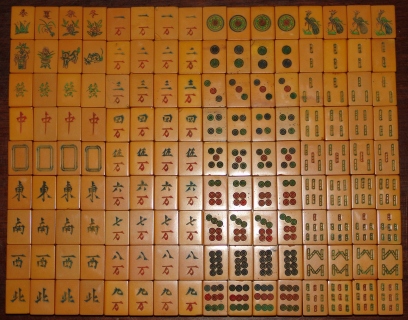
I am now officially confused about the makeup of your set. Please lay out all the tiles like this:
And please provide a total tile count. (Add up "9 Bams, 9 Circles, 9 Character, 8 Flowers, 16 Winds, 16 Dragons , 4 Jokers and 4 White Tiles" for me so I don't have to do math myself.) I don't need that for the other set, but I'm totally confused about this one.
The box has a sliding top ... a wooden box - not sure what type.
I call that type of box the "slide-top" (or "sliding top") box. (^_^)
May the tiles be with you.
Tom Sloper
Author of "The Red Dragon & The West Wind," the definitive book on Mah-Jongg East & West.
Los Angeles, California, USA
June 22, 2010
What is its vintage and origin? - Part 1
>From: Nathalie
>Sent: Tuesday, June 22, 2010 7:14 AM
>Subject: Vintage of Mahjong Set?
>Dear Mr Sloper,
>we have found your website very useful indeed and as a result purchased your book to help us get more out of playing Mahjong.
>Please would you examine the following photos to help us determine the age and origin of a set I bought my husband in January of this year?
>Following your instructions:
>1. Contents: Bams, Circle, Character - 9 of each, 8 Flowers, 16 Winds and 16 Dragons. There is also a 'counter' and 4 mini dice
>2. There are no paper materials, but the inside edge of the box was lined with newspaper (photo attached)
>3. We believe the set is made of bone and bamboo
>4. We purchased this particular set at our local village antique shop for about £80. The owner of the shop said that she purchased many items from this customer who she believes used to live in Bermuda, and may have also once lived in Singapore. The previous owner was an older British lady who said it had not been played in many years.
>5. Dimensions: 13 mm x 27 mm x 20 mm
>6. 9 Bams, 9 Circles, 9 Character, 8 Flowers, 16 Winds, 16 Dragons
>7. Container: It was sold to us in a wooden box - possibly Mahogany. The box has a sliding top without any markings. The top was warped and the centre square was reglued. We recently sent it to someone to restore the box so that it was more secure. I am sorry we do not have a photo.
>8. Cracks: Photo attached
>9. 1 Bam - photo attached
>10. Dragons - photo attached
>11. Flowers - photo attached
>12. No Jokers were in this set
>Thank you in advance for your assistance. In a following email, I will be sending you another breakdown of my daughter's new set. It is her 9th Birthday today and she loves the game so much, we bought her a set in the same shop we found my husband's.
>with kind regards,
>Nathalie
>KENT, ENGLAND


Hello, Nathalie. You asked:
the age
At first, without seeing the box, I thought it to be a processed fishbone set as described in FAQ 7c. But when you described the box, I changed my guess. That type of slide-top box was common in the thirties, prior to the outbreak of WWII, and warping is not uncommon in those. But this newspaper lining is troubling. Your description of how it lined the box, together with the fact that you are able to provide a photo of the newspaper but not the box, are confusing -- it might indicate that the box is of more recent origin, that I was right about the tiles being reconstituted fishbone. So, the set is either from the 1930's or the 1980's-1990's.
and origin
Most likely China. There's also a chance it was made in Japan.
There is also a 'counter'
I assume you're referring to the wind indicator (as described in FAQ 7d).
May the tiles be with you.
Tom Sloper
Author of "The Red Dragon & The West Wind," the definitive book on Mah-Jongg East & West.
Los Angeles, California, USA
June 22, 2010
This week's column
>From: linda mayberry
>Sent: Monday, June 21, 2010 8:35 AM
>Subject: Column 456 - June 20
>Hi Tom,
>Love your column! I read and practice every week, and have learned a lot. I don't understand how #15 in column 456, June 20th can be 2468 #2. I thought the two's had to be a pair, not a Pung. I could only see it as 24698 #7.
>Please explain; what am I missing?
>Thanks.
>Linda Mayberry
Hi Linda,
Right you are. I fixed it, thanks to you!
May the tiles be with you.
Tom Sloper
Author of "The Red Dragon & The West Wind," the definitive book on Mah-Jongg East & West.
Los Angeles, California, USA
June 21, 2010
Rules for playing with Bertha
>From: ddepippo
>Sent: Friday, June 18, 2010 7:03 AM
>Subject: Playing with three players and Bertha
>When playing with Bertha and you draw a Joker from her are you able to keep it. or discard it as Jokers are not supposed to be passed?
Hello Mr. or Ms. Depippo,
At first you threw me with that "Bertha" thing, but my crystal ball informs me that "Bertha" is your group's cutesy name for "Not Me," the imaginary friend in the daily cartoon "Family Circus" -- also called "the wall" by American players, "the king" by Chinese players. The imaginary fourth player.
The answer is, if you're going to make up rules, you get to decide how your rules should work. Read Frequently Asked Questions 13A & 14. The FAQs are above left (scroll up and look for the blue and yellow flashing arrow, emblazoned "READ 1ST," like this  ). ).
May the tiles be with you.
Tom Sloper
Author of "The Red Dragon & The West Wind," the definitive book on Mah-Jongg East & West.
Los Angeles, California, USA
June 18, 2010
Are we playing with too many tiles?
>From: Dottie
>Sent: Thu, June 17, 2010 7:36:18 AM
>Subject: Mah-Jongg Q+A
>My mah-jongg question or comment is: I have read the FAQ’s about the mystery tiles, and still haven’t found this answer. I am learning the American game, using the National MJ cards. I was taught to play with 8 flowers and 8 winds, but I see on the site that an American set of tiles has only 4 winds and 4 flowers. Are we playing with too many tiles.
>I apologize if this is answered elsewhere. The font on the website is killer on my eyes and I have spent a lot of time looking and learning, and love the site. Thank you so much. I have also just ordered your book, so maybe that will help as well.
>Thank you for you help,
>Dottie
I have read the FAQ’s about the mystery tiles, and still haven’t found this answer.
That's because you were reading the wrong FAQ.
I was taught to play with 8 flowers and 8 winds
Really? Here's what 8 flowers and 8 winds looks like:

I see on the site that an American set of tiles has only 4 winds and 4 flowers.
That's not true. Look in FAQ 7b. An American set of tiles has 16 winds, 8 flowers, and 8 jokers. Like this:

May the tiles be with you.
Tom Sloper
Author of "The Red Dragon & The West Wind," the definitive book on Mah-Jongg East & West.
Los Angeles, California, USA
June 17, 2010
How to handle an annoying player?
>From: Susan T
>Sent: Thu, June 17, 2010 7:09:54 AM
>Subject: MJ ?
>What are the rules or suggestions if one in your group both continually miscall a discarded tile and continually decides they want a discarded tile after the next to play has already drawn from the wall.
>Thank you
Hi Susan, you wrote:
What ... if one in your group ... continually miscall a discarded tile
I'm not sure what the word "miscall" means to you. Do you mean that she mistakenly says she wants a discarded tile a lot? Or do you mean she misnames them a lot? If the former, you can call her dead the instant she erroneously exposes tiles from her hand. If the latter, then you have to understand that she's either struggling with the game, easily flustered, or slow (slow learner or slow thinker). Either be patient with her, or dump her.
What are the rules or suggestions if one in your group ... continually decides they want a discarded tile after the next to play[er] has already drawn from the wall.
Sounds to me like she's a slow thinker. There's nothing wrong with calling a discard after another player picks up a tile -- read about the "window of opportunity" rule in FAQ 19, above left. But if this happens a lot, then the best thing for the rest of you to do is not be too fast to pick from the wall. Do this: when someone discards a tile, pause a beat before reaching for the wall. A "beat" is not a long pause (it can be as long as one second, maybe just count to yourself, 1, 2, 3, reaching for the wall on 3), but this gives her just a little longer to think about whether or not she wants the tile, most likely reducing the number of times she interrupts the play.
May the tiles be with you.
Tom Sloper
Author of "The Red Dragon & The West Wind," the definitive book on Mah-Jongg East & West.
Los Angeles, California, USA
June 17, 2010
I found a MISTAKE!!! in your latest column
>From: Raena
>Sent: Thu, June 17, 2010 4:14:46 AM
>Subject: June 13 column #455 ERROR
>#7. It can't be W-D#5 because the hand is concealed. Call her dead
>Sent from my iPad
Subject: June 13 column #455 ERROR
All right, all right! No need to rub my face in it! I should have taken more time to double-check it before putting it online.
because the hand is concealed.
OK, I've fixed it. Thanx 2 U.
May the tiles be with you.
Tom Sloper
Author of "The Red Dragon & The West Wind," the definitive book on Mah-Jongg East & West.
Los Angeles, California, USA
June 17, 2010
How does claiming a discard work?
>From: davida
>Sent: Wednesday, June 16, 2010 6:17 PM
>Subject: mah jongg question
>If a player discards a tile, and the player opposite the discarder calls the tile, does the
>player to the right of the discarder lose their turn?
> Davida
Yes.
If you're learning by a book, you need a better book*. Please scroll up and look for the blue and yellow flashing arrow, emblazoned "READ 1ST," like this ). FAQ 3 lists all the best mah-jongg books.
The best way to learn mah-jongg, though, is from a teacher. See FAQs 4a & 15.
If you can't afford to buy a book, and can't find a teacher in your area, mah-jongg websites are listed in FAQ 4b.
May the tiles be with you.
Tom Sloper
Author of "The Red Dragon & The West Wind," the definitive book on Mah-Jongg East & West.
Los Angeles, California, USA
June 16, 2010
* Or you need to read it more carefully.
The exception to the "NEVER" rule? (part 2)
>From: Joanne
>Sent: Wed, June 16, 2010 2:47:47 PM
>Subject: Re: Unusual situation re Mah Jongg
>Thanks for your quick reply. That was what our consensus was but in our group of 12 players there seems to be some dispute and we were looking for an “expert” opinion.
>J. Fisher
The exception to the "NEVER" rule?
>From: Joanne
>Sent: Wed, June 16, 2010 1:42:39 PM
>Subject: Unusual situation re Mah Jongg
>Today our group encountered an unusual situation. We are aware that jokers cannot be used in singletons . . . However there was some disagreement about whether a joker could be used as part of a singleton if it allowed the player to Mahj. There was a dispute about this . . .
>Here’s the situation:
>Player picked a tile which she then exchanged for a joker which was exposed on someone else’s rack. The player who exchanged the joker then wanted to use that joker to go “Mahj”. We agreed that the joker could be used if the player was going to then expose three or more tiles to make Mah Jongg. The player, however, wanted to use the joker to go Mahj with only one tile + the joker.
>Some in our group felt this was allowed, citing a rule that you could use a joker in a doubleton if one was going Mahj. Others in the group cited the rule (printed in one of the rule books held by one of the players) that a joker could never be used as part of a doubleton.
>Can you provide a definitive answer to this question?
>Thank you.
>Joanne
Hi Joanne,
The answer is no. Look on the back of your NMJL card. The word "NEVER" is capitalized, underlined, and bold.
Also see FAQ 19E3.
May the tiles be with you.
Tom Sloper
Author of "The Red Dragon & The West Wind," the definitive book on mah-jongg East & West.
Los Angeles, California
June 16, 2010
"Any 3 Suits" means I can use 1 suit if I want, right?
>From: Rhonda
>Sent: Tue, June 15, 2010 8:37:56 AM
>Subject: MahJongg Question
>I'm very new to playing this game but will do research to learn. I was playing last week and went for the following hand:
>It was #5 under Consecutive Run:
>FF 1111 2222 3333 (Any 3 suits, any 3 consec Nos.)
>Instead of having 3 different suits - I had all the same suit. My rationale was the word "any". My group disqualified my hand but I thought I would research it. I found your website and more specifically, FAQ19. Now I know FAQ19 is specifically for 'two colors' but I concluded that that 'any' means 'any' despite 2 or 3 colors.
>I shared this information with those that I was playing with and some took exception to my conclusion. Can you please comment on this since I was unable to find a specific FAQ for this particular situation.
>Thankyou!
>http://www.sloperama.com/mjfaq/mjfaq19.htm
>Q: What does "any suit" mean when there are two colors?
>A: Here is the Tom Sloper philosophy of how to interpret the card:
>... The word "any" is clear. You KNOW what the word "any" means. Do not let the color-coding on the card "color" your thinking! For more on how to read the card, see answer AJ and answer AK. If you'd like to refresh your memory as to the meaning of the word "any," you can use any dictionary.
Hello Rhonda,
Forgive the brevity of this response. I have very little time before needing to depart. I'll post this response on the BB later.
The parenthetical doesn't only say "any." It says "any 3."
Therefore the parenthetical does not override the color-coding. The color-coding clearly shows 3 colors. The parenthetical clearly specifies 3 suits.
As for FAQ 19, you weren't specific as to which part of the FAQ you were looking at. You overlooked FAQ 19AJ, where it says:
"It might say 'any 3 suits' (which would only clarify that [a set] ... could be any suit as long as it's a different suit from the other [differently colored] sets..."
You were wrong -- your friends were right.
May the tiles be with you.
Tom Sloper
Author of "The Red Dragon & The West Wind," the definitive book on mah-jongg East & West.
Los Angeles, California
The Ides of June, 2010
I'm glad we agree on what the best book is
>From: Nubble
>Sent: Monday, June 14, 2010 4:02 PM
>Subject: mah jongg
>I've been using and recommending Elaine Sandberg's book to all my new students. It's the best book because it's so clear and easy to follow. I'm glad to see you agree with that assessment. Thanx. Beth
Actually, Beth, I don't. I think MY book is the best, because it covers all the up-to-date rules in detail. I'm guessing you must have read my February 4, 2007 column -- or my foreword in her book. Both of those were written before my own book, "The Red Dragon & The West Wind," was published. So once my book came out, my opinion had to be adjusted, you see! I admit to some bias, of course... (^_^)
May the tiles be with you.
Tom Sloper
Author of "The Red Dragon & The West Wind," the definitive book on Mah-Jongg East & West.
Los Angeles, California, USA
June 14, 2010
What if nobody has 3 tiles to pass?
From: jackie.
Sent: Monday, June 14, 2010 10:08 AM
Subject: Mah-Jongg Q+A
My mah-jongg question or comment is:
Hi Tom,
My games plays by the rules and use the NMJL Card. All 4 of us wanted to steal one tile on the last charleston.
I did not see the answer on the FAQ's and I did look.
We just passed two tiles to the right for the last charleston. Did we do the correct thing?
Thanks for all you know and share!!!!
Jackie B
Hi Jackie,
It's not a "frequently asked" question. I've only been asked two times before that I can recall. Consider this crazy thought:
Most likely, there's only one player (or at most two players) who absolutely cannot pass any tiles. SOMEONE has at least one tile she can pass ... the dealer, for instance. If the dealer cannot declare mah-jongg, she is going to have to start the game by discarding a tile. That mean she has one tile (at least) that she can pass.
Since there is at least one player who can pass at least one tile, it's possible to satisfy the rule requiring that a Last Right pass take place. It's permissible to Blind Pass on the Last Right, as you know.
The Blind Pass is the loophole that'll get you through this impasse.
Because Blind Passing is permitted on this pass, all that's needed is at least one passable tile. And unless the dealer can declare mah-jongg, there is one. If the dealer can declare mah-jongg, just let her do that and be done with it.
So, in the worst case, then, the dealer passes one tile right and says, "I owe you two more." That player can pass it right and say, "I owe you two more," and so on, until each player has passed the tile right. Then the dealer need only repeat the process twice (saying, instead of "I owe you two more," rather "Now I owe you one more" and "Here's your third tile" on the 2nd and 3rd time, respectively). Now each player has (in effect) passed three tiles to each other player, using the Blind Pass workaround, although in actuality nobody has actually changed her hand. And the requirement that a Last Right be passed has been satisfied (thanks to the Blind Pass loophole).
Or you could just all SAY you did the above, have a good laugh, and signal the dealer to discard. It amounts to the same thing anyway. Think about it!
BTW, you may notice that I don't call it "stealing." Read column #353 for why I don't.
May the tiles be with you.
Tom Sloper
Author of "The Red Dragon & The West Wind," the definitive book on Mah-Jongg East & West.
Los Angeles, California, USA
June 14, 2010
Need flowers, jokers, and blank tiles
From: Hanahou69 aol.com aol.com
Sent: Monday, June 14, 2010 8:05 AM
Subject: Set Wanted
Set Wanted:
Minimum# of tiles needed: I have a set that has never been use and I think it is Bakelite it has no flowers or jokers. I would like to find them. I also have a Japanese set that needs 8 blanks. the tiles are small and also has never been used.
Preferred color of tiles:
Material the tiles should be made of:
Type of case desired:
Accessories that must be included:
Thank you for helping me. Georgeann Humphreys 623 474 3332 (Ltc Richard G Humphreys) husband
Georgeann,
Read Frequently Asked Question #7Q.
Please scroll up and look for the blue and yellow flashing arrow, emblazoned "READ 1ST," like this ). Find the link to FAQ #7Q and click it.
Good luck! May the tiles be with you.
Information request
>From: Eric
>To: Webmaster@Sloperama.com
>Sent: Saturday, June 12, 2010 11:42 PM
>Subject: Mah Jongg set information request
>Hello Tom,
>I just inherited this nice set. It is a "Mah-Lowe" set that seems to be in very good shape and hasn't had much (if any) use. I'd really like to know the value of it. I would describe the condition as excellent to "near-mint".
>The Details:
>-162 Tiles - I can't tell whether they are Bakelite or Casein
>-Standard american tile dimensions
>-Has the complete set of Dots, Craks, and Bams
>-Green crane 1 Bam
>-Complex Crak symbol
>-Complete set of winds
>-Complete dragons with red and green dragon drawings and white square
>-Only two jokers, red and black
>-12 occupational flowers up to number 5, 12 emperors up to number 5
>-Has circular wind indicator disc (identical to the one in your faq)
>-Two green dice
>-5 multicolored racks with chip holders (bending keeper arms)
>-Many multicolored chips, even numbers of all
>-Has 4 booklets of NMJL hands and rules dated 1958
>-Wood suitcase with locking latches, two keys, alligator skin finish
>The strange number of flowers makes me wonder if it's a full set. Since there's 12 of each type, I'm assuming it's normal.
>Thanks in advance,
>-Eric


Hi Eric, you asked:
I'd really like to know the value of it.
If the case is "excellent to 'near-mint'" as you say it is, then it's a high-value set. I wouldn't accept less than $200 for it, if I were you. But I wouldn't advise anyone to pay more than $150 for it, so it's impossible to sell! (^_^)
I can't tell whether they are Bakelite or Casein
Neither. They're Catalin. So-called "Bakelite" tiles are actually Catalin (actual Bakelite is always dark -- according to at least one expert -- see FAQ 7c3). Bakelite and Catalin are nearly identical substances, as I understand it, so when somebody says he has a Bakelite set, I usually don't bother correcting him.
Has 4 booklets
"Cards." We call those "cards." See FAQ 7i.
The strange number of flowers makes me wonder if it's a full set. Since there's 12 of each type, I'm assuming it's normal.
If you take a look at column 311, you'll see that 24 flowers was "normal" (i.e. "a full set") from 1950 to 1955. And 2 jokers weren't required by the NMJL until 1960. So, to answer your question, it's not abnormal but you'd have to define what your definition of "a full set" is before I could answer that part.
The major flaw of your set is the missing a #2 flower in what you call "emperors." There are numerous gaps in your flowers, as you've already identified. Nobody who'll use the set to play American mah jongg will care about that, but a collector would see that it's been stripped of tiles -- perhaps to give to someone else to increase the flower count of another set. Somebody who'll use the set to play American mah jongg will have to sticker some of the flowers anyway, to bring up the jokers to eight.
May the tiles be with you.
Tom Sloper
Author of "The Red Dragon & The West Wind," the definitive book on Mah-Jongg East & West.
Los Angeles, California, USA
June 13, 2010
Wright-Patterson
>From: The Nelsons
>Sent: Thursday, June 10, 2010 11:06 AM
>Subject: Question please about WrightPatterson OWC rule books
>Hi
> Please I need some help.
> I am trying to find an updated contact for Wright-Patterson OWC. I see you have a mailing address for books , with prices from 2003, but the web address does not work. Do you have an updated contact , site or e mail. Hate to mail a check and I don't even know if the are still in business.
> Thanks
> Deborah
>looking for players in Orlando
Hello Deborah, you wrote:
I see you have a mailing address for books , with prices from 2003,
I do? With prices? Where? I just looked in FAQ 3, didn't see any prices there. And I looked in FAQ 2b, didn't see any prices there either. Where did you find W-P prices on my site?
but the web address does not work.
Ah. Okay, then I need to fix that.
First step -- I did a quick Google search.
Then I got a list of results, tried them one by one... The listings at mahjongg.com and mahjongmuseum.com were fine but not the official site of the Officers' Wives' Club, so I kept looking...
Then I found the current W-P Officers Spouses' Club website. That's the problem. They changed their organization's name, so changed their web address. They changed it to http://wrightpattersonosc.org/mah-jongg.html
I have now fixed the entry in FAQ 3, thanks to you.
looking for players in Orlando
See Frequently Asked Question #15, and use the Find Players bulletin board (site links are above left).
May the tiles be with you.
Tom Sloper
Author of "The Red Dragon & The West Wind," the definitive book on Mah-Jongg East & West.
Los Angeles, California, USA
June 10, 2010
Called her dead. She denied it, so I was dead.
>From: Barbara
>Sent: Thursday, June 10, 2010 7:21 AM
>Subject: (no subject)
>Hi:
>I called someone dead because she was playing the 3,6,9 hand with the dragons where you need pairs and two flowers. I called her dead because there was 6 flowers on the table. She said she wasn't dead; therefore, I became dead; but at the end when it was over, she was dead but she said I shouldn't have called her dead because there were actually three 3's on the table and I was counting the flowers. I hope u understand; and if so, can you tell me who was wrong. Thank you.
>Barbara
Hello Barbara, you wrote:
 I called her dead because there was 6 flowers on the table. I called her dead because there was 6 flowers on the table.
 That leaves two flowers. Since you don't see 7 flowers on the table, you can't call her dead. That leaves two flowers. Since you don't see 7 flowers on the table, you can't call her dead.
She said she wasn't dead; therefore, I became dead;
What??!!?? Sounds to me like somebody (four somebodies, in fact) needs to read the rulebook.
Since you don't have a rulebook, read Frequently Asked Question #19AB.
Please scroll up and look for the blue and yellow flashing arrow, emblazoned "READ 1ST," like this ). Find the link to FAQ #19 (it's marked with a red, white, and blue flashing arrow, emblazoned "AMERICAN," like this  ) and click it. ) and click it.
After you've landed at the FAQ 19 page, please bookmark it so you can easily return to it anytime you have a mah-jongg question. Answers to all of the most frequently-asked questions about American (NMJL) mah-jongg are found in FAQ 19. Please always check the FAQs first, before asking a question. Thanks!
at the end when it was over, she was dead but she said I shouldn't have called her dead because there were actually three 3's on the table and I was counting the flowers.
So, you're saying she had her flower pair?
I hope u understand;
noidontifindithard2followu
can you tell me who was wrong.
All 4 players were wrong. The penalty for calling someone dead is not death. Read FAQ 19AB.
May the tiles be with you.
Tom Sloper
Author of "The Red Dragon & The West Wind," the definitive book on Mah-Jongg East & West.
Los Angeles, California, USA
June 10, 2010
Another riichi/dora majan question
>From: Laethiel
>Sent: Wednesday, June 09, 2010 6:46 PM
>Subject: Mah-Jongg Q+A
>Hi Tom, thanks for your answers to my earlier questions. I have another riichi/dora mahjong question today, regarding concealed kan after riichi.
>I know that a concealed kan cannot be declared after riichi if it would change the player's wait(s) or any interpretation of the player's melds (e.g., 2-2-2- 3-3-3 4-4-4 could be considered 2-3-4 2-3-4 2-3-4, so you couldn't kan any of them). However, what if the player currently had 2 concealed kans + concealed pon (for simplicity, let's say of East winds, since they can't be in a chii) + pair + 2-3 bamboo, waiting on 1 or 4 bamboo, and drew the fourth copy of East. Since declaring kan on East would add the san-kan-tsu yaku to the hand, would it be legal to do so? A similar situation for suu-kan-tsu would be 3 concealed kans + concealed pon + one tile waiting for pair; I assume the verdict would be the same on turning the pon into a kan in this case.
>Thanks again,
>Laethiel
Hi Laethiel, you wrote:
I know that a concealed kan cannot be declared after riichi if it would change ... any interpretation of the player's melds (e.g., 2-2-2- 3-3-3 4-4-4 could be considered 2-3-4 2-3-4 2-3-4,
What? I never heard that one.
drew the fourth copy of East. Since declaring kan on East would add the san-kan-tsu yaku to the hand, would it be legal to do so?
Yes. It doesn't change the hand. And it doesn't change the wait. So changing a pung to a kong is legal.
You might want to double-check this with the folks on the ReachMahjong forum. http://www.reachmahjong.com/en/forum/
May the tiles be with you.
Tom Sloper
Author of "The Red Dragon & The West Wind," the definitive book on Mah-Jongg East & West.
Los Angeles, California, USA
June 9, 2010
How does "betting" work? (FAQ 19W)
>From: CWanda415
>Sent: Wednesday, June 09, 2010 5:08 PM
>Subject: Mah-Jongg Q+A
>My mah-jongg question or comment is:
>I am the 5th player. I bet on a Wall game. A player got Mah Jongg. What do I pay her if
>(1) she got MJ herself, and (2) someone gave her MJ?
>Thank you,
>Wanda
Hello Wanda,
Okay, you got me. FAQ 19W doesn't actually specify these two answers. So I don't get to tell you "go read the FAQ" this time (and I have to go add this to the FAQ).
 You pay the same amount any other player pays. You are "just any non-winner" in this case. You pay the same amount any other player pays. You are "just any non-winner" in this case.
 You pay the same amount any non-discarder pays. You are "just any non-discarder" in this case. You pay the same amount any non-discarder pays. You are "just any non-discarder" in this case.
May the tiles be with you.
Tom Sloper
Author of "The Red Dragon & The West Wind," the definitive book on Mah-Jongg East & West.
Los Angeles, California, USA
June 9, 2010
Project Mah Jongg at the Museum of Jewish Heritage
>From: PR Intern
>Sent: Wednesday, June 09, 2010 6:51 AM
>Subject: Project Mah Jongg at MJH
>Dear Tom:
>As someone who teaches mah jongg, we thought you would be interested in learning about Project Mah Jongg, an exhibition now on view at the Museum of Jewish Heritage – A Living Memorial the Holocaust, located in Lower Manhattan.
>Project Mah Jongg explores a game that, since the 1920s, has ignited the popular imagination with its beautiful tiles, mythical origins, and communal spirit. Come learn the history and meaning of the beloved game that became a Jewish-American tradition. The exhibition will be on through January 2, 2011. For more information and a schedule of related public programs, as well as pick-up games in the gallery, please visit www.projectmahjongg.com.
>Would it be possible for you to share information about this exhibition with your community of students and veteran players? We can provide a logo and blurb for a print or e-newsletter and/or a printed rack card for distribution.
>We would be delighted to welcome group visits; arrangements can be made by calling 646.437.4304.
>Please be in touch if you have any questions or need any materials. We look forward to welcoming you to the Museum!
>Sincerely,
>Emily
>Communications Department
>Museum of Jewish Heritage - A Living Memorial to the Holocaust
>36 Battery Place New York, NY 10280
Hi Emily,
OK, cool. I'll let my readers know, by posting your announcement email on my online bulletin board. But sorry, posting art and other wording would go beyond what I can offer.
Too bad I hardly ever get to New York. If the Holocaust Museum here in L.A. ever wanted to do something similar, I have a very nice collection of awesome mahjong sets.
May the tiles be with you.
Tom Sloper
Author of "The Red Dragon & The West Wind," the definitive book on Mah-Jongg East & West.
Los Angeles, California, USA
June 9, 2010
What do these flower tiles say, part 3
>From: Lori
>To: Lajohni; tomster
>Sent: Sunday, June 06, 2010 4:33 PM
>Subject: RE: Fw: What do these flower tiles say?
>Wow thanks Tom, this is printing and going into that MJ box with the set! Funny how answers can pop up after so long. Thanks to Amy, too – Best, Lori
(^_^)
Your Ningbo photos and story
>From: Ray & Ruth
>Sent: Sunday, June 06, 2010 1:10 PM
>Subject: Nigbo
>Tom,
>Just wanted to tell you how much I enjoyed your pictures and description of Ningbo. We visited Ningbo in 1993, driving in from the coast. Westerners were rare back then and women lifted up their children to see a red haired German gal in our party. Men were building the road around us with trowels! We visited China's oldest library, an open air market and ate lunch at the Ningbo Hotel before returning to our ship and up the Yangtse and Nanjing, then overland by train to Shanghai.
>It was a treat to see your pictures and read about your trip. My, what a change in Nigbo! Amazing!. Shanghai was quite westernized then.
>Thanks.
>Ruth
Hi Ruth,
Thanks for sharing your own Ningbo experience! And yes, I've seen the "trowel" approach you mention. I saw it at the airport in Chengdu 3 years ago -- one of the runways was getting the "manhandling" repair treatment. Not like the big machinery we always expect to see for such efforts. My first visit to China was around the time of your visit to Ningbo, so I have seen a lot of change there since then. And that's cool that you were at the Tianyi library too!
May the tiles be with you.
Tom Sloper
Author of "The Red Dragon & The West Wind," the definitive book on Mah-Jongg East & West.
Los Angeles, California, USA
6/6/2010
How old is this one?
>From: Fedor
>Sent: Sunday, June 06, 2010 8:46 AM
>Subject: Another Mah Jongg Set
>Hi, Tom.
>If you don't mind, I would like to share some information about another set. It's a cheap one, made of bakelite. Suppose something about 1930-s, what do you think? Here are the details:
>1)Â Â Â Â Â Only tiles.
>2)Â Â Â Â Â No paper materials.
>3)Â Â Â Â Â Bakelite, clearly.
>4)Â Â Â Â Â Purchased in Shanghai for $20.
>5)Â Â Â Â Â 24mm X 17mm X 12 mm.
>6)Â Â Â Â Â 144 tiles (standard 136 tiles + 8 flowers).
>7)Â Â Â Â Â Wooden container, clearly not an original one.
>8)Â Â Â Â Â Simple crack characters.
>9-11) See the attachments.
>12) No jokers.
>Thanks!
>Fedor

Hi Fedor,
Actually, I don't think they are Bakelite (or Catalin, for that matter) -- bakelite and Catalin are shinier materials, with a degree of translucence. Your tiles are not shiny, and are totally opaque. So I think your tiles are casein instead. However, I agree that they might be from the 1930's. (They might also be from the 1940's, 1950's, or 1960's.)
Cheers!
Tom Sloper
Author of "The Red Dragon & The West Wind," the definitive book on Mah-Jongg East & West.
Los Angeles, California, USA
6/6/2010
Set age determination, part 2
>From: Debbie Beauchesne
>Sent: Sunday, June 06, 2010 10:05 AM
>Subject: RE: Mah Jongg set age determination
>You have been most helpful, Tom, and it truly is appreciated.
>Best, Debbie
You're welcome, Debbie.
What do these flower tiles say, part 2 (from September 11, 2008)
From: "Amy Chapman"
Sent: Sunday, June 06, 2010 1:16 AM
Subject: Re: What do these flower tiles say?
> My mah-jongg question or comment is:
> I looked at the unidentified set of flower tiles from September 2008
> that say 中秋賞月 仁宗見母. 中秋賞月 is a clear reference to celebrating
> the Mid-Autumn Festival. Not knowing much about China, I did some
> research on 仁宗見母. I couldn't find a clear-cut reference, but my best
> guess is that the tiles are meant to be read "Emperor Renzong meets his
> mother" and tell some version of Emperor Song Renzong learning about his
> birth mother, a low-ranking palace woman (he had been raised by the
> Empress). In one verson, she had been exiled to the Cold Palace (the
> characters above the gate may be 冷宮 "cold palace", but I'm unsure on
> the first). In this version, she was still alive after he came to power
> and learned the truth, so I'm not sure where the empty chair fits in.
> Another version has it that the Emperor's mother had died before he
> found out the truth, which explains the empty chair. The story was used
> in opera and might have been popular. I wouldn't feel comfortable fully
> endorsing any version, but this could help.
> Thank you for having such a nice site!
> Amy
Hi Amy,
You're referring to the flower tiles Johni and Lori asked about on September 11, 2008 (see FAQ 7e, http://www.sloperama.com/mjfaq/special.htm, and http://www.sloperama.com/majexchange/bulletinbd-archive6.htm).

I'll add this to FAQ 7e. Thanks!
May the tiles be with you.
Tom Sloper
Author of "The Red Dragon & The West Wind," the definitive book on Mah-Jongg East & West.
Los Angeles, California, USA
6/6/2010
Set age determination
>From: Debbie
>Sent: Saturday, June 05, 2010 5:04 PM
>Subject: Mah Jongg set age determination
>Hello, Tom,
>With the passing of my mother, I have unearthed my grandmother’s MahJongg set. Based on the extensive information you provide on your website, I believe that this is a Japanese set probably purchased in the 1920’s. I never knew that my grandmother played MahJongg (she died in 1990), but I'm guessing my mother kept her set for sentimental reasons.
>There are 144 tiles (only 4 flowers, 8 blank tiles), 3 small dice, 88 counting sticks (36 one’s, 40 ten’s, 8 five red-dotted somethings and 4 five red-dotted plus four green dotted somethings.) I believe the tiles are bone and dove-tailed bamboo and measure 1 inch high X 11/16s wide X 1/2 inch deep. The bone depth is 3/8 inch.
>The set is in a wooden box with a metal and wood handle and closes with 2 metal latches. There are no paper materials in the case. The case does show signs of wear.
>I understand that you may publish my descriptions and photos. More importantly, I appreciate your assistance in appraising this set. After that, I will be able to determine if this set should find a new home.
>Sincerely,
>Debbie


Hello Debbie,
Your set is probably Japanese (possibly Korean), made for use in the country of manufacture (since there are no Western indices). I think the white tops are not bone but rather plastic (probably polystyrene), based on its similarity to sets in my collection.
The reason there are no paper materials is that some American (either your mother or grandmother or a previous owner of the set) threw them away because they were in Japanese, thus unreadable.
The set is not usable by players of American mah-jongg -- never was -- so it's likely that the set was purchased by mistake (without realizing it had too few tiles and had no indices).
It could have been made in the 1990's (unless you know for a fact that it was owned by your grandmother who died in 1990). If not, it was made not long before 1990 -- probably the 1980's, maybe the 1970's.
Tom Sloper
Author of "The Red Dragon & The West Wind," the definitive book on Mah-Jongg East & West.
Los Angeles, California, USA
June 5, 2010
Your trip to China -- story and photos!
>From: Lynn
>Sent: Friday, June 04, 2010 6:35 PM
>Subject: Mah-Jongg Q+A
>My mah-jongg question or comment is: I just finished reading about your trip to the Mah Jongg Museum and China. What an interesting story and great photos! My husband especially liked the photo of the soccer billboard! I can't wait to see the photos on the desktop large monitor. The chicken soup reminded me of the first time I ate fish at my in-laws. The whole fish was on the plate and my father-in-law cut off the head and ate the whole thing, eyeballs and all!!!
>Gee, I sometimes use two hands to play mah jongg. Guess I will have to use only one but since I am ambidextrous, which one should I use? Maybe I will alternate between games!!
>Thank you for sharing your adventures and photos with us. "RD&WW" comes to all my mah jongg games and "the tiles have been with me." Lynn P.
(^_^)
How old is my Mah-Jongg set, part 6
>From: Fedor
>Sent: Friday, June 04, 2010 5:00 PM
>Subject: Re: How old is my Mah-Jongg set?
>Hello Tom,
>Many thanks to you and Michael for the job! Here are some comments:
>It seems to me to be a bog standard circa 1920's Chinese set.
> That definitely goes along with the crane 1B's, then.
>>>> So, no artificial aging then? Thant's good, as I wanted to by a set worn 'in a natural way'
>It appears the tiles have a slight curvature? Also, I was told by someone(can't remember who) that players would hold the tiles in their hands and feel the engravings rather than look at them. I don't know if that was/is true? It would explain the worn engravings.
> I can confirm that many Chinese and Japanese players show off by finger-reading the tiles (you probably read that on the newsgroup long ago). And yes, it might explain the wear on the engravings -- and maybe even the slight curvature. The set must have been used a LOT. Which is unusual, given that many Chinese throw a set away after "bad joss" (bad luck) has built up in it over time.
>>>>The seller told me about it (holding the tiles without looking at them) when I asked him about the sheen.
>The material is bone and bamboo, clearly, due to the presence of the Haversian canals' pitting on the bone surface.
> Yeah, I didn't see any Haversian system in Fedor's first 2 photos, but in the later hi-res photos, that was visible.
>>>>Yeah, it's bone, no doubt of it. It's my mistake to have chosen most 'beautiful' tiles, not most representative ones.
>Why buy just a basic Chinese set though?
> I assume that it was presented very convincingly as being "Qing Dynasty." Hopefully Fedor didn't pay too much for it.
>>>>The answer is that simple: my friends and I play without flowers or jokers, so I do not need any. The seller told me that it was either late Qing (1900-1911) or early Minguo (1911-1920), so the exact claim was that the set was older than 90 years, wich it not true, I suppose. Hope, it worths not much less than USD200?
>Thanks again to you both, you are doing great job! And the site is dreat: very useful and extremely interesting.
>All the best,
>Fedor
Hi Fedor, you wrote:
 So, no artificial aging then? Thant's good, as I wanted to by a set worn 'in a natural way' So, no artificial aging then? Thant's good, as I wanted to by a set worn 'in a natural way'
Well, you sure got that! (^_^)
The seller told me that it was either late Qing (1900-1911) or early Minguo (1911-1920), so the exact claim was that the set was older than 90 years, wich it not true, I suppose.
I agree with Michael. Less than 90 years old.
Hope, it worths not much less than USD200?
Sorry. Considerably less. Can't be more exact than that, since you haven't given me all the information from FAQ 7h.
Thanks again to you both, you are doing great job! And the site is dreat: very useful and extremely interesting.
Cool, you're welcome.
May the tiles be with you.
Tom Sloper
Author of "The Red Dragon & The West Wind," the definitive book on Mah-Jongg East & West.
Los Angeles, California, USA
June 4, 2010
3 Q's re MCR aka CO, part 2
>From: Eric
>Sent: Friday, June 04, 2010 3:36 PM
>Subject: RE: 3 quick questions regarding Chinese Offical Mahjong
>Hello again Tom:
>Thanks for the time to answer my questions. I kind of thought those were the answers, but I just thought I'd make sure. Thanks so much.
>Eric
You're welcome, Eric.
I hope you find one of those sets! In other words...
"May the tiles be with you."
Tom Sloper
Author of "The Red Dragon & The West Wind," the definitive book on Mah-Jongg East & West.
Los Angeles, California, USA
June 4, 2010
3 Q's re MCR aka CO
>From: Eric
>Sent: Friday, June 04, 2010 1:44 PM
>Subject: 3 quick questions regarding Chinese Offical Mahjong
>Hello Mr. Sloper,
>I have your book and had a couple of quick questions regarding the Chinese Offical version.
>1. Some of the scoring don't follow the traditional chow/pung/kong sets. For example, #34 Lesser Honors and Knitted Tiles. My question is this: Can you still meld tiles to make this hand (or similar hands) or do you need to draw them all from the wall/concealed? Can you call for a tile to finish this hand/make mahjong?
>2. In some version of Mahjong, they use a dead wall. Is there a dead wall/flower/kong area that has to be set at a certain number for Chinese official Mahjong? Or can you just draw until all the tiles on the four walls are gone?
>3. Final question. The set that is picutred on the front of your book, where could I find such a set? I've been looking for a set with green backs, chinese symbols for the dragons but still has indicies. The set on the cover looks perfect. Any memory of where it came from.
>Thanks,
>Eric
Hi Eric,
I'm delighted to hear that you're an owner of my book! You asked:
#34 Lesser Honors and Knitted Tiles. My question is this: Can you still meld tiles to make this hand (or similar hands) or do you need to draw them all from the wall/concealed?
There are no exposable (meldable) sets or groupings in this hand. Therefore it has to be a concealed hand. It is winnable on a discard, though. See "Those tricky 'knitted' thingies in MCR (CO)" at the bottom of FAQ 22.
You can access the Frequently Asked Questions through the FAQs links above left..
Is there a dead wall/flower/kong area that has to be set at a certain number for Chinese official Mahjong? Or can you just draw until all the tiles on the four walls are gone?
There's no dead wall in MCR. I implied this in rules 59 & 60 on page 138, but perhaps I should add that explicitly in future editions.
 The set that is picutred on the front of your book, where could I find such a set? I've been looking for a set with green backs, chinese symbols for the dragons but still has indicies. The set that is picutred on the front of your book, where could I find such a set? I've been looking for a set with green backs, chinese symbols for the dragons but still has indicies.
That's a very common Hong Kong style set. See FAQ 7k and Appendix 1 in the book.
May the tiles be with you.
Tom Sloper
Author of "The Red Dragon & The West Wind," the definitive book on Mah-Jongg East & West.
Los Angeles, California, USA
June 4, 2010
How old is my Mah-Jongg set, parts 4 & 5
>From: Michael Stanwick
>To: Tom Sloper
>Sent: Friday, June 04, 2010 10:15 AM
>Subject: Re: How old is my Mah-Jongg set?
>Hi Tom. It seems to me to be a bog standard circa 1920's Chinese set.
>Cheers
>Michael
>
>From: Michael Stanwick
>To: Tom Sloper
>Sent: Friday, June 04, 2010 10:25 AM
>Subject: Re: How old is my Mah-Jongg set?
>Tom, just read your reply on your site. From the pics it seems to me to be, as I said, a standard Chinese set from somewhere between 1915 and 1936 or thereabouts. I lean more towards the 1920's myself. It appears the tiles have a slight curvature? Also, I was told by someone(can't remember who) that players would hold the tiles in their hands and feel the engravings rather than look at them. I don't know if that was/is true? It would explain the worn engravings.
>The material is bone and bamboo, clearly, due to the presence of the Haversian canals' pitting on the bone surface.
>Why buy just a basic Chinese set though?
>Cheers
>Michael
Hello Michael, you wrote:
It seems to me to be a bog standard circa 1920's Chinese set.
That definitely goes along with the crane 1B's, then.
It appears the tiles have a slight curvature? Also, I was told by someone(can't remember who) that players would hold the tiles in their hands and feel the engravings rather than look at them. I don't know if that was/is true? It would explain the worn engravings.
I can confirm that many Chinese and Japanese players show off by finger-reading the tiles (you probably read that on the newsgroup long ago). And yes, it might explain the wear on the engravings -- and maybe even the slight curvature. The set must have been used a LOT. Which is unusual, given that many Chinese throw a set away after "bad joss" (bad luck) has built up in it over time.
The material is bone and bamboo, clearly, due to the presence of the Haversian canals' pitting on the bone surface.
Yeah, I didn't see any Haversian system in Fedor's first 2 photos, but in the later hi-res photos, that was visible.
Why buy just a basic Chinese set though?
I assume that it was presented very convincingly as being "Qing Dynasty." Hopefully Fedor didn't pay too much for it.
Cheers, Michael.
Tom Sloper
Author of "The Red Dragon & The West Wind," the definitive book on Mah-Jongg East & West.
Los Angeles, California, USA
June 4, 2010
Recent tournament in Michigan
>From: Lynn Huffman
>Sent: Friday, June 04, 2010 6:40 AM
>Subject: pics of MJ tourney in northern Michigan
>Hey, Tom,
>I’m an avid reader of your website’s weekly column, and recommend your site to all MJ beginners/players.
>FYI, we hosted the Traverse City area of northern Michigan’s first Mah Jongg tourney on June 2, 2010. We had 36 players at 9 tables. It was fun, but lots of work because none of us three organizers had ever been to a MJ tourney, let alone plan and host one! I used your FAQs on tourney play to help us plan tho.
>Here’s a webpage of the day - http://gallery.me.com/pathaber#100353
>Wishing me lots of Jokers,
>Lynn Huffman
Cool, Lynn.
May the jokers be with you.
Tom Sloper
Author of "The Red Dragon & The West Wind," the definitive book on Mah-Jongg East & West.
Los Angeles, California, USA
June 4, 2010
How old is my Mah-Jongg set, part 3
>From: Fedor
>Sent: Thursday, June 03, 2010 7:00 PM
>Subject: Re: How old is my Mah-Jongg set?
>Dear Tom,
>Thank you for your answer. Following Michael's comment, I'm sending some pictures of the entire set. As for me personally, I find the idea of artificial aging quite reasonable, but there is still some hope that the problem is in bone (it's not plastic, I'm sure) itself (might it be not cow bone? Cat? Dog? ^_^). This hypothesis however is challenged by Crack Five that obviosly came from another set but has the same sheen that meen the material is not unique. I would appreciate your prompt reply as today is my last day in Beijing and I still has a chance to find the guy who sold me this fake.
>Kind Regards,
>Fedor


Hello Fedor,
It doesn't look so artificial now that I see more of it. But Michael is the real authority on authenticity. I believe you (now that I see more) that it's not plastic. The weird thing is those 1B tiles...
Tom Sloper
Author of "The Red Dragon & The West Wind," the definitive book on Mah-Jongg East & West.
Los Angeles, California, USA
June 3, 2010
How old is my Mah-Jongg set, part 2
>From: Michael Stanwick
>To: Tom Sloper
>Sent: Thursday, June 03, 2010 1:35 PM
>Subject: Re:Fedor's tiles
>Tom, I don't think Fedor's tiles are artificially aged. It would make the job easier if he could provide the entire set of tiles displayed - plus showing them on their sides so we can see the dovetail joints.
>Cheers
>Michael
How old is my Mah-Jongg set?
>From: Fedor
>Sent: Thursday, June 03, 2010 4:29 AM
>Subject: How old is my Mah-Jongg set?
>Dear Tom,
>Thank you for your great web-site! I just wanted to share with you some information about my Mah-Jongg set in exchange to your thoughts on how old the set actually is. Please find the completed questionnaire bellow:
>1)Â Â Â Â Â Nothing except 136 tiles.
>2)Â Â Â Â Â See [1].
>3)Â Â Â Â Â Bone and bamboo.
>4)     The claims have been made by the seller that this set was from the Qing Dynasty (or at least before 1920-s). It was bought in an ‘antiquity’ shop in Beijing not long ago.
>5)     The proportions are 2.25:1.67:1, and the proportion “bone:bamboo� is about 1:3. It’s hard to measure exactly in metrics as I don’t have anything of known length on me, but suppose it’s something like 22.5mm:16.7mm:10.0mm or just a little bit larger.
>6)     136 ties (all the basics – suits, winds, dragons – present).
>7)Â Â Â Â Â The container is cheap and modern, nothing to do with the origin of the tiles.
>8)Â Â Â Â Â The simple-style crak characters.
>9)Â Â Â Â Â See the attachment.
>10)Â Â See the attachment (also provided coins-1 as bams-1 is unclear).
>11)Â Â No flowers.
>12)Â Â No jokers.
>I would be delighted to read about my set on your web-site. If you need any more information, just ask.
>--
>Sincerely,
>Fedor


Hello Fedor,
I'm not sure your set is made of bone and bamboo, based on the curvature discernible at the corners and edges (see the reflected light). Looks almost like plastic to me. The aging process used on these tiles might have given them an unnatural sheen, if they are bone.
The One Bam in your set depicts a crane. Some experts might be able to tell you which part of China the set was made in, based on this crane. And it might also even tell approximately when the set was made. I've seen this crane on lots of bone and bamboo sets, but not on plastic tiles.
Most likely, the set was artificially aged. It's likely not Qing Dynasty. I hope you didn't pay a lot for it!
May the (non-fake) tiles be with you.
Tom Sloper
Author of "The Red Dragon & The West Wind," the definitive book on Mah-Jongg East & West.
Los Angeles, California, USA
June 3, 2010
My trip to Shanghai and Ningbo
Two weeks ago, I was in China on a mahjong trip! Story and photos at
http://www.sloperama.com/shanghainingbo/shangbo1.htm
How does the color-coding work on the NMJL card?
>From: Wanda
>Sent: Wednesday, June 02, 2010 2:19 PM
>Subject: Question on 2010 Mah Jongg Card
>"2468" #3
>FF 2222 8888 DDDD
>Do the 2's have to be BAMS, the 8's CRAKS, and what about the Dragons...White?
>Thanks........
Hello Wanda,
You have asked Frequently Asked Questions #16 & #19J.
Please scroll up and look for the blue and yellow flashing arrow, emblazoned "READ 1ST," like this ). Find the link to FAQ #19 (it's marked with a red, white, and blue flashing arrow, emblazoned "AMERICAN," like this ) and click it.
After you've landed at the FAQ 19 page, please bookmark it so you can easily return to it anytime you have a mah-jongg question. Answers to all of the most frequently-asked questions about American (NMJL) mah-jongg are found in FAQ 19. Please always check the FAQs first, before asking a question. Thanks!
In FAQ 16, read all the frequently asked questions about
11DD
111DDD
1111,
FF
GGGG
2010
RRRR, and
NNNNN DDDD 11111.
I didn't write an FAQ about that two-eight-dragon hand, but the answer to the question you asked is contained in the answers to the usual questions about those 3 hands -- also see FAQ 19J. And read the back of your NMJL card.
May the tiles be with you.
Tom Sloper
Author of "The Red Dragon & The West Wind," the definitive book on Mah-Jongg East & West.
Los Angeles, California, USA
June 2, 2010
14 or 16 TILES? ... Or 14 or 16 STACKS?
>From: Julie
>Sent: Wednesday, June 02, 2010 2:34 PM
>Subject: (no subject)
>Hi Tom,
>atch the discards and watch the number of tiles in the Wall. As it approaches the end (zero or fourteen or sixteen tiles remaining, depending on your game's rules), the tension increases - and it's more important to be careful what you discard when there are fewer tiles remaining to be drawn. If the number of tiles in the Wall is getting low, don't discard any tiles which you do not see in the discard area.
>Tom, when you say 14 or 16 tiles remaining to the wall - do you mean the stacked tile or single tile. So 28 vs. 14. You can probably guess why I am asking. I play with women who say it is still earlier so they will throw to a third exposure when they need one for MJ. I say never throw to a third exposure regardless of where you are in the game.
>Thanks.
>Julie
Hello Julie, you wrote:
when you say [in FAQ 8] 14 or 16 tiles remaining to the wall - do you mean the stacked tile or single tile. So 28 vs. 14.
That is 14 or 16 TILES. If I meant 14 or 16 stacks, I would have used the word "stacks." But that particular bit of strategy is general, and it refers to the Asian mahjong practice of reserving the last 14 (or 16) tiles as a "dead wall" which is not used in play. If your variant doesn't use a dead wall, then ignore the "14 or 16 tiles" bit, because you play all the way through to the end of the wall.
You can probably guess why I am asking. I play with women who say it is still earlier so they will throw to a third exposure
No. I never would have guessed that the reason you were asking about the length of the dead wall was that you play American mahjong and just didn't know I was talking about a feature of Asian mahjong.
I play with women who say it is still earlier so they will throw to a third exposure
That strategy advice was not referring to the number of exposures at all -- it was referring to the length of the remaining wall.
I say never throw to a third exposure regardless of where you are in the game.
You can use whatever strategy you want to. Strategy principles are not the same thing as rules. Maybe you should buy a rulebook for your group (sounds like you're all confused as to the difference between "strategy principles" and "rules"). Rules are beholden on everyone -- strategy principles are not. Or are you talking about "hot wall" or "cold wall" table rules? If so, read FAQ 19Y & FAQ 14. You can access the FAQs via the links above left.
May the tiles be with you.
Tom Sloper
Author of "The Red Dragon & The West Wind," the definitive book on Mah-Jongg East & West.
Los Angeles, California, USA
June 2, 2010
Technical support for my computer game, part 2
>From: Rena
>Sent: Wednesday, June 02, 2010 1:31 PM
>Subject: Shanghai on the Mac
>FYI, you were nice enough to refer me to Activision via phone (I had no response from e-mail). The person I reached had never heard of the game. He said they absolutely do not support this game anymore and would not suggest how to make the game work on new Macs. He was less than helpful. Just so you don't refer others to them for the same thing.
Rena,
I find it hard to believe that Activision Customer Support never heard of any of their ten-year-old software products, but it is not hard to believe that they no longer support it. It is a ten-year-old product, after all. Getting on eleven. If Activision can't answer your questions for you, nobody can. Like I wrote in FAQ 24.
May the tiles be with you.
Tom Sloper
Author of "The Red Dragon & The West Wind," the definitive book on Mah-Jongg East & West.
Los Angeles, California, USA
June 2, 2010
Various European rules
>From: Colin
>Sent: Tuesday, June 01, 2010 6:50 AM
>Subject: "national" rules in European countries?
>Dear Tom,
>I have Jelte Rep's wonderful The Great Mahjong Book. I like how it covered not only the Chinese forms of the game but the various "national" rules of European countries, particularly France, Germany, Italy and the Netherlands. But I was curious, are these like, "old" rules for these countries from back in the day? or did they use these rules as official rules for their respective national Mahjong organizations up to now? And if so, have they largely abandoned them at their national tournaments in favor of the new Chinese Official (AKA Mahjong Competition Rules) rules?
>Sorry to have to bother you with this question, mais mon francais est tres mal (translation: "my French sux") so I can't very well write the French Mahjong federation and find out.
>I especially love some of these French hands like Mahjong of the Crazy Monkey. Very inventive. I think I counted 44 of them!
>Best regards,
>Colin B.
Hi Colin, you wrote:
are these like, "old" rules for these countries from back in the day? or did they use these rules as official rules for their respective national Mahjong organizations up to now?
I couldn't say exactly. The book is very recent, you know, so "back in the day" in this context means "eight years ago when the book was originally published in Dutch." 2002 was the same year that the Tokyo WCMJ was held, which did send shockwaves throughout much of the mahjong world. But even so, many players in Europe had become aware of rule sets beyond their national rules through games like Four Winds and Shanghai Dynasty. HKOS and riichi/dora were already making inroads (the former because of its simplicity, the latter due to its added gambling excitement factor).
have they largely abandoned them at their national tournaments in favor of the new Chinese Official (AKA Mahjong Competition Rules) rules?
Unlikely. Old habits die hard. Besides, many players see MCR as flawed -- useful for the purpose for which the rule set was created, but not fun enough for regular play. A lot of Europeans share my preference for the Japanese rules. They've been holding riichi/dora tournaments, and even a washizu tournament, in Europe lately. But I'm willing to bet there are still plenty of households who play the national variant.
mon francais est tres mal (translation: "my French sux")
Anata no kotoba wo yoku wakarimashita. J'ai comprend votre mots.
I can't very well write the French Mahjong federation and find out.
Most Europeans do English just fine. You could even ask Jelte Rep, through his brother's forum. At least, I think there's a forum at mahjongnews.com, but I don't know how to get to it at present (the site has been reorganized several times).
I especially love some of these French hands like Mahjong of the Crazy Monkey. Very inventive.
If you want to collect inventive hands, you'll find a lot of them out there. See Western/British MJ, Indian Army Wives MJ, Wright-Patterson MJ, and even Japanese (some links have been shared on the ReachMahjong.com forum).
I think I counted 44 of them!
It's not unusual for a variant to have a list of 50 to 60 hands.
May the tiles be with you.
Tom Sloper
Author of "The Red Dragon & The West Wind," the definitive book on Mah-Jongg East & West.
Los Angeles, California, USA
June 1, 2010
Anticipating its history, part 12
>From: Edwin Phua
>Sent: Sunday, May 30, 2010 1:32 PM
>Subject: Re: Zhonghua
>Dear Tom and Michael,
>Yes, in the case of the eight flower tiles put together (red, followed by green), the full phrase would be 中華麻雀公司監製 which does mean something like "manufactured under the supervision of the China Mahjong Company", which is close to what Tom guessed in the first reply to William!
>In the modern context, I would say it is strange to have a company name on the flower tiles (for example, I would think it is awkward to call a flower the "si" flower (green flower 2) or the "jian" flower (green flower 3), but perhaps in a Western environment where the mahjong set is played by players who cannot read Chinese, it is of no major consequence. That said, I must say that the variety of tile designs for all these old 1920s, 1930s mahjong sets make for rather interesting collections.
>Cheers!
>Edwin Phua
Anticipating its history, part 11
>From: Michael Stanwick
>Sent: Sunday, May 30, 2010 7:26 AM
>Subject: Re: Anticipating its history, part 11.
>hello Tom and Edwin.
>
>>I do apologise, as I did forget to mention that 華 is the traditional character and 华 is the simplified version in the original email. I had meant to, but it slipped my mind while I was crafting the email!
>>Although I am Chinese, I am admittedly not exactly a strong reader and writer of the Chinese script and am only a passable speaker of Mandarin. However, I do know some, so I try to help with what I have!
>
>No need to apologise Edwin. I value most highly your input. I do not speak or read Chinese. My knowledge is dictionary based and, where an in-depth knowledge is required, I rely on a Chinese colleague for guidance (he wasn't consulted in this case).
>
>> The term 中华/中華 is usually parsed as "Chinese" in almost every context, since 中 refers to China and 华/華 refers to Chinese (e.g. 华人 huárén "Chinese person/Chinese people"; this is distinct from 中国人 zhōngguórén "Chinese citizen", i.e. citizen of [People's Republic of] China). So, even if a company wants to name itself as 中华, it would be interpreted by Chinese readers as "Chinese" and not as "Prosperous China".
>
>That is very interesting. My Chinese-English Pinyin Dictionary (Oxford) has 中華 and 中 both listed as the noun, 'China'.
>
>> Also, while 中 may indeed refer to China/Chinese, I think it depends a lot on context, and only in specific cases. For example, I had used the example 中国人 earlier, which means "Chinese citizen". No idiomatic speaker would ever use just 中人 to refer to the same, or to a Chinese person (which would be referred using words like 汉人, 唐人, 华人 etc., depending on the cultural context). Moreover, 中 has a common meaning of "middle, centre" and inappropriate use may lead to confusion.
>> And, it is true that the Chinese language does like to shorten terms and words for conciseness and brevity (perhaps an effect of Wényánwén, literary Chinese). Yet, it depends a lot on the context. For example, no one I know and myself would call Chinese mahjong 中麻将 (in contemporary Chinese); it would sound rather odd. Instead, we would probably call it 中式麻将 "Chinese-styled mahjong".
>>I really do not know if there is a branch of the Mah-jongg Sales Company in China, so I am unable to address that particular issue.
>
>Yes I take your points on board.
>My focus was that these Flowers/Seasons tiles sinograms were meant to convey information about who made the tile set.
>I have found the information regarding the MJ Sales Company. It is in their 2nd edition catalogue, 1923, and appears in a letter written by J. M. Tees, Manager. Here is the relevant part of what he said;
>"... hand-made by skilled Chinese workmen in China, under the supervision of our efficient Chinese organisation, the Mah-Jongg Company of China;...".
>In view of that and if we take your points on board, I wondered whether the intent of the tiles was to say ..."Manufactured under the supervision of the Chinese MJ Company" - or something like that?
>Regards
>Michael
Our rules, part 2
>From: f t
>Sent: Saturday, May 29, 2010 12:25 PM
>Subject: Re: your opinion
>Thanks for your comment. I thought we came up with a vanilla western style. I believe that was your terminology....We want to use flowers and jokers...we were just trying to come up with an easy way to score this.
Hi Frank,
I coined the moniker "vanilla western" for the game as described by
Strauser & Evans, Thompson & Maloney, Whitney, Carkner, Robertson, Pritchard, and Glass (as described in FAQ 2b). Chinese Classical, but westernized in particular ways. If you take HK MJ and add in modified classical scoring, custom special hands, a Charleston and jokers, I wouldn't call that "a vanilla western style."
I still don't know exactly what your primary purpose is -- either it's to design a new kind of mahjong (I understand the fun of game design, after all I'm a game designer), or it's to make an easy scoring system with a game that's easy to win. Adding in jokers and a Charleston makes the game easy to win, but does that increase the fun? I don't know. And does that increase the simplicity? I don't think so -- because now you have to have Charleston rules and joker rules.
And as for your scoring system, if you want easy, then just say 10 points (or 25 cents, or a dollar -- whatever!) for the player who goes mahjong with an ordinary hand, and double the score for a special hand.
Have you and your friends tried the quiz in FAQ 2a and have you all read FAQs 10 & 14?
May the tiles be with you.
Tom Sloper
Author of "The Red Dragon & The West Wind," the definitive book on Mah-Jongg East & West.
Los Angeles, California, USA
May 29, 2010
Anticipating its history, part 10
>From: Edwin Phua
>Sent: Saturday, May 29, 2010 10:50 AM
>Subject: Re: Zhonghua
>Dear Tom and Michael,
>I do apologise, as I did forget to mention that 華 is the traditional character and 华 is the simplified version in the original email. I had meant to, but it slipped my mind while I was crafting the email!
>Although I am Chinese, I am admittedly not exactly a strong reader and writer of the Chinese script and am only a passable speaker of Mandarin. However, I do know some, so I try to help with what I have!
>
>The term 中华/中華 is usually parsed as "Chinese" in almost every context, since 中 refers to China and 华/華 refers to Chinese (e.g. 华人 huárén "Chinese person/Chinese people"; this is distinct from 中国人 zhōngguórén "Chinese citizen", i.e. citizen of [People's Republic of] China). So, even if a company wants to name itself as 中华, it would be interpreted by Chinese readers as "Chinese" and not as "Prosperous China".
>
>Also, while 中 may indeed refer to China/Chinese, I think it depends a lot on context, and only in specific cases. For example, I had used the example 中国人 earlier, which means "Chinese citizen". No idiomatic speaker would ever use just 中人 to refer to the same, or to a Chinese person (which would be referred using words like 汉人, 唐人, 华人 etc., depending on the cultural context). Moreover, 中 has a common meaning of "middle, centre" and inappropriate use may lead to confusion.
>
>And, it is true that the Chinese language does like to shorten terms and words for conciseness and brevity (perhaps an effect of Wényánwén, literary Chinese). Yet, it depends a lot on the context. For example, no one I know and myself would call Chinese mahjong 中麻将 (in contemporary Chinese); it would sound rather odd. Instead, we would probably call it 中式麻将 "Chinese-styled mahjong".
>
>I really do not know if there is a branch of the Mah-jongg Sales Company in China, so I am unable to address that particular issue.
>Best regards,
>Edwin
Our rules
>From: f t
>Sent: Saturday, May 29, 2010 9:20 AM
>Subject: your opinion
>Hi Tom,
>Thanks for being there to consult. Some friends want to learn a western style mah jongg with an easy scoring system... we found 1924 English rules on line and used their special hands section....so we came up with this.
>1. Regular HK mah jongg
>2. flowers as bonus
>3. 4 jokers
>4. 1 charleston, 3 tiles passed right, over, & left
>5. 5 special hands:
> a. 111 234567 999 88 or 111 345678 999 22
> b. DDD DDD DDD 123 55 (3 different dragons, any chow, any pair)
> c. NNN EEE WWW SSS 55 (any pair)
> d. 11 22 44 66 WW EE DD (any seven concealed pairs)
> e. Four groups of any concealed kongs or pungs
>Scoring: Special hand 13 & Mah jongg
>Mah-jongg 10 pts, nothing for chows, 1/2 pt for exposed pung, 1 pt for concealed pung,
>1 pt for exposed kong 2 pts for concealed kong. 1 point for each flower, 1 point for each pair of winds or dragons - highest score wins after 4 rounds...could you suggest an ultimate limit score, and do you suggest 8 jokers instead of 4? We do not play for money, just for fun, and want to keep it simple but still challenging. I would like to know your opinion on this as we'd would like to start a group.
>Thanks so much,
>Frank from NYC
Hello Frank, you wrote:
Some friends want to learn a western style mah jongg with an easy scoring system...
Why does it have to be "western style"?
How do you define "western style" (what is it that you perceive as the hallmarks of "western style") exactly?
Have you and your friends tried the quiz in FAQ 2a and have you all read FAQs 10 & 14?
Scoring: Special hand 13 & Mah jongg
You lost me there.
Mah-jongg 10 pts, nothing for chows, 1/2 pt for exposed pung, 1 pt for concealed pung,
>1 pt for exposed kong 2 pts for concealed kong. 1 point for each flower, 1 point for each pair of winds or dragons
You call that "simple"?
I would like to know your opinion on this
Why do you need to create new rules? I don't get it.
as we'd would like to start a group.
Rather than create some new rules so that you can then start a group, why not form the group first, then create the rules together (if new rules really need to be created at all, that is to say if you all agree that new rules should be created)?
May the tiles be with you.
Tom Sloper
Author of "The Red Dragon & The West Wind," the definitive book on Mah-Jongg East & West.
Los Angeles, California, USA
May 29, 2010
Anticipating its history, part 9
>From: Michael Stanwick
>Sent: Friday, May 28, 2010 10:25 AM
>Subject: Re; zhonghua
>Hello Edwin. Nice to hear from you.
>You said;
>"Actually, 华 usually refers to the Chinese people in general, especially for people of Chinese descent not living in China. 中华 zhōnghuá is a (poetic) reference to China (and/or things Chinese), so the phrase can be parsed simply as "Chinese mahjong".
>Yes, I agree this can be so. However, I would like to make one small point. I didn't base my interpretation on just the individual reading - although that is the one I chose. I have zhonghua in my pinyin dictionary but considered it too cumbersome - bearing in mind that zhong does the job of refering to China as well.
>With a limit of just 8 tiles I thought that using two tiles when one could do to be extravagant and then thought that perhaps an alternate meaning was called for - hence my second option and hence the word as 'China'.
>Also, I had in the back of my mind that there was a branch of the MJ Sales Co in China and so plumbed for that option.
>Perhaps I am mistaken in that?
>Cheers
>Michael
Mahjong Competition Rules (MCR aka Chinese Official rules)
>From: Colin
>Sent: Friday, May 28, 2010 6:51 AM
>Subject: Winning Etiquette in Competition Rules (Chinese Official)
>Hi Tom,
>In your book, page 171, you have stated: it's not permitted to put the winning tile among the other hand tiles prior to exposure (that's a punishable offense). Do you mean that you have to turn the rest of your tiles over, first, then add the winning tile to the turned up tiles to show everyone? is that what you mean?
>You've written a wonderful book, by the way, it's been helpful :)
>Have a great day,
>Colin
Hi Colin, you wrote:
Do you mean that you have to turn the rest of your tiles over, first, then add the winning tile to the turned up tiles to show everyone? is that what you mean?
That's one of the possible ways of showing the win, implied by my statement. Another way would be to take the winning tile and place it face-up on your side of the table, then reveal the tiles in your hand. Glad my book has been helpful to you, Colin! Cheers.
May the tiles be with you.
Tom Sloper
Author of "The Red Dragon & The West Wind," the definitive book on Mah-Jongg East & West.
Los Angeles, California, USA
May 28, 2010
Anticipating its history, age and approximate value, part 8
>From: Michael Stanwick
>Sent: Friday, May 28, 2010 4:26 AM
>Subject: Re: 'casein' tile set
>Bill, well done on being inquisitive about your MJ set!
>As a beginner, you may like to know that there is a wealth of information that we have accumulated about this game - and most of that info was garnered quite recently.
>Tom's site features most of the salient points about the history of this game.
>For a more detailed account of the tile set and, to a limited extent, parts of the game-play, may I 'blow my own trumpet' and suggest the 5 articles I have written and can be found in The Playing-card, the journal of the International Playing Card Society. Each article sports relevant colour illustrations and tables. Details of the issues and volumes involved can be found on Tom's site.
>The issues can be purchased online I think, but if you have any problem obtaining the journals, I can supply colour photocopies as a last resort.
>Regards
>Michael Stanwick
The website of the IPCS is http://i-p-c-s.org/ (as is easily found by Googling it, but I thought that worth adding).
Michael's articles are THE latest word about scholarly research into the history of mahjong (if I may join Michael in blowing his trumpet).
 Subject: Re: 'casein' tile set Subject: Re: 'casein' tile set
Bill's set is bone and bamboo. The casein set is Charles'. If this was meant to be addressed to Charles' casein set rather than Bill's bone and bamboo set, the title of this post would be "Addressing the value of an old set, part 11" rather than "Anticipating its history, age and approximate value, part 8."
Cheers! May the tiles be with you.
Tom Sloper
Author of "The Red Dragon & The West Wind," the definitive book on Mah-Jongg East & West.
Los Angeles, California, USA
May 28, 2010
42 pictures for you
>From: MGS -- pasta514
>Sent: Thursday, May 27, 2010 9:43 PM
>Subject: 42 pictures for you
>Hi Tom,
>I have a Mahjong set here that I'm interested in selling (probably ebay) and was interested in determining age and value. From your website I suspect these are Bakelite tiles. Also, based on your page: http://www.sloperama.com/mahjongg/column311.htm is it possible this is a 1937-1942 set? I guess I'm trying to figure out if it's worth a lot based on age (if it really is old) or if it's not worth a lot because it only has 148 tiles. Thanks in advance I hope you find the photos interesting.
>Michael
>This Mahjong set was owned by my wife's grandmother. It has 148 original, matched tiles in excellent condition. Plus 4 other tiles which are slightly different color and size.
>One tile has a red sticker that says “Big Joker” on it which to me looks like a factory applied sticker. The other 7 stickered jokers are home-made.
>Tile Dimensions are :
>148 tiles – 1.26” long x 0.866” wide x 0.419” thick
>2 tiles - 1.26” long x 0.862” wide x 0.460” thick
>1 tile - 1.26” long x 0.867” wide x 0.466” thick
>1 tile - 1.26” long x 0.853” wide x 0.501” thick
>One of the 5 trays is missing the end piece and has been repaired with out it being replaced. (See photos.)
>The chips are as follows:
>23 dark, dark blackish blue & slightly shiny
>21 black, (looks original)
>1 black plastic with a square hole
>12 red and slightly shiny
>2 dark red and slightly shiny (slightly thicker) see photo
>36 red, (looks original)
>15 yellow/butterscotch with a slight swirl (looks original)
>Case is in fair condition, see photos. The hinges are not original. The latches open and close, but no key is available. The handle on the case appears to be bakelite (burgundy) which I have not see on ebay elsewhere. Perhaps this offers a clue as to the age.
>There are two green plastic die.
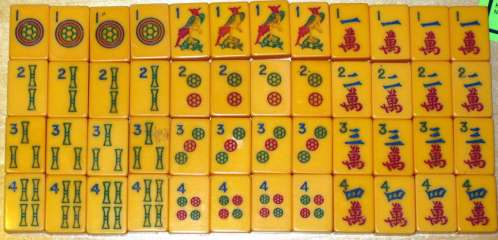


Hello Michael, you wrote:
Subject: 42 pictures for you
Why??
Why did you think I needed so many photographs? Why would I need four different photos of the sides of tiles, and three photos of backs of tiles, and twelve photos of the case...?? Geez! Talk about overkill...
Why did you think "42 pictures for you" was a good subject line? It sounded like spam! The only reason I opened it was that the email was from MGS -- Montreal Game Summit. I figured maybe they'd finally found some photos of me when I was at the Montreal Game Summit and were belatedly sending them to me. Otherwise I would have just deleted the email altogether.
age
You didn't say, but I assume that the four mismatched tiles are all joker-stickered, and the other four joker-stickered tiles are all flower tiles. That means that the set originally had 12 flower tiles. If we assume that the manufacturer was American and knew the NMJL's requirement, that would place the origin date at 1943. Quite possibly, some manufacturers were making sets with 4 extra flowers earlier or later than that date (see Michael Stanwick's Wednesday, May 26, 2010 5:21 AM post below about "hua ma que" or "Flower MJ"), so "1930s or 1940s" is the better thing to say as to the set's time of manufacture.
value
Get rid of those ugly joker stickers, clean up the tiles and put new nice joker stickers on it, and you might get $90 for it, give or take. The main problem is the four mismatched tiles. You didn't say, but I assume those are all joker-stickered tiles, meaning that it's fairly easy to tell when there's a joker in the wall. The coin chips are all mismatched too.
One of the 5 trays
In your photos I see only 2 trays. I see 5 racks, though. See FAQ 7d.
is missing the end piece
That's confusing. I see 5 racks with 5 coin holders. If one of them is broken somehow, your photos don't make that clear, and a broken rack reduces the value. You should either repair it or remove it from the set before putting it on eBay.
There are two green plastic die.
"Dice." The plural of "die" is "dice."
Tom Sloper
Author of "The Red Dragon & The West Wind," the definitive book on Mah-Jongg East & West.
Los Angeles, California, USA
May 28, 2010
Anticipating its history, age and approximate value, parts 6 & 7
>From: Michael Stanwick
>To: Tom Sloper
>Sent: Friday, May 28, 2010 4:14 AM
>Subject: Re:that X character
>Hi Tom. You said;
>"So then in 中X麻雀 as shown in Bill's tiles, the word "China" is covered by 中 alone. And the X character (I'd include it here in text but I haven't been able to find it) is "prosperous" I guess."
>Yes. Oddly enough, I was helping Jim May with translation of some of his more difficult tile characters and this character 'X' caused me no end of difficulty.
>If you go to
>http://www.mandarintools.com/chardict.html
>set the parameters to 'comprehensive' search, 'UTF-8' and 'trad and simple characters' and then type in 'hua' in the pinyin field, you should find it.
>It has wider meanings and nuances than those given at that site of course.
>Cheers
>Michael
>From: Edwin Phua
>Sent: Friday, May 28, 2010 2:08 AM
>Subject: Characters on the flowers
>Dear Tom,
>I refer to the phrase 中华麻雀 zhōnghuá máquè found on the Flower tiles from Bill of South Africa.
>Michael Stanswick had rendered the phrase as "prosperous MJ Company of China" due to the individual readings of the characters 中 zhōng and 华 huá. Actually, 华 usually refers to the Chinese people in general, especially for people of Chinese descent not living in China. 中华 zhōnghuá is a (poetic) reference to China (and/or things Chinese), so the phrase can be parsed simply as "Chinese mahjong".
>Best regards,
>Edwin Phua
>Singapore
[Michael] this character 'X' caused me no end of difficulty.
[Tom] Yes. There's usually one that does. This is why I told Bill earlier, "I don't like" trying to help people translate their flowers.
 [Edwin] 中 zhōng and 华 huá [Edwin] 中 zhōng and 华 huá
[Tom] See, that 华 huá doesn't look like the character on Bill's tile, so I never would have recognized it. Using Michael's advice to look for pinyin "hua" works. I went on Zhongwen (which has been redesigned and is now more a pinyin chat forum or something) and did a pinyin search on zhonghua and found 華 -- it still doesn't look quite like what I was expecting from Bill's photo. Going by stroke count, I found 革 and 草 in my Japanese kanji book, but knew those not to be it. On Zhongwen, I see that 华 is an alternate character for 華. Again: more reasons why I don't like trying to translate flowers for folks. My books are about Japanese. Online resources cover more characters but are hard to find or to use. Zhongwen insists on displaying characters so tiny that it causes wear and tear on the eyes.
[Michael] http://www.mandarintools.com/chardict.html
[Tom] I suppose I need to remember that site. Probably better than Zhongwen (just that I can remember Zhongwen's name, and am familiar with how to use it). I've bookmarked MandarinTools, hopefully next time this comes up I'll remember to look for the bookmark.
May the tiles be with us, everyone.
Tom Sloper
Author of "The Red Dragon & The West Wind," the definitive book on Mah-Jongg East & West.
Los Angeles, California, USA
May 28, 2010
Anticipating its history, age and approximate value, part 5
>From: William
>To: Tom Sloper
>Sent: Thursday, May 27, 2010 2:40 PM
>Subject: Re: Mah jong information request
>Dear Mr.Sloper,
>Very many thanks for your informative response.
>The knowledge both you and your other correspondent have is amazing.
>I will become an avid reader of the BB in future.
>Once again thank you for helping out a beginner.
>Yours sincerely,
>Bill
Cool, Bill! (^_^)
May the tiles be with you.
Tom Sloper
Author of "The Red Dragon & The West Wind," the definitive book on Mah-Jongg East & West.
Los Angeles, California, USA
May 27, 2010
Anticipating its history, age and approximate value, part 4
>From: Michael Stanwick
>To: Tom Sloper
>Sent: Thursday, May 27, 2010 1:55 PM
>Subject: Re: Flowers/Seasons interpretation
>Tom, Bill asked;
>"I wonder if you could also translate the ideograms on the Flowers and one circles."
>Tom, you have done well when you said;
>"I can tell you this much, though -- the red characters (2nd column in your pic) might say something like "China Mahjong," but only if the 1st two characters go together in an archaic way to write "China." 中國麻雀 (showing the present characters for "China" and the old way of writing "mahjong"). 1st character is clearly Chung, and the 3rd and 4th characters are clearly "mah jongg." I don't know what that 2nd character is. Can't find that character in any of the places I usually look."
>Ok. In Pinyin we have "zhong hua ma que" = China Splendid/prosperous/brilliant Sparrows(MJ).
>"The green characters (1st column) are another problem altogether. The first two characters seem to say "company," but I don't have the time to try to look up characters 3 and 4. Maybe, reading red to green, they just say something boring like "China Mahjong Company, Ltd." "
>Yep I agree! "gong si jian zhi" = company (gongsi) supervise manufacture.
>If the red tiles are placed before the green tiles, we can surmise/interpret;
>zhong hua ma que gong si jian zhi = manufactured by the prosperous MJ Company of China.
>That is my rendition.
>Regards
>Michael Stanwick
Cool, Michael!
So then in 中X麻雀 as shown in Bill's tiles, the word "China" is covered by 中 alone. And the X character (I'd include it here in text but I haven't been able to find it) is "prosperous" I guess.
Hopefully William is keeping an eye on the board...
May the tiles be with you.
Tom Sloper
Author of "The Red Dragon & The West Wind," the definitive book on Mah-Jongg East & West.
Los Angeles, California, USA
May 27, 2010
In-depth strategy for Asian mahjong
>From: Benjamin H
>Sent: Thursday, May 27, 2010 2:41 AM
>Subject: Indepth Strategy
>Hi Tom,
>I was wondering if you had any advice on where to go to learn indepth strategy on the Chinese and Japanese styles of the game?
>Thanks for your assistance!
>Ben H
Hi Ben,
I suggest you check the list of books in FAQ 3 and the websites in FAQ 4. The Millington and Whitney books, and the works of Mai Hatsune and Takunori Kajimoto, are highly recommended. See also my writeup on Takunori Kajimoto's strategy guide in column 374. Jenn Barr's book is the only other resource in print on Japanese mahjong strategy (in English). And register on the ReachMahjong and USPML forums, where you'll find ongoing strategy discussions.
http://www.reachmahjong.com/en/forum/ and
http://www.uspml.com/start.htm respectively.
May the tiles be with you.
Tom Sloper
Author of "The Red Dragon & The West Wind," the definitive book on Mah-Jongg East & West.
Los Angeles, California, USA
May 27, 2010
Addressing the value of an old set, parts 9 & 10
>From: Michael Stanwick
>To: Tom Sloper
>Sent: Thursday, May 27, 2010 5:15 AM
>Subject: Re: pics for charles
>Hello Tom.
>Charles asked;
>> I would appreciate seeing any photos Mr. Stanwick has of similar tiles.
>> After looking at many of the photos of sets in the internet I have yet to see ones that have the same shape and graphics as the
>> tiles in my set.
>Sure, ready to oblige.
>Here is a 'casein' set with similar Flowers/Seasons. [1930 9a]
>Here is a similar set in bone and bamboo. [1930 6a]
>Here are 16 Flowers/Seasons that are in a 156 tile set.[1930 29e]
>Cheers
>Michael


>From: Michael Stanwick
>To: Tom Sloper
>Sent: Thursday, May 27, 2010 6:13 AM
>Subject: Re: link to a casein set in an attache case
>Tom. Here is a better link to a 'casein' tile set in the familiar 'attache-style' case.
>http://cgi.ebay.co.uk/mah-jong-set-/220612017739?cmd=ViewItem&pt=UK_Toys_Games_Games&hash=item335d803e4b
>Michael
Awesome, Michael. Cheers!
May the tiles be with you.
Tom Sloper
Author of "The Red Dragon & The West Wind," the definitive book on Mah-Jongg East & West.
Los Angeles, California, USA
May 27, 2010
Anticipating its history, age and approximate value (part 3)
>From: William
>To: Thomas Sloper
>Sent: Thursday, May 27, 2010 4:39 AM
>Subject: Fw: Mah jong information request
>Dear Mr.Sloper,
>Many thanks for your prompt response.
>I wonder if you could also translate the ideograms on the Flowers and one circles.
>Thank you.
>Bill

Hello Bill, you wrote:
I wonder if you could also translate the ideograms on the Flowers
I don't really like doing that. It's a lot of work for very little benefit. If you read FAQ 7e you'll find resources you can use to try to read them for yourself.
I can tell you this much, though -- the red characters (2nd column in your pic) might say something like "China Mahjong," but only if the 1st two characters go together in an archaic way to write "China." 中國麻雀 (showing the present characters for "China" and the old way of writing "mahjong"). 1st character is clearly Chung, and the 3rd and 4th characters are clearly "mah jongg." I don't know what that 2nd character is. Can't find that character in any of the places I usually look.
The green characters (1st column) are another problem altogether. The first two characters seem to say "company," but I don't have the time to try to look up characters 3 and 4. Maybe, reading red to green, they just say something boring like "China Mahjong Company, Ltd." -- 中國麻雀公司XX
When I run that phrase through iGoogle I get: 中國麻將有限公司 (note that "majiang" is written differently today than it was back then).
and one circles.
I already said: (from the 1 Dot tiles)... "Liberty Mah-Jongg." 自由麻雀
May the tiles be with you.
Tom Sloper
Author of "The Red Dragon & The West Wind," the definitive book on Mah-Jongg East & West.
Los Angeles, California, USA
May 27, 2010
Anticipating its history, age and approximate value (part 2)
>From: Michael Stanwick
>To: Tom Sloper
>Sent: Wednesday, May 26, 2010 2:14 PM
>Subject: Re: New query
>Hello Tom.
>Referring to the latest set query [from William], the tile set is a typical Babcock set. The box is also. See Babcock's Red books of Rules for pics of the tiles. I think they are also mentioned in the MJ Sales Company's two MJ brochures (they sold the babcock sets). Yes, i have just chacked and in their 2nd edition catalogue 1923 they show their 'Mah-Jongg' tile set and it is as shown in your poster's pics.
>The sliding front is not original to the box IMO. MJ Sales Co's front sported the Chinese characters for Ma Que as shown on the front of babcocks red books of rules. So the rest of the box is a typical MJ Sales Co., box but it never had the bird and tile motifs on the sliding front as evidenced from their catalogues. Besides, the sliding front wood is of a different grain to the box.
>The trays should be stacked with tiles so that one row consists of tiles on their sides (ie long sides facing left to right) with the next row consisting of tiles in the normal vertical position and then this is repeated. That way the tiles for each suit should fit in one tray each.
>The tiles date from the early 20's and were most probably made in Shanghai since Babcock was based there. I think the saying on the 1D tiles is most likely a call for the game to be seen as culturally acceptable.
>Cheers
>Michael
Hi Michael,
That all makes good sense to me. Thanks bunches!
Cheers,
Tom Sloper
Author of "The Red Dragon & The West Wind," the definitive book on Mah-Jongg East & West.
Los Angeles, CA (USA)
May 26, 2010
Addressing the value of an old set, part 8
>From: Michael Stanwick
>To: Tom Sloper
>Sent: Wednesday, May 26, 2010 1:16 PM
>Subject: Re: 'casein' tile set
>Hello Tom.
>
>[Michael] those tile sets
>[Tom] Not sure which sets we're talking about -- hand-carved sets as opposed to machine-made sets, or sets in briefcase-type cases, or 1930s sets.
>
> Sorry. The attache cased, hand-engraved, casein?, tile sets made in China.
>
>[Michael] usually consist of 148 tiles or, sometimes, 152 or 156 tiles. The additions were in the Flowers/Seasons and I think we have evidence that the extra tiles were used to play a special type of MJ in China called 'Flower MJ'. If you remember we detailed it is an article in the playing card [the Journal of the International Playing-Card Society]. The extra tiles were not intended for American MJ IMO.
>[Tom]I assume you're referring to Volume 37, No. 1 (July-Sep. 2008). I see that in that article, you refer to a 1941 book discovered by Hongbing Xu that describes hua ma que (Flower MJ) -- and I was interested in your breakdown of "inner" flowers vs. "outer" flowers.
>
>Sorry, my answer was misleading/ambiguous. I meant that the extra added Flowers (over and above the eight already present) were added to tile sets that were used to play Hua Ma Que (Flower Sparrows/MJ).
>
> [Michael] I am aware that that scenario is favoured by some American collectors.
>[Tom] What scenario is that? I got lost there. The scenario that the extra flowers were used for hua ma que is favored by some American collectors?
>
>I was referring to my comment "So I suppose it is possible that they imported the tiles into the US and then put them in those cases."
>Cheers
>Michael
Cheers right back at you, Michael.
Tom
Anticipating its history, age and approximate value
>From: William
>Sent: Wednesday, May 26, 2010 8:00 AM
>Subject: Mah jong information request
>Dear Mr.Sloper,
>I attach a letter and some photographs from my set which I trust are self explanatory.
>One point I missed was that the Box seems to have a carved signature in chinese characters on the bottom.
>I am interested in as much as you can tell me about its history,age and approximate value.
>Many thanks in anticiapation of your response.
>Yours sincerely,
>W.G.Price
>Note: These attachments will expire in 30.00 days.
>13.00 file(s) attached (55.28 MB): View All
>mah-jong-set-docx
>0.01 MBViewmah-jong-set-024-jpg
>4.68 MBViewmah-jong-set-002-jpg
>4.06 MBViewmah-jong-set-006-jpg
>4.33 MBViewmah-jong-set-008-jpg
>5.44 MBViewmah-jong-set-010-jpg
>4.59 MBViewmah-jong-set-013-jpg
>5.31 MBViewmah-jong-set-014-jpg
>3.65 MBViewmah-jong-set-015-jpg
>4.47 MBViewmah-jong-set-017-jpg
>4.26 MBViewmah-jong-set-018-jpg
>4.37 MBViewmah-jong-set-020-jpg
>5.08 MBViewmah-jong-set-022-jpg
>5.04 MBView
>powered by-- simple, private, sharing and collaboration Learn more.
>Mah Jong Set
>Request for a free appraisal and valuation. I understand that you have the right to publish any response you may be kind enough to make and to use my pictures in any manner you choose.
>1.The set consists of the complete basic 136 tiles plus 8 “flower” tiles and 8 papered Big Joker tiles. All the Wind indicator tiles come in a Ming together with a number of scoring sticks and a wooden coffin with 4 bone dice.The box is made of wood ,unknown type ,and has 5 drawers.An interesting feature of the box is a release button for the front cover situated on top of the box.
>2.All the items are in very good condition, a small number of tiles have minor chips ,they have no smell.The box is in good condition two of the drawers have cracks on the bottom panel, there is a minor crack on the front cover.
>3.The tiles are made of bone dovetailed into a slightly bevelled bamboo back. They would benefit from cleaning.
>4. I understand that the set was purchased in an auction in the USA and sold to me over the internet.I was led to believe that the set was from the earlier part of the 20th Century.
>5.Dimensions of the tiles are :-
>3cmX2cmX1cm
>6.Complete set of 136 tiles plus 8 flowers,8 Big Jokers, a bone Ming and dice in a wooden coffin, a number of bone scoring sticks.
>7.The set comes in a five drawer wooden box,each drawer has a small bone handle and fits into its own “floored “section.The box has a sliding front cover activated by a button on the top of the box.The box has brass fittings on all corners, two brass handles on the top of the box and has two hand painted tiles on the front cover on either side of a peacock image. All fittings are in good condition.There is a carved signature on the bottom of the box
>8.The Craks are of the older type and a picture is attached.
>9.I am also attaching pictures of the One Bams,The Dragons,The Flowers and the 8 X Big Jokers.I also attach some general pictures of the set and its box.
>10.There are no paper items.
>I trust this is sufficient information for you. I have just started collecting sets and have enjoyed using your web site information to assist me .Many thanks.
>Yours aye
>Bill [LAST NAME DELETED],
>[ADDRESS DELETED] ,South Africa.
>25th May 2010


Hello Bill, you asked about the set's:
History
It was purchased on eBay (according to you). Before that, who knows. The set may have been manufactured in China or Japan, most likely in the early 1920's. From there it might have been shipped to the U.S. or England. Most likely the U.S., since it has clearly been previously owned by an American. The manufacturer name (from the 1D tiles) appears to be "Liberty Mah-Jongg."
Age
I agree with its being from the "early twentieth century." That means it's older than 60 years. My guess is early 1920s -- possibly into the 1930s but probably not (that makes its probable age 85+).
Value
It looks like a nice one. It has been modified to make it suitable for American-style mah-jongg so it would be reasonably valuable for a player of that variant. Since you're in South Africa, the stickered jokers don't so much as add to its value as detract from it. I wonder if there are extra flowers under the stickers, or if the extra tiles were cannibalized from another set. My guess as to the value is anywhere from US$160 to $400.
Tom Sloper
Author of "The Red Dragon & The West Wind," the definitive book on Mah-Jongg East & West.
Los Angeles, CA (USA)
May 26, 2010
Addressing the value of an old set, parts 6 & 7
From: "Charles
Sent: Tuesday, May 25, 2010 10:28 PM
Subject: Re: value of an old set
> The opinions that Michael Stanwick have offered are most interesting. It is possible that my grandfather may have acquired the case
> and instruction book in 1950's but to my certain knowledge this set has been unchanged and in my possession for the past 40 years.
> My grandfather may have received this set as a parting gift from one of business associates in Shanghai. After living Shanghai in
> the 1930's he returned to Hawaii until the end of WWII. When Mah Jong started to gain in popularity again having more tiles to use
> as jokers was essential. We had never been able to locate tiles that are of identical shape and color to use as additional jokers
> for this set so we never played with it.
> From a post by Michael Stanwick:
>> Also, it seems to me, from the photos, that the tile motifs are hand engraved - apart from those so-called
>> 4 'jokers/monks'. IMO, I think they are additions to the set and hence not original.
> The tiles do seem to be engraved rather than molded, stamped or embossed. As for the 4 'jokers/monks' all I can offer is that they
> appear to be identical to all of the other tiles in the set as far as the graphics, shape and color. If they were added it must have
> been very soon after my grandfather acquired the set.
> I would appreciate seeing any photos Mr. Stanwick has of similar tiles.
> After looking at many of the photos of sets in the internet I have yet to see ones that have the same shape and graphics as the
> tiles in my set.
> Anything the readers on this bulletin board could do to identify a maker of tiles in my set would be most helpful.
>From: Michael Stanwick
>Sent: Wednesday, May 26, 2010 5:21 AM
>Subject: Re: 'casein' tile set
>Hi Tom. You asked some important questions.
>
> [Me] IMO, I think they are additions to the set and hence not original.
>[You] What are "they" exactly? The 4 callings? The monk jokers?
>
>The Monk Jokers.
>
>[Me] I have never found, here in the UK, a hand engraved synthetic tile set in one of those 'American' cases.
>[You] Do you think it's feasible that manufacturers put sets in different cases depending on the market? It's long been known that American players want racks, and racks necessitate the "trumpet" style case.
>
>It is feasible. However, IMO the cases were made by American manufacturers. So I suppose it is possble that they imported the tiles into the US and then put them in those cases. But those tile sets usually consist of 148 tiles or, sometimes, 152 or 156 tiles. The additions were in the Flowers/Seasons and I think we have evidence that the extra tiles were used to play a special type of MJ in China called 'Flower MJ'. If you remember we detailed it is an article in the playing card. The extra tiles were not intended for American MJ IMO.
>
>I am aware that that scenario is favoured by some American collectors. However, I have not seen any evidence that that case and tile set matching was done. Of the collectors I have read or spoken to who mention that explanation, none have put forward any evidence to support that contention. If anyone knows of any evidence I would be interested.
>
>[Me] ... attache style case sets
>[You] Like the zippered leather type, I presume, and like the flimsy vinyl cases the Hong Kong manufacturers use, and the cloth-covered ones the fishbone sets came in, and the newer aluminum type that the Ace of Heartz "Washizu" set comes in (http://www.sloperama.com/mahjongg/column438j.htm)?
>
>'Like' - in shape only. The attache style cases were made of thick cardboard over which was hand stitched leather on the outside. The interior was lined in felt and sported 5 trays - 4 four the tiles and a thin tray for the bone scoring sticks, position indicator and dice (plus extra tiles if necessary).
>
>[Me] ... have stamps or provenances that squarely show their origin as straight from China
>[You] I haven't run into any of those myself.
>
>Not all have them. The stamps were customs stamps, usually, or the names of the ships and ports through which the case passed.
>
> [Me] It is my contention that it was these cases that the **hand engraved** bakelite/casein tile sets came in. I have also seen these attache style case sets on ebay US as well.
>[You] I'm due a return visit to eBay myself, so I'll take that as further weight for the need to go.
>
>Here is an example on ebay US at the moment.
>http://cgi.ebay.com/ANTIQUE-MAH-JONG-SET-156-BONE-BAMBOO-TILES-COUNTER-CASE-/380237026868?cmd=ViewItem&pt=LH_DefaultDomain_0&hash=item5887e49634
>The tiles are bone. Sometimes these cases did house bone tiles. I am not sure if these bone tiles came with this case but the presence of extra Flowers/Seasons tiles again suggests a period of around the late 20's and the 1930's. It is difficult to tell if the extra tiles are original to the set. On the face of it they do look similar.
>Cheers
>Michael
Good morning, Charles and Michael.
 [Charles] Anything the readers on this bulletin board could do to identify a maker of tiles in my set would be most helpful. [Charles] Anything the readers on this bulletin board could do to identify a maker of tiles in my set would be most helpful.
If you haven't looked at Jim May's website or CHarli's site, you can find links to them in FAQ 4a above left.
[Michael] those tile sets
Not sure which sets we're talking about -- hand-carved sets as opposed to machine-made sets, or sets in briefcase-type cases, or 1930s sets.
[Michael] usually consist of 148 tiles or, sometimes, 152 or 156 tiles. The additions were in the Flowers/Seasons and I think we have evidence that the extra tiles were used to play a special type of MJ in China called 'Flower MJ'. If you remember we detailed it is an article in the playing card [the Journal of the International Playing-Card Society]. The extra tiles were not intended for American MJ IMO.
I assume you're referring to Volume 37, No. 1 (July-Sep. 2008). I see that in that article, you refer to a 1941 book discovered by Hongbing Xu that describes hua ma que (Flower MJ) -- and I was interested in your breakdown of "inner" flowers vs. "outer" flowers.
I wonder if sets made to play hua ma que would need to be "localized" for markets outside China -- that is, incorporating Western indices (Arabic numerals and Roman letters).
Sets made for use in America after 1943 often came with extra flowers because in 1943 the National Mah Jongg League required extra flowers. Also, I presume that most American sets after 1943 (up to the mid-sixties or so) were made in the U.S. One of these days I ought to study up on manufacturers...
[Michael] I am aware that that scenario is favoured by some American collectors.
What scenario is that? I got lost there. The scenario that the extra flowers were used for hua ma que is favored by some American collectors?
[Michael] 'Like' - in shape only.
Yes, that's what I was trying to discern. Cheers!
Tom Sloper
Author of "The Red Dragon & The West Wind," the definitive book on mah-jongg East & West.
Los Angeles, California
May 26, 2010
Japanese mahjong Q's
>From: Laethiel
>Sent: Tuesday, May 25, 2010 7:13 PM
>Subject: Mah-Jongg Q+A
>My mah-jongg question or comment is: I was recently directed to your site by an online acquaintance, so I wanted to thank you for all the great info and ask a few questions regarding riichi/dora mahjong.
>
>I know that if one player remains dealer long enough to have 5 markers on the table, ryanhan shibari is applied to all players. What I'm unsure of this: if a hand ends in a draw with the dealer being no-ten, and dealership is passed with at least 5 markers down, is ryanhan shibari still applied? Or if, say, 3 markers were passed on to the new dealer, who was then dealer long enough to bring the total number of markers up to 5, would ryanhan shibari be applied then? Or would it not go into effect until the current dealer has been dealer long enough to add 5 markers? (I assume that if there are 5 markers on the table, regardless of which dealer they were added under, ryanhan shibari is in effect, but I'm not sure).
>
>I recently had the concept of an open hand versus an open mentsu (meld) explained to me, and I wanted to make sure I had one particular point right. Are san-an-kou (three concealed triplets) and suu-an-kou (four concealed triplets) the only yaku in which the concealed/open state of the mentsu matters? That is, all other yaku that are closed only or subject to kuisagari are valid/have their full, non-kuisagari values via tsumo or ron as long as your hand was concealed, right?
>
>If you are in tenpai but have not declared riichi and someone discards a tile that would complete your hand (4 mentsu + jantou (pair)), but you cannot ron it because you would have no yaku, are you in temporary furiten? (I think so, but I'm not positive.) E.g., you have a koutsu of 7 pin, jantou of 5 pin, 1-2-3 pin, 1-2-3 man, 2-3 sou, waiting on 1 sou for san shoku doujun, which would be your only yaku, and someone discards 4 sou. (At least, I think san shoku doujun would be the only yaku in the example I made up.) You would then be temporary furiten until you next draw or call a chi/pon/kan, correct?
>Thanks,
>Laethiel
Konnichiwa Laethiel, you wrote:
if a hand ends in a draw with the dealer being no-ten, and dealership is passed with at least 5 markers down, is ryanhan shibari still applied? (I assume that if there are 5 markers on the table, regardless of which dealer they were added under, ryanhan shibari is in effect, but I'm not sure).
Yes. The minimum score requirement stays at 2 fan until the huge amassment of dealer win markers is wiped out.
all other yaku that are closed only or subject to kuisagari are valid/have their full, non-kuisagari values via tsumo or ron as long as your hand was concealed, right?
To rephrase the question: when making a concealed hand, under what circumstances am I screwing up the "concealedness" of the hand by winning on a discard?
Consider the chow hands (iipeikou, ryanpeikou, sanshoku, itsu). If the hand is concealed up to the point of obtaining the final tile, it doesn't matter where in the hand that tile fits. So yes, it's only San ankou and Suu renkou where the distinction is important.
If you are in tenpai but have not declared riichi and someone discards a tile that would complete your hand (4 mentsu + jantou (pair)), but you cannot ron it because you would have no yaku, are you in temporary furiten? (I think so, but I'm not positive.)
I think so, too.
you have a koutsu of 7 pin, jantou of 5 pin, 1-2-3 pin, 1-2-3 man, 2-3 sou, waiting on 1 sou for san shoku doujun, which would be your only yaku, and someone discards 4 sou. (At least, I think san shoku doujun would be the only yaku in the example I made up.) You would then be temporary furiten until you next draw or call a chi/pon/kan, correct?
Yes.
By the way, there's a forum dedicated to Japanese majan -- it's at http://www.reachmahjong.com/en/forum/
May the pai be with you.
Tom Sloper
Author of "The Red Dragon & The West Wind," the definitive book on Mah-Jongg East & West.
Los Angeles, California
May 25, 2010
Wrong tile count (times two)
>From: Sharon
>Sent: Tuesday, May 25, 2010 3:40 PM
>Subject: Mah-Jongg Q+A
>My mah-jongg question or comment is: The Charleston is over but east has not discarded yet. A player discovers they don’t have enough tiles and another player has to many. How do you decide what tile is to be given to the player who does not have enough tiles?--------------
Hello Sharon, your question is:
A player discovers they [sic] don’t have enough tiles and another player has to [sic] many. How do you decide what tile is to be given to the player who does not have enough tiles?
That's the wrong question. The correct question should be, "what is supposed to be done in this instance?" In the 12 years I've been carefully documenting the NMJL's official rules and updates, I have not seen anything about a player who has too MANY tiles at the conclusion of the Charleston, before the dealer discards.
According to the official rules, if a player has one too few tiles (at that exact moment in the game), she takes the tile from the end of the wall (as you would expect).
Also according to the rules, if a player has "wrong tile count" before the Charleston, all tiles are thrown in.
Also according to the rules, if a player has "wrong tile count" after the dealer discards, that player is dead.
None of those rules applies to your question. So we have to go with what is reasonable. Which of these is most reasonable?
Throw the hand in and redeal;
Player with too many tiles put her tiles face-down on the table and mush them up -- player with too few tiles take one at random;
Call player with too many tiles dead.
I assume most people won't want to do #1. #3 seems a bit harsh. So I'd go with #2, as a reasonable middle ground.
May the tiles be with you.
Tom Sloper
Author of "The Red Dragon & The West Wind," the definitive book on Mah-Jongg East & West.
Los Angeles, CA (USA)
May 25, 2010
Addressing the value of an old set, part 5
>From: Michael Stanwick
>Sent: Tuesday, May 25, 2010 2:24 PM
>Subject: Re: 'casein' tile set
>Hi Tom. Just saw your reply about the 'bakelite/casein' tile set on your Q & A bulletin board.
>I have quite a few of these sets (and seen more on ebay) with the 4 callings on the tiles - Fisherman, Woodcutter, Farmer, Scholar - so I wouldn't characterise them as unique.
>Also, it seems to me, from the photos, that the tile motifs are hand engraved - apart from those so-called 4 'jokers/monks'.
>IMO, I think they are additions to the set and hence not original.
>I am also suspicious about the case. I have never found, herer in the UK, a hand engraved synthetic tile set in one of those 'American' cases. All the sets I have come across outside of ebay are in attache-style cases made from a thick cardboard frame with leather stitched over it and the inside lined in either red, green or blue felt. Of course I am in the UK, where those trumpet style long cases with the racks and coin holders were rarely found - if ever. A lot of the attache style case sets I have examined and also in my collection, have stamps or provenances that squarely show their origin as straight from China - usually by way of expats or officials returning from there.
>It is my contention that it was these cases that the **hand engraved** bakelite/casein tile sets came in. Some of those that found their way to the US - either in the 30's and 40's or recently via purchases from ebay UK (or ebay US), were then placed in the more quality American cases. I have also seen these attache style case sets on ebay US as well.
>Regards Michael
Hi Michael,
It's great to hear from you. I thought of you when I was at the Mahjong Museum in Ningbo the other day.
You wrote:
IMO, I think they are additions to the set and hence not original.
What are "they" exactly? The 4 callings? The monk jokers?
I have never found, here in the UK, a hand engraved synthetic tile set in one of those 'American' cases.
Do you think it's feasible that manufacturers put sets in different cases depending on the market? It's long been known that American players want racks, and racks necessitate the "trumpet" style case.
attache style case sets
Like the zippered leather type, I presume, and like the flimsy vinyl cases the Hong Kong manufacturers use, and the cloth-covered ones the fishbone sets came in, and the newer aluminum type that the Ace of Heartz "Washizu" set comes in (http://www.sloperama.com/mahjongg/column438j.htm)?
have stamps or provenances that squarely show their origin as straight from China
I haven't run into any of those myself.
It is my contention that it was these cases that the **hand engraved** bakelite/casein tile sets came in. I have also seen these attache style case sets on ebay US as well.
I'm due a return visit to eBay myself, so I'll take that as further weight for the need to go.
Tom Sloper
Author of "The Red Dragon & The West Wind," the definitive book on mah-jongg East & West.
Los Angeles, California
May 25, 2010
Column #450
>From: Wendy French
>Sent: Tue, May 25, 2010 10:51:37 AM
>Subject: Weekly Mah-Jongg Column - May 9 #450
>Mr. Sloper....
>Thanks for the GREAT column (and book). I was just catching up on your columns from the past couple of weeks when I noticed what I think is an omission in your May 9th, #450 column. I think the answer to #1 should also include Consecutive Run #6 as well....of course, it is also a concealed hand so she would still be dead.
>Hopefully, I am right and haven't bothered you for nothing. Your columns really helped me master American Mah Jongg a couple of years ago when I was first learning to play. I thought I should maybe point out any omissions I see in the hopes of helping other new players just like I was a couple of years ago.
>Thanks....Wendy French
>Glendale, AZ
>--
Right you are, Wendy. I've made that notation to the column, thanx 2 U! (^_^)
May the tiles be with you.
Tom Sloper
Author of "The Red Dragon & The West Wind," the definitive book on Mah-Jongg East & West.
Los Angeles, California (in the good ol' U.S. of A.)
May 25, 2010
Where to buy a Chinese set?
>From: Susan
>Sent: Tue, May 25, 2010 12:33:04 AM
>Subject: I'd like to purchase a Chinese mah jongg set
>Hi Tom,
>Have one of your books: it's my bible. I am in Japan right now and played Japanese style mah jongg with some friends yesterday. I will be returning home to New York tomorrow, however, and would like to purchase a decent Chinese set with instructions. Actually, I think you have instructions in your book, don't you?
>Anyway, I'd appreciate some advice as to where to buy such a set. I don't mind if it's new, as long as it's well made. Many thanks for your time.
>Sincerely, Sue
Hi Sue,
I'm delighted that you have my book! You wrote:
I am in Japan right now and played Japanese style mah jongg with some friends yesterday. I will be returning home to New York tomorrow, however, and would like to purchase a decent Chinese set
While you're in Japan, you can buy a Japanese set. They don't sell Chinese sets there. But of course, you and all your players have to be able to read the Chinese numbers (on the suit of Craks) and the names of the winds in Chinese. (In other words, "are you sure you really want to do that?") -- See FAQs 7a, 7b, 7d. The FAQs are above left.
with instructions.
No Chinese set comes with comprehensible instructions (except those sets with Dragon Chang's "Wonderful Taiwan Mahjong"). My book (which you already have) describes the Chinese Mahjong Competition Rules. If you want simpler rules, read FAQs 10 & 17 and get Amy Lo's book (see FAQ 3).
I'd appreciate some advice as to where to buy such a set.
See FAQs 7m and 7k. And see Appendix 1 in my book.
May the tiles be with you. Literally!
Tom Sloper
Author of "The Red Dragon & The West Wind," the definitive book on Mah-Jongg East & West.
Los Angeles, California (USA)
May 25, 2010
FAQ 19N
>From: Jamie
>Sent: Mon, May 24, 2010 7:36:13 PM
>Subject: Retreiving Jokers
>When two jokers are in an exposure can you retrieve both at one time if you have the replacement tiles?
Thank you for your mah-jongg question or comment! (^_^)
You have asked Frequently-Asked Question #19N. Please go to http://www.sloperama.com/mjfaq/mjfaq19.htm and find your answer. Please always check the FAQs before asking a question.
This response will be posted on the Maj Exchange's Q&A bulletin board (http://www.sloperama.com/majexchange/bulletinbd.htm).
May the tiles be with you!
Tom Sloper - Game Development Consultant
- Sloperama Productions. Services for game developers and publishers; "Making Games Fun, And Getting Them Done." http://www.sloperama.com/business.html.
- Helpful information and answers for game industry hopefuls. http://www.sloperama.com/advice.html.
- Information and bulletin boards about the game of mah-jongg. http://www.sloperama.com/mjfaq.html
Author of "The Red Dragon & The West Wind," the definitive book on mah-jongg East & West.
Shanghai Pudong International Airport
May 25, 2010
Those prongy things are supposed to hold COINS??? -- part 2
>From: Lynn
>Sent: Mon, May 24, 2010 6:03:05 PM
>Subject: Mah-Jongg Q+A
>My mah-jongg question or comment is: American mah jongg re: "perfect sisters" I have been reading your questions and answers tonight and it sounds like the "perfect sisters" should invest in a copy of your book, "The Red Dragon & The West Wind" since they will find the answers to their questions and more. It is a great investment especially for high school dropouts and everyone who plays mah jongg even if they have Masters degrees!!
>Somewhere I read that the player who is East shakes the dice and then places them in the "coin holder" of the rack belonging to the player on her right (if players are using a purse). Isn't that a better place for the dice than just on the corner of the table?
>Enjoy your trip. My "RD&WW" comes to all my mah jongg games now. Lynn P
Hi Lynn, you wrote:
Somewhere I read that the player who is East shakes the dice and then places them in the "coin holder" of the rack belonging to the player on her right... Isn't that a better place for the dice than just on the corner of the table?
If you think so, then put them there. Most people I play with have the coin chips on the prongs, and still put the dice there too. There's no "rule" that that's what you're supposed to do.
May the tiles be with you.
Tom Sloper
Author of "The Red Dragon & The West Wind," the definitive book on mah-jongg East & West.
Shanghai, China
May 25, 2010
Addressing the value of an old set, part 4
>From: Charles
>Sent: Sun, May 23, 2010 2:42:25 PM
>Subject: Re: value of an old set
>Hi Tom,
>I apologize for not making the complete check list you need.
>Hopefully this is what you need.
>Regards,
>Charles
>---------Start of check list------------------
>SET VALUATION CHECKLIST:
>1. Write a factual detailed list of all the contents of your set.
>136 Bamboo, Circles, Characters, Winds and Dragon tiles.
>4 Flower tiles
>4 Season tiles
>4 Monk tiles
>4 Racks
>2 Die
>4 Four wind discs
>1 Disc holder
>35 Green coins
>25 Blue coins
>25 White coins
>20 Red coins
>1 Case, alligator pattern, brown velvet lining
>2 Trays, brown velvet lining
>2 Keys
>1 Instruction book, MAH JONG FOR BEGINNERS
>2. IMPORTANT: Describe the condition of all the components of the set.
>The condition of:
>tiles - EXCELLENT
>dice - EXCELLENT
>wind discs - EXCELLENT
>holder - EXCELLENT
>coins - EXCELLENT
>racks - GOOD
>Case - FAIR
>Trays - GOOD
>Keys - GOOD
>3. What are the tiles made of ?
>tiles - Bakelite
>dice - Bakelite
>wind discs - Bakelite
>holder - Bakelite
>coins - Unknown, may be Bakelite
>racks - Wood, with stain finish and metal coin holders attached
>4. Describe what you know about when the set was made or purchased, if you know.
>Our family history tells that this set was purchased in Shanghai in the 1930's by my Grandfather.
>5. What are the dimensions of the tiles?
>Dimensions are in inches:
> tile: (L)1.88x(W)0.882x(H)0.525
>wind disc: (D)0.653x(H)0.980
>disc holder: (D1)1.112x(D2)0.659x(D3)0.557x(H1)0.500x(H2)0.378
> die #1: (L1-6)0.448x(L2-5)0.450x(L3-4)0.449
> die #2: (L1-6)0.453x(L2-5)0.454x(L3-4)0.457
> coin: (D1)0.855x(D2)0.247x(H)0.083
> (coins size varies, this is typical)
>6. How many tiles are there in the set?
>148 tiles
>7. What other pieces (besides tiles) are included with the set?
>4 Racks
>2 Dice
>4 Four wind discs
>1 Disc holder
>35 Green coins
>25 Blue coins
>25 White coins
>20 Red coins
>1 Case
>2 Trays
>2 Keys
>1 Instruction book, MAH JONG FOR BEGINNERS
>8. What kind of container does the set come in?
>Hinged case with two trays. The case and tray have an alligator pattern covering with brown felt lining.
>9. What condition is the container in?
>FAIR condition. The case shows wear at the handle. The metal fittings are dull and tarnished. The latches work but seem to need lubrication.
>10. Does the set have any paper materials -- a manual, a label, anything at all? What's the condition?
>GOOD condition. Instruction book with dust jacket, "MAH JONG FOR BEGINNERS" by SHOZO KANAI and MARGRET FARELL, Revised Edition, January 1955, Printed in Japan by Obun Printing Co., Ltd., Tokyo.
>Writing on inside of front cover "Property of Charles C Thode".
>The instruction book appears have been added to this set about 1955.
>11. Which kind of craks are in this set -- the older kind or the later kind?
>The craks are the elaborate-style character.
>12. Provide a picture of the One Bams.
>See attached picture (22_detail)
>13. Provide a picture of the dragons.
>See attached picture (22_detail)
>14. And provide a picture of the flowers/seasons.
>See attached picture (22_detail)
>15. How many jokers (if any) does the set have?
>There are no joker tiles.
>-----------end of check list------------------

Hi Charles,
OK, now I have what I need.
I agree that the 1930's sounds about right.
The material is not Bakelite. Note the sharp corners. It's more likely Casein.
Actually, you do have jokers - 4 of them. Your "monk" tiles function as jokers.
The number of chips seems to be divisible by 5 rather than 4, perhaps so that a fifth player can participate (although then the chips couldn't fit onto the rack prongs, since there are only 4 racks).
Don't know why someone would have added in the Kanai and Farell book, unless they were playing the classic Japanese rules later (not that anybody would have necessarily known that there were multiple rule sets at the time). Quite possibly, the set was made in Japan, in the 1950's, and the book packed in at the time of manufacture.
Your set is particularly nice, because the tiles are in such good condition and the set has the fairly rare "bamboo shoot" 1 Bam tiles. Your season tiles are reasonably attractive, but the other four flower tiles (not depicting flowers -- shown with red Arabic numerals and blue Chinese characters) are unique. Four occupations. Just guessing: fisherman, woodcutter, farmer, merchant.
It's not unusual for a set that comes in that type of case to have the case show the terrible wear and tear that it does. It's being in its present condition isn't all that bad a thing. I wouldn't try repairing it myself unless I was a professional restorer.
I hear that sets' prices on eBay have gone up recently. In case that's so, I'm evaluating on the high side a bit. I'd say this set might go for anywhere from $200 to $500 complete (meaning: don't take anything out and don't do anything to it). Your experience could vary. Especially if you tried selling it on eBay during Memorial Day week or Fourth of July week, when people are on vacation rather than buying stuff, or if you write a poor pitch, or something weird happens in the world just as you're trying to sell it. I wouldn't sell it for less than $200, anyway, because of the features I mentioned above.
Tom Sloper
Author of "The Red Dragon & The West Wind," the definitive book on mah-jongg East & West.
Shanghai, China
May 24, 2010
Addressing the value of an old set, part 3
>Dear Mr. Sloper,
>Thank you for taking the time to look at my set.
>Attached are 21 pictures that I hope will help you.
>Please post any of this information you like to your web site.
>The resolution of these photos is 640x480 to keep the attachments small(ish).
>If you would like higher resolution photos please let me know.
>Regards,
>Charles Ader.


Hi Charles,
Nice pictures. You didn't give me the information I asked you to provide. See FAQ 7H.
Tom Sloper
Author of "The Red Dragon & The West Wind," the definitive book on mah-jongg East & West.
Shanghai, China
May 23, 2010
Addressing the value of an old set, parts 1 & 2
>From: Charles
>To: webmaster
>Sent: Sat, May 22, 2010 6:52:04 PM
>Subject: Mah-Jongg Q+A, value of an old set
>My mah-jongg question or comment is:
>Is this the correct email address to ask about the value of my old Mah Jong set?
>Thank you,
>Charles
>From: Charles
>To: tomster
>Sent: Sat, May 22, 2010 6:53:36 PM
>Subject: value of an old set
>Is this the correct email address to ask about the value of my old Mah Jong set?
>Thank you,
>Charles
It's one of several correct addresses, Charles. Please make sure to provide the information I need (as outlined in FAQ 7H, above left).
May the answer be with you.
Tom Sloper
Author of "The Red Dragon & The West Wind," the definitive book on mah-jongg East & West.
Shanghai, China
May 23, 2010
Is the 1st Charleston dance really "mandatory"? (part 2)
>From: ellen
>Sent: Sat, May 22, 2010 3:27:13 AM
>Subject: Re: Question concerning Mah Jongg
>Thank you, Tom!
You're welcome.
May the tiles be with you.
Tom Sloper
Author of "The Red Dragon & The West Wind," the definitive book on mah-jongg East & West.
Ningbo, China
May 22, 2010
My sister and I, part 2
>From: Janice
>Sent: Fri, May 21, 2010 12:41:54 PM
>Subject: Mah-Jongg Q+A
>My mah-jongg question or comment is:
>Thank you Mr. Expert, Smart Person. Truly, I spent at least five hours reading and researching your site and have read my NMJL rulebook and could not find or was not clear on these issues. And I have a master's degree. (So does my perfect sister.) I wonder what high school drop outs ask. Maybe they don't think things to distraction like we do. Thanks, again, and I may be back in touch if my ego can handle being put in its place so soundly again. :-)
>Janice
Heh. Niihau from Ningbo, Janice. We're off to see mahjong landmarks today. In the rain.
May the tiles be with you.
Tom Sloper
Author of "The Red Dragon & The West Wind," the definitive book on mah-jongg East & West.
Ningbo, China
May 22, 2010
My sister and I are both always right.
>From: Janice
>Sent: Fri, May 21, 2010 1:35:45 AM
>Subject: Questions.
>I have spent all night reading your Q&A site. Very informative and most of my questions were answered there. However, I still have the following questions and we play NMJL rules:
>1) Can a discarded joker be retrieved for Mah Jongg and, if so, can it be used in a pair or as a single?
>2) When a wall game is played, I understand that we are to start over, build new walls and deal and do Charleston(s), etc. The question is: Is the second game a continuation of the first making it a very long single game, or is the first wall game considered a game in itself and is finished with no winner, making the continuation portion a second game in its own right?
>3) If Mah Jongg is made in error, do they discard before returning their tiles to their rack?
>4) To determine the break in the first wall, is one die used or two?
>5) Can an exposed joker be replaced with an appropriate dragon at the player's turn?
>Please advise. I am tried of quibbling with my sister. We are both always right. :-) Thank you.
Hello Janice, you wrote (right as always):
I have spent all night reading your Q&A site... Can a discarded joker be retrieved for Mah Jongg
I guess you missed FAQ 19G. In there it plainly says:
Once a joker is discarded, it is DEAD. "Down is dead." Nobody can claim it and use it. Period. End of story.
can it [a joker] be used in a pair or as a single?
The answer to that is on the back of your NMJL card. I believe the word "NEVER" is in there somewhere. In bold, all caps, and underlined.
Is the second game a continuation of the first
No. You get a new dealer and everything.
If Mah Jongg is made in error, do they discard before returning their tiles to their rack?
No. She is "dead." Discarding would be considered "playing." Someone who is "dead" is not able to play. Look on the back of your card. It talks there about what a dead player stops doing.
 is one die used or two? is one die used or two?
Two. Sounds like somebody needs to buy a rulebook or at least read the rules somewhere. You can visit Linda Fisher's website (see FAQ 4a).
 Can an exposed joker be replaced with an appropriate dragon at the player's turn? Can an exposed joker be replaced with an appropriate dragon at the player's turn?
Only if the joker-containing exposure is of dragons, and only if your dragon matches the exposed dragons. Read the back of the card. Read FAQs 19M, N, O, P. Read Linda Fisher's website.
I am tried of quibbling with my sister. We are both always right. :-)
Well, so am I, but that doesn't mean she's going to believe me!
May the tiles be with you.
Tom Sloper
Author of "The Red Dragon & The West Wind," the definitive book on mah-jongg East & West.
Ningbo, China
May 21, 2010
Is the 1st Charleston dance really "mandatory"?
>From: ellen
>Sent: Thu, May 20, 2010 5:27:35 PM
>Subject: Question concerning Mah Jongg
>Hello Tom Sloper:
>I looked in your book, but could not find an answer to this specific situation. And since I have been playing for just the past few months (since January), I felt the need to ask someone who could give a correct answer.
>By some miracle, I received the following tiles with the deal:
>F, 2bam, soap, 1bam, soap, North, East, 2dot, soap, joker, joker, 7bam, 8bam.
>I was playing with a friend's black tiles, and those three soaps mesmerized me! But as I recognized the possible hand to play was the bottom line of Singles and Pairs, I knew that the jokers were useless. However, jokers cannot be passed in the Charleston!
>Therefore, I am guessing that I will have to break up the hand with the first passing in the Charleston. What would you suggest?
>Thank you for your help. But especially thank you for all your work in your website. I felt the need to get your book, so that I could study it while enroute doing errands and waiting for others.
>Sincerely,
>Ellen
>Greensboro, NC
Hi Ellen,
Yes. If you have nothing you can pass except jokers, because the first Charleston dance (with RALph) is mandatory, you are required to pass three tiles in the first right and the first across, regardless of what damage that does to your hand. You can blind pass up to three tiles in the first left and you can stop the Charleston before the dance with LARry.
I don't have easy access to my book as I write this, since I am traveling (I'm in Shanghai). But I think the word "mandatory" (in FAQ 19AG, above left) is self-explanatory.
I've had people ask me "but my hand was so wonderful at the first deal, do I really have to pass three tiles out of it?"
I think it's unfortunate that the rules require this. But the rules are explicit. "Mandatory" means "mandatory."
This reply will go up on the bulletin board when I am able. Will try now but might not be able to do it from here.
May the tiles be with you!
Tom Sloper
Shanghai, China
Author of "The Red Dragon & The West Wind," the definitive book on mah-jongg East & West.
May 21, 2010
>From: "thesandiagroup@att.net"
>To: thesandiagroup@att.net
>Sent: Wed, May 19, 2010 9:58:06 AM
>Subject: "The Men of Mah Jongg" Play coming to LA!!
>Hello Mah Jongg teachers, lovers, aficionados!
>Please put this out to everyone on your Mah Jongg e-mail list. The play opens on September 1st, 2010 in Beverly Hills at Theatre 40, so make your reservations now!
>Questions call: 505.286.1683
>Cell: 505.681.8376
>For ticket reservations call the theatre at:
>Reservation Line: (310) 364-0535
>Or log onto: www.theatre40.org
>FOURTH MAJOR PRODUCTION IN TWO YEARS
>PRESENTS
>"The Men of Mah Jongg"
>opening in Los Angeles at Theatre 40
>September 1, 2010
Those prongy things are supposed to hold COINS??? Not dice?
>From: Lynn
>Sent: Tuesday, May 18, 2010 4:17 PM
>Subject: Mah-Jongg Q+A
>My mah-jongg question or comment is: RE: Email on 4/26 from Lisa A Kannof and the coin holders. I thought that section of the rack was there to hold the dice before it was your turn to throw them for the next game. So my $3.00 in coins is supposed to be put there? Where do you put the dice then? Thanks you for enlightening me. Lynn P.
Hi Lynn,
If your group uses the plastic "coin" chips, then yes, that's what the prongs are for. The prongs go through the holes in the middle of the chips. See these photos from FAQ 7D:


But if you use money coins, (actual U.S. quarters and dimes and nickels), then you can put those on the end table where you put your munchies while playing. You can put the dice at the corner of the table (between the current dealer and the next dealer). Look at the photos on page 106 of RDWW.
May the tiles be with you.
Tom Sloper
Author of "The Red Dragon & The West Wind," the definitive book on Mah-Jongg East & West.
Los Angeles, CA (USA)
May 18, 2010
Conflicting calls, part 2
>From: Lynn
>Sent: Tuesday, May 18, 2010 3:53 PM
>Subject: Mah-Jongg Q+A
>My mah-jongg question or comment is: Previous American mah jongg question re:conflicting calls. One of the other players was a substitute player and the other player didn't know what was the correct thing to do. Since player to right of dealer didn't say, Wait, hold it, etc.", (shouldn't she have said something?) I (player to the dealer's left) called the tile and felt I should have claimed it since she was silent until after I had exposed my tiles. I had no idea she even wanted it as past practice has been to say, "Wait," while the player decides if she can use tile. How long should the other players "wait" and aren't you supposed to indicate you may be able to use the tile? I didn't have my trusty " RDWW" book with me but if I had had it, I would have looked it up and read it to the players. RDWW - p. 53 (rules 63(i) and (ii)), p. 96. Since I had already exposed my tiles, then I should have kept the tile but as you said for harmony sake (and it was the last game of the day) it was better to give up the tile! The sub won the game by picking the last tile which was a joker!! Oh well, there's always next time and I will carry RDWW with me from now on. Thanks for your help. Lynn P
Hi Lynn, you wrote:
player to right of dealer didn't say, Wait, hold it, etc.", (shouldn't she have said something?)
She did. She just waited until you'd already taken the discard and made your exposure. She waited too long to say it, as you rightly surmised.
I had no idea she even wanted it as past practice has been to say, "Wait,"
Saying "wait" is an indecisive player's way of saying "I want that." There is no rule that says a player is supposed to say "wait." The official rule only says that the player should voice her desire for the discard.
How long should the other players "wait"
If nobody says anything, while you pause a beat and then reach for the discard and then make your exposure, then you waited long enough.
But maybe you're asking how long other players should wait once somebody has said "wait." If that's the question, then the answer is "until she says 'never mind' or takes the tile."
aren't you supposed to indicate you may be able to use the tile?
She did. She just didn't say it until after you'd made your exposure.
Since I had already exposed my tiles, then I should have kept the tile
Yes.
but as you said for harmony sake (and it was the last game of the day) it was better to give up the tile!
You'd know better than I, since you were there and had a feel for the "harmony" and I don't.
I will carry RDWW with me from now on.
I think that's a good idea.
May the tiles be with you.
Tom Sloper
Author of "The Red Dragon & The West Wind," the definitive book on Mah-Jongg East & West.
Los Angeles, CA (USA)
May 18, 2010
Conflicting calls
>From: Lynn
>Sent: Monday, May 17, 2010 2:39 PM
>Subject: Mah-Jongg Q+A
>My mah-jongg question or comment is: When playing American mah jongg Player A threw a 3 dot, I was sitting to her left, called it and displayed it with another 3 dot and a joker on the top of the rack but I hadn't taken my fingers off one of the tiles. The Player to the right of Player A called the 3 dot and said she should have it because she was next in line for her turn but I said she should have spoken quicker since I had time to call it, take it and display it before she even called it. I gave the tile to her but wonder what was the correct thing to do. Neither of us called mah jongg since we had 8 wall games in a row today. The players were complaining but I said that wall games meant we were playing defensively. Thanks for you answer. Lynn P
Hi Lynn,
While it's true that it isn't a "race" to see who can speak sooner, there is such a thing as an unreasonably long delay. You judged it to have been an unreasonably long delay on her part, yet you gave in and gave her the tile anyway. I'm assuming that she is a strong-willed person and you didn't have any allies speak up for you in that instance. (I assume that because you gave in despite your reasonable judgment that the tile should be yours.)
Sometimes it doesn't just come down to the rules. Especially when the rules do not specify split-second timing in all cases. Sometimes it comes down to the strength of personality, and the strength of alliances. And sometimes it comes down to harmony. Sometimes it's more harmonious to give in -- and sometimes, numerous repeated slights can build to an eventual blow-up.
In general, the best policy is usually a fairly strict adherence to the official rules. That way everybody knows where the lines are drawn and what to expect when one of these little hiccups occurs.
May the tiles be with you.
Tom Sloper
Author of "The Red Dragon & The West Wind," the definitive book on Mah-Jongg East & West.
Los Angeles, CA (USA)
May 17, 2010
Can a player rob their own kong to mah jongg?
>From: Roman & Donna
>Sent: Saturday, May 15, 2010 2:26 PM
>Subject: Mah jongg question
>Can a player rob their own kong to mah jongg?
It depends, Roman & Donna. It depends on which kind of mah jongg you play, and what exactly you mean by "robbing a kong."
"Robbing the kong" is a special move allowed in Asian forms of mah jongg, in which a player picks a tile from the wall, and it's the fourth tile of its kind and s/he has already exposed a pung of that tile, and says "kong," adding that tile to the pung. Another player can say "mah jongg" and take that tile if it's the tile he needs to win. So are you saying you picked the fourth of a tile, said "kong," added it to your own exposed pung, then said "oh $#!+ wait, I mean mah jongg"? Is that what you're asking?
Or are you a player of American mah jongg, and you're talking about redeeming a joker atop your own rack?
What are you asking, Roman & Donna? A or B?
May the tiles be with you.
Tom Sloper
Author of "The Red Dragon & The West Wind," the definitive book on Mah-Jongg East & West.
Los Angeles, CA (USA)
The Ides of May, 2010
How much is it worth? (FAQ 7H)
>From: Joseph
>Email: n2oubearthlink.net
>Sent: Thursday, May 13, 2010 7:21 PM
>Subject: Set For Sale
>Set For Sale:
>Hi this was my mothers set. I just found it in the closet and was wondering the value of this type of set. I don't know anything about the pieces names etc. so I have includes a lot of pictures. I counted 162 tiles and 5 racks the carrying case shows some sign of wear and a few small tears on outside corners and edges that look like a material. Please see photos for further info.
>I am interested in selling this set and would appriciate a starting value. I keep haveing to delete pics mail won't go through its too much for your box.
>Thanks in advance
>Joe


Hi Joe, you wrote:
was wondering the value of this type of set.
It depends.
I don't know anything about the pieces names etc.
Read FAQs 7a, 7b, 7c, 7d, & 7e.
The Frequently Asked Question links above. Please scroll up and look for the blue and yellow flashing arrow, emblazoned "READ 1ST," like this ).
would appriciate a starting value.
Read FAQ 7h. Answers to all of the most frequently-asked questions about mah-jongg are found in the FAQs. Please always check the FAQs first, before asking a question. Thanks!
I keep haveing to delete pics mail won't go through its too much for your box.
I'm not surprised. They were huge! Just 3 photos were almost 8 megabytes! Dude, you need to resize them for emailing. (Like it says in the FAQ.)
May the tiles be with you.
Tom Sloper
Author of "The Red Dragon & The West Wind," the definitive book on Mah-Jongg East & West.
Los Angeles, CA (USA)
May 13, 2010
I found an error in your column
>From: Effie
>Sent: Wednesday, May 12, 2010 7:05 PM
>Subject: Comment on Column #450
>Dear Mr. Sloper:
>I am a new Mah Jongg player and I always look forward to your weekly strategy column. However, in this week's column, #450, I believe I found an error. The player in exposure #1 couldn't possibly be playing W-D#5, as you suggested, because that hand is concealed.
>I've learned a lot from your past columns and I look forward to more.
>Sincerely yours,
>Effie
Hi Effie,
The column says this:
And it's said that for four days now (since Kathleen emailed me on Sunday, below).
Unless there's a magic force field that prevents someone from doing something against the rules, it is indeed possible to make the two erroneous exposures. If someone does that, the rules say you can call her dead. And that's what the column says.
Maybe you just didn't notice the last 2 sentences? Or maybe you have been waiting five days to email me? (^_^)
May the tiles be with you.
Tom Sloper
Author of "The Red Dragon & The West Wind," the definitive book on Mah-Jongg East & West.
Los Angeles, CA (USA)
May 13, 2010
Frequently Asked Question 19G (can I claim a discarded redeemable tile)
>From: jackie
>Sent: Tue, May 11, 2010 7:22:19 PM
>Subject: Mah-Jongg Q&A
>My mah-jongg question is
>if I discard a 5 crak and a player has a kong (three 5 craks and a joker) exposed, can that player (with the exposed kong, three 5 craks and joker) call the 5 crak, and replace the joker from her hand with my discarded 5 crak and rack the joker into their hand?
>jackie
Hi Jackie,
You have asked Frequently Asked Question #19G.
Please scroll up and look for the blue and yellow flashing arrow, emblazoned "READ 1ST," like this ). Find the link to FAQ #19 (it's marked with a red, white, and blue flashing arrow, emblazoned "AMERICAN," like this ) and click it.
After you've landed at the FAQ 19 page, please bookmark it so you can easily return to it anytime you have a mah-jongg question. Answers to all of the most frequently-asked questions about American (NMJL) mah-jongg are found in FAQ 19. Please always check the FAQs first, before asking a question. Thanks!
May the tiles be with you.
Tom Sloper
Author of "The Red Dragon & The West Wind," the definitive book on Mah-Jongg East & West.
Los Angeles, CA (USA)
May 11, 2010
Conflicting claims
>From: Barbara
>Sent: Monday, May 10, 2010 4:40 PM
>Subject: Questions
>1. Player A throws a 5 bam. Player B, to A’s right, picks from the wall and calls Mah Jongg at the same exact time that Player C, to B’s right, calls the 5 bam. Doesn’t Player B’s Mah Jongg take precedence? What if Player B had picked the tile but had not yet declared Mah Jongg when Player C called the 5 bam?
>Thanks,
>Barbara
Hi Barbara, you asked:
Doesn’t Player B’s Mah Jongg take precedence?
You have asked Frequently Asked Question #19I. Please scroll up and look for the blue and yellow flashing arrow, emblazoned "READ 1ST," like this ). Find the link to FAQ #19 (it's marked with a red, white, and blue flashing arrow, emblazoned "AMERICAN," like this ) and click it. After you've landed at the FAQ 19 page, please bookmark it so you can easily return to it anytime you have a mah-jongg question.
 What if Player B had picked the tile but had not yet declared Mah Jongg when Player C called the 5 bam? What if Player B had picked the tile but had not yet declared Mah Jongg when Player C called the 5 bam?
Then she should say "maj" now. Mah Jongg takes precedence. Mah Jongg trumps everything. Read FAQ 19H. Answers to all of the most frequently-asked questions about American (NMJL) mah-jongg are found in FAQ 19. Please always check the FAQs first, before asking a question. Thanks!
May the tiles be with you.
Tom Sloper
Author of "The Red Dragon & The West Wind," the definitive book on Mah-Jongg East & West.
Los Angeles, CA (USA)
May 10, 2010
Mah Jong Club Baden website
>From: Otto Myslivec
>To: Undisclosed-Recipient:;
>Sent: Monday, May 10, 2010 4:19 AM
>Subject: homepage: mahjong-baden.at
>Ladies and gentlemen, dear friends,
>Mah Jong Club Baden goes online.
>www.mahjong-baden.at
>First steps are done to present an overview about Mah Jong in Baden.
>If you prefer, please put a link at your homepage and tell us to link yours.
>Sorry for most articles are written in German. Tournament announcements are written also in English.
>A short information about Mah Jong Club Baden in Englsh will follow as soon as possible.
>To send us your feedback, please use buttom "Kontakt".
>We hope you enjoy - see you at the Mah Jong tables, somewhere, sometiime!!!!!!!
>Martin "Lupo" Hofmann
>Otto Myslivec
>Austria/Europe
Cool.
I'm adding the link to the FAQs
May the tiles be with you.
Tom Sloper
Author of "The Red Dragon & The West Wind," the definitive book on Mah-Jongg East & West.
Los Angeles, CA (USA)
May 10, 2010
Picked the wrong tile from the wall. What now?
From: bncnewman
Sent: Sunday, May 09, 2010 8:47 PM
Subject: Mah Jongg
> My mah-jongg question or comment is:
> A player selected the wrong tile from the wall....the tile had not been racked and when we noticed that the incorrect tile had been picked. We had the player return the tile and repick the correct tile.......was this correct?
> The tile she originally had in her had was for the "Win"...
> Help
> Carol
Hi Carol,
Yes, you did the right thing. It doesn't matter what tile it was--it wasn't HER tile, so she had to put it back.
May the tiles be with you.
Tom Sloper
Author of "The Red Dragon & The West Wind," the definitive book on Mah-Jongg East & West.
Los Angeles, CA (USA)
May 9, 2010
Today's column
>From: Kathleen
>Sent: Sunday, May 09, 2010 6:55 PM
>Subject: Mah-Jongg Q+A
>My mah-jongg question or comment is:
>I love your strategy column! On today’s column (May 9,2010 column #450), I think the first example with the pung of 1 cracks and the pung of 1 bams exposed is a dead hand. Winds-Dragons #5 is a concealed hand. This concealed hand has caught a few of the experienced Mahj players in my group.
>Regards,
>Kathleen
Good catch, Kathleen! I adjusted the column, thanks to you.
May the tiles be with you.
Tom Sloper
Author of "The Red Dragon & The West Wind," the definitive book on Mah-Jongg East & West.
Los Angeles, CA (USA)
May 9, 2010
Technical support for my computer game
>From: Rena
>To: Tom Sloper
>Sent: Sunday, May 09, 2010 7:14 AM
>Subject: Shanghai technical support question
>Hi Tom,
>Do you know if there's any way to get Shanghai Dynasty to work on a MacBook Pro using Snow Leopard? I can't get Activision to respond.
>Thanks!
>Rena
You're saying that you cannot get to a human tech support person when you telephone Activision tech support? I do not believe you. Keep trying. NOBODY EXCEPT ACTIVISION can answer your technical support question. The number is 310-255-2050.
Tom Sloper
Author of "The Red Dragon & The West Wind," the definitive book on Mah-Jongg East & West.
I don't do technical support!
Los Angeles, CA (USA)
May 9, 2010
Can a player "reverse redeem" twice? (FAQ 19AL is only about reverse-redeeming one tile)
>From: Marie
>Sent: Saturday, May 08, 2010 4:18 PM
>Subject: Re: Mah-Jongg Q+A
>thank you - I have to admit that I did indeed find the answer but I think I did not make my question clear
>we had a player try to replace two numbers with two jokers to make her hand a jokeless hand - not for a single or pair - we all said NO - do you agree?
>Thanks
Hello Marie,
Your clarification of the question is actually less clear than your initial question. In your first question you were asking about "reverse redemption" -- the act of giving somebody a joker, to take a natural tile (a non-joker tile). I don't know how FAQ 19AL is not clear on this, so all I can do (since I need you to learn to catch your own fish, as the Chinese proverb goes) is quote directly from FAQ 19AL here:
 Q: Can I "reverse-redeem"? That is to say, if I have a joker in my hand can I put it in somebody's exposure and take a natural tile from that exposure? Q: Can I "reverse-redeem"? That is to say, if I have a joker in my hand can I put it in somebody's exposure and take a natural tile from that exposure?
A: No.
So that was the answer to the question. I don't see how your new question changes anything. If she's not allowed to reverse redeem one tile, it should be obvious that she's not allowed to reverse redeem two tiles.
Am I missing something here?
Maybe the extra words that were in the FAQ (until I deleted them just now) confused you? Those now-deleted words mentioned one possible reason for wanting to reverse-redeem. The motive of the player is unimportant. The action itself is prohibited by the rules.
May the tiles be with you.
Tom Sloper
Author of "The Red Dragon & The West Wind," the definitive book on Mah-Jongg East & West.
Los Angeles, CA (USA)
May 8, 2010
Can a player "reverse redeem"? (FAQ 19AL)
>From: Marie
>Sent: Thursday, May 06, 2010 5:24 PM
>Subject: Mah-Jongg Q+A
>My mah-jongg question or comment is:
>a player has 2 jokers & 2 number tiles (5)
>can another player replace the 2 numbers with 2 jokers? now leaving 4 jokers up
>thank you
Hello Marie,
Welcome, newcomer! In addition to this Q&A board, this site also has many "Frequently Asked Questions" (FAQs). All comers to this site are urged to look for their answers in the FAQs before asking a question.
You have asked Frequently Asked Question #19AL. Please scroll up and look for the blue and yellow flashing arrow, emblazoned "READ 1ST," like this ). Find the link to FAQ #19 (it's marked with a red, white, and blue flashing arrow, emblazoned "AMERICAN," like this ) and click it.
After you've landed at the FAQ 19 page, please bookmark it so you can easily return to it anytime you have a mah-jongg question. Answers to all of the most frequently-asked questions about American (NMJL) mah-jongg are found in FAQ 19.
May the tiles be with you.
Tom Sloper
Author of "The Red Dragon & The West Wind," the definitive book on Mah-Jongg East & West.
Los Angeles, CA (USA)
May 6, 2010
Racking
>From: Billie
>Sent: Wednesday, May 05, 2010 6:08 PM
>Subject: Racking a tile
>Our foursome had some issues today with "when is a tile racked."
>In AD you state, " 'Racking' a tile means placing it on the sloping front of the rack."
>If you are still holding it, and it is in the sloping area, but not "placed" or "released" from your fingers, does that count? In your fingers doesn't seem to be in the rack, but does it count as being "racked?"
>Thanks!
Hi Billie,
In FAQ 19AD I state that the tile must be placed on the sloping front of the rack, as you say. Is it not clear that that means the tile has made contact with the surface of the rack and your fingers have released it and it's among the other tiles on your rack?
If there's a split-second judgment to be made as to whether the tile has been racked before a call for the live discard was made, then use the "click" of the tile touching the rack (assuming the racker is honestly aiming to release the tile). If you have a 2-vs.-2 disagreement as to whether the call came before the racking, well, your group just has to come up with a way to decide. Maybe mud wrestle for it (arm wrestling is for men). Or pull hair? (Or flip a coin.)
If your group doesn't like my thinking, your group can make any table rule you want. Read FAQ 14. However, when you go to a tournament... (as it says in the FAQ).
May the tiles be with you.
Tom Sloper
Author of "The Red Dragon & The West Wind," the definitive book on Mah-Jongg East & West.
Los Angeles, CA (USA)
Cinco de Mayo, 2010
How much is part 2 worth?
>From: gilmour
>To: Tom Sloper
>Sent: Wednesday, May 05, 2010 2:02 PM
>Subject: Re: valuation of Mahjong set dated 1931
>Dear Tom
>Thank you for your quick response. I'll hang on to the set and try to interest the grandkids in playing.
>Frieda
You're welcome, Frieda!
May the fun be with you.
Tom Sloper
Author of "The Red Dragon & The West Wind," the definitive book on Mah-Jongg East & West.
Los Angeles, CA (USA)
Cinco de Mayo, 2010
How much is it worth?
>From: gilmour
>Sent: Wed, May 5, 2010 3:48:05 AM
>Subject: Fw: valuation of Mahjong set dated 1931
>Dear Tom,
>I would be grateful if you could give me an idea what my Mah-jong set may be worth. It was sold in England (see below), so I hope you can still help me.
>I have done my best to comply with your check list and I am attaching photos as requested.
>I would say it is in 'good' condition according to your check list. The tiles are slightly rubbed on the surface, similar to the picture you show of a tile of the same age.
>I believe my Mah-jong set is bone & bamboo.
>There are 148 tiles:
>4 x 9 each of the full set of circles, bamboo, characters,
>4 x 4 winds
>4 x 2 dragons
>8 flower tiles, each different
>8 blank tiles
>110 counting sticks
>4 position discs
>small box that held the dice.
>There are 3 black racks with a design (see photo) but it is difficult to ascertain from what material they are made - could be wood that is very heavily enamelled. I don't want to damage them by scraping them.
>1 wooden rack.
>The dice are missing.
>The instruction book is in fair condition. Dated 1931 and with the name of Hamley Bros. Ltd, London (the still existing toy shop in Regent Street, London, England).
>The set is boxed in a heavy cardboard Rowntree's Smarties box, which I think could even be of value to people who collect such things. The set has been in that box for as long as I can remember. It was originally my mother's.
>The counting sticks and 4 discs are in a smaller cardboard box.
>I look forward to your response.
>Frieda


Frieda, let's list the flaws of the set.
One wind disc is missing (the big one is the lid for the wind disc container)
The wind disc container is missing
The original case is missing
The tiles are variedly marked with Haversian system (some heavily so, some lightly so, some not marked)
The original dice are missing
 The cardboard box is unattractive and probably valueless The cardboard box is unattractive and probably valueless
 The racks don't all match The racks don't all match
 Some sticks are missing (they're not divisible by 4) Some sticks are missing (they're not divisible by 4)
 The booklet is cookie-stained (somebody long ago set a cookie or a muffin on it, and some oil or butter seeped into the cover) and falling apart The booklet is cookie-stained (somebody long ago set a cookie or a muffin on it, and some oil or butter seeped into the cover) and falling apart
 There aren't enough tiles for someone who wants to use it to play American mah-jongg. There aren't enough tiles for someone who wants to use it to play American mah-jongg.
The most valuable thing about the set is the booklet. It alone is worth maybe $20, maybe more, to a collector who doesn't have that manual and values it for any possible nuances of rule differences that it might contain. The set, without the booklet, is only worth the parts that could be scavenged to rescue other sets. All in all (booklet included), you should expect to get $40 for it -- maybe as much as $50 or $60 because numerous collectors want to bid on it for the booklet, if you're lucky.
Tom Sloper
Author of "The Red Dragon & The West Wind," the definitive book on Mah-Jongg East & West.
Los Angeles, CA (USA)
Cinco de Mayo, 2010
The column de cette semaine
>From: Molly
>Sent: Monday, May 03, 2010 7:39 AM
>Subject: m'aidez mais tu
>C’est tres drole.
Et tu, Molly?
May the tiles be with tu.
Tom Sloper
Author of "The Red Dragon & The West Wind," the definitive book on Mah-Jongg East & West.
Los Angeles, CA (USA)
May Troisième, 2010
The column d'aujourd'hui
>From: Jennifer
>Sent: Sunday, May 02, 2010 2:02 PM
>Subject: WWYD May 2
>Pardonnez-moi. I am a totally new player just trying to make sense of the game, but why would you not consider 2010#2 for the 4th example in WWYD? As I count it with jokers, there are 12 tiels toward that hand.
>JB
Très bien, Jennifer.
You still discard a 1 or 2. I'll make that mod to the column, with a tip of the beret à vous.
May les tiles be avec vous.
Tom Sloper
Author of "The Red Dragon & The West Wind," the definitive book on Mah-Jongg East & West.
Los Angeles, CA (USA)
May 2, 2010
What if the word "any" is not used? (FAQ 19AK)
>From: P&L
> Sent: Sunday, May 02, 2010 9:40 AM
>Subject: Mah-Jongg Q+A
>My mah-jongg question or comment is:
>This came up in our Thursday playing group
>2010 NMJL card 2468 #3 = FF 2222 8888 DDDD Normally they say Any 2 suits. This does not. Does that mean it is 2 Bamboo, 8 Characters, and white dragon only?
>LOVE your website.
>THANKS
Hello P, or L, as the case may be.
You have asked Frequently Asked Question #19AK: "What if the word 'any' is not used?"
As you probably already know, the FAQs are above left. By the way, thanks for the love and the thanks!
May the tiles be with you.
Tom Sloper
Author of "The Red Dragon & The West Wind," the definitive book on Mah-Jongg East & West.
Los Angeles, CA (USA)
May 2 ("But You?" Day), 2010
Their non-racking really bugs this stickler!
>From: "FrankHeidi
>Sent: Fri, April 30, 2010 12:11:08 PM
>Subject: Mah-Jongg Q+A
>My mah-jongg question or comment is:
>Please tell me if I am being overly picky! We have a person who just joined our group who has a habit of touching the rack with her newly picked-up tile, but instead of putting it into her rack she keeps it in her closed hand and picks and throws her discard, with the same hand, and afterward puts her tile in her rack. Is there a rule about having 13 tiles on the rack?
>In one group I have played with, some women do not keep all their tiles on the rack. Sometimes while they are deciding what to play they leave some tiles on the table in front of them. Again, same problem. Should I stop stressing over this? I am a stickler for playing right and it really bugs me!
>Thank you, I LOVE your site!!
>Heidi
Hi Heidi,
You need to lighten up. Let's take a look at these two things:
instead of putting it into her rack she keeps it in her closed hand and ... throws her discard
I've done that myself sometimes. Consider under what circumstances this could be a problem, and who it could be a problem for.
The only way this could be a problem is if somebody decides she wants to call the live discard. Right? So. Who is it a problem for? Not the player who wants the discard! The window of opportunity on that discard is not closed yet. If somebody wants it, the person holding the picked tile -- not having racked it yet -- has to put it back on the wall.
Upshot: no problem.
some women do not keep all their tiles on the rack. Sometimes ... they leave some tiles on the table in front of them [on the card]
Again: consider under what circumstances this could be a problem, and who it could be a problem for.
This is only a problem if somebody decides she wants to call the live discard. Right? So. Who is it a problem for? Not the player who wants the discard! The window of opportunity on that discard isn't closed by putting the picked tile on the card (on the table between the player and her rack) -- it's only closed by "racking" it. I define "racking" in FAQ 19. So, if a player picks from the wall and puts the tile on her card (not on her rack) and somebody calls the live discard, the picker has to put her tile back on the wall.
Upshot: no problem.
It might be a good idea to talk this out with your group before the situation arises. If a majority of the group decides not to abide by what I've said, then you know how the group is going to be playing. And there's clarity about your group's "table rules."
Clarity is a GOOD thing.
May the tiles be with you.
Tom Sloper
Author of "The Red Dragon & The West Wind," the definitive book on Mah-Jongg East & West.
Los Angeles, CA (USA)
April 30, 2010
Mahjong at the museum
>From: David"
>Sent: Fri, April 30, 2010 6:56:13 AM
>Subject: Mah-Jongg Q+A
>Hello Tom,
>I'm not sure if you've mentioned this on your site yet, but for those folks in the NYC area, the Museum of Jewish Heritage is going to have a mahjong exhibit starting on May 4th. More details here:
>http://projectmahjongg.com/
>They're also selling your book (and other mahjong merchandise) in the gift store.
>Hope all is well,
>David
Hi David,
Thanks for the heads-up!
May the tiles be with you.
Tom Sloper
Author of "The Red Dragon & The West Wind," the definitive book on Mah-Jongg East & West.
Los Angeles, CA (USA)
April 30, 2010
I want to buy a passport to Mumbai for my kitty #3
>From: Sushila Singh
>Sent: Thu, April 29, 2010 1:26:21 AM
>Subject: RE: Mumbai Style
>Here it is with joy Gurujee,
>"Mumbai Style Mahjongg" as Coined by Tom Sloper while in Mumbai.
>Below is Sushila Singh's Table Rules that evolved to help learning and playing Mahjongg Mumbai Style.
>14 years ago there was no one who taught Mahjongg in Mumbai. There were four old ladies who kindly invited me to join their group and play.I asked for a book of rules that they were following and they said they did not have one. So I went on the net and there I discovered the many ways MJ was played in the World....mind boggling! I decided I wanted to play the Classical Chinese way as after all it was the original root.
>I read up all the literature I could find books/net and and chewed Tom's brains via email.whenever I had a problem understanding anything. He had all the information on his site and yet he answered each and every question of mine with patience and kindness. That is when I decided I would teach Mahjongg and spread it in Mumbai. People found CC & WC very monotonous so I evolved a style where all the rounds were different. The South Round are the Special Hands and only in that Round you can buy from the left.
>East: A)4 sets of anything Pung/Run/Mixed Run/Crochet and a pair.
> B)Passport: 5 Random Honors/3pairs in a suit/3pairs in three different suits/3knits
>Note:It is not necessary to have a Passport but if you do then just match the other remaining tiles.
>This hand is what I teach first as then my students get familiar with all the tiles and the names automatically.
>
>East Round: Any Game
>South Round: Special Hands (with buying from left)
>West Round: Goulash (Pung/Kong only 1suit must cover 3dbls.)
>North Round: Dealers Choice
Namaste, Sushila.
Back then I was working at Activision, with much of my focus on the Shanghai line of mahjongg games. Anyway, I hope this helps Sheila... I mean Stella. I'm such a bloke.
May the tiles be with you.
Tom Sloper
Author of "The Red Dragon & The West Wind," the definitive book on Mah-Jongg East & West.
Los Angeles, CA (USA)
April 29, 2010
I want to buy a passport to Mumbai for my 2nd kitty, too
>From: Rosstella
>Sent: Wednesday, April 28, 2010 5:59 PM
>Subject: Re: Question & Answer
>Thanks Tom, much appreciated. Sorry if I sounded like a bit of a Twit about what the Pass was. It's not a term used in the type of Mah Jong I play.
>Thanks again
>Cheers
>Stella
G'Day, Stella
Oh! I slap my forehead. OK, well, by passing I mean the Charleston, the Goulash. Thompson & Maloney, and Robertson, refer to it as Goulash. The part in which each player passes 3 tiles to another.
May the tiles be with you.
Tom Sloper
Author of "The Red Dragon & The West Wind," the definitive book on Mah-Jongg East & West.
Los Angeles, CA (USA)
April 28, 2010
Joker redemption
From: "Elizabeth
Sent: Wednesday, April 28, 2010 3:15 PM
Subject: mah jongg question
> Dear Mr. Sloper,
> I just want to make sure I understand answer A2.
> Player A has two 7s and one joker exposed on her rack. Player B
> discards the same 7 because she doesn't need the joker on player A's
> exposed rack.
> Player A picks up the 7, racks it to replace the joker, puts the joker
> in her "hand" and uses it to Mah Jongg in another combination. That
> joker was the final tile she needed to win.
> Can Player A do this??
> I could not figure out from your website of FAQ if this was a
> legitimate move.
> Many thanks for the clarification.
> Sincerely,
> Elizabeth
Dear Ms. Elizabeth,
It took me quite a while to figure out which "answer 2" you were talking about (there must be dozens of them in FAQ 19). You were talking about FAQ 19G, "Can I claim a discarded redeemable tile."
You wrote:
Player B
> discards the same 7 because she doesn't need the joker on player A's
> exposed rack.
> Player A picks up the 7
It says in FAQ 19G.2:
Once a redeemable tile has been discarded, it can only be taken for mah-jongg or to create a new set for exposure. It is NOT permitted to take the tile in order to redeem it for a joker.
I think that's fairly clear, without being overly wordy.
racks it
FAQ 19AD.2 says:
If you mean she put it atop (on the horizontal surface of) a rack, that is not "racking."
to replace the joker
She used it to redeem an exposed joker. And clearly this is illegal, given what it says in FAQ 19G.2.
I could not figure out from your website of FAQ if this was a
> legitimate move.
She "took the tile in order to redeem it for a joker." Would you agree that that's what she did? That's what FAQ 19G.2 says she is "NOT permitted" to do. Would you agree that FAQ 19G.2 clearly says she can't do that? If not, please help me understand how the FAQ wording is unclear (I sincerely want to fix it, if there's a problem -- but I'm honestly not seeing it at the moment.)
May the tiles be with you.
Tom Sloper
Author of "The Red Dragon & The West Wind," the definitive book on Mah-Jongg East & West.
Los Angeles, CA (USA)
April 28, 2010
Game to add to FAQ 5
>From: GRAHAME BOOTH
>Sent: Tuesday, April 27, 2010 9:59 PM
>Subject: Online Taiwan MahJong
>Hello Tom,
>If you have this link already I apologize, but I did not see it
>http://www.allmj.com/
>Grahame Booth
>Calgary, Alberta
Hi Grahame,
Nope, it's not listed already. Will list it now. Thanks!
May the tiles be with you.
Tom Sloper
Author of "The Red Dragon & The West Wind," the definitive book on Mah-Jongg East & West.
Los Angeles, CA (USA)
April 27, 2010
Can't find understandable scoring rules for Chinese mahjong
From: "Hilda
Sent: Tuesday, April 27, 2010 8:32 PM
Subject: Chinese scoring rules
>I play American mah jongg, but today I had my first lesson in Chinese
> mah jongg and I loved it.
> I've checked many sites and can't find a well-written, understandable
> set of rules for scoring. Can you help?
> Many thanks for your help. Hilda Korner
Hi Hilda,
WHICH Chinese variant are you asking about? Hong Kong? Taiwanese? MCR? World Series? Classical? FAQ 2b clarifies the differences. FAQ 3 lists books. FAQ 5 lists websites you may not have seen. Of course, MY book is highly recommended (by me anyway)... IF you are talking about Majiang Competition Rules.
May the tiles be with you.
Tom Sloper
Author of "The Red Dragon & The West Wind," the definitive book on Mah-Jongg East & West.
Los Angeles, CA (USA)
April 27, 2010
Rack'em? Or wait for all to be dealt?
>From: Joseph
>Sent: Tue, April 27, 2010 2:16:30 PM
>Subject: Mah-Jongg Q+A
>My mah-jongg question or comment is: At the start of a game when players are drawing their 13/14 tiles from the wall(s), may they rack them immediately or do they need to wait until they have drawn all 13/14 tiles?
Hello Joseph,
I hereby declare this a "Frequently Asked Question." Accordingly, I shall be adding this to FAQ 19. But, for the moment, you can scroll down and read the post entitled "Viewing your tiles during the deal," From: Dee Dee, Sent: Fri, March 5, 2010 7:31:43 PM
May the tiles be with you.
Tom Sloper
Author of "The Red Dragon & The West Wind," the definitive book on Mah-Jongg East & West.
Los Angeles, CA (USA)
April 27, 2010
1. Its age; 2. The stickers. 3. Thanks!
>From: Sharon
>Sent: Tue, April 27, 2010 2:12:50 PM
>Subject: Re: vintage joker stickers
>thank you so much. i wanted to post my quastion on the page to save you a step but i couldn't find the page. i had seen it the night before and there are so many pages i couldn't figure out where it was.. thanks for your website and all the good information. you are doing a good service.
>my logic about the stickers was that maybe it would be better to have crummy authentic vintage stickers than to put brand new ones on a vintage set, but in the end it is the tiles that count, i guess?
>thanks for what you do.
>Sharon
Hi Sharon, you wrote:
i wanted to post my quastion on the page to save you a step but i couldn't find the page.
You did it the only way it's possible to do it. There used to be an automatic form here, but then spambots started using it to flood my email inbox, so I took it out.
my logic about the stickers was that maybe it would be better to have crummy authentic vintage stickers than to put brand new ones on a vintage set
Did I say anything to indicate that I didn't understand your logic? I understood your logic perfectly.
but in the end it is the tiles that count, i guess?
I thought I expressed my opinion on this already. If you're so unsure about this point, you'd have to send me photos of your "crummy" "vintage" stickers, 2 of which you already ruined so there's no going back as far as those 2 are concerned anyway, so why bother at all?
You seem to be looking for a general "law" you can apply to this question for future occurrences. How about this: if the "vintage" stickers look nice, leave them on. If they don't, take them off, restoring the set to its original (pre-sticker) appearance. Don't put stickers back on the now-pristine tiles at all. Unless your intent is to use the set to play mah-jongg and you need jokers, in which case why are you even worrying about whether to remove crummy old stickers in the first place.
There. Now that I wrote more words, are you happier now? (^_^) I realize you were already somewhat happy (thanks for the thanks).
May the tiles be with you.
Tom Sloper
Author of "The Red Dragon & The West Wind," the definitive book on Mah-Jongg East & West.
Los Angeles, CA (USA)
April 27, 2010
Desperately seeking "real" American Mah Jongg DVD
>From: "e.rae
>Sent: Tue, April 27, 2010 11:39:59 AM
>Subject: American Mah Jongg
>Hi Tom,
>I'm new to Mah Jongg and have been playing with the 2010 card.
>I searched the internet in hopes of finding "real" American Mah Jongg DVD (not the solitaire match games) so I can privately play on my computer in hopes of developing skills and speed.
>Is there a DVD or CD of this kind?
>Thank you,
>Eleanor
Hi Eleanor,
When you say "DVD," I assume you mean you are looking for a computer game. On physical media. Playable solo, against A.I. opponents. Well, sorry. You should read
Frequently Asked Question #5 and find out what your other options are. Scroll up and look for the FAQs links at the left.
May the tiles be with you.
Tom Sloper
Author of "The Red Dragon & The West Wind," the definitive book on Mah-Jongg East & West.
Los Angeles, CA (USA)
April 27, 2010
1. Its age; 2. The stickers.
>From: Sharon
>Sent: Tue, April 27, 2010 12:32:01 AM
>Subject: vintage joker stickers
>hi tom,
>i've been studing your site for 2 days now, since i've acquired my mothers mah johngg set from the 50's or so. i used to hang around when the women came over to play and as a child knew how to play myself.
>my question is, if i remove the joker stickers and replace them with new ones, does that lower t value of the set? the set has original 50's or 60's stickers over flower tiles.
>i was trying to figure out what year the set was from so i peeled off 2 of the joker stickers to see what was underneath. now i need to replace them.
>
>my set has the usual 144 tiles plus 18 flowers, 8 of which are/were covered with joker stickers.16 of the flowers fit in the box with the other 144 tiles and then there are 2 extra flowers that were in the compartment which contains the dice and bettor. seems like my mom picked up 2 extra tiles somewhere because they don't really fit in the box with the other tiles. 144 tiles plus 16 extra flowers fit perfectly in the box. that means that there are 24 flowers that have come with the set plus the 2 extra that don't really fit in the compartments that hold the tiles. so i am thinking that my set is 1950-1955 since it has 24 flowers that fit in the compartments. does that sound right to you?
>the tiles are for sure bakelite and the 5 racks are are red, yellow, blue, green and marroon catalin or bakelite, each with a butterscotch bakelite ledge that separates the coins from the tiles.
>going by the amount of flowers in the set, do you think it is from 1950-55? it comes in a green "alligator" case.
>
>i had to peel of 2 of the joker stickers in order to count the flowers..to see what was under the stickers. after doing that, i could tell that all the other jokers had flowers underneath.
>so now i need to replace 2 stickers and the other stickers are all old and crummy looking. if i replace them will it lower the value, rather than keeping the authentic joker stickers from the 50's or 60's?
>so there are 2 questions here. do you think i assessed the age of my set correctly according to the amount of flowers and will it lower the value of my set to replace the vintage joker stickers with new ones?
>thank you, sharon
Hi Sharon, you asked:
do you think i assessed the age of my set correctly according to the amount of flowers
Sounds like it.
will it lower the value of my set to replace the vintage joker stickers with new ones?
I doubt it. You said they looked crummy before.
May the tiles be with you.
Tom Sloper
Author of "The Red Dragon & The West Wind," the definitive book on Mah-Jongg East & West.
Los Angeles, CA (USA)
April 27, 2010
Can you mahjong if you have a pair
>From: "mgreens5
>Sent: Mon, April 26, 2010 7:25:56 PM
>Subject: Mah-Jongg Q+A
>My mah-jongg question or comment is: Can you mahjong if you have a pair
Bonjour, Monsieur Greens.
No, you can't. You have to have much more than a pair. You have to have a complete mahjong hand. (^_^)
Perhaps you are asking a different question, though (not the one I answered). You might have asked a Frequently Asked Question. We have answers to all the frequently asked questions about American mahjong in FAQ 19, and if you play an Asian form of mahjong, check out FAQ 20 to see if your question is answered there.
I'm just guessing here -- you might be asking FAQ 19E3 ("Can I say mah-jongg on a discard that completes my hand by completing a pair"). Take a look at the FAQs, they're above left. If you don't find your answer, you can ask again. May the tiles be with you.
Tom Sloper
Author of "The Red Dragon & The West Wind," the definitive book on Mah-Jongg East & West.
Los Angeles, CA (USA)
April 26, 2010
Want to "buy" a "passport" to Mumbai for my "kitty"
>From: Rosstella
>Sent: Sun, April 25, 2010 11:22:22 PM
>Subject: Question & Answer
>G'Day Tom
>I run a Mah Jong group (blokes & sheilas) in a small town in regional New South Wales. We play Max Robertson's rules and hands, along with Thompson & Maloney's hands.
>I found your column 396 & 399 really interesting. Mumbai-Style Mah Jong is not too different to what the Aussies play. I wondered it you could explain to me what the "Passport" is, also how does the Kitty work? At what point can you buy a discard? Also what do you mean when you say, the dealer chose to stop the passing very early in the process. So many questions!
>Once a month I add a different element or style of Mah Jong into our play just for fun. ie.
>a Charleston or a Lucky Dip (a selected hand you must play for that round). I would love to add some Mumbai elements for my group to play.
>Thank you Tom for all the info. & time you put into your site. It's a great fix for my Mah Jong addiction!
>Cheers
>Stella
G'Day, Stella, yes, so many questions!
what the "Passport" is
As I said in the column, it's a set of 5 or 6 unique honor tiles. Like ESWNR, or GRENW. Some of the Mumbai hands require or permit a passport to fill out the hand -- the rest of the hand could then be pungs or chows, or a straight, or pairs. Might depend on what the dealer had set for that deal (if it's a "dealer's choice" hand).
how does the Kitty work?
The column said you add to the kitty if you're buying a discard. You also put some chips in at the beginning of the hand, I think. I ought to dig up my notes, if I can remember where they are... but I'm not at home as I write this. The winner of the hand takes the kitty.
At what point can you buy a discard?
While the discard is fresh. Provided the dealer hadn't said "no buying discards."
what do you mean when you say, the dealer chose to stop the passing very early in the process.
I think it's a clear sentence. What is the question exactly?
May the tiles be with you.
Tom Sloper
Author of "The Red Dragon & The West Wind," the definitive book on Mah-Jongg East & West.
Los Angeles, CA (USA)
April 26, 2010
Lucky find with unlucky aspects
>From: "LAKannof
>Sent: Mon, April 26, 2010 12:21:10 AM
>Subject: Mah-Jongg Q+A
>My mah-jongg question or comment is:
>I got lucky today. I found a beautiful vintage set, Royal Depth Control, at a thrift store. All tiles were there and they look hardly used. The paint is in great condition. One problem though. There were five racks. All five had been 'amputated'. The coin attachment was gone. You can still see the screw holes from the sides. Why would they do that? and...a friend gave me extra racks but I like the original colors better so I tried to switch the coin plates. I could not get them screwed in. Have you ever seen this before? Do you have a suggestion about screwing the coin holder from one rack to another?
>Thanks. Lisa
Hello Lisa, you wrote:
The coin attachment was gone. Why would they do that?
Maybe you're an eBay seller, not a player of American mah-jongg. People who play American mah-jongg don't use the coin chips, and don't even know why they're on the racks in the first place. Besides, the racks belonged to the previous owner, who felt she had a perfect right to do whatever she wished with her property. You're exhibiting the same attitude in trying to rescue the racks with cannibalized parts. Do you have to justify that to anybody?
I tried to switch the coin plates. I could not get them screwed in.
Have you ever seen this before?
Um, "this"? No. I never saw anybody write that they couldn't screw coin attachments onto racks without saying what the problem is.
Do you have a suggestion about screwing the coin holder from one rack to another?
I've tried doing this before myself. First, the holes in the coin holder have to line up with the holes in the end of the rack. And the bottom of the coin holder (when the holes are aligned) has to be aligned with the bottom of the rack. And the side of the coin holder has to project above the top of the rack, so as to provide a stop, preventing the tiles from being slid off the left of the rack. It might be necessary to drill pilot holes.
Then, you have to use the right size and kind of screw. If the racks are Bakelite or Catalin, you don't want to force big screws in there. That could split the old plastic. Try a variety of screws (probably tapered wood screws, not straight-shank sheet metal screws) until you find one that will go in snugly. And the head of the screw should be the rounded head type with a flat bearing surface, not a flat head with a conical bearing surface for a countersunk hole -- and the head of the screw has to be large enough to not pass through the hole in the coin holder. The length of the screw is also important, because those Bakelite/Catalin racks often had a Bakelite/Catalin endplate between the rack and the coin holder. If those have been lost, then shorter screws than the originals have to be used.
May the tiles be with you.
Tom Sloper
Author of "The Red Dragon & The West Wind," the definitive book on Mah-Jongg East & West.
Los Angeles, CA (USA)
April 26, 2010
How do I photograph ivory tile ends?
>From: Dennis
>Sent: Sunday, April 25, 2010 10:18 AM
>Subject: Ivory Mah-Jongg Set
>I have a Mah-Jongg set made in the 1920s. Book dated 1923. Shanghi. My Mother got this as a gift when she went to Juliard. The tiles are I beleive ivory dovetailed to bamboo. The ivory shows grain on the faces when turned in bright light. the sides show layers and I beleive I saw croshatching but cannot get a picture to capture it. The face is smooth like soap but hard. Can you give me any advice on photgraphing the crosshatch or layering on the sides and ends.
>Dennis
 Well, Dennis, I'm no photographer. But try this link. Well, Dennis, I'm no photographer. But try this link.
May the close-up photographs be with you.
Tom Sloper
Author of "The Red Dragon & The West Wind," the definitive book on Mah-Jongg East & West.
Los Angeles, CA (USA)
April 25, 2010
Like numbers ???
>From: Barbara
>Sent: Fri, April 23, 2010 1:06:08 PM
>Subject: Mah-Jongg Q+A
>My mah-jongg question or comment is:
>Like numbers ???
Read instructions above ???
Read previous Q&A below ???
Where can I get Hanafuda?
>From: "Somanypets
>Sent: Tue, April 20, 2010 3:22:24 AM
>Subject: Hanafuda Cards
>Hi,
> I would like to ask you if you know of a place in the U.S. that sells Hanafuda Cards.
> I can only find them from sites in Japan and the cost of shipping is unbelievable.
> I just moved to the Mainland from Hawaii and have given all of my sets to my nieces and nephews as they all learned to play at a young age.
> I'm in Illinois, (southern) and cannot find any now to teach some of the kids down here.,
> Thank you very much,
> Mary
 Aloha, Mary. Aloha, Mary.
Kinokuniya book stores sell them. http://bookweb.kinokuniya.co.jp/ohb/02/contents/storeinfo.html
Also see
http://www.sloperama.com/hanafuda/more.htm and
FAQ 7k (above left) - any store that sells Japanese mahjong sets also probably carries hanafuda.
May the flower cards be with you.
Tom Sloper
Author of "The Red Dragon & The West Wind," the definitive book on Mah-Jongg East & West.
Los Angeles, CA (USA)
April 20, 2010
Called her dead but she wasn't. What now?
>From: Michelle
>Sent: Saturday, April 17, 2010 8:52 AM
>Subject: Mah-Jongg Q+A
>My mah-jongg question or comment is:
>Player A exposed 3-7 dot and 4-9 dot (planning on Consecutive #1). Player B notices 3 - 6 dot on the table and calls player A dead. Player A looks at the table and agrees she is dead. Player C says that player A is not dead because she still could make Consecutive #3. Player C says that if player A makes the hand, player B has to pay for the table. What should happen?
>Michelle
Welcome, Michelle.
You have asked Frequently Asked Question #19AB. Please scroll up and look for the blue and yellow flashing arrow, emblazoned "READ 1ST," like this ). Find the link to FAQ #19 (it's marked with a red, white, and blue flashing arrow, emblazoned "AMERICAN," like this ) and click it.
After you've landed at the FAQ 19 page, please bookmark it so you can easily return to it anytime you have a mah-jongg question. Answers to all of the most frequently-asked questions about American (NMJL) mah-jongg are found in FAQ 19. Please always check the FAQs first, before asking a question. Thanks!
May the tiles be with you.
Tom Sloper
Author of "The Red Dragon & The West Wind," the definitive book on Mah-Jongg East & West.
Los Angeles, CA (USA)
April 17, 2010
How do we handle a slow player?
>From: Lynn
>Sent: Thursday, April 15, 2010 7:13 PM
>Subject: Mah-Jongg Q+A
>My mah-jongg question or comment is: General mah jongg comments and questions: My friend tells me that in her 2 mah jongg groups the players can call for a discard even when they play a concealed hand. They don't play for money so she says it doesn't matter. I told her that they are not playing by the NMJL rules but can make their own rules if all agree.
> A question from her is: What do you do about a player who just takes too long to decide what to pass on the Charleston, whether to call a discard, and what to discard at her turn. I suggested using a timer but we wondered how long to set it for (I know, as a former teacher, I am not supposed to end a sentence with a preposition!). A minute seems too long but a few seconds are definitely NOT long enough for her. Is there any way to speed up her thinking process? All the players have been playing the same amount of time (2 years) so she is not a new player. Is there any way she can practice by herself? Thanks for your answers to my questions. I'm getting to like this new card. Lynn P.
Hi Lynn, the only part of your email I see a need to reply to is your question:
What do you do about a player who just takes too long to decide
Read FAQ 19BA, and good luck! You know where the FAQs are.
May the tiles be with you.
Tom Sloper
Author of "The Red Dragon & The West Wind," the definitive book on Mah-Jongg East & West.
Los Angeles, CA (USA)
The Ides of April, 2010
Frequently Asked Question 19AC
>From: Linda
>Sent: Thu, April 15, 2010 12:13:58 PM
>Subject: Mah-Jongg Q A
>If you have the wrong number of tiles, should you call yourself dead?
Welcome, Newcomer!
As it says in the instructions above, we have answers to most of the Frequently Asked Questions about American mah-jongg available for you to read and use right here. And you are requested to please always check the FAQs before asking a question.
You have asked Frequently Asked Question #19AC.
Please scroll up and look for the blue and yellow flashing arrow, emblazoned "READ 1ST," like this ). Find the link to FAQ #19 (it's marked with a red, white, and blue flashing arrow, emblazoned "AMERICAN," like this ) and click it.
After you've landed at the FAQ 19 page, please bookmark it so you can easily return to it anytime you have a mah-jongg question. Answers to all of the most frequently-asked questions about American (NMJL) mah-jongg are found in FAQ 19. Please always check the FAQs first, before asking a question. Thanks!
May the tiles be with you.
Tom Sloper
Author of "The Red Dragon & The West Wind," the definitive book on Mah-Jongg East & West.
Los Angeles, CA (USA)
The Ides of April, 2010
Frequently Asked Question of the Month
>From: Diane
>Sent: Thu, April 15, 2010 7:43:49 AM
>Subject: Mah-Jongg Q+A
>My mah-jongg question or comment is:
>The like numbers on the 2010 card. The second one with the dragons. My question is; the set with the 2 like numbers and the 2 dragons. Can a tile be picked , and jokers used ,and the set exposed, or is it treated like 2 pairs and it can only be picked for Mahjongg.
Hi Diane,
Welcome. This question has been asked and answered many times in the past three weeks. It's answered below and in Frequently Asked Question #16.
Please scroll up and look for the blue and yellow flashing arrow, emblazoned "READ 1ST," like this ). Find the link to FAQ #16 (it's marked with a red, white, and blue flashing arrow, emblazoned "AMERICAN," like this ) and click it.
Answers to all of the most frequently-asked questions about American (NMJL) mah-jongg are found in FAQs 16 & 19. Please always check the FAQs first, before asking a question. Thanks!
May the tiles be with you.
Tom Sloper
Author of "The Red Dragon & The West Wind," the definitive book on Mah-Jongg East & West.
Los Angeles, CA (USA)
The Ides of April, 2010
Frequently Asked Question 19H
>From: elsafran
>Sent: Tue, April 13, 2010 9:51:56 AM
>Subject: Whatelse but mah jongg!
>Have not seen you at the last few tournaments I attended.....like you would actually remember me.
>In our Sunday game, we had a situation. Now I would like to know if we handled it correctly.
>A tile was discarded.
>Two players called it; both for mah jongg.
>The player whose turn was next, claimed the tile.
>She exposed her tiles. She did have mah jongg BUT she had previously made a disclosure to a closed hand, so she was dead.
>Then the other player took the tile for her mah jongg. (Since the claimed tile did not make the 1st player dead, we agreed it was legal to take the tile and mah jongg.)
>Did we handle this situation correctly?
>Thank you for your input.
>Elsa
Hi Elsa,
Yes. See FAQ 19H (above left) and see rule 98f (page 63) of my book.
See you at a tournament one of these days.
May the tiles be with you.
Tom Sloper
Author of "The Red Dragon & The West Wind," the definitive book on Mah-Jongg East & West.
Los Angeles, CA (USA)
April 13, 2010
This must be a misprint, no?
>From: Lynn
>Sent: Fri, April 9, 2010 8:06:11 PM
>Subject: Mah-Jongg Q+A
>My mah-jongg question or comment is: Concerning NMJL 2010 card: Under WINDS - DRAGONS, 5th one down, is this a misprint as a concealed hand? It is followed by an exposed hand. To follow the setup of the rest of the card it should be printed last if concealed instead of next to last. BTW I got my book (RD&WW) back and will never lend it out again. The "tiles have been with me" lately! Thank you for your answers to all my questions. Lynn P.
Hi Lynn,
There's no rule that a concealed hand has to be at the bottom of a section. True, it is a general practice that the League seems to have followed most of the time -- but...
Occasionally, the first "Yearly" hand (upper left family) is concealed as well;
Another general practice the League seems to have followed most of the time is to make any "four pungs and a pair" (or two singles instead of the pair, essentially no more difficult) a concealed hand since otherwise it would be too easy to make;
It often happens that one principle or rule has to be trumped by another rule -- in this case, another general practice the League seems to have followed most of the time is to put any "winds and numerous dragons" hands at the bottom of the W-D family.
Glad to hear that all is well in the Lynn world.
May the tiles continue to be with you.
Tom Sloper
Author of "The Red Dragon & The West Wind," the definitive book on Mah-Jongg East & West.
Los Angeles, CA (USA)
April 10, 2010
Single for mahjong?
>From: "teads613
>Sent: Thu, April 8, 2010 6:23:29 AM
>Subject: Mahjong Question
>Can you pick up a single tile for your mahjong? ie. as in NEWS or 2009?
>THANKS!
>Jan
Welcome, Jan.
2010, you mean (2009 is over). You have asked Frequently Asked Question #19E3.
Please scroll up and look for the blue and yellow flashing arrow, emblazoned "READ 1ST," like this ). Find the link to FAQ #19 (it's marked with a red, white, and blue flashing arrow, emblazoned "AMERICAN," like this ) and click it.
After you've landed at the FAQ 19 page, please bookmark it so you can easily return to it anytime you have a mah-jongg question. Answers to all of the most frequently-asked questions about American (NMJL) mah-jongg are found in FAQ 19. Please always check the FAQs first, before asking a question. Thanks!
May the tiles be with you.
Tom Sloper
Author of "The Red Dragon & The West Wind," the definitive book on Mah-Jongg East & West.
Los Angeles, CA (USA)
April 8, 2010
I don't think you are grumpy
>From: Pamela
>Sent: Wednesday, April 07, 2010 5:12 PM
>Subject: Mah-Jongg Q+A
>My mah-jongg question or comment is: I just wanted to say Thank You for providing such a great service. Whenever I have a question about a new card I know I can find the answer here. Please don't stop providing guidance even though I know it takes the patience of a saint.
>Pamela
>PS I don't think you are grumpy.
Thank you, Pamela! (^_^)
May the tiles be with you.
Tom Sloper
Author of "The Red Dragon & The West Wind," the definitive book on Mah-Jongg East & West.
Los Angeles, CA (USA)
April 7, 2010
Thanks
>From: John
>Sent: Wednesday, April 07, 2010 5:14 PM
>Subject: thanks
>Hi,
>Just wanted to thank you for being so up to date.
>Last night my Mah Jongg group met to play with the new 2010 NMJL card for the first time. Two of us swore that the Matching Like Nos & Dragons hand (printed: 11DD 111DDD 111) must be a misprint. The four other players said that if the NMJL printed it, it must be so :0)
> I’m looking forward to next week’s session and dispelling the myth of the truth of the printed word (or numbers and dragons in this case)
>Prill
You're welcome, Prill.
May the tiles be with you.
Tom Sloper
Author of "The Red Dragon & The West Wind," the definitive book on Mah-Jongg East & West.
Los Angeles, CA (USA)
April 7, 2010
Any idea of where beginner lessons take place?
>From: Katie
>Sent: Wednesday, April 07, 2010 12:26 PM
>Subject: Mah-Jongg Q+A
>My mah-jongg question or comment is: I am interested in learning how to play?/ Any idea of where beginner lessons take place? Katie
Welcome to my website, Katie.
Please scroll up and look for the blue and yellow flashing arrow, emblazoned "READ 1ST," like this ). FAQ 4a has a list of teachers in California, New York, Florida, and other parts of the country.
If you don't find a teacher in your area there, you can check the Find Players Bulletin Board - it lists teachers, as well as players who are seeking a group.
If you don't find anyone listed on the Find Players BB, you can post your own announcement there. And you can also try the tips listed in FAQ 15. Good luck!
Tom Sloper
Author of "The Red Dragon & The West Wind," the definitive book on Mah-Jongg East & West.
Los Angeles, CA (USA)
April 7, 2010
Where can I buy old NMJL cards?
>From: Marilyn Anton
>Sent: Tue, April 6, 2010 10:14:05 AM
>Subject:
>Good Morning!
>I am searching everywhere for a copy or original 1940 National Mah Jongg League Standard Hand card for my 70th Birthday party friends are giving me this month and I wonder if you could help me?
>There was a Mah jongg Museum site that showed the card but it seems the Museum isn't viable anymore as my emails fail. National tells me they only keep last years card and there is no archive, and Mah jongg Maven told me to ask you.
>Thank you so much for whatever you can do to help,
>Marilyn Anton
>marilynlanton溌att.net
Hi Marilyn,
The place most people get old cards is eBay. You can check my Accessories For Sale bulletin board, you can try contacting people who sell old tiles on my Tiles For Sale board, and I'm posting this on the Accessories Wanted board. Good luck!
By the way, the MahjongMuseum website is still online. But yeah, don't bother sending emails there.
May the card be with you.
Tom Sloper
Author of "The Red Dragon & The West Wind," the definitive book on Mah-Jongg East & West.
Los Angeles, CA (USA)
April 6, 2010
I read your latest column over coffee, and...
>From: Wendy
>Sent: Tue, April 6, 2010 8:14:34 AM
>Subject: Column #445 - Exposure #6
>Mr. Sloper....
>If my morning coffee has kicked in, I think the answer to Exposure #6 may also include Consecutive Run #5 in addition to the two hands you mentioned (Consec. #2 and 13579 #2).
>If my coffee hasn't kicked in yet and I am wrong, I apologize ahead of time for wasting your time!
>Thanks for the great column (and the great book)....
>Wendy French
Good eye, Wendy!
I added that to the column, thanx 2 U!
May the tiles be with you.
Tom Sloper
Author of "The Red Dragon & The West Wind," the definitive book on Mah-Jongg East & West.
Los Angeles, CA (USA)
April 6, 2010
A little oopsie in this week's column
>From: Georgianna T. Klein
>Sent: Sunday, April 04, 2010 6:24 AM
>Subject: Mah-Jongg Q+A Column #445 error
>My mahjong comment is:
>Question 6 should read "Consec. #2."
>6. Could be 13579 #2 or Consec. #3. The hot tiles are clear: 5B, 7C, 6B, 8C.
Doh! Thanks, Georgianna. I fixed that 3 and changed it to a 2, thanx 2 U! By the way, when I was posting the column, I noticed that I just missed a wonderful coincidence by a week -- column #444 could have been posted on 4/4, if I'd just been even lazier than usual and skipped another week. But then it's 4/4/10, not 4/4/4 anyway, so... oh well!
May the tiles be with you.
Tom Sloper
Author of "The Red Dragon & The West Wind," the definitive book on Mah-Jongg East & West.
Los Angeles, CA (USA)
April 4, 2010
How old is it? Part 5 (was: Mystery tiles)
>From: D S
>Sent: Fri, April 2, 2010 5:13:23 PM
>Subject: Fw: Mah Jongg question
>Ok I just looked & under the stickers all of the tiles are flowers. There are a total of 156 tiles, 16 flowers, the Kibitzer tile, the other mystery joker with bearded man & 2 animal tiles. Hopefully this has made more sense & I appreciate your help.
Hi Sharon,
Read column 311 (purple banner above) and FAQ 7g.
May the tiles be with you.
Tom Sloper
Author of "The Red Dragon & The West Wind," the definitive book on Mah-Jongg East & West.
Los Angeles, CA (USA)
Good grief (I mean Good Friday), 2010
Mystery tiles, part 4 (changing to: How old is it?)
>From: D S
>Sent: Fri, April 2, 2010 4:28:57 PM
>Subject: Re: Mah Jongg question
>Tom The tile can be placed on the rack & no one would be able to tell the difference. It is exactly the same color & size as the others in the set. My question is since the set has all flowers with no jokers was this intended to be used as one of the jokers? The entire set has 154 tiles including this one. I am not sure if there were more but all tiles match perfectly. I am only trying to get an estimate of how old the set is. I do know that it is definitely Bakelite.
>Thanks again & Happy Easter!
Hi Sharon, you wrote:
The tile can be placed on the rack & no one would be able to tell the difference. It is exactly the same color & size as the others in the set
Then it's a joker tile. Mystery solved.
the set has all flowers with no jokers
That's not true, though. You told me before that there was a joker, and now you know this tile is also a joker. Are you saying that the 3 mystery tiles you asked about in your first email do not match the other tiles in the set?
The entire set has 154 tiles including this one.
But before you said the set had 156 tiles! Which is it -- 154 or 156?
I am only trying to get an estimate of how old the set is.
If that's what you wanted to know, why didn't you say so? I told you before, if you want my help determining your set's age, you have to read FAQ 7g and give me more information. As part of that information, you have to help me understand exactly how many tiles there are in the set, and exactly what tiles are in the set. If you have 8 stickered jokers, can you tell if they were really all flowers originally, therefore the set came with 16 flowers, 2 jokers, and 2 animals, or what exactly. You want me to piece together a puzzle for you, but you are not giving me more than 1 or 2 pieces of the puzzle!
May the tiles be with you.
Tom Sloper
Author of "The Red Dragon & The West Wind," the definitive book on Mah-Jongg East & West.
Los Angeles, CA (USA)
April 2, 2010
You say potato, I say potahto
>From: "JBlitzer
>Sent: Fri, April 2, 2010 4:23:13 PM
>Subject: Mah-Jongg Q+A
>My mah-jongg question or comment is:
>You state a sextet is six identical tiles. pls note the sextet of
>336 33669 and a sextet of 336699 - not identical number
>jblitzer
>Judy Judy
Hello hello, Judy,
You say that's a sextet, I say it isn't. Let's call the whole thing off!
Seriously, since you don't believe what I say, why don't you just ask the League?
May the tiles be with you.
Tom Sloper
Author of "The Red Dragon & The West Wind," the definitive book on Mah-Jongg East & West.
Los Angeles, CA (USA)
April 2, 2010
Mystery tiles, part 3
>From: D S
>Sent: Fri, April 2, 2010 2:30:33 PM
>Subject: Re: Mah Jongg question
>Tom sorry to have to send the picture of the tile this way but I do not have outlook express.
>Sharon
Hi Sharon,
I don't know why you're apologizing.
And I can't help you yet, because you aren't giving me enough information. I still don't know (because you haven't told me) if your Kibitzer is a regular mah jongg tile (i.e. you could put it into a wall randomly with other tiles and nobody would be able to tell which one it was) or a differently-shaped, differently-sized piece. And I'm not sure what your current question is. I'm not a mind-reader. If you want me to give you answers, you need to give me a clear question and enough information for me to put the pieces of the puzzle together.
May the tiles be with you.
Tom Sloper
Author of "The Red Dragon & The West Wind," the definitive book on Mah-Jongg East & West.
Los Angeles, CA (USA)
April 2, 2010
Mystery tiles, part 2
>From: D S
>Sent: Fri, April 2, 2010 1:47:20 PM
>Subject: Re: Mah Jongg question
>Thank you so much for your quick reply.
>I did forget to mention one thing. There is also a tile that says Kibitzer with a mans face. Is this also a mystery tile & does it help in determinging th eage of the set?
>Thank you so much,
>Sharon
Hi Sharon,
You're welcome. You have now written:
There is also a tile that says Kibitzer with a mans face. Is this also a mystery tile
The definition of a "mystery tile" is... "a tile that's in Sharon's set and Sharon doesn't know what it is." If you don't know what it is, then to you it's a mystery tile. Did you read FAQ 7e yet?
does it help in determinging th eage of the set?
That piece might or might not be original to the set, so I don't know.
If you want to know how old your set is, you need to read FAQ 7g and give me information and pictures.
If you want to know something about your Kibitzer tile you'd need to send me a picture. For starters, I don't know if it's a regular mah jongg tile (i.e. you could put it into a wall randomly with other tiles and nobody would be able to tell which one it was) or a differently-shaped, differently-sized piece.
May the tiles be with you.
Tom Sloper
Author of "The Red Dragon & The West Wind," the definitive book on Mah-Jongg East & West.
Los Angeles, CA (USA)
April 2, 2010
Mystery tiles (Frequently Asked Question 7e)
>From: D S
>Sent: Fri, April 2, 2010 12:14:53 PM
>Subject: Mah Jongg question
>Hello, I have 3 tiles that came with a set my Uncle gave me when my Aunt passed away.
>The set is a very deep butterscotch. One of the tiles is of a bearded man & says joker the other 2 are of what looks like an owl & another small animal but not sure what it is.
>There are 156 tiles & she had some stickers on 8 for jokers. Under the stickers are the flower tiles.
>I was wondering if the 3 tiles mentioned above came with this set because they match exactly but why are there only 3 like it.
>Thank you so much,
>Sharon
Hi Sharon, you wrote:
One of the tiles is of a bearded man & says joker the other 2 are of what looks like an owl & another small animal but not sure what it is.
Those mystery animal tiles are probably flower tiles. Please scroll up and find the links to the Frequently Asked Questions (look for the blue and yellow flashing arrow, emblazoned "READ 1ST," like this ). Find the link to FAQ #7e (Mystery Tiles) and click it.
I was wondering if the 3 tiles mentioned above came with this set because they match exactly
If the tiles match the other tiles perfectly (in material, size, and color), then they probably did come with the set originally.
but why are there only 3 like it.
Those old yellow tile sets came with varying numbers of flowers and jokers. Read FAQ 19AI and column 311. So there's no mystery as to why sets sometimes have extra flowers. But why 3, you ask. The answer is, I don't know. You have given me insufficient information. You had said:
>There are 156 tiles & she had some stickers on 8 for jokers. Under the stickers are the flower tiles.
If there are 156 tiles total, and you have 3 extra tiles (1 joker and 2 flowers), then you must have also 1 additional extra tile. Because as you can see in FAQs 7a & 7b, there should be 136 tiles of the basic set, plus 8 flowers and 8 jokers for 152 tiles. That leaves 4. You've only described 3, so there must be 1 extra tile (just based on doing the math, and making an assumption that your set has 8 regular flowers).
May the tiles be with you.
Tom Sloper
Author of "The Red Dragon & The West Wind," the definitive book on Mah-Jongg East & West.
Los Angeles, CA (USA)
April 2, 2010
How should this be interpreted?
>From: Rhfranke
>Sent: Thursday, April 01, 2010 4:54 PM
>Subject: Mah-Jongg Q+A
>My mah-jongg question or comment is:
>Regarding the hand discussed in column #444, your column implied that the pung of numbers or the pung of dragons can be exposed. However, an email I received from the American Mah Jongg League states "This hand is to be played as 3 suites as 2 pair-2 pungs and 1 Kong. IN NO WAY CAN A SINGLE EXPOSURE CONTAIN NUMBERS AND DRAGONS TOGETHER.'
>Is this to be interpreted that only the Kong can be exposed, or can each of the pungs be exposed separately?
>Thanks.
>Rhoda
Hi Rhoda,
Maybe the League's second email (which was sent out today) clarifies your question -- in case you didn't get that email, it's just below this answer. But here, let me explain the exposability and jokerability of the entire 11 DD 111 DDD 1111 hand:
11 - this pair is not exposable, except for mah jongg. No pairs are ever exposable, except in the case of mah jongg. And jokers cannot be used in this pair (or any pair). But you probably already knew that.
DD - this pair is also not exposable, and cannot contain jokers, as explained above.
111 - this pung is exposable, and you may use up to 3 jokers in this pung. But if you're exposing it prior to mah jongg, then of course you have to declare it on a natural number tile (you can't have more than 2 jokers in this pung at the time of exposing it, if you're not declaring mah jongg, since you're declaring the pung on a discard, and you can't call a discarded joker).
DDD - this pung is exposable, and you may use up to 3 jokers in this pung, just as explained above.
1111 - this kong is exposable, and you may use up to 4 jokers in this kong. But if you're exposing it prior to mah jongg, then of course you have to declare it on a natural number tile (you can't have more than 3 jokers in this kong at the time of exposing it, if you're not declaring mah jongg, since you're declaring the pung on a discard, and you can't call a discarded joker).
If anything about this hand is still unclear after reading my column, and FAQ 16, and all the emails below about this hand, well... you know where to find me.
May the tiles be with you.
Tom Sloper
Author of "The Red Dragon & The West Wind," the definitive book on Mah-Jongg East & West.
Los Angeles, CA (USA)
April Fool's Day, 2010
Subject: 11DD 111DDD 1111 (Any like Nos. Matching Dragons) again
>From: OrderAck@nationalmahjonggleague...
>To: ...@sloperama.com>
>Sent: Thursday, April 01, 2010 1:49 PM
>Subject: 11DD 111DDD 1111 (Any like Nos. Matching Dragons)
>Dear Member:
>IN THE LIKE NUMBER GROUP - THE 2ND HAND
> 11 DD 111 DDD 1111
>THIS HAND IS TO BE PLAYED:
>2 PAIR 11 DD
>2 PUNGS 111 DDD
>1 KONG 1111
>THERE SHOULD BE A SPACE BETWEEN 11(space)DD 111(space)DDD
>Thank you for playing Mah Jongg!!
>Please do not reply to this email. This email is from an automated system and you will not receive a response.
The horse's mouth (so to speak) speaks a second time. Guess the first email wasn't clear enough for some folks...?
May the tiles be with you.
Tom Sloper
Author of "The Red Dragon & The West Wind," the definitive book on Mah-Jongg East & West.
Los Angeles, CA (USA)
April Fool's Day, 2010
Color key
Blue = an FAQ, a question that's been asked frequently.
Purple = an angry email from a disgruntled reader.
Green = a happy email from a grateful reader.
Red = a technical support question about a computer game.
Orange = a weird or off-topic email.
Black = none of the above. Regular question or comment.
MORE Q&A!!
 CLICK HERE to read older Q&A postings! CLICK HERE to read older Q&A postings!
 CLICK HERE to return to the present and see the latest Mah-Jongg Q&A postings! CLICK HERE to return to the present and see the latest Mah-Jongg Q&A postings!
|


 SITE LINKS


