A forbidden technical support question that I'm answering, but I know I'll regret it
>From: patty alpert
>Sent: Tuesday, April 01, 2008 7:12 PM
>Subject: shanghai 2nd dynasty
>hi tom,
>long time fan of your shanghai 2nd dynasty user. (i use it almost every day!!)
>i'm having a problem, maybe you can help. i already have the 2008 card programmed in (it was a snap). but some glitch has occurred. the program keeps freezing up..something is sucking up all my cpu.
>heres my question: ive un-installed and re-installed several times. (it takes forever)
>is there a short cut to JUST installing JUST the american NMJL version instead of all the solitaire and different versions of mahjong?
>ANY help you have would be greatly appreciated
>patty
 Hi Patty, Hi Patty,
I'm putting on my magical April Fool hat, jamming my index fingers into my temples, and squinting my eyes real hard... trying to see through the Internet... and look into your computer...
AHA! You have the old green CD, and you've never downloaded the patch from Activision. Am I right? Am I right?
As you might have surmised from the magical vision I had there just now, you need to download the patch from Activision. But you're not allowed to ask me how to do that (see FAQ 24, above left). You're an experienced Internet wiz, and therefore you can figure out all by yourself how to find Activision's website, then how to find Activision's support page, then how to find and download and install the patch.
AND here's another thing you need to do - copy the file ALPBRWDL.q3 from the CD to the folder C:\Program Files\Activision\Shanghai Second Dynasty\q3. But you're not allowed to ask me how to do that (see FAQ 24, above left). You're an experienced computer wiz, and therefore you can figure out all by yourself how to open two folders and drag and drop a file from one to the other.
One last thing. Do NOT tell anybody I helped you with this. And never ask me another technical support question again! (Read FAQ 24.) I'm probably going to regret that I helped you today (there'll probably be a flood of tech support questions now, and I'm gonna get real surly on them all).
Tom Sloper / トム·スローパー
/
湯姆 斯洛珀 / 탐 슬로퍼
MJ溌Sloperama中com
Los Angeles, CA (USA)
April Fool's Day, 2008
Author of "The Red Dragon & The West Wind," the definitive book on mah-jongg East & West. Available at bookstores, BN.com, and Amazon.com.
Frequently Asked Question #7K
>From: Jack Antflick
>Sent: Tuesday, April 01, 2008 3:39 PM
>Subject: Mah-Jongg Q+A
>My mah-jongg question or comment is: Sir/Madam: I live in the Los Angeles area. I would like to buy a new American-style mahjong set. Can you tell me a few places in the local areas of Los Angeles, Monterey Park, L.A. Chinatown, or the San Fernando Valley where I can buy a set?
>Thanks very much.--Jack
Sir/Madam Jack:
Please read FAQ 7K. Above left, you will find the complete list of links to the Frequently Asked Questions. You want #7K. Just click it and read.
I am positive that there are lots of shops in Monterey Park that aren't listed. So if you go on an expedition there, it'd be really cool if you'd take notes and send them to me so I can post them here for other folks.
May the tiles be with you.
Tom Sloper / トム·スローパー
/
湯姆 斯洛珀 / 탐 슬로퍼
Los Angeles, CA (USA)
April Fool's Day, 2008
Author of "The Red Dragon & The West Wind," the definitive book on mah-jongg East & West. Available at bookstores, BN.com, and Amazon.com.
That tricky quints hand
>From: Millerjl©aol:com
>Sent: Tuesday, April 01, 2008 2:55 PM
>Subject: 2008 Mah Jong card question
>My mah-jongg question or comment is:
>On the new 2008 card, in the first quint hand 1123 11111 11111, can any of the 3 numbers in the first set be doubled, or does it have to be the first number in the run?
>Example: 3445 44444 44444
> or 6788 88888 88888
>Are these legal runs?
>Thanks for the help.
>Jan Miller
>millerjl©aol:com
Hi Jan,
I haven't gotten around to revising FAQ 16 for the 2008 card yet. But I did write about this in my latest column. Read last Sunday's column (it's column #357, dated March 30). Click the purple banner atop this page to get to the columns page.
After you read that column, if you still aren't sure what the answer is, read "the Tom Sloper philosophy of how to interpret the card," in FAQ 19J (the FAQ links are above left). If you still aren't sure after reading those, come on back and I'll give it to you straight. Promise! (^_^)
May the tiles be with you.
Tom Sloper / トム·スローパー
/
湯姆 斯洛珀 / 탐 슬로퍼
Los Angeles, CA (USA)
April Fool's Day, 2008
Author of "The Red Dragon & The West Wind," the definitive book on mah-jongg East & West. Available at bookstores, BN.com, and Amazon.com.
Newly discovered facts about the origin of Mah Jong
>From: May Venn
>Sent: Tuesday, April 01, 2008 1:35 PM
>Subject: Origin of Mah Jong
>Dear Mr. Sloper,
>I've been quietly doing serious research on Confucius and came across an ancient scroll that was found in the foundation of an old barn in Sichuan. It turns out that Confucius really did play mah jong! The game really is that old. It wasn't called mah jong back then, of course (it was indeed Joseph Park Babcock who gave the game that name).
In Confucius' time the game was called "lóng gòng." It was written 朧貢, meaning "moonlight tribute." Apparently the game was played only in the nighttime.
I wish I could send you some photographs of the scroll, but the Chinese authorities prohibit cameras in the archive there, and I've been prevented from making any sort of copy. I know you've been actively working to promote a factually correct history of mah jong, so I wanted to let you know this. You'll probably want to make some corrections to your F.A.Q. #11, and issue an erratum for your book.
>--
>May Venn
>The tooth will out -- So sayeth my dentist
And a Happy Fool's Day to you too, "May Venn." (^_~)
May the tiles be with y'all, all year 'round!
Tom Sloper / トム·スローパー
/
湯姆 斯洛珀 / 탐 슬로퍼
Los Angeles, CA (USA)
April Fool's Day, 2008
Author of "The Red Dragon & The West Wind," the definitive book on mah-jongg East & West. Available at bookstores, BN.com, and Amazon.com.
MCR scoring with multiple pungs/kongs, part 5
>From: afeist
>Sent: Tuesday, April 01, 2008 8:50 AM
>Subject: Re: more MCR
>So: One of the reasons that thirteen orphans is so bloody hard, and that honors and knitted tiles is a hand at all, is that you have to get it all yourself. No claiming anything (until maybe the end). So when we're dealing with "how hard is concealed vs. how hard is melded", one way to look at it is how many tiles do I have to have myself (vs. how many are claimed). So for the hand CK CK CK MP (and ignoring the pair), I have to have--in my hand, not claimed from anyone, but dealt or drawn--the four tiles for each of the kongs, plus two tiles from the pung. And 4+4+4+2=14. Similarly, for CK CK MK CP, I have to have--in my hand, not claimed from anyone, but dealt or drawn--four tiles for CK, three for MK, and three for CP; and 4+4+3+3=14. So these two hands require the same amount of "tiles in hand" without any help from your friendly opponents. (And for that matter, they each have one claimed tile, so we get the same amount of help from our friendly opponents in each case too.) So from a difficulty standpoint, these hands are the same. (Since they're both KKKP, and I have to have the same number of tiles in hand, fourteen of them, which is a lot when you think about it.)
>Maybe that's a little clearer.
>--
>Andrew Feist
>It's better to give than to have to pay taxes on it.
Hi Andrew, you wrote:
 So when we're dealing with "how hard is concealed vs. how hard is melded", one way to look at it is how many tiles do I have to have myself (vs. how many are claimed). So when we're dealing with "how hard is concealed vs. how hard is melded", one way to look at it is how many tiles do I have to have myself (vs. how many are claimed).
 [Click!] Aha. Something just clicked there. (Maybe you heard it too?) [Click!] Aha. Something just clicked there. (Maybe you heard it too?)
So [in regards to Antonio's original March 27th post] from a difficulty standpoint, these hands are the same.
Gotcha. Interesting!
Maybe that's a little clearer.
Not just a little! I'm glad you took the trouble to give it another try. Thanks, it gives me another way to look at things.
May the tiles be with you.
Tom Sloper / トム·スローパー
/
湯姆 斯洛珀 / 탐 슬로퍼
Los Angeles, CA (USA)
April Fool's Day, 2008
Author of "The Red Dragon & The West Wind," the definitive book on mah-jongg East & West. Available at bookstores, BN.com, and Amazon.com.
What happens to the tile?
>From: kenneth kent
>Sent: Tuesday, April 01, 2008 6:25 AM
>Subject: Mah Jong question
>Dear Tom,
>Question: A tile is thrown and two players want it. The first player in rotation is calling it for an exposure and the second player in rotation is calling it for Mah Jong. However, after exposing one exposure using the called tile the player realized she called Mah Jong in error. The table recognized that she was dead, but could the first player who called get the called tile or did it stay with the "dead hand".
>Thanks
>Barbara
Hi Barbara,
Since the 2nd claimant wants it for exposure only, and not for mah-jongg, she cannot get the tile. It must stay in the dead hand. See the January 2005 bulletin from the NMJL, and this is also rule 98f on page 63 of my book.
May the tiles be with you.
Tom Sloper / トム·スローパー
/
湯姆 斯洛珀 / 탐 슬로퍼
Los Angeles, CA (USA)
April Fool's Day, 2008
Author of "The Red Dragon & The West Wind," the definitive book on mah-jongg East & West. Available at bookstores, BN.com, and Amazon.com.
Do you know of places in Shanghai where I can purchase blank tiles?
>From: Ccd1227
>Sent: Sunday, March 30, 2008 12:47 PM
>Subject: Mah-Jongg Q+A
>My mah-jongg question or comment is:
>Do you know of places in Shanghai where I can purchase blank tiles? I have a set I purchased in Beijing with no jokers and am wondering how to add them. Thank you, Connie
Hi Connie, you asked:
 Do you know of places in Shanghai where I can purchase blank tiles? Do you know of places in Shanghai where I can purchase blank tiles?
Nope. Everything I know about physical places to buy mah-jongg stuff outside the USA is in FAQ 7M. I'm sure your hotel will have an English-language phone book. And I'd really appreciate it if you could send me the information you discover while you're there, so I could add the info to the FAQ.
I have a set I purchased in Beijing with no jokers and am wondering how to add them.
Read FAQs 7Q & 7R.
May the tiles be with you.
Tom Sloper / トム·スローパー
/
湯姆 斯洛珀 / 탐 슬로퍼
Los Angeles, CA (USA)
March 30, 2008
Author of "The Red Dragon & The West Wind," the definitive book on mah-jongg East & West. Available at bookstores, BN.com, and Amazon.com.
In what year(s) were the trays in the photo in FAQ 7A made, part 2
>From: Sue Wellerstein
>Sent: Sunday, March 30, 2008 12:59 PM
>Subject: Re: Mah-Jongg question:
>Hi, Tom,
>Read your response. Thank you for it.
>I guess I didn't ask the right question to get the answer I am looking for: I am just trying to determine when this set was made. The only defining item that makes it different from American sets made today is the plastic tile trays. You mention in FAQ7A that the pictured set was from 2001. Would you guess mine is from about the same time period?
>I like to know when the sets I have were made.
>thx
>Sue
Hi Sue, you wrote:
I guess I didn't ask the right question to get the answer I am looking for
I get that a lot more than you'd think! (^_^)
I am just trying to determine when this set was made.
Ah. Asking about one thing to find out a different thing. I call that a "primrose path" question. I've smelled a lot of primroses! (^_^)
You mention in FAQ7A that the pictured set was from 2001. Would you guess mine is from about the same time period?
If you have a set just like a set I bought new in 2001, yes. I would guess that it was made between 1990 and 2008 (certainly not after 2008, though).
I like to know when the sets I have were made.
Read FAQ 7G. (You know where the FAQs are.)
May the tiles be with you.
Tom Sloper / トム·スローパー
/
湯姆 斯洛珀 / 탐 슬로퍼
Los Angeles, CA (USA)
March 30, 2008
Author of "The Red Dragon & The West Wind," the definitive book on mah-jongg East & West. Available at bookstores, BN.com, and Amazon.com.
In what year(s) were the trays in the photo in FAQ 7A made?
>From: Sue Wellerstein
>Sent: Sunday, March 30, 2008 11:44 AM
>Subject: Mah-Jongg question:
>Hi,
>This is in regard to FAQ 7A. I recently bought a used mah jongg set that is exactly like the one shown in this picture. A label on the side of the box says it was made in Taiwan. I know this is an American set. But, the American sets I've seen that are new have a different type of tray to hold the tiles- two long flat boxes that are the width of the mah jongg case and usually made of the same material as the inside of the box. The one I purchased and the one in the picture are the only ones I've seen that show plastic trays to hold the mah jongg tiles.
>Do you know what year(s) the sets with the plastic tile trays were made?
>Thank you,
>Sue
Hi Sue,
I count no less than 17 photos in that FAQ. Maybe you meant to attach the photo you were talking about, but if so, nothing was attached.
A label on the side of the box says it was made in Taiwan. I know this is an American set.
I presume you're talking about a modern set, made for playing American-style mah-jongg, but made in Taiwan. As far as I know, all sets made for playing American-style mah-jongg are made in Taiwan or Hong Kong these days.
the American sets I've seen that are new have a different type of tray to hold the tiles
OK, so what you're saying is you haven't seen the wide variety of sets that are out there. You could go on any of the vendor sites listed in FAQ 4A and you can go on eBay, and you'll see a lot of different set configurations.
two long flat boxes that are the width of the mah jongg case
I call that kind of tray "the good kind of tray" (insofar as American sets are concerned). I guess you're talking about those deep white ones that are a pain in the butt to get the tiles back into. Very poor ergonomic design, if ya ask me! (^_^)

Note "the bad kind of tray" in this set
The good kind of tray is the kind the American manufacturers used to make, back when there were American manufacturers of mah-jongg sets.

Note "the good kind of tray" in this old American-made Catalin/Bakelite set
The one I purchased and the one in the picture are the only ones I've seen that show plastic trays to hold the mah jongg tiles.
Okay, so if you're stuck with "the bad kind of tray," just go buy some of the good kind. You can safely throw away the old ones (unless maybe you can find a use for them in the kitchen or the craft bench or something).
Do you know what year(s) the sets with the [bad kind of] plastic tile trays were made?
I have no idea, and I couldn't care less when such trays started to be made... but the end of the period of time when such trays are manufactured can't come too soon, if ya ask me! Why on earth are you asking? Who cares when these started to be made, what difference could it possibly make to anybody?
May the tiles be with you.
Tom Sloper / トム·スローパー
/
湯姆 斯洛珀 / 탐 슬로퍼
Los Angeles, CA (USA)
March 30, 2008
Author of "The Red Dragon & The West Wind," the definitive book on mah-jongg East & West. Available at bookstores, BN.com, and Amazon.com.
MCR scoring with multiple pungs/kongs, part 4
From: afeist
Sent: Saturday, March 29, 2008 3:05 PM
Subject: more MCR
> Clarifying:
> The tile counts are not necessarily winning tiles (the winning count on an all pungs hand always has to be 1--if I'm missing the pair--or 2). It's how many tiles are mine, versus how many tiles I claimed. In a concealed kong, all 4 of those tiles are mine; in a melded pung, 2 of those tiles are mine and 1 I claimed from someone. Hence 4+4+4+2. Similarly, in a concealed pung, all 3 of those tiles are mine, so the second hand is 4+4+3+3 (one 3 from the melded kong, of which 3 tiles are mine as well).
> As to the kongs: well that whole thing is just confusing, but I'll use the numbers on the back of the green book for clarity. My understanding was that hand 17 (three kongs) didn't combine with 48/57 (two kongs, concealed or melded), but was supposed to instead combine with 12/33/66 (four/three/two concealed sets) as appropriate. The reason being that 48 wasn't "really" a separate hand, but two kongs for four + concealed kong for two + concealed kong for two (this came out, I thought, at the time when the ruling for "yes, one melded kong and one concealed kong is worth six points, not three" was made). And if 57 is really just supposed to mean "two kongs", then of course that's implied by "three kongs". But I may have extrapolated that ruling too far (odds are: yes).
> --
> Andrew Feist
> It's better to give than to have to pay taxes on it.
Hi Andrew,
Since I still don't quite follow your first point, I'm just going to address the question about combining the fan.
Three Kongs (fan #17) implies two kongs, but it doesn't imply two concealed kongs. That is to say, if you have three kongs, it goes without saying that two of them are ... kongs. But it is not by any means inevitable that two of them are... concealed. So fan #17 can be combined with fan #48, but not with fan #57. See page 180 in my book (my book being more up to date than the Green Book). I'm pretty sure you have a copy. (^_^)
May the tiles be with you.
Tom Sloper / トム·スローパー
/
湯姆 斯洛珀 / 탐 슬로퍼
Los Angeles, CA (USA)
March 29, 2008
Author of "The Red Dragon & The West Wind," the definitive book on mah-jongg East & West. Available at bookstores, BN.com, and Amazon.com.
Singapore luck
>From: Lin Daotong
>Sent: Saturday, March 29, 2008 9:50 AM
>Subject: Mah-Jongg
>Hi Tom,
> I have been losing at mahjong recently, and came to your site for some strategies, went back, lost again and came back here.
>Anyway I think I have kinda found the problem, I am playing the Singapore Variant of Mahjong, so just to confirm here, It has 4 extra animals that give a pt or an extra fan to the person. Each fan here gives the winning hand an exponential win, i.e. $1, $2, $4, $8
>Also when the winner games, the one who threw the winning card pays double, while the other 2 pays normal, eg 2 $1s and 1 $2 winner gets $4, however if the hand is self made, every one pays double, i.e 3 $2, winner gets $6
>So I think this variant has luck as a dominant factor? If that is the case, is there anything I can do?
>Thanks
>Edmond

Hi Edmond,
Yes, I would say that the chance ("luck") factor is definitely increased, under the rules you're playing by. That doesn't mean strategy is useless, however.
Nobody can ascribe a number to your game's "luck factor" - nobody can tell you, for instance, "it's 57% chance and 43% strategy."
If the game was 100% chance, you would win (on average, considering hundreds of games played) approximately 25% of the time (assuming you play a four-player game). But since it isn't purely chance, you can increase the percentage of wins by playing with good strategy.
Regardless, though, no matter how strategically you play, chance will still give you streaks of bad luck, and evenings when you come away with more than you started with. Maybe you haven't been doing anything wrong - it could just be a bad luck streak. It happens to all of us!
Beyond the above, all I can offer you is my FAQ 8.
May the tiles be with you (IOW, "good luck")!
Tom Sloper / トム·スローパー
/
湯姆 斯洛珀 / 탐 슬로퍼
Los Angeles, CA (USA)
March 29, 2008
Author of "The Red Dragon & The West Wind," the definitive book on mah-jongg East & West. Available at bookstores, BN.com, and Amazon.com.
MCR scoring with multiple pungs/kongs, part 3
From: afeist
Sent: Friday, March 28, 2008 11:29 PM
Subject: MCR rules discussion
> Referring to the MCR pungs/kongs discussion on the board:
> We're not comparing a concealed pung to a concealed kong -- the second hand swapped out a concealed kong+melded pung for concealed pung+melded kong. Usually when dealing with difficulty I think "how many tiles do *I* need to have/draw" -- and in both cases, the answer is fourteen; the first hand requires 4+4+4+2, while the second 4+4+3+3.
> Also, I thought I remembered that you couldn't combine Two Kongs (concealed) with Three Kongs (but should rather combine two concealed sets, or in this case three concealed sets, instead). But I don't see that in the green book (it just says "points for concealment may be added"). Did I dream that up, or was that a proposal that didn't happen, or what?
> --
> Andrew Feist
> It's better to give than to have to pay taxes on it.
Hi Andrew,
Great to hear from you. Thanks for your additions to the discussion:
 the second hand swapped out a concealed kong+melded pung for concealed pung+melded kong. the second hand swapped out a concealed kong+melded pung for concealed pung+melded kong.
Good point! I knew there was another way to look at it, and that it could be seen as not being a flaw in the scoring.
 Usually when dealing with difficulty I think "how many tiles do *I* need to have/draw" Usually when dealing with difficulty I think "how many tiles do *I* need to have/draw"
I'd like to understand this better. As I read this by itself (without the rest of your example), I interpret it as meaning "which tiles can I win on, how many of each are remaining in play." That doesn't seem to be where you were going with this, though:
 in both cases, the answer is fourteen; the first hand requires 4+4+4+2, while the second 4+4+3+3. in both cases, the answer is fourteen; the first hand requires 4+4+4+2, while the second 4+4+3+3.
I'm totally lost now. Here, I've put Antonio's two hands together with what you said:
~ three concealed kongs, one melded pung (requires 4+4+4+2)
~ two concealed kongs, one melded kong, one concealed pung (requires 4+4+3+3)
I left out the pair for ease of reading Antonio's hands. I don't know if that was needed to understand what you said about how many tiles each hand needs. All I know is I don't understand the point - and I very much want to, because I'm sure there's something brilliant in there somewhere.
 I thought I remembered that you couldn't combine Two Kongs (concealed) with Three Kongs I thought I remembered that you couldn't combine Two Kongs (concealed) with Three Kongs
Well, if you have three kongs, and two of them are concealed, you score 32 for Three Kongs, plus 8 points for concealment. If your three kongs are all concealed, you score 32 for Three Kongs, and you have to get 16 points from the Pungs row for the concealment (since there's no "Three Concealed Kongs" fan).
 (but should rather combine two concealed sets, or in this case three concealed sets, instead). (but should rather combine two concealed sets, or in this case three concealed sets, instead).
Sorry, I don't follow.
 But I don't see that in the green book (it just says "points for concealment may be added"). But I don't see that in the green book (it just says "points for concealment may be added").
I accept partial responsibility for that. That's how I "translated" the rather poor English translation we'd gotten from China. The thing they were trying to say wasn't making sense to me, so I just simplified it, knowing full well that the reader would have to interpret and extrapolate.
As far as I was concerned, the polishing of the English was nowhere near finished yet (we still had numerous questions, most notably the wording about the practice of discarding flowers), but the WMCC went ahead and printed the book. They wanted to have printed green books for the 2007 WCMJ.
 Did I dream that up, or was that a proposal that didn't happen, or what? Did I dream that up, or was that a proposal that didn't happen, or what?
I don't know. I vaguely remember something like that being said during those pre-green book discussions, for what it's worth.
May the tiles be with you.
Tom Sloper / トム·スローパー
/
湯姆 斯洛珀 / 탐 슬로퍼
Los Angeles, CA (USA)
March 29, 2008
Author of "The Red Dragon & The West Wind," the definitive book on mah-jongg East & West. Available at bookstores, BN.com, and Amazon.com.
MCR scoring with multiple pungs/kongs, part 2
From: "Antonio E. M. Ramos"
Sent: Friday, March 28, 2008 7:44 PM
Subject: Re: Mahjong - Chinese Official Scoring
> Hello, Tom.
> Thanks a lot for your so fast answer.
> I'm glad to know that the way I counted the points was correct, for both
> hands.
> Mr. Kugimiya does have a point saying that the first hand has more valuable
> sets than the second one.
> However, I'm disappointed to confirm that a concelead pung is more valuable
> than a concelead kong, in this particular case.
> But, well... that's the rule, and it must be followed. :)
> Thanks again.
> Antonio
Bom dia, Antonio.
Well, there might be another way to look at it (other than "a concealed pung is more valuable than a concealed kong"), but I'm not thinking of one at the moment.
Come again anytime. May the tiles be with you.
Tom Sloper / トム·スローパー
/
湯姆 斯洛珀 / 탐 슬로퍼
Los Angeles, CA (USA)
March 28, 2008
Author of "The Red Dragon & The West Wind," the definitive book on mah-jongg East & West. Available at bookstores, BN.com, and Amazon.com.
MCR scoring with multiple pungs/kongs of various types
From: "Antonio E. M. Ramos"
Sent: Thursday, March 27, 2008 8:15 PM
Subject: Mahjong - Chinese Official Scoring
> Hello, Tom.
> Sorry for sending this e-mail, but I have a doubt about Chinese Official
> Mahjong Rules, and nobody I know can clarify it.
> Since your site is the best I've seen about Mahjong and the Chinese Official
> Rules, I'm writing to you, hoping you can help me about this question.
> I often play Mahjong with three other friends in Brazil, and we don't know
> how to count points when there are three concelead kongs.
>
> Supposing a player calls Mahjong having three concelead kongs, one melded
> pung and a pair.
> He gets 32 points because he has three kongs.
> He gets 16 points because he has three concelead pungs/kongs.
> He gets 6 points because of the "All Pungs" rule.
> Having this hand, he gets at least 54 points.
>
> If another player calls Mahjong having two concelead kongs, one melded kong,
> one concelead pung, and a pair, he should get less points than the first
> one, since he has an easier hand.
> However, it is not what it seems to me, when I read the rules.
> He gets 32 points because he has three kongs.
> He gets 16 points because he has three concelead pungs/kongs.
> He gets 8 points because he has two concelead kongs.
> He gets 6 points because of the "All Pungs" rule.
> Having this hand, he gets at least 62 points.
>
> Am I doing something wrong?
> I searched for clarification and found this chart:
> http://www.ninedragons.com/mahjong/kong_table.htm
> Looking at the chart, my reasoning seems correct.
> I hope you can help me about this doubt.
> Thanks a lot.
> Sincerely,
> Antonio
Hi Antonio!
I don't know why you apologized for emailing me your mah-jongg question. I mean, people email me mah-jongg questions every day! Anyway, it's understandable that you find it confusing how to combine the multiple pungs/kongs concealed/exposed. It's a question that others have discussed before (most notably in the rec.games.mahjong newsgroup in September 2006, thread name "CO Kongs"). It was that discussion (in which people from all over the world discussed this very question) that inspired the NineDragons chart you mentioned. You can view that thread at
http://groups.google.com/group/rec.games.mahjong/ - type "CO Kongs" in the Search box.
I agree with your thinking as to the scores for the two example all-pung/kong hands you described:
three concealed kongs, one melded pung (54 pts)
two concealed kongs, one melded kong, one concealed pung (62 pts)
The problem, you say, is that case #1 seemingly ought to score higher than case #2. Kimito Kugimiya, a Japanese participant in that controversy, made an interesting point - that a melded pung could essentially be ignored when considering all the various possible combinations. A melded pung (unless it's an honor or terminal) collects no points under MCR except insofar as it affects the overall pung/kong count. So, under that principle (we can refer to it as the "Kugimiya melded pung principle"), the difference between your examples #1 and #2 is that example #1 has 3 valuable sets while example #2 has 4 valuable sets - so it makes sense (looking at it this way) for example #2 to score higher.
I hope this helps put your quandary to rest!
May the tiles be with you.
Tom Sloper / トム·スローパー
/
湯姆 斯洛珀 / 탐 슬로퍼
Los Angeles, CA (USA)
March 28, 2008
Author of "The Red Dragon & The West Wind," the definitive book on mah-jongg East & West. Available at bookstores, BN.com, and Amazon.com.
Use of "zeroes" in consecutive hands (American MJ)
>From: "Oringer"
>Sent: Thursday, March 27, 2008 12:26 PM
>Subject: Mah-Jongg Q+A
>> My mah-jongg question or comment is:
>> A new player was going for the second hand under "Singles & Pairs", which
>> calls for 7 consecutive pairs, all of the same suit. He tried to use two
>> soaps as "zeros", with his run ending with a pair of sixes. None of the
>> more experienced players have ever seen anyone use soaps as zeros unless
>> trying for the date, 2007.
>> We told our new player that soaps could only be zeros when making 2007, but
>> he wants an answer from a higher source, so I'm hoping you can settle this
>> for us. If soaps can indeed be used to make consecutive runs, there are
>> many hands on the card which would be affected so we're anxious to settle
>> this issue.
>> Thanks for your help,
>> Sue Oringer
>> Bayside, CA
Hi Sue,
I doubt that your wacko friend would accept my being "a higher source." He needs to send his question, in writing, with a self-addressed stamped envelope, to the NMJL (their address is on the card).
In the meantime, while you're all waiting for the NMJL to stop laughing and write him back and tell him that he's got a screw loose... since at least three of you do not have bats in the belfry, you can all just outvote him and set a table rule that says, "zeroes are not permitted in Consecutive hands until and unless the NMJL says in writing that they are."
And don't bother looking for this rule in the official NMJL rulebook or in my FAQs or my book, either. Nowhere will you find it written, "zeroes may not be used in Consecutive hands," because nobody thought anybody would think that they could! (^_^) Actually, in my book on page 47, I wrote "zeroes on the card represent White Dragon." I didn't use wording that could be interpreted as meaning that zeroes are regular numbers that can be used in Consecutive hands.
May the tiles be with you.
Tom Sloper / トム·スローパー
/
湯姆 斯洛珀 / 탐 슬로퍼
Los Angeles, CA (USA)
March 27, 2008
Author of "The Red Dragon & The West Wind," the definitive book on mah-jongg East & West. Available at bookstores, BN.com, and Amazon.com.
Malaysian 3-player rules
>From: Justin WWK
>Sent: Thursday, March 27, 2008 3:50 AM
>Subject: Q&A about Malaysia's Mahjong and '13 unique wonders'~ O.o
>Hi,
>I was reading about the malaysia's 3 players mahjong recently in your website.
>I came across the part about the ways to win with max fan.
>There's the 13 unique wonders that scores pretty high.
>I was wondering how can that happen in a 3 player's mahjong,
>when it only consist of the 'dot' tiles, and without the 'bamboo' tiles
>and the 'ten thousand' tiles?
>Hope you reply soon.
>A newbie mahjong player,
>Justin.
Hi Justin,
Wow, good question! It won't be easy to dig up Vincent Cheah's email address from my old archive discs, so until such time as I can straighten that out with him, I'll just go ahead and modify the article. (I am listed as co-author after all.) There. I just added a footnote to that hand: "(only applicable when playing with all 3 suits)." I presume sometimes a fourth player wants to join, so all suits would be kept, then this hand is feasible. But otherwise, of course, you're right - with 2 suits left out of the game, 13 Orphans would be impossible.
May the tiles be with you.
Tom Sloper / トム·スローパー
/
湯姆 斯洛珀 / 탐 슬로퍼
Los Angeles, CA (USA)
March 27, 2008
Author of "The Red Dragon & The West Wind," the definitive book on mah-jongg East & West. Available at bookstores, BN.com, and Amazon.com.
Any suggestions as to where I might look for the specific tiles needed for this table?
>From: Ron & Sandra Ellis
>Cc: ronsan30Ⓐtelus,net
>Sent: Wednesday, March 26, 2008 10:27 PM
>Subject: automatic mah-jong table
>Hello:
> I've read over and over and over your site and there is such a plethora of information and particularly with reguards to tiles I find it mind boggling. In short after eight months of searching I am no farther ahead in finding tiles for a table I purchased. When I found the table, it was not working so I bought it and found the problems and got it working. I have no experience with mah-jong, but I have a sincere desire to learn. If you could give me any suggestions as to where I might look for the specific tiles needed for this table I would be very appreciative. Attached are some pictures of the table I picked up.


Hi there, Ron and/or Sandra,
You say you want (1) to learn mah-jong, and you want (2) to find tiles for your table. I can help you with the former, but the latter is a problem.
1. For the former, start with FAQ 2a, learn basics in FAQ 10, then look for books in FAQ 3 and/or websites in FAQ 4b.
2. The plaque on your table says "Shuang Yang," and all the writing on the sticker is Chinese. That tells me that the company that made your table is "Shuang Yang" (or else the table's model name is "Shuang Yang"), and the company is in either China or Taiwan. I know nothing about the company or how to contact it, but if you can find someone who can read and write Chinese, I'm sure it can be found on the Internet. Then you can order tiles from them - if the company still exists, they'll probably accept payment by credit card. Or maybe the shop or person who sold you the table can help you get in touch with the manufacturer. Sorry! That's all I got.
Good luck! May the tiles be with you.
Tom Sloper / トム·スローパー
/
湯姆 斯洛珀 / 탐 슬로퍼
Los Angeles, CA (USA)
March 26, 2008
Author of "The Red Dragon & The West Wind," the definitive book on mah-jongg East & West. Available at bookstores, BN.com, and Amazon.com.
How the heck can I sell this thing?
From: "Christina Mansson" (cfangac溌yahoo.com)
Sent: Tuesday, March 25, 2008 11:40 AM
Subject: Automatic Shuffling Mah Jong Table
> Hi-
> I am not sure you can help me, but I thought I would try.
> I inherited an Automatic Shuffling Mah Jong Table from my dad, and I don't use it. It is in very good condition and it works and has all the pieces. Basically, he bought it a few years back because it was a pretty cool piece of engineering. His Mah Jong group would rotate houses every other week and there were 12-16 players, so I think it was only used 2-4 nights total.
> I am interested in selling it and I went to an e-bay store and they said that they were not sure it would sell on e-bay, so I am trying to find out the best way to sell it. I am also not 100% sure what would be a proper price to ask for.
> Can you help me? I am in the East Phoenix area, and I don't think there are many people around here that actually play Mah Jong. It is really heavy, so the e-bay store said that they would make the buyer responsible for shipping...which again, I have not idea if that would be appropriate.
> If you are not sure what I can do with this table, can you offer me another person to contact who may be able to help me?
> Thanks in advance,
> Christina Mansson
Hi Christina,
I bought my Japanese dealing machine on eBay. If you don't post it on eBay, you definitely won't reach potential buyers on eBay. So if you want to sell it... well, go ahead and post it on eBay. (Tip: post it for starting price of 99 cents, that's cheaper.) I'm also posting this on my Accessories For Sale bulletin board.
Another thing you can try is FAQ 15. Keep in mind that your table is only good for Asian forms of mah-jongg (it's useless for people who play only American/NMJL rules since it doesn't deal enough tiles). The tips I offer in FAQ 15 for finding mah-jongg players in your area can possibly help you find people locally who might want to buy it.
May the sale be with you.
Tom Sloper / トム·スローパー
/
湯姆 斯洛珀 / 탐 슬로퍼
Los Angeles, CA (USA)
March 25, 2008
Author of "The Red Dragon & The West Wind," the definitive book on mah-jongg East & West. Available at bookstores, BN.com, and Amazon.com.
Those tricky rules governing "200x" and "NEWS" groupings
>From: Mabellljcl中aol.com
>Sent: Tuesday, March 25, 2008 8:53 AM
>Subject: Mah-Jongg Q+A
>My mah-jongg question is:
>Can a player use a tile for 2007 from the wall and show it or does this have to be only used for a "Mah Jongg?
>We had a question and play according to this plus using a tile for NEWS.
>Thanks you,
>Joan
>Mabellljcl溌aol.com
Hi Joan,
I didn't understand your question. Two parts of your question were mysterious to me. You wrote:
and show it
I don't follow. After you pick a tile from the wall, assuming it doesn't give you mah-jongg, that tile is your "happy secret." You never (underlined AND bold AND italicized) have to show any "happy secret" completed groupings to anybody. The only time you have to meld a completed grouping is when you take someone's discard to complete it. Or have I totally misunderstood what you meant by "and show it"?
or does this have to be only used for a "Mah Jongg?
Again, I'm not following you. There's nothing you could pick from the wall whose only permissible use is for mah-jongg (you certainly wouldn't have to throw away a tile you want and need). Calling a discard to fill a single or pair is only permissible when you're ready for mah-jongg - perhaps that's what you were referring to? Read FAQ 19E3. The FAQ links are above left. Click the FAQ 19 link, then bookmark the page for your future reference.
You're very welcome to rephrase the question, if I haven't given you the answer you're seeking...
May the tiles be with you.
Tom Sloper / トム·スローパー
/
湯姆 斯洛珀 / 탐 슬로퍼
Los Angeles, CA (USA)
March 25, 2008
Author of "The Red Dragon & The West Wind," the definitive book on mah-jongg East & West. Available at bookstores, BN.com, and Amazon.com.
Question about Japanese scoring, part C (C for "Christensen")
From: "Tina Christensen"
Sent: Tuesday, March 25, 2008 2:44 AM
Subject: Q&A board, pinfu scoring
> Question about Japanese scoring, part B (B for "Beer&Ramen")
>
> Tom answered:
> "I just looked at the scoring chart of the European Mahjong Association,
> and they don't have N/A in the 20pts/3fan cell. And Ryan Morris' scoring
> chart doesn't either - same for Wei-Hwa Huang's chart. But Alan Kwan's
> scoring chart shows a blank in the 20pts/3fan cell, like Jenn & Garthe's."
>
> Well, actually we all agree, but there is one important difference in
> scoring terminology. As Ryan Morris, EMA doesn't add "two fan for going
> out". You'll see a 1 fan column in our charts, which wouldn't be possible
> if you always add "two fan for going out". So in the EMA chart the "1 fan
> column" is equivalent to the "3 fan column" on Jenn's site. Terribly
> confusing, I know. We had Jenn as an advisor when we made the EMA rule
> booklet, but she didn't comment this.
>
> The actual points awarded are the same off course, and in reality (in the
> calculations behind the tables) we do also add those "two fan for going
> out", but since we don't expect people to do the actual doubling of base
> scores and rounding off, but rather we expect them to use the look-up
> tables, the "two fan for going out" are ignored to simplify things. I
> thought that was the standard, actually, but since Jenn has it on her
> site, I don't know?
> Tina
> --
> Tina Christensen
> tina中mahjong.dk
DOH! It's forehead-slapping time. In checking those other charts, I looked only at the one cell, without paying any attention to the numbers contained in those or neighboring cells. It's been so long since I actually used the Shanghai: Second Dynasty chart, I forgot. When looking up a score on the chart one only counts the yaku-based fan (ignoring the fan for going out) to find the appropriate cell.
It never occurred to me that there were different charts. So before using a chart, the player needs to be aware of whether the chart includes or excludes the 2 fan for going out. Jenn says on her site, about her charts (note: Jenn uses the term "hand point" or "HP" rather than fan):
These charts include the 2 HP bonus for winning a hand. Modern charts often omit these two hand points and count 3 HP as 1 HP, starting with the one that was earned. This method works exactly the same, but requires only 1 HP to win, rather than 3 HP.
So, when using a non-dealer chart to score the pinfu example I cited yesterday:
Jenn's chart:
- Ron - 30 points and 3 fan (1 fan for pinfu + 2 fan for going out) - 1000 points from the discarder
- Tsumo - 20 points and 4 fan (1 fan for concealed self-pick + 1 fan for pinfu + 2 fan for going Out) - 300 points from each non-dealer, 500 points from the dealer
The Shanghai and EMA charts:
- Ron - 30 points and 1 fan (for pinfu) - 1000 points from the discarder
- Tsumo - 20 points and 2 fan (for concealed self-pick & pinfu) - 300 points from each non-dealer, 500 points from the dealer
So this lays to rest the question from "Beer/Ramen" as to why some charts show "N/A" in certain cells - when you allow for the difference in methodology for using the charts, you see that they are actually consistent with one another.
May the tiles be with us all.
Tom Sloper / トム·スローパー
/
湯姆 斯洛珀 / 탐 슬로퍼
Los Angeles, CA (USA)
March 25, 2008
Author of "The Red Dragon & The West Wind," the definitive book on mah-jongg East & West. Available at bookstores, BN.com, and Amazon.com.
Re the "Jewish connection" FAQ
>From: Marjorie Freiman
>Sent: Monday, March 24, 2008 2:46 PM
>Subject: Possible response to a question posed on your Mah Jongg website
>Hi Tom,
>I'm a relative newcomer to Mah Jongg and just read pages and pages of your online Mah Jongg material (thank you!). I have one possible answer to one of your questions, "Why are so many Mah Jongg players Jewish?"
>
>In the 1930s and 1940s when Jews were trying to get out of Europe, many countries had imposed quotas and were no longer accepting Jews and/or visas became impossible to obtain. One of the places that was still open to and accepting Jews was Shanghai, and administrative personnel who were trying to help the Jews escape often arranged for those visas. A large number of European Jews thus ended up in Shanghai and it is there that many of them picked up the game of Mah Jongg.
>Thanks for all your help on the game!
>Marjorie
Hi Marjorie,
Welcome newcomer! (^_^) Of course you're talking about FAQ 19T. I didn't mention Shanghai having been a haven for Jewish refugees in FAQ 19T, but I did mention it in my book! So I agree with you that it's possible that the "Jewish connection" with mahjong may have been influenced by these times of refuge in Shanghai.
WWII wasn't the only time Shanghai served as a haven - there was also an earlier diaspora, just before WWI.
What people usually mean when they erroneously refer to "Jewish mah jongg," though, is the NMJL game, which originated in New York City in 1937. Any refugees in Shanghai during either period would have learned Chinese Classical rules - a very different game from the NMJL game. If any Shanghai refugees migrated to America after 1937, they would have had to re-learn the game.
So there are definitely pieces of the puzzle that haven't been put in place yet, but at the very least, I agree with you that Jews have good reason to hold a fondness for things Chinese, based on history.
May the tiles be with you.
Tom Sloper / トム·スローパー
/
湯姆 斯洛珀 / 탐 슬로퍼
Los Angeles, CA (USA)
March 24, 2008
Author of "The Red Dragon & The West Wind," the definitive book on mah-jongg East & West. Available at bookstores, BN.com, and Amazon.com.
Question about Japanese scoring, part B (B for "Beer&Ramen")
>From: Biiruramen
>Sent: Sunday, March 23, 2008 11:10 PM
>Subject: Mah-Jongg Q+A
>My mah-jongg question or comment is:
>Thanks, you just answered several of my questions in your response to Marissa's question. One thing I am not quite sure about is scoring for a pinfu (or peace, or no-points) hand in riichi mahjong. The scoring chart you showed makes sense to me, because a pinfu hand gets 20 base points, you get 1 yaku for the hand, plus 2 extra fan for winning, which is 20 X 2 X 2 X 2, and if you are a non-dealer and go ron, the discarder pays 4 times this amount rounded up, which is 700, and the chart shows that. However, the scoring chart on Jenn and Garth's Reach Mahjong website has a "N/A" for a 20 base point hand with 3 Hand Points (Hand Points = Fan) for both dealer and non-dealer. And the scoring chart in the "Complete Reach Mahjong Online Rulebook" also shows a blank for a 20 base point hand, which would have to be the pinfu hand, right? Could you explain the "N/A"? They don't reply to my emails :( And doomo for the title and isbn # of the Kagimoto book.
Hi Beer/Ramen, you wrote:
One thing I am not quite sure about is scoring for a pinfu
I left the following out of yesterday's response to Marissa, since it went too far beyond what she was asking about:
There are two special cases in scoring -- Pin-Huu (Japanese: "Pinfu") with Tsumo (self-pick) and Chii Toitsu (Seven Pairs).
Pinfu - The Tsumo win would normally be worth 2 points, but "Pinfu" literally means "no points." You get a Fan for Pin-Huu anyway, so the Tsumo points are not awarded when you get Pinfu.
Chii Toitsu - Player earns the 25 base points only - no additional Tsumo points (and no points for Dragon or Wind pairs). Use the special 25-point column in the chart.
So. When your hand is pinfu, it's always concealed (you can't claim pinfu as a yaku if you've made any exposed chows). So now it's just a question of whether you win by discard (ron) or by self-pick (tsumo).
Ron - you get 30 points and 3 fan - 1 fan for pinfu + 2 fan for going out.
Tsumo - you get 20 points and 4 fan: 1 fan for concealed self-pick + 1 fan for pinfu + 2 fan for going Out.
(or peace
Ah. You've been on Jenn's site, then. (^_^) Ryan Morris calls pinfu "Flat Hand."
the scoring chart on Jenn and Garth's Reach Mahjong website has a "N/A" for a 20 base point hand with 3 Hand Points (Hand Points = Fan) for both dealer and non-dealer. And the scoring chart in the "Complete Reach Mahjong Online Rulebook" also shows a blank for a 20 base point hand, which would have to be the pinfu hand, right? Could you explain the "N/A"?
I just looked at the scoring chart of the European Mahjong Association, and they don't have N/A in the 20pts/3fan cell. And Ryan Morris' scoring chart doesn't either - same for Wei-Hwa Huang's chart. But Alan Kwan's scoring chart shows a blank in the 20pts/3fan cell, like Jenn & Garthe's.
As you can see by the little discussion above, you can get 20pts/4fan OR 30pts/3fan, but (at least with pinfu anyway), never 20pts/3fan. I guess the reason for blanking that cell on the chart is that there's no way to get 20pts/3fan. And if that's true (I haven't analyzed it that thoroughly to say for sure that it is), then the question isn't why Alan Kwan and Jenn & Garthe blank out the cell, but rather why others don't.
And doomo for the title and isbn # of the Kagimoto book.
Dou itashimashite. If you get the book, I hope it helps you.
May the tiles be with you.
Tom Sloper / トム·スローパー
/
湯姆 斯洛珀 / 탐 슬로퍼
Los Angeles, CA (USA)
March 24, 2008
Author of "The Red Dragon & The West Wind," the definitive book on mah-jongg East & West. Available at bookstores, BN.com, and Amazon.com.
Question about Japanese scoring
>From: Marissa Vincenti
>Sent: Sunday, March 23, 2008 7:55 PM
>Subject: riichi scoring question
>Hi, Tom!
>I need a clarification about scoring. In our game, my friend was in tenpai with a "hon iisou" hand that was concealed, but she won on a discard. Because the entire hand was concealed before she won on the discarded tile, she thought she should get 3 yaku for a concealed hand. I thought she should get only 2 for an exposed hand, since she won by discard. Could you clarify this? I can't remember what unit the tile completed--a pon, pair or chi--would that make a difference? If the winning tile completed a pon, then we would technically score that pon as "exposed," right? So the hand could not be "concealed."
>Help!
>Marissa
Hi Marissa,
Long time no see! (^_^) You wrote:
Because the entire hand was concealed before she won on the discarded tile, she thought she should get 3 yaku for a concealed hand. I thought she should get only 2 for an exposed hand, since she won by discard.
The hand counts as concealed because she had no exposures prior to winning on the discard. She's right - she gets 3 fan (not 3 yaku).
I can't remember what unit the tile completed--a pon, pair or chi--would that make a difference? If the winning tile completed a pon, then we would technically score that pon as "exposed," right?
Right.
So the hand could not be "concealed."
Wrong. Read this, from the now-discontinued Activision game Shanghai: Second Dynasty, with new edits by me (in italics):
HOW JAPANESE SCORING WORKS
The following points apply to regular Mah-Jongg hands that add up to 5 fan or less.
Going Out, Concealed, on a discard - 30 base points
Going Out on 7 Pairs - 25 points (and add no other points)
Going Out any other way - 20 base points
After base points, add more points as appropriate:
Going Out on Self-Pick - 2 points
One-Chance - 2 points
Pung/Simples, Exposed - 2 points
Pung/Simples, Concealed - 4 points
Pung Honor/Term, Exposed - 4 points
Pung Honor/Term, Concealed - 8 points
Kan/Simples, Exposed - 8 points
Kan/Simples, Concealed - 16 points
Kan Honor/Term, Exposed - 16 points
Kan Honor/Term, Concealed - 32 points
Pair of Dragons - 2 points
Pair Own or Prevailing Wind - 2 points
After arriving at total points, if result is not divisible by ten (except in case
of 25 points for 7 Pairs), then round UP to the nearest multiple of ten. Add up the fan, then look up the score in the appropriate chart.
Scoring Chart-Dealer
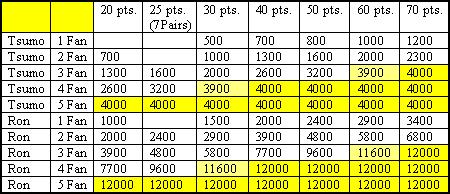
Scoring Chart-Non-Dealer

An important fine detail: when you go Out on someone's discard, the grouping
completed by the discard is considered to be exposed (for point-scoring
purposes). The hand itself, however, is still regarded as concealed, if no melds
were made prior to going Out.
And that "important fine detail" is precisely what you needed to know, Marissa.
Oh - and about the fan / yaku thing. Hon iisou is a yaku that's worth 3 fan when concealed. So a yaku is a "scoring element" (an aspect of the hand or the method of winning that earns one or more score-doublers). And a fan is a "score-doubler." You and your group need to un-learn the terminology you had been using, so you can use it correctly going forward - but you all sound really smart to me, so it should be no problem.
Now get back in there and ganbatte kudasai!
May the tiles be with you.
Tom Sloper / トム·スローパー
/
湯姆 斯洛珀 / 탐 슬로퍼
Los Angeles, CA (USA)
March 23, 2008
Author of "The Red Dragon & The West Wind," the definitive book on mah-jongg East & West. Available at bookstores, BN.com, and Amazon.com.
i want A K Q J an so on instead of tiles
>From: teresa grey
>Sent: Saturday, March 22, 2008 5:58 PM
>Subject: Mah-Jongg Q A
>My mah-jongg question or comment is: Hi my name is teresa i am looking for a mahjongg game to download i want A K Q J an so on instead of tiles can you please help me..
>Thanking you
>Teresa
Hi, Teresa.
I think what you're saying is, "I want a solitaire tile-matching game program, with playing card designs on the tiles." Maybe you can find one in FAQ 12, above left. You'll have to download some and try them out - I don't know offhand which ones have playing card design tiles.
Good luck,
Tom Sloper / トム·スローパー
/
湯姆 斯洛珀 / 탐 슬로퍼
Los Angeles, CA (USA)
March 22, 2008
Author of "The Red Dragon & The West Wind," the definitive book on mah-jongg East & West. Available at bookstores, BN.com, and Amazon.com.
what was the site I could go to to post, part 2
>From: sherri
>Sent: Friday, March 21, 2008 3:36 PM
>Subject: RE: need more mahjongg games
>thanks for getting back to me....and it's great to have someone so into mahjongg to ask questions....you're greatly appreciated!
It's nice to be appreciated, Sherri. I see you were already listed on the Find Players BB, so all you have to do is contact the other Boca Raton players who've posted on there.
May the tiles be with you.
Tom Sloper / トム·スローパー
/
湯姆 斯洛珀 / 탐 슬로퍼
Los Angeles, CA (USA)
March Into Spring, 2008
Author of "The Red Dragon & The West Wind," the definitive book on mah-jongg East & West. Available at bookstores, BN.com, and Amazon.com.
How do you play American with six players. Need an answer right now!
>From: ZoomisEZ
>Sent: Friday, March 21, 2008 10:42 AM
>Subject: Mah-Jongg Q+A
>My mah-jongg question or comment is:
>Hi, hope this has not been answered on the website, because i do remember reading it in your book. However, I can't remember the exact answer. How do you play American with six players. I think you said both players out bet, and some kind of order but i don't remember.
>Please replay as soon as possible, they are all here right now!
>Thanks,
>Michele
Hi Michele,
Wow, a realtime question?? I was away from the computer for the past half hour or so. I reserve the right to get away from the computer for hours at a time, as I see fit and as circumstances warrant! (^_^)
The six-player mention in my book is on page 123 (that's an easy number to remember). Bottom of the second-to-last paragraph.
Also, it's the last paragraph of FAQ 13a (above left). And in your NMJL rulebook, it's on page 24.
Tom Sloper / トム·スローパー
/
湯姆 斯洛珀 / 탐 슬로퍼
Los Angeles, CA (USA)
Spring equinox, 2008
Author of "The Red Dragon & The West Wind," the definitive book on mah-jongg East & West. Available at bookstores, BN.com, and Amazon.com.
what was the site I could go to to post wanting to play more mahjongg games? I'm looking for games in Boca Raton
>From: sherri
>Sent: Friday, March 21, 2008 5:45 AM
>Subject: need more mahjongg games
>Hey Tom.......what was the site I could go to to post wanting to play more mahjongg games? I'm looking for games in Boca Raton, Florida......thanks for the help!
Hi Sherri,
Happy spring. If I understand you correctly, what you're looking for is the Find Players Bulletin Board. Look above left (scroll all the way up). Under "Site Links" you'll see a short section entitled "Maj Exchange Boards." There's a little yellow "U.R. HERE" arrow pointing to the name of this bulletin board you're looking at now (the "Q & A Bulletin Board"), and right underneath that is the "Find Players BB." Click that and you'll go to the page I think you're asking about. Recommend you read the instructions before you post.
May the games be with you.
Tom Sloper / トム·スローパー
/
湯姆 斯洛珀 / 탐 슬로퍼
Los Angeles, CA (USA)
The spring equinox, 2008
Author of "The Red Dragon & The West Wind," the definitive book on mah-jongg East & West. Available at bookstores, BN.com, and Amazon.com.
Couple questions about American mah-jongg
>From: The Tomers
>Sent: Wednesday, March 19, 2008 2:31 PM
>Subject: Mah-Jongg Q+A
>My mah-jongg question or comment is: I was playing the last hand under singles and pairs with the 2007 card. It is a concealed hand. Was I able to call a discard if it is for Mah Jongg.
>Also, is a closed hand and a concealed hand the same thing.
>Thank you
>Arlene
Hi Arlene, you asked:
It is a concealed hand. Was I able to call a discard if it is for Mah Jongg.
That's Frequently Asked Question #19E3. Please click the FAQ 19 link above left, then bookmark the page for your future reference. See answer E3 (answer E answers several interrelated often-asked questions). And of course, this is also answered in my book, "The Red Dragon & The West Wind."
is a closed hand and a concealed hand the same thing.
Yepper. If you had my book, you'd already know that (both terms are in the glossary in the back).
May the tiles be with you.
Tom Sloper / トム·スローパー
/
湯姆 斯洛珀 / 탐 슬로퍼
Los Angeles, CA (USA)
March 19, 2008
Author of "The Red Dragon & The West Wind," the definitive book on mah-jongg East & West. Available at bookstores, BN.com, and Amazon.com.
Regarding D. B. Pritchard's last book, part 2
>From: HarwichU3A
>Sent: Tuesday, March 18, 2008 9:10 AM
>Subject: Re: Mah-Jongg Q+A
>Thank you for your reply.
>Here is a further question:
>Re: page 59 of THE NEW MAHJONG; The International Game by D. B. Pritchard
>12/2 Knitted sequence
>Can these sets that form the sequence 258, 147, 369 be considered chows and so can be made from discards and laid down before the full sequence is made? Or should they remain concealed until declaring mahjong and so cannot use discards?
>Celia
Hi Celia, you wrote:
Can [knitted] sets ... be considered chows
Sort of. But only when you have 147 in one suit, 258 in the 2nd suit, and 369 in the 3rd suit, making a Knitted Straight. You can't just have a 258 and the rest of the hand be regular chows, and call that All Chows. 258 is not a knitted "chow" - it's a knitted set that only makes knitted chows in the presence of the other 2 knitted sets. A knitted chow would be, for instance: 1B 2C 3D. And MCR does not permit the existence of such a beast without its counterparts.
Can [knitted] sets ... be made from discards and laid down before the full sequence is made?
No.
May the tiles be with you.
Tom Sloper / トム·スローパー
/
湯姆 斯洛珀 / 탐 슬로퍼
Los Angeles, CA (USA)
March 18, 2008
Author of "The Red Dragon & The West Wind," the definitive book on mah-jongg East & West. Available at bookstores, BN.com, and Amazon.com.
Regarding D. B. Pritchard's last book
>From: HarwichU3A
>Sent: Tuesday, March 18, 2008 4:23 AM
>Subject: Mah-Jongg Q+A
>My mah-jongg question or comment is:
>We started a Mahjong group a year ago and are self taught using THE NEW MAHJONG; The International Game by D. B. Pritchard and a bit of help from two players who play using other rules.
>Your comments on Pritchard's book are appreciated. We wrote to Pritchard to clarify some of the rules but he has died. We would like to start an on-line discussion group on playing by the new rules as there does not seem to be one. How do you suggest we do this?
>Celia Strachan
Hello Celia, you wrote:
Your comments on Pritchard's book are appreciated.
OK, sure. What would you like to know?
We would like to start an on-line discussion group on playing by the new rules as there does not seem to be one.
But there is one. If you go to http://www.mahjongnews.com/ you'll see a link at lower right that says "Forum about Int. Rules." Click that and you'll go to http://www.mahjongnews.com/forum.htm where you'll see that there are two forums: Mahjong Competition Rules and World Mahjong Championship. You want the first one. Click it and you'll be in the place where people have been discussing MCR for years already.
How do you suggest we do this?
Sorry, this bulletin board exists for the purpose of answering mah-jongg questions - not website-building questions.
You can also get answers to MCR questions right here, of course - half of my book, "The Red Dragon & The West Wind," is about the same New International game Pritchard wrote about in his final book. And together with the European mahjong leaders, I worked with the World Mahjong Organization to help polish the English translation in the WMO's "Green Book" of rules. And I write a weekly strategy column (see purple banner, above) - it often discusses MCR.
Many of the people who answer questions on the Mahjong News MCR forum are champion players who've played MCR in Europe, Japan, and China. And I've played in those tournaments too. So you can get answers to rule clarifications right here, or on the Mahjong News forum - no need to create a new forum.
So - got a rule question I can help you with?
May the tiles be with you.
Tom Sloper / トム·スローパー
/
湯姆 斯洛珀 / 탐 슬로퍼
Los Angeles, CA (USA)
March 18, 2008
Author of "The Red Dragon & The West Wind," the definitive book on mah-jongg East & West. Available at bookstores, BN.com, and Amazon.com.
Lack of English books about Japanese mahjong = a crying shame
>From: Biiruramen
>Sent: Monday, March 17, 2008 7:32 PM
>Subject: Mah-Jongg Q+A
>My mah-jongg question or comment is:
>It's a crying shame there are no English books devoted entirely to Riichi mahjong. Is there anything in the works, either by you or anyone you know? Can you recommend a couple of Japanese language Riichi books? I am already aware of all of the English language mahjong books that discuss Riichi, as well as the websites (yours included). Doomo.
Hi Beer/Ramen, o hisashi buri desu. Long time no see.
I am not writing such a book at the present time. But my next one might include Japanese rules... if and when.
And yes, I do know 2 or 3 people who are probably writing one. My lips are sealed beyond that, since I don't know if anything's been announced. Are you a user of Yakitori Online?
I couldn't tell you about Japanese language books, since my nihongo is heta. But I would think that any book by my friend Takunori Kajimoto must be very good indeed. He gave me a copy of his book in Chengdu last November. I don't know its full title since I can't read kanji, but I can post a scan of it.

Since I can't read kanji, all I can make out of the title is "Nantoka-kantoka Manual." (For those who don't know Japanese, nantoka-kantoka means "something-or-other.") The ISBN number is 978-4-8399-2512-3. And if you're familiar with Japanese book custom, the orange strip is a removable paper wrap (the cover itself just continues the tan color down to the bottom). I don't know if it goes into the basics for beginners - it might be all advanced strategy.
I have a couple other Japanese books with lots more illustrations that are probably better for beginners, but I don't imagine my beloved Beer/Ramen needs a beginner guide.
May the books be with you.
Tom Sloper / トム·スローパー
/
湯姆 斯洛珀 / 탐 슬로퍼
Los Angeles, CA (USA)
Saint Patrick's Day, 2008
Author of "The Red Dragon & The West Wind," the definitive book on mah-jongg East & West. Available at bookstores, BN.com, and Amazon.com.
What's "Chinese Bakelite"?
>From: Angelica Teal
>Sent: Monday, March 17, 2008 8:22 PM
>Subject: Chinese bakelite?
>Hello Tom and thank you for all the great info about this awesome game. Can you explain what thy mean by "Chinese bakelite" Thank you. Angelica
Hi Angelica,
No. I can't. Who's "they"?
Somebody else asked about "Chinese Bakelite" once before, and I don't recall what, if anything, was learned at that time as to what the heck this mysterious substance might be. It's just a weird name somebody made up for selling stuff on eBay, probably - it's not a widely accepted term for a particular kind of plastic, so far as I know.
May the tiles be with you.
Tom Sloper / トム·スローパー
/
湯姆 斯洛珀 / 탐 슬로퍼
Los Angeles, CA (USA)
Saint Patrick's Day, 2008
Author of "The Red Dragon & The West Wind," the definitive book on mah-jongg East & West. Available at bookstores, BN.com, and Amazon.com.
Ain't got enough tiles for the dance - what now?
>From: PBassell溌aol.com
>Sent: Monday, March 17, 2008 1:56 PM
>Subject: Mah-Jongg Q+A
>My mah-jongg question or comment is:
>I would like to know, if you can't pass anything at the beginning of the game, before the
>Charleston begins can you stop the passing. I just got home from playing maj, and one of
>the girls, she could only pass 2 tiles, all she needed was 3 titles from the beginning, what
>happens in that case.
>Thank you
>PBassell中aol.com
Hello P,
Look on the back of your NMJL card. The rule is stated very clearly: "First Charleston compulsory - three passes (right, across, left)." The operative word here is "compulsory" - I assume we all know what it means. If not: http://education.yahoo.com/reference/dictionary/entry/compulsory.
May the tiles be with you.
Tom Sloper / トム·スローパー
/
湯姆 斯洛珀 / 탐 슬로퍼
Los Angeles, CA (USA)
Saint Patrick's Day, 2008
Author of "The Red Dragon & The West Wind," the definitive book on mah-jongg East & West. Available at bookstores, BN.com, and Amazon.com.
Do you know anything about this company?
>From: Jane Wilcox
>Sent: Monday, March 17, 2008 12:03 PM
>Subject: Ivory Craft Company
>Hello, I have an Ivory Craft Mah-Jongg set. I have been unable to find much information about the company orther than that it was in production only a short time. Do you know anything about this company--time period, kinds of sets it produced, number of sets, etc. Also, did some other company produce the same type of set? I think mine is Ivory Craft but am not completely sure. There were no jokers in my set, and the flowers may not be an exact match. Thank you, Jane Wilcox
Hi Jane,
I am not an authority on mah-jongg manufacturers. For those who simply want to collect information about the manufacturer of a set, I always refer inquirers to Jim May's Mah Jongg Cyber Museum, CHarli's museum page, and Paul Jaeger's Mah Jong Library site (all 3 are listed near the bottom of FAQ 4a, above left).
HOWEVER - I might be able to help you with your real question. Why are you looking for information on this manufacturer? If I knew that, I could probably be of some help to you. Knowing what dates a company existed, and where it existed, isn't very interesting information, IMNSHO.
Let's see if I can help you with other things you mentioned in your email.
You wrote:
did some other company produce the same type of set?
And what type of set might that be? Read FAQs 7a, 7b, & 7c.
I have an Ivory Craft Mah-Jongg set... I think mine is Ivory Craft but am not completely sure.
I am thoroughly confused now. You have an Ivory Craft set, but you're not sure if it's an Ivory Craft set?? \(>_<)/
If you're saying you think it might be made of ivory, read FAQs 7c & 7c2.
There were no jokers in my set
Which tells you it was made before the time the NMJL started requiring jokers, if the set was made for American mah-jongg, or that it was made for Asian forms. Read FAQs 11H & 19S and my March 25, 2007 column (#311, purple banner above).
and the flowers may not be an exact match.
Read FAQs 11H & 19AI and my March 25, 2007 column (#311, purple banner above).
May the tiles be with you.
Tom Sloper / トム·スローパー
/
湯姆 斯洛珀 / 탐 슬로퍼
Los Angeles, CA (USA)
St. Patrick's Day, 2008
Author of "The Red Dragon & The West Wind," the definitive book on mah-jongg East & West. Available at bookstores, BN.com, and Amazon.com.
Forehead-slapping time again (I can see that rollaway look in your eyes)
As the great Homer (Simpson) famously said: "DOH!"
I just realized that of course, "R Williamson," who yesterday asked the same question asked by "Sarah Williamson" a month ago, is of course the same person who asked the same question a month ago. Checking the emails again, I see that both emails came from the same email address. I always email new posters to let them know that my response is on the bulletin board, with a link and complete instructions. But obviously Sarah never saw the answer the first time. When the usual procedure doesn't work, try a different procedure. Hopefully she'll come and find her answer before another month passes.
Tom Sloper / トム·スローパー
/
湯姆 斯洛珀 / 탐 슬로퍼
Los Angeles, CA (USA)
St. Patrick's Day, 2008
Author of "The Red Dragon & The West Wind," the definitive book on mah-jongg East & West. Available at bookstores, BN.com, and Amazon.com.
Is there really a rule that says I can't space my tiles on my rack? (redux)
>From: R WILLIAMSON
>Sent: Friday, February 22, 2008 7:00 PM
>Subject: Mah-Jongg Q+A
>My mah-jongg question or comment is:
>
>* Is there a rule which dictates a player's tiles must be racked touching each other when they're set up to play mah-Jongg?
>* If not, please suggest how to, politely, put a fellow players demand to rest in this regard.
>I play mah-jongg with four other women. One of them insists that I must rack my tiles abutting each other..
>
>Her problem is that I space out my tiles on my rack, so she can't readily tell whether I'm short or over 13 tiles in my rack..
>My problem is, if my tiles touch, I have difficulty organizing them into hands; so I separate them with spacing between kongs, pungs, etc.
>
>This is the only way I can comfortably organize my tiles. Maybe it's an eyesight thing and/or mah-jongg inexperience. I know it's not a wise way to play, because of the spacing, players can sometimes guess tiles needed. This person has never mentioned I give away my hand spacing out my tiles, so has not made it an issue for this reason.. She just wants to quickly see how many tiles are in my rack without counting them individually.
>
>Often she catches another player without the correct number of tiles in her rack, ending that person's play. This is not a weakness in my play (although I do have many,) so it isn't likely that she'd find I'm short or over on tiles, anyway.
>
>I'm not a confrontational person and don't wish to spoil player harmony, so would welcome suggestions from you or your readers on how I can politely resolve this matter.
>By the way, this person's been playing Mah-Jongg over 40 years.
Hello R,
The identical question was asked and answered one month ago. Please scroll down to the Sunday, February 17, 2008 post from Sarah Williamson, entitled "Is there really a rule that says I can't space my tiles on my rack?"
That question is colored purple, just like yours (so you can spot it easily).
But you added a little something extra with your question:
please suggest how to, politely, put a fellow player's demand to rest in this regard.
My suggestion is that you send a stamped self-addressed envelope to the National Mah Jongg League and ask them to put the actual rule in writing - whether or not a player is officially permitted to space her tiles on her rack. Then when you've gotten the reply, and if you find the reply helpful to your position, the next time your playmate raises the issue of tile spacing, you can ever so politely pull the letter out and show it to her.
May the tiles be with you.
Tom Sloper / トム·スローパー
/
湯姆 斯洛珀 / 탐 슬로퍼
Los Angeles, CA (USA)
March 16, 2008
Author of "The Red Dragon & The West Wind," the definitive book on mah-jongg East & West. Available at bookstores, BN.com, and Amazon.com.
I like to watch while being there online
>From: Nic Nick
>Sent: Saturday, March 15, 2008 10:02 PM
>Subject: Mah jong -- how to observe a game online
>Dear Tom Sloper,
>Thanks for sharing your passion for Mah Jong. By the way, I got your Internet site from the book--thanks.
> I would like to learn to observe a game on line. For some reason the connection to www.tumj.com fails. Do you know of another site? Or way to learn from home and observe before trying to play. Currently, Mahjong Titans (solitaire) is completely addictive and I really want to play the real Mahjong now that I am familiar with the traditional tiles.
>I am in the Chicagoland area (IL).
>Thanks for your assistance.
>Sincerely,
>Joanna
Hi Joanna,
I'm so glad you came by way of my book! (^_^) You wrote:
the connection to www.tumj.com fails.
I can't help you with technical support issues for any computer game. FAQ 24 offers tips for ways to obtain tech support. But I happen to know that the creator of XMJ (the game available on TUMJ) frequents the mahjong newsgroup (http://groups.google.com/group/rec.games.mahjong/) - you could post a query there... but I see that someone asked about TUMJ on the newsgroup today, and the XMJ creator believes TUMJ is running unattended. Which leads us nicely to your next question:
Do you know of another site?
Sure, lots. See page 223 of my book, and for even more, click the FAQ 5 link, above left.
But I'm puzzled. XMJ uses Classical Chinese rules, but my book describes the Official rules instead - so, accordingly, TUMJ is not listed in my book. So I wonder how you came to be trying TUMJ rather than, say, a site that offers American or Chinese Official rules (such as those I did list in my book or in FAQ 5).
Or way to learn from home and observe before trying to play.
Every online game is different. Some do offer a way to observe a game in progress, and some don't. And I can't tell you how to do it. You have to try and explore. I recommend Mahjong Time for starters, since they offer both Chinese Official and American (the two variants I described in my book). Just be patient, read, try stuff. I'm sure you'll figure it out.
May the tiles be with you.
Tom Sloper / トム·スローパー
/
湯姆 斯洛珀 / 탐 슬로퍼
Los Angeles, CA (USA)
March 16, 2008
Author of "The Red Dragon & The West Wind," the definitive book on mah-jongg East & West. Available at bookstores, BN.com, and Amazon.com.
The seven-eleven rule
From: "Vicki Davis" (vickser)
Sent: Thursday, March 13, 2008 5:18 PM
Subject: Mah-Jongg Q+A
> My mah-jongg question or comment is:
> Hi Tom
> Is it true that the winner receives double if a 7 or 11 is rolled, or
> that just one of those "made-up" table rules?
Hi Vicki,
The first thing I wondered is what kind of mah-jongg you play (which is weird -- that I'd wonder that, I mean, since no kind of mah-jongg has a seven-eleven rule), but your name sounded familiar, so rather than just ask "what kind of mah-jongg do you play," I searched this page for your name and found your February 27 posts, below - and that told me that you play American mah-jongg.
* If you look on the back of your NMJL card, you'll find no mention of any seven-eleven rule.
* If you had the official NMJL rulebook, "Mah Jongg Made Easy," you'd find no mention of it in there, either.
* If you had my book, "The Red Dragon & The West Wind," you wouldn't find it mentioned in there, either.
* You won't even find it anywhere on this whole website - or anywhere on the Internet.
Which ought to tell you that it's not an official rule. The straight poop: I never heard of a seven-eleven rule before. It's a new one on me! But I have heard of a "daily double" table rule, and the group I played with used a "double dice" table rule. I think I might have mentioned one or both of those in my book.
Personally, I think this sort of table rule adds some extra spice to the game. But there are a lot of players who don't like spicy gameplay (I guess it burns the change purse). Read FAQ 14 to learn more about Tom Sloper's Rules On Table Rules.
May the tiles be with you.
Tom Sloper / トム·スローパー
/
湯姆 斯洛珀 / 탐 슬로퍼
Los Angeles, CA (USA)
March 13, 2008
Author of "The Red Dragon & The West Wind," the definitive book on mah-jongg East & West. Available at bookstores, BN.com, and Amazon.com.
Mystery fish
From: "Maria Justiliano"
Sent: Thursday, March 13, 2008 11:32 AM
Subject: Mah-Jongg Q+A
> My mah-jongg question or comment is:
> I purchased, at an auction, an "#085 Traditional Chinese Boxed Set." It
> is gorgeous. In the bottom drawer, a previous owner left 10 white
> (ivory?) fishes, each about 2 1/4" long. (There seem to be 5 pairs.)
> I've enclosed a "Not-so-good" picture. Can you tell me what they
> might be? Thank you, Maria Justiliano
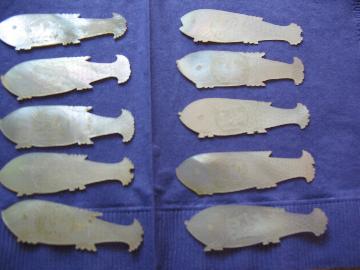
Hi Maria,
The only reason I can think of for these to be in the mah-jongg set was to use them as extra scoring chips. You're perfectly safe in taking them out of the set - they have no official use in a mah-jongg set.
Tom Sloper / トム·スローパー
/
湯姆 斯洛珀 / 탐 슬로퍼
Los Angeles, CA (USA)
March 13, 2008
Author of "The Red Dragon & The West Wind," the definitive book on mah-jongg East & West. Available at bookstores, BN.com, and Amazon.com.
Frequently Asked Question #7Q
>From: Ktcapri®aol,com
>To: tomster®Sloperama,com
>Sent: Wednesday, March 12, 2008 1:25 AM
>Subject: blank bakelite tiles
>Dear Tom,
>I was recently given a bakelite mah jongg set as a gift and would like to purchase eight blank bakelite tiles (or ones with similar color) so that I can send them to "Mah jongg Maven" and have them engraved with my name on them (in lieu of joker tiles). Please let me know if you know where I can find these blank tiles.
>Many Thanks,
>Karen Todman
>Fax: 310-███-████
>Tel: 310-███-████
>email: KTcapri®aol:com
Hi Karen,
Read FAQ 7Q (the Frequently Asked Question links are above left).
May the tiles be with you (... but blank ones probably won't be - sorry!).
Tom Sloper / トム·スローパー
/
湯姆 斯洛珀 / 탐 슬로퍼
Los Angeles, CA (USA)
March 12, 2008
Author of "The Red Dragon & The West Wind," the definitive book on mah-jongg East & West. Available at bookstores, BN.com, and Amazon.com.
Identify my Chinese Opera characters
From: "cynthia gallagher" (chiquitaroad)
Sent: Monday, March 10, 2008 10:46 AM
Subject: Mah-Jongg Q+A
> My mah-jongg question or comment is: Hello, I have a bone and bamboo
> set with Chinese Opera characters, men, for the 8 Flower/Season
> tiles. I've tried finding who they represent on the net but
> unsuccessfully. Can you help me with this quest? Do you know which
> characters they represent? Thanks, Cyn

Hi Cyn,
Chinese Opera, huh? I don't know anything about Chinese Opera. Are you sure that's where these guys are from? Because I've usually heard this sort of tile referred to as "Scholars." Wolfram Eberhard, in his book, "A Dictionary of Chinese Symbols," says that "scholar" is one of "the four callings," and that the scholars are symbolized by "the eight precious things." Eberhard doesn't give a list of the eight top scholars and how to identify them, but if you're interested in Chinese symbolism, I recommend his book to you - and also that of C.A.S. Williams, "Outlines of Chinese Symbolish & Art Motives." Both books are listed in FAQ 3, above left. Williams lists "The Eight Immortals," who may be what your flower tiles represent. It's too much work for me to try to help you identify which is which from Williams' book, but if you really want to know, I recommend you get his book. It's easy to find on Amazon (that's where I got my copy, if I recall correctly). And of course, a Google search on "the eight immortals" or "the eight scholars" might give you your answers as well.
May the tiles be with you.
Tom Sloper / トム·スローパー
/
湯姆 斯洛珀 / 탐 슬로퍼
Los Angeles, CA (USA)
March 10, 2008
Author of "The Red Dragon & The West Wind," the definitive book on mah-jongg East & West. Available at bookstores, BN.com, and Amazon.com.
Color-blindness
>From: Lynne Rosenberg
>Sent: Monday, March 10, 2008 4:21 AM
>Subject: Mah-Jongg Q+A
>My mah-jongg question or comment is:
>My husband is color blind (red/green). Do you have any suggestions to make playing this game any easier? Any manufacturer that identifies the tiles somehow?
>Thanks!
Hi Lynne, you wrote:
Do you have any suggestions to make playing this game any easier [for people who are color-blind]?
Yes. You didn't say which kind of mah-jongg you and your husband play. (Your having a Jewish last name doesn't necessarily mean that you play American mah-jongg.) And you didn't mention whether your mah-jongg set (assuming you have one) has Chinese character dragon tiles or pictorial "dragon" dragon tiles. It matters, because the color-blindness problem is easier to solve for American mah-jongg than for certain Asian variants (including British mah-jongg and Wright-Patterson). I'm just going to discuss here some suggestions assuming you play American mah-jongg. Obviously, the tips I give you also assume you're going to make modifications to your own set, and that you'll always play with your own set.
Discerning Red Dragon from Green Dragon
Your set might have (A) Chinese character dragon tiles, or it might have (B) tiles depicting dragon images.
A. Chinese Character Dragon Tiles


The most common characters are "fa" (green / Fortune) and "chung" (red / Center).
Sometimes they are marked F and C respectively, and sometimes they are not.


The characters that were used in some antique sets are "feng" (green / phoenix) and "leung" (red / dragon).
B. Pictorial Dragon Tiles


Some manufacturers used to make different-looking dragons (the green dragon looked distinct from the red).


But all too often, manufacturers use the same image for both colors - as in these two examples.
So your husband might be able to simply memorize which one is red, and which one is green, in all the cases above except the same-looking dragons. But if he prefers, he could:
1. Get letter stickers (from office supply or arts/crafts shops) and mark them "R" and "G" or...
2. Using a 1/16" drill bit, make a 1/32" deep hole in the upper right corner of the red dragons, and fill with red nail polish or paint. If he's a craftsman with a garage workshop, he can set up a rig on his drill press to make sure that the little hole is identically placed on each of the red dragons.
Discerning the red suit (Craks) from the green suit (Bams)
Your husband needs to just remember that the green dragons go with the Bams, and the red dragons go with Craks. If he prefers, he could drill a shallow hole in the upper right corner of the Craks, and fill with red nail polish or paint, to match the red dragon treatment as in suggestion 2 above.
And that's the extent of it. Someone who's color-blind and plays American mah-jongg only needs to be able to discern the red dragons from the green dragons, and to associate those dragons with the appropriate suits. I can't help him with marking the card - he'll have to come up with his own system (maybe an underline under all green symbols, and an overline over all red symbols). If you and your husband play an Asian variant that uses the hand "All Green," I think he can figure out a solution based on what I've set forth above, to mark the "green-only" bams (2, 3, 4, 6, 8).
Any manufacturer that identifies the tiles somehow?
Not for American mah-jongg. Take a look at FAQ 7e above left - sets exist with the words "red" and "green" on those dragons, but I can't tell you exactly where to go and buy one. And before you ask me how to convert an Asian set for the American game, my recommendation is that you buy two sets (if you can find a vendor that sells sets so marked), and sticker the jokers. FAQs 7q & 7r highlight the problem. The "where to buy mah-jongg sets" FAQ is FAQ 7k.
May the tiles be with you.
Tom Sloper / トム·スローパー
/
湯姆 斯洛珀 / 탐 슬로퍼
Los Angeles, CA (USA)
March 10, 2008
Author of "The Red Dragon & The West Wind," the definitive book on mah-jongg East & West. Available at bookstores, BN.com, and Amazon.com.
Seeking jokers for burgundy-layered set
From: "Marcela Bowler" <mbowler©optonline,net>
Sent: Monday, March 10, 2008 8:25 AM
Subject: Purchase of tiles
> Is it possible to buy the joker tiles for a set? The tiles in the set are
> layered with burgandy? Please respond at your earliest convenience.
> Thank you,
> Marcela
Hi Marcela,
It's possible, but difficult. Read FAQ 7r (above left).
If you find someone who has burgundy-layered tiles, you'll need to give them dimensions of your tiles, and also you'll need to clarify whether your tiles are "enrobed" (meaning the burgundy layer covers 5 sides of the tiles) or just two-tone (meaning the burgundy layer is just the back of the tiles). And of course, although you didn't say, I assume that the non-burgundy part of your tiles is yellow catalin/Bakelite.
May the tiles be with you.
Tom Sloper / トム·スローパー
/
湯姆 斯洛珀 / 탐 슬로퍼
Los Angeles, CA (USA)
March 10, 2008
Author of "The Red Dragon & The West Wind," the definitive book on mah-jongg East & West. Available at bookstores, BN.com, and Amazon.com.
Is a dropped pick an automatic discard?
>From: Don Zerfas
>Sent: Sunday, March 09, 2008 6:34 PM
>Subject: discard??
>I'm hoping that this is a current address. I have a simple question but one our group has talked (and laughed) about.
>**When drawing from the wall, and I drop the tile and it is exposed, must I leave it there as my discard, even though I might need it for my hand? Would this be answered in your list of #A FAQ's from 2005??
>Thanks for your help.
>Ruth Zerfas
>West Bend, WI
Hi Ruth,
I'm glad your group talks and laughs. That's a good thing! You wrote:
must I leave it there as my discard, even though I might need it for my hand?
It depends. You didn't say which rules you play by, and you didn't say whether you're playing in a charged competitive setting like a tournament, or in a relaxed setting like a home where the players talk and laugh.
If you're playing (Chinese) Mahjong Competition Rules, in an international-class tournament, or if you're playing in a televised million-dollar contest like the World Series of Mahjong in Macau, and even if you're playing apple-pie American mah-jongg in a Las Vegas money-prize tournament, then yes. You've screwed up big time, and your tile is officially a discard.
But if you're playing in the home of a friend, and you all like one another, and you aren't out to screw each other over, then my recommendation is that you just say, "Oy! I'm such a klutz!" and quickly pick up the tile and put it in your hand, hoping that the others don't tell you that you have to leave it on the discard floor (most nice folks, in a friendly setting, won't be nasty in that way).
Would this be answered in your list of #A FAQ's
I'm going out on a limb and guessing that you're talking about FAQ 19A...?
... from 2005?? I'm hoping that this is a current address.
I guess it's been 3 years since you've visited this site. Because I can't imagine any other reason why you'd think I was silent/inactive for the past 3 years. Just try and shut me up for that long! (^_^)
May the tiles be with you.
Tom Sloper / トム·スローパー
/
湯姆 斯洛珀 / 탐 슬로퍼
Los Angeles, CA (USA)
March 9, 2008
Author of "The Red Dragon & The West Wind," the definitive book on mah-jongg East & West. Available at bookstores, BN.com, and Amazon.com.
Thanks so much -- you have a very helpful website!
>From: Mindy Briggs
>Sent: Sunday, March 09, 2008 4:08 PM
>Subject: Thanks!
>I just posted a Mah-Jongg set for sale on your site (listed on eBay). After reviewing all of your information, I was able to accurately determine the age, quality, and composition of what I had. Thanks so much for making the information available -- you have a very helpful website!
>Mindy Briggs
Cool.
Tom Sloper / トム·スローパー
/
湯姆 斯洛珀 / 탐 슬로퍼
Los Angeles, CA (USA)
March 9, 2008
Author of "The Red Dragon & The West Wind," the definitive book on mah-jongg East & West. Available at bookstores, BN.com, and Amazon.com.
Making an illustrated guide for kids, part 6
>From: Alice Wood
>Sent: Sunday, March 09, 2008 3:35 PM
>Subject: More on illustrated guide
>Wow, lots of replies. Thanks everyone for feeding my creativity!! We're due to write the first part of the assessment - a publisher proposal - this week and you've all helped me immensely. I do agree with Mr. Swagerty about the precociousness of a child's learning ability; I have been taught to always assume higher ability than lower ability for any given age group. If I write the text with the idea of having it almost picture-book style with clear symbols for the tiles, I feel it may as well be to them an advanced tile-matching game that, "oh look, adults play too, yayness!!" I'll definitely give the 7 - 11 age group a try, based on your anecdotes, let's see if I can make it work...
>Thanks again, everyone. ^^
>Alice
>Ad Astra Per Aspera
>(A rough road leads to the stars)
Making an illustrated guide for kids, part 5
>From: Anna Rosen
>Sent: Sunday, March 09, 2008 6:54 AM
>Subject: Allice Woods Mah Jongg children's book
>Hi Tom!!
>I saw the post on Alice Wood's project on a Mah Jongg book for children and have read with interest the response from other players on the subject.
>
>Our firm has been supplying Mah Jongg items since 1996 (www.kmaindustries.com) and I have personally seen an incredible evolution as far as Mah Jongg players are concerned in the past five to six years. When we first started handling the Mah Jongg line, most of our customers were ladies over 50 and some sporadic men.
>
>Today, we have customers as young as seven years old, teenagers who have discovered the game on the Internet, men and women of all ages and ethnic backgrounds. During the 2004 hurricanes here in Florida, we had parents calling us to purchase our mini Mah Jongg set which they used to teach their children to play Mah Jongg and to entertain them during the long hours that we all had to endure with no electricity, no water and very little food.
>
>As I indicated on a newpaper interview, The Palm Beach Post did on me and my firm, "Mah Jongg is not just for little old Jewish ladies anymore"
>
>I am often asked about doing something related to Mah Jongg for young children. A number of my Mah Jongg students have taught Mah Jongg to their grandchildren. Some of them have used the Mah Jongg Kards which they find helpful because the illustrations are big.
>
>The idea of coming out with Mah Jongg book for children is a wonderfully innovative one and I wish Alice success in her endeavor.
>Have a Great Mah Jongg Day!!
>Anna Rosen
Yes, let's all have a great mah-jongg day.
Tom Sloper / トム·スローパー
/
湯姆 斯洛珀 / 탐 슬로퍼
Los Angeles, CA (USA)
March 9, 2008
Author of "The Red Dragon & The West Wind," the definitive book on mah-jongg East & West. Available at bookstores, BN.com, and Amazon.com.
What does "opp." mean?
>From: Karen Pitner
>Sent: Friday, March 07, 2008 11:21 PM
>Subject: Question on 2007 NMJL
>I should have asked this question months ago. Instead I steered clear of the hand and waited until just before the 2008 cards were to come out.
>The question I have is about the concealed hand under consecutive run.
> 111 22 333 DDD DDD (Any 3 Consecutive Nos., Any 3 Suits, Pungs Opp. Dragons)
>What is the Opp. in Pungs Opp. Dragons?
>Karen Pitner
>(541) ###-#### home
>(541) ###-#### cell
>"Don't audit life. Show up and make the most of it now."
Hi Karen,
It means "opposite." In a 2-color (black & white) universe, what's the opposite of white? Rhetorical question. You know the answer intuitively. Well, this hand is a 3-color hand. The number tiles are all one color. The two dragons are shown in the only 2 possible remaining colors... the "opposite" colors. If you had my book, "The Red Dragon & The West Wind," you could have just looked in the glossary of mah-jongg terms and found your answer right away.
May the tiles be with you.
Tom Sloper / トム·スローパー
/
湯姆 斯洛珀 / 탐 슬로퍼
Los Angeles, CA (USA)
March 8, 2008
Author of "The Red Dragon & The West Wind," the definitive book on mah-jongg East & West. Available at bookstores, BN.com, and Amazon.com.
She keeps stopping the Charleston because she has 2 hands. What's the solution?
From: "Joseph Levy" (joeandruth© hargray:com)
Sent: Friday, March 07, 2008 2:43 PM
Subject: Mah-Jongg Q+A
> My mah-jongg question or comment is: What are the rules for stopping
> the passing after the first Charleston. May you stop the passing and
> then option 3 tiles? One of our players consistently stops the
> passing because she has 2 possible hands. what is the solution?
Hi Joseph, you wrote:
What are the rules for stopping
> the passing after the first Charleston.
Read Frequently Asked Question #19AG. The FAQ links are above left.
May you stop the passing and
> then option 3 tiles?
I assume you are referring to the optional courtesy pass that follows the Charleston. Read FAQ 19AH.
One of our players consistently stops the
> passing because she has 2 possible hands.
When you say "consistently," do you mean she does it with 75%-90% of the deals she gets? Or were you exaggerating, and she really does it only 50% of the time, or even less often than that? Because there is such a thing as reasonableness. Stopping the Charleston more often than four times in an evening's play might mean that she needs some strategy help. Maybe the rest of you could chip in and buy her a copy of my book! Yeah, that's the ticket!
what is the solution?
Not sure how much of a problem it really is, but I think I gave you one possible solution above (that one works for me, anyway!).
I was going to make a joke about some people preferring a solution of gin and tonic, while others prefer a solution of orange juice and vodka, but I decided against it.
May the tiles be with you.
Tom Sloper / トム·スローパー
/
湯姆 斯洛珀 / 탐 슬로퍼
Los Angeles, CA (USA)
March 7, 2008
Author of "The Red Dragon & The West Wind," the definitive book on mah-jongg East & West. Available at bookstores, BN.com, and Amazon.com.
Making an illustrated guide for kids, part 4
>From: Ben Swagerty
>Sent: Friday, March 07, 2008 1:29 PM
>Subject: Mah-Jongg Q+A
>My mah-jongg question or comment is: Hi Tom, Benjamin from Oklahoma here. I had written to you before about some mah jongg stuff I have done with my third graders. I have had success teaching mah jongg to students as young as 1st graders. Granted it is Taiwan style, but as can often times be the case, the youngest are the most precocious and more often than not, whip the older students and me soundly. Oh, we also use the asian tiles with no western numerals. The kids have less of a problem with this than most adults. They learned by being shown and by doing. I think a picture book written at a 7 year old’s level will ultimately end up being more useful for adults learning mah jongg than any child.
Cool, Ben! I'm sure Alice will be happy to read your words.
Tom Sloper / トム·スローパー
/
湯姆 斯洛珀 / 탐 슬로퍼
Los Angeles, CA (USA)
March 7, 2008
Author of "The Red Dragon & The West Wind," the definitive book on mah-jongg East & West. Available at bookstores, BN.com, and Amazon.com.
Making an illustrated guide for kids, part 3
>From: Sylvain Malbec
>Sent: Friday, March 07, 2008 2:07 AM
>Subject: Re: Making an illustrated guide for kids
>
>Hello Tom, hello Alice,
>I've got too few experience in teaching mahjong for young kids to tell at wich age a child can understand a mahjong book, so I can't help very much.
>But I've a question for Alice:
>
>Did you have already try to teach mahjong to adults?
>Considering even adults have some difficulties (at least one adult by treaching day ask "What is a pair?"), it would be difficult for a kind to learn mahjong just from a book, without teacher.
>
>I've got only 3 advices for you:
>- Bring adults to a table and learn them mahjong. Find out difficults parts.
>- Bring kids to a table and learn them mahjong. Determine at wich age it's too difficult.
>- If it apears too hard, think about simplier rules like Yunan mahjong or Donjara.
>
>Yunan mahjong is quite simple: no honors, no claim chow, a hand must use no more than 2 suits. (<- this idea come from Benjamin Boas)
>Donjara is not realy mahjong but is designed for kids: a winnig hand is 3 pung, no chow (tiles haven't numbers anyway).
>
>Usefull links:
>A review of a teaching session (look at least the § "Conclusion"): http://www.yakitorionline.com/forum/viewtopic.php?t=257
>Donjara: http://www.omosiro-flash.net/963.swf
>
>
>PS: Don't forget to put [Western] numbers on [the characters suit] tiles for illustations.
>--
>Sylvain MALBEC
>sylvain.malbec at gmail.com
>chat: dhaos_mana at hotmail.fr
Tres bien, Sylvain. Good suggestions.
Tom Sloper / トム·スローパー
/
湯姆 斯洛珀 / 탐 슬로퍼
Los Angeles, CA (USA)
March 7, 2008
Author of "The Red Dragon & The West Wind," the definitive book on mah-jongg East & West. Available at bookstores, BN.com, and Amazon.com.
What's the official way to handle our table rule?
From: "Edith Itzkin"
Sent: Thursday, March 06, 2008 3:50 PM
Subject: Mah-Jongg Q+A
> If the bettor bets on the player who throws in to a thid exposure, that
> player has to pay for for the table
> :Does the bettor have to pay also? This has been a question that no
> one seems to have the answer to. I look fordward to your response.
> Thank you. Edith Itzkin EDLITZ©OPTOMONLINE:NET
Hi Edith,
To get your answer, please read FAQ 14. The Frequently Asked Question links are above left.
Ordinarily, I recommend that folks get a copy of the official rulebook. But that doesn't necessarily apply when people make up their own rules. (Personally, I don't recommend making up one's own rules - it can cause too much confusion... in my so-called "humble" opinion.)
May the tiles be with you.
Tom Sloper / トム·スローパー
/
湯姆 斯洛珀 / 탐 슬로퍼
Los Angeles, CA (USA)
March 6, 2008
Author of "The Red Dragon & The West Wind," the definitive book on mah-jongg East & West. Available at bookstores, BN.com, and Amazon.com.
Making an illustrated guide for kids, part 2
>From: Alice Wood
>Sent: Thursday, March 06, 2008 10:07 AM
>Subject: RE: MJ Q - Writing for Children
>Thanks for the advice. Funny, my lecturer told me to go ask someone who'd know more about it, heh heh. And I can assure you I'm definitely not one for plagarism, though if I may I'd love to cite the material in my bibliography.
>Alice
>Ad Astra Per Aspera
>(A rough road leads to the stars)
Hi Alice,
Well, then, he was telling you the same thing I was. Who would know better about the learning abilities of seven-year-olds? A video game producer, or an educator? Then again, weren't we all seven years old once?
If you thought I'd tried teaching mah-jongg to second-graders, well, you can think again. The youngest students I've worked with have been high-schoolers. You're not re-treading territory that I'm familiar with, if that's what you were thinking. You're blazing a whole new trail.
And of course it would only be appropriate to cite me (and any other sources you use in your research) in your bibliography.
May the tiles be with you.
Tom Sloper / トム·スローパー
/
湯姆 斯洛珀 / 탐 슬로퍼
Los Angeles, CA (USA)
March 6, 2008
Author of "The Red Dragon & The West Wind," the definitive book on mah-jongg East & West. Available at bookstores, BN.com, and Amazon.com.
Making an illustrated guide for kids
>From: Alice Wood
>Sent: Thursday, March 06, 2008 6:44 AM
>Subject: MJ Q - Writing for Children
>Hello, me again with the penchant for apparently dodgy Latin. (I nabbed it from a quotes site and just thought it sounded good...)
>The [January 25] advice on scoring was very useful, thanks a lot. Now I've got a rather different query. At my university I'm doing a final year module called 'Creative Non-Fiction for Children', and for the assessment I've decided to attempt writing a vague 'how to play' guide for young children, in detailed picture book style. I'm trying to funnel the majority of FAQ 10 into the main and add on a nice 'further info' bit at the back. Now the thing is I don't know how young I can go, i.e. before I get to 'too young to understand the idea', so I'd like to ask your learned opinion: would it be more feasible to aim the book at seven- or ten-year-olds?
>Alice
>Ad Astra Per Aspera
>(A rough road leads to the stars)
Hi Alice,
I am learned in mah-jongg and the production of computer/video games. I am not learned in the education of children.
However, I can remember being seven and ten years old. At seven I don't think I could have read a mah-jongg book (even illustrated), but at ten I would have been all over it. Since you're in university working on a course that deals specifically with the education of children, maybe you should discuss this with your teacher?
And of course make sure you use your own words, not my copyrighted words.
And I'd read in some science fiction novel when I was young (10 or older, to be sure) that "ad astra per aspera" meant "to the stars with hope." I always figured "aspera" was a root for "aspiration" but according to http://www.stars21.com/translator/latin_to_english.html, "roughness" is perhaps closer to the meaning of "aspera."
May the tiles be with you.
Tom Sloper / トム·スローパー
/
湯姆 斯洛珀 / 탐 슬로퍼
Los Angeles, CA (USA)
March 6, 2008
Author of "The Red Dragon & The West Wind," the definitive book on mah-jongg East & West. Available at bookstores, BN.com, and Amazon.com.
Can I chow to win? Or do I have to self-pick?
>From: Charles/Cordelia Christopher
>Sent: Wednesday, March 05, 2008 4:11 PM
>Subject: When you mah jongg in Classical Chinese Rules, is it permissable...
>Hi Tom
>When you Mah Jongg using Classical Chinese rule set:
>If you have 4 sets of 3 and 1 green dragon, and a player discards a green dragon, can you Mah Jongg to make the pair or do you have to hope to draw the second green dragon from the wall?
>Also:
>If you have 4 sets of three and in your concealed hand you have a pair and a 2 number chow, if any player discards the 3rd number for your chow, can you mah jongg picking up the tile to complete the chow or do you still have to follow the rule of picking up a chow only from the preceding player on your left?
>Thanks
>Cordelia Christopher
Hi Cordelia,
Your 2nd question is answered in FAQ 20 (above left).
Once you know the answer to your 2nd question, I think you'll know the answer to your 1st question too.
But if I'm wrong, you know where to ask.
So... do you have a book that you use as your Chinese Classical "bible"? If so, if you tell me which book it is (tell me author's name, that's usually more important than the title, which mostly all sound alike), I can show you which page your answer is on.
Tom
>From: Charles/Cordelia Christopher
>Sent: Wednesday, March 05, 2008 4:49 PM
>Subject: Re: When you mah jongg in Classical Chinese Rules, is it permissable...
>So I can pick up any tile, including a tile to complete a chow, to complete a Mah Jongg hand; so I can also pick up the green dragon, in question 1, as long as I mah jongg? Thanks-I thought that was true.
>Although I play Wright-Patterson I've taught people in myAsheville, NC little mountain neighborhood and here in Hilton Head Island where we can play outside. I found the rules on-line although I have an old Babcock book at home that I think I am mostly using except for the last step of scoring where you subtract your score from the winners. But I don't have a printer here in Hilton Head so at home I printed out a rule set-a one pager for simplicity for new players and it's by Paul E. Jaeger, Nov. 23, 2004.
>Thanks again for your wonderful web site. We are mostly retired in my groups and new people to the game really enjoy it-especially those who played years ago in a NMJL group. They feel so free of penalty-and the fact that you can collect scores without actually winning by Mah Jongg is really enjoyable, especially for beginners.
>Sincerely,
>Cordelia Christopher
Cordelia, you wrote:
Thanks-I thought that was true.
You're welcome - you thought right! (^_^)
I found the rules on-line although I have an old Babcock book
OK, well, that online page you found obviously sucks. Use a different one. And as much as we all owe Babcock for popularizing the game in America and Europe, his simplified rules (assuming you have the more common paperback pamphlet, not the hardcover book) don't go into enough details. Better you have a Foster or a Harr or a Millington.
a rule set-a one pager for simplicity ... by Paul E. Jaeger, Nov. 23, 2004.
Well, obviously that's no good either, at least not for when you need to know how things work.
And I'm so glad you're spreading the joy of mah-jongg! And that's really cool that ex-NMJL players are enjoying the classic! Keep it up, girl! (^_^)
May the tiles be with you.
Tom Sloper / トム·スローパー
/
湯姆 斯洛珀 / 탐 슬로퍼
Los Angeles, CA (USA)
March 5, 2008
Author of "The Red Dragon & The West Wind," the definitive book on mah-jongg East & West. Available at bookstores, BN.com, and Amazon.com.
She was talking and forgot to discard
>From: Tomer, Arlene E.
>Sent: Wednesday, March 05, 2008 7:01 AM
>Subject: Mah-Jongg Q+A
>My mah-jongg question or comment is: Player A was talking and forgot to discard a tile. The next person (B) picked from the wall and racked. I noticed that player A had 14 tiles and I called her on it and declared her dead. She didn't think she should be penalized just because player B picked and racked before she discarded. My reasoning is if she wasn't talking she would have remembered to discard a tile. What do you think?
>Arlene Tomer
Hi Arlene,
There are 3 ways this could have been handled. And "what I think" depends on the circumstances.
The way you handled it would be the right way to go if Player B could be judged faultless for picking before Player A had discarded - like if Player A had said to Player B, "Okay, I'm done, you can go ahead and take your turn," or if A had simply gestured to B in a manner to indicate the same.
If Player B went ahead and picked without first being sure that it was her turn, she (Player B) could be rightly called dead.
The harmonious way to go might be to rectify the situation without calling anybody dead, together with a gentle suggestion that Player A's talking might be interfering with "everybody else's" concentration. B puts tile back, A discards, and just move on.
Which way I'd go would be dependent on how egregious Player A's talking really had been. If she'd already received some gentle nagging about how her talking wasn't helping the game, and I was really fed up, I might be tempted to go with #1 like you did. But otherwise, when Player B reached for the wall, I'd probably put out a hand and say, "hold on, B. I think A hasn't discarded yet...?"
May the tiles be with you.
Tom Sloper / トム·スローパー
/
湯姆 斯洛珀 / 탐 슬로퍼
Los Angeles, CA (USA)
March 5, 2008
Author of "The Red Dragon & The West Wind," the definitive book on mah-jongg East & West. Available at bookstores, BN.com, and Amazon.com.
How many cards are dealt in Hawaiian hanafuda, part 2
>From: Laura Pila
>To: Tom Sloper
>Sent: Tuesday, March 04, 2008 1:19 PM
>Subject: Re: Hanafuda Answer Found
>Thank you for your response. Here's where I got my information...
>http://www.hanafubuki.org/sakura.html
>Laura
>25/7 (^_^)
 Cool, Laura! Cool, Laura!
Thanks. I'll add that link to the Hanafuda Links page.
May the flower cards be with you.
Tom Sloper / トム·スローパー
/
湯姆 斯洛珀 / 탐 슬로퍼
Los Angeles, CA (USA)
March forth! (^_~) 2008
Author of "The Red Dragon & The West Wind," the definitive book on mah-jongg East & West. Available at bookstores, BN.com, and Amazon.com.
How do I know if I'm ready to enter a mahjong tournament?
>From: jackie.berman@...
>Sent: Tuesday, March 04, 2008 11:50 AM
>Subject: Mah-Jongg Q+A
>My mah-jongg question or comment is:
>Should you be an expert to play in a tournament?
>I just entered myself and I am not quite sure if I am ready.
>Are there all different levels of players in tournaments?
>I know this is a very vague ques. I'm just trying to get a feel for what
>it would be like at a tournament.
>Any advice for a tournament beginner?
>Thank you in advance for your expert advice
Hi Jackie Dot,
Very good question! In China at an international-class tournament one time, I had a teammate who had only played mahjong online. She had sat down at a table with pro players to practice in advance of the first round of real play (which would occur the next day) and experienced serious self-doubts. At the table with real players, they'd kept urging her to play faster, and now she was gunshy about playing "for real."
I urged her not to drop out. I took a page from my book, "The Red Dragon & The West Wind," and told her to simply focus on keeping up rather than trying to win. In time, she'd get comfortable at the table and eventually her tiles would come together. So she stuck it out, had a great time, and didn't embarass herself with her final score.
But enough of the parable. Your situation is different. You didn't say what kind of mahjong you play, or whether the tournament is local, national, or international, and you haven't already traveled halfway across the world. (^_^) Let's see if I can make a questionnaire that'll help you make this decision.
Can you play the game at a reasonable pace, without making the other players wait every time it's your turn?
If another player urged you to move faster, would you be able to make a discard and take the criticism in stride (without getting all flustered)?
Would you like to meet new players?
If you answered any question "no," then don't go. But if you answered "yes" to all three questions, then what are you waiting for? "March forth" and play!
May the tiles be with you.
Tom Sloper / トム·スローパー
/
湯姆 斯洛珀 / 탐 슬로퍼
Los Angeles, CA (USA)
"March forth," 2008
Author of "The Red Dragon & The West Wind," the definitive book on mah-jongg East & West. Available at bookstores, BN.com, and Amazon.com.
How many cards are dealt in Hawaiian hanafuda?
>From: Laura Pila
>Sent: Tuesday, March 04, 2008 11:05 AM
>Subject: Hanafuda
>Aloha,
>I learned how to play while living in Hawaii. What I want to know is what is the number of cards dealt in hand and on the table when there are multiple players?
>Such as, 3, 4, 5 or 6. For each of these, how may cards are dealt to each player and how many cards are dealt to the table?
>Thank you very much.
>Laura
>25/7
>From: Laura Pila
>Sent: Tuesday, March 04, 2008 11:14 AM
>Subject: Hanafuda Answer Found
>So sorry. Found the answer to my question online by looking up the Hawaiian-named version, "Sakura".
>Many thanks.
Hi Laura,
As I wrote in my Hanafuda zone, I was aware of a Hawaiian variant called "Higo Bana," which is played differently from Japanese Koi-Koi and Korean Go-Stop. And I also did refer to "Sakura Taisen's rules" in the Variants page. When you say you found a Hawaiian version named "Sakura," I have to wonder if that's similar to the "Sakura Taisen" rules I was referring to.
I wrote that article a long time ago, and I don't recall where I found the original reference to "Sakura Taisen's rules." Looking in Wikipedia now, I see that "Sakura Taisen," also known as "Sakura Wars," is a Japanese series of Sega video games that were also translated to television and manga (Japanese comics). Perhaps one or more older games incorporated hanafuda, I don't know for sure.
Sorry for going on so long, Laura. The thing is, I'd love to know where you found your answers. Looking up "Sakura hanafuda" on Google just now, the top links are:
http://www.geocities.com/TheTropics/9445/hanafuda.htm
http://en.wikipedia.org/wiki/Hanafuda
So I'll make sure those links are in my Hanafuda Links page.
May the flower cards be with you.
Tom Sloper / トム·スローパー
/
湯姆 斯洛珀 / 탐 슬로퍼
Los Angeles, CA (USA)
March forth, 2008
Author of "The Red Dragon & The West Wind," the definitive book on mah-jongg East & West. Available at bookstores, BN.com, and Amazon.com.
...where can I obtain AMJA rules, part 2
>From: Bruce Bacher
>Sent: Tuesday, March 04, 2008 10:42 AM
>Subject: Re: NMJL vs. AMJA
>Dangit! You're right (of course). FAQ 7i gives me the answer and much more. Sorry I missed it.
Well, to be honest, I looked at FAQ 7i and saw that it didn't specifically say that the AMJA card is played with NMJL rules, so I added that concurrently with replying to your post. (^_~)
May the tiles be with you.
Tom Sloper / トム·スローパー
/
湯姆 斯洛珀 / 탐 슬로퍼
Los Angeles, CA (USA)
March forth, 2008
Author of "The Red Dragon & The West Wind," the definitive book on mah-jongg East & West. Available at bookstores, BN.com, and Amazon.com.
Got your book, learning NMJL rules, but where can I obtain AMJA rules?
>From: Bruce Bacher
>Sent: Tuesday, March 04, 2008 6:45 AM
>Subject: NMJL vs. AMJA
>I'm reading your book and learning the NMJL rules. Yesterday on the internet I came across the American Mah-Jongg Association. I understand that they are separate organizations with separate cards.
>My question: does the AMJA play by the same rules as the NMJL? If not, where can I obtain AMJA rules, since I don't see them listed on their website.
>Thanks.
>--
>Bruce
Hi Bruce,
The AMJA card is played using the NMJL rules. I have information about the AMJA here on my site in FAQs 4a & 7i.
May the tiles be with you.
Tom Sloper / トム·スローパー
/
湯姆 斯洛珀 / 탐 슬로퍼
Los Angeles, CA (USA)
March forth, 2008
Author of "The Red Dragon & The West Wind," the definitive book on mah-jongg East & West. Available at bookstores, BN.com, and Amazon.com.
What if there's no parenthetical?
>From: teads613
>Sent: Monday, July 21, 2003 9:11 AM
>Subject: Mah-Jongg Q+A
>Sorry, we are real beginners in our group- I did read the rules...
>on the card, can a consecutive run start with ANY number on the first two hands in the consecutive run section or do they HAVE to
>start with 1 or 5?
>Thanks
Hello Mr. or Ms. Tead,
You've asked Frequently Asked Question #19AJ. Please click the FAQ 19 link, above left, then bookmark the page for future reference. Scroll down and read answer AJ.
You wrote, "I did read the rules..."
This isn't so much a rules question as a matter of understanding how the card works. And how the card works isn't explained very thoroughly in the NMJL rulebook. But if you had my book, "The Red Dragon & The West Wind," you'd find this explanation on page 46:
30. Hands may be marked with numbers and/or letters. In the absence of parenthetical words saying otherwise, the numbers and/or letters represent specific tiles (as logical per standard usage). When parenthetical words so indicate, the numbers and/or letters may be representative or symbolic of non-specific tiles, as indicated in parentheses.
May the tiles be with you.
Tom Sloper / トム·スローパー
/
湯姆 斯洛珀 / 탐 슬로퍼
Los Angeles, CA (USA)
3/3/2008
Author of "The Red Dragon & The West Wind," the definitive book on mah-jongg East & West. Available at bookstores, BN.com, and Amazon.com.
Today's column
>From: gailbsmith
>Sent: Sunday, March 02, 2008 2:01 PM
>Subject: great column
>Tom,
>Great column today(3/2/08)...I really enjoyed seeing how you think through the Charleston and reason out your passes. Watching the hands come and go is great for beginners and experienced players.. Thanks so much fo all the good tips, help and encouragement.
>Gail Smith
Great, Gail! Glad you found it worthy.
May the tiles be with you.
Tom Sloper / トム·スローパー
/
湯姆 斯洛珀 / 탐 슬로퍼
Los Angeles, CA (USA)
March 2, 2008
Author of "The Red Dragon & The West Wind," the definitive book on mah-jongg East & West. Available at bookstores, BN.com, and Amazon.com.
Where can I find Hong Kong mahjong rules, Part 2
From: rebecca adams
Sent: Saturday, March 01, 2008 6:13 PM
Subject: Re: mahjong rules
>Thanks--I appreciated such a detailed and specific response
>good day,
>Rebecca
You're welcome, Rebecca.
I'll be here when you have follow-up questions.
Tom Sloper / トム·スローパー
/
湯姆 斯洛珀 / 탐 슬로퍼
Los Angeles, CA (USA)
March 1, 2008
Author of "The Red Dragon & The West Wind," the definitive book on mah-jongg East & West. Available at bookstores, BN.com, and Amazon.com.
Where can I find Hong Kong mahjong rules?
>From: rebecca adams
>Sent: Saturday, March 01, 2008 3:35 PM
>Subject: mahjong rules
>Would like to find a set of simple Hong Kong rules for only two beginners on the web? or book source? thanks
>If this does not exist, please recommend another style for only two beginners and where I can find rules. thanks again
Hi Rebecca, you asked:
Would like to find a set of simple ... rules ... on the web?
See FAQ 10. The FAQs are above left.
Would like to find ... Hong Kong rules ... on the web?
See FAQ 4b.
... or book source?
See FAQ 3.
...for only two beginners...
First you have to learn HK rules using any of the above. Rules for two players are given in FAQ 13b.
If this does not exist, please recommend another style for only two beginners
Read FAQ 2a to choose the best style for you.
and where I can find rules.
FAQ 2b lists all known styles, with list of books for each. FAQ 3 gives details on the books. FAQ 4b contains links to the websites.
You're welcome to ask questions here anytime. May the rules be with you.
Tom Sloper / トム·スローパー
/
湯姆 斯洛珀 / 탐 슬로퍼
Los Angeles, CA (USA)
March 1, 2008
Author of "The Red Dragon & The West Wind," the definitive book on mah-jongg East & West. Available at bookstores, BN.com, and Amazon.com.
Tiles wanted
>From: Shirley Hoaglin
>Email: shoaglin©yahoo.com
>Sent: Saturday, March 01, 2008 7:30 AM
>Subject: Mahjong Tile Request 4 tiles needed
>Attaching a picture or two if that helps
>[063.jpg (1.33 MB) 065.jpg (1.42 MB)]
>I bought a set about 20 years ago in Hong Kong...set was made by Nagato
>Skokai, Inc. company and the booklet inside says its an all plastic american
>jumbo set #MJE-107. Tiles are completely white and are 1 1/4x 1/2 x 7/8 size. No Nagato Skokai company comes up when I google it. Do you have any idea
>where I could get replacement tiles so I can make them into jokers to go
>with my set? Any help you can give me would be appreciated. I need 4 tiles to go with the 4 blanks I have.
Shirley:
It's "Nagato Shokai." Maybe Googling that proper spelling will turn up more hits. But I don't know what you expect to find. It's a Japanese company, and I have no idea if the company still exists, and if it does, their website will surely be in Japanese, and I imagine you probably don't read Japanese.
Sorry, but we don't host photos on the "Wanted" or "For Sale" bulletin boards. We'd quickly run out of webhost space - your two photos alone, for instance, come to almost 3 megabytes. You have to get your photos hosted, then post a link. To learn how to post photos online, click here.
You asked "Do you have any idea where I could get replacement tiles" on a page where a couple of sources of replacement tiles are listed in bold green and red type (you had to scroll down past them to post your announcement) - so yes, I have at least 2 ideas, right there at the top of the bulletin board. You could also check the Tiles For Sale bulletin board, and FAQ 7r.
Good luck! May the tiles literally be with you.
Tom Sloper / トム·スローパー
/
湯姆 斯洛珀 / 탐 슬로퍼
Los Angeles, CA (USA)
March 1, 2008
Author of "The Red Dragon & The West Wind," the definitive book on mah-jongg East & West. Available at bookstores, BN.com, and Amazon.com.
How much is my set worth, part 2
From: Bruce Bacher
Sent: Friday, February 29, 2008 3:20 AM
Subject: Re: what's it worth?
Thanks for the appraisal, Tom!
PS: I'm currently reading your book. You're a good teacher.
Awesome! (^_^)
May the tiles be with you.
Tom Sloper / トム·スローパー
/
湯姆 斯洛珀 / 탐 슬로퍼
Los Angeles, CA (USA)
Leap Year Day, 2008
Author of "The Red Dragon & The West Wind," the definitive book on mah-jongg East & West. Available at bookstores, BN.com, and Amazon.com.
What happens if someone has wrong tile count, part 2
>From: Jenny Sullivan
>Sent: Thursday, February 28, 2008 7:07 PM
>Subject: RE: Mah-Jongg Q+A
>Thanks for such a speedy response!
You're welcome, Jenny. Thanks for thanking me! (^_^)
May the tiles be with you.
Tom Sloper / トム·スローパー
/
湯姆 斯洛珀 / 탐 슬로퍼
Los Angeles, CA (USA)
February 28, 2008
Author of "The Red Dragon & The West Wind," the definitive book on mah-jongg East & West. Available at bookstores, BN.com, and Amazon.com.
How much is my set worth?
>From: Bruce Bacher
>Sent: Thursday, February 28, 2008 4:44 PM
>Subject: what's it worth?
>I have a circa 1920-23 Parker Brothers tileset with Babcock rules. I'd like to know how much it's worth, just for curiosity's sake. I paid $50 for it about 7 years ago. Below are the answers to your "Set Valuation Checklist". I have attached pictures also.
>I'm not interested in selling it - I'm just curious how much it might be worth.
>1) The set contains 1 cardboard box with 4 inner drawers, a rulebook copyrighted 1920 by J P Babcock and 1923 by Parker Brothers, 36 tiles each of the 3 suits, 12 dragon tiles, 16 wind tiles, 4 flower tiles, 4 tiles showing modes of transportation, 1 wooden dice cup, 2 dice, and a large number of scoring sticks (see pic).
>2) The box is in very good condition except for the lid, which I would say is only fair (see pic). It is torn in a couple of places and has been taped. It also has a small stain. I would describe everything else as very good to excellent. The tiles have some color variations but they seem like normal variations to me rather than stains (see pics). The dice cup, dice, and scoring stick are all excellent.
>3) The tiles are made of wood. The lid says "Maple Edition" on it, so I assume the wood is maple.
>4) The box lid says "Copyrighted 1920-1923". The rules pamphlet says "Copyright 1920-1922 by J P Babcock" and "Copyright 1923 by Parker Brothers, Inc." I found the set in an antique shop around the summer of 2001. That's all I know of its history.
>5) The tiles are 2.1 cm wide, 3.1 cm tall, and 1.1 cm deep.
>6) 36 tiles each of the 3 suits (108 in all), 12 dragon tiles, 16 wind tiles, 4 flower tiles, 4 tiles showing modes of transportation. Total number of tiles: 144
>7) 1 wooden dice cup, 2 bone dice, scoring sticks: 40 green sticks 5.7 cm long, 32 yellow sticks 6.8 cm long, 36 red sticks 8.3 cm long, and 8 blue sticks 9.6 cm long.
>8) It's a cardboard box with 4 drawers.
>9) The box is in very good condition except for the lid, which I would say is only fair (see pic). It is torn in a couple of places and has been taped. It also has a small stain.
>10) The set has a manual in very good condition. Red, copyrighted 1920 by J P Babcock and 1923 by Parker Brothers.
>11) Older style craks.
>12) see attached pics
>13) see attached pics
>14) see attached pics
>15) zero jokers
>--
>Bruce Bacher


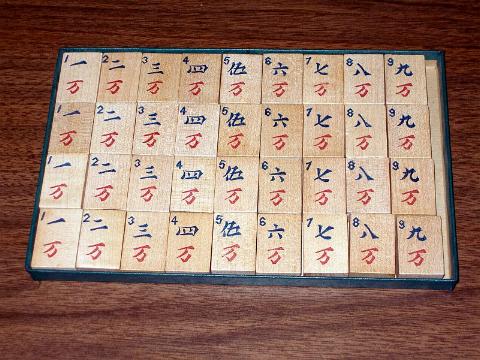


Hi Bruce, well, let's see...
1920-23 Parker Brothers tileset with Babcock rules.
1923. See FAQ 11.
The box is in very good condition except for the lid
Yes. The box is your set's weak point. I have two of these sets in my collection - one box is in worse condition than yours.
The tiles have some color variations but they seem like normal variations to me rather than stains
I agree. By the shine of your tiles, I'd say your tiles are in excellent condition.
 manual in very good condition. manual in very good condition.
Nice. The box and the manual (both being made of paper) are key components of these maple sets.
I'd say your set is worth about fifty dollars, give or take. That's in keeping with what I paid for my two sets also. If the box was perfect, it'd be worth maybe $75 or $80.
May the tiles be with you.
Tom Sloper / トム·スローパー
/
湯姆 斯洛珀 / 탐 슬로퍼
Los Angeles, CA (USA)
February 28, 2008
Author of "The Red Dragon & The West Wind," the definitive book on mah-jongg East & West. Available at bookstores, BN.com, and Amazon.com.
What happens if someone has wrong tile count and the dealer hasn't discarded yet?
>From: Jenny Sullivan
>Sent: Thursday, February 28, 2008 4:02 PM
>Subject: Mah-Jongg Q+A
>My mah-jongg question or comment is:
>If players get confused during the Charleston, resulting in too many tiles in one hand and too few in another, are both dead? Or does the rule ["Too Many/Few Tiles - Player is holding 12 or less tiles (13 or less after picking) - or player is holding 15 or more tiles (14 or more between turns)"] go into effect after East discards the 14th tile and play begins?
Hi Jenny,
See Rule 9 on page 18 of your NMJL rulebook - rule 92 on page 60 of my book. Nobody's dead if the dealer hasn't discarded yet. They should rectify the error if possible (FAQ 9, above left), else everyone throw their hands in and redeal.
May the tiles be with you.
Tom Sloper / トム·スローパー
/
湯姆 斯洛珀 / 탐 슬로퍼
Los Angeles, CA (USA)
February 28, 2008
Author of "The Red Dragon & The West Wind," the definitive book on mah-jongg East & West. Available at bookstores, BN.com, and Amazon.com.
Trying to figure out the original purpose of my 172-tile set
>From: Bruce Bacher
>Sent: Thursday, February 28, 2008 5:47 AM
>Subject: tile set question
>I've read your FAQ entries about tile sets and still have a question about a set I've acquired.
>
>It's made of bakelite, so that makes me think it might be rather old. The symbols and pictures are pressed into the tiles (rather than hand carved), so that makes me think it was mass-produced (and maybe not so old?). The coloring/painting on the symbols is rather sloppy in places, so that makes me think it's not high quality. OK so far.
>
>There are 172 total tiles, which is more than I've seen mentioned for any set of rules in your FAQ. There are 32 special tiles, including those like in the FAQ that say "one year four seasons", the set of four scholarly skills (calligraphy, painting, etc.), animal tiles (cat, rat, rich man, and pot o' gold), various flowers, and various people. The FAQ says somewhere that flowers and jokers were added to sets to accommodate American MJ rules, increasing the total number of tiles in those sets. But, none of the sets you mention has as many as 172, and none of my tiles are obviously jokers.
>
>Somewhere in the depths of my memory I seem to recall a set of rules that requires 172 tiles. Maybe I saw it mentioned in the 4WMJ game? Do you know of a ruleset that specifies 172 tiles?
>
>I'm just curious whether this tile set was made for any particular set of rules, or whether it just allows the players to choose which types of flower tiles they want to play with.
>Thanks for any help/wisdom you can provide.
>--
>Bruce Bacher
Hi Bruce, your question is:
I'm just curious whether this tile set was made for any particular set of rules, or whether it just allows the players to choose which types of flower tiles they want to play with.
Those aren't the only two possible explanations for why your set has 36 flowers. (You didn't give me your flower count, so I had to do math. 172-136=36.) I'm pleased that you did your homework before asking, though. You read FAQs 7a, 7e, and 19. But I don't think you looked at FAQ 2b.
Yes, your set is old - somewhere between 30 and 70 years old. Most likely it was made in the early 50's (making it ~50 years old). As you can see in Column 311, the NMJL required 24 flowers then. So your set's manufacturer probably just wanted to anticipate where the NMJL might go with the flower count. That's my guess as to why your set has 36 flowers.
May the tiles be with you. Oh wait, they already are. In abundance!
Tom Sloper / トム·スローパー / 湯姆 斯洛珀 / 탐 슬로퍼
Los Angeles, CA (USA)
February 28, 2008
Author of "The Red Dragon & The West Wind," the definitive book on mah-jongg East & West. Available at bookstores, BN.com, and Amazon.com.
Two questions about death (in two emails)
>From: "Vicki Davis" (vickser)
>Sent: Wednesday, February 27, 2008 10:25 PM
>Subject: Mah-Jongg Q+A
>> My mah-jongg question or comment is:
>> Can you explain the advantage of calling another player's hand dead?
Hi Vicki,
The dead player stops removing tiles from the wall. Your chances of picking a needed tile go up. To put it simply (and probably not entirely accurately, due to the complications of "combinatorics"), your chances of getting that tile go up from 25% to 33.3%.
>From: "Vicki Davis" (vickser)
>Sent: Wednesday, February 27, 2008 10:26 PM
>Subject: Mah-Jongg Q+A
>> My mah-jongg question or comment is:
>> If a player calls Mahj in error, are her Jokers available for replacing?
>> (Thanks!)
Well, Vicki, it depends. Read FAQ 19P.
May the tiles be with you.
Tom Sloper / トム·スローパー / 湯姆 斯洛珀 / 탐 슬로퍼
Los Angeles, CA (USA)
February 27, 2008
Author of "The Red Dragon & The West Wind," the definitive book on mah-jongg East & West. Available at bookstores, BN.com, and Amazon.com.
Is this legal? I think it's rude!
From: "█████ █████"
Sent: Tuesday, February 26, 2008 6:36 PM
Subject: Mah-Jongg Q+A
> My mah-jongg question or comment is:
> I play with someone who grabs her tile and holds her hand on it while
> she waits for the person before her to discard. She does this so she
> can quickly grab it and put it in her rack so no one can call the tile
> discarded before it. Is this legal? I think it's rude!
From: "█████ █████"
Sent: Tuesday, February 26, 2008 6:37 PM
Subject: Mah-Jongg Q+A
> My mah-jongg question or comment is:
> Just realized she might see this - please disregard last question, or
> at least please don't post my screen name.
> Thanks.
Hello █████,
Read FAQ 19R (above left). Now get out your 2007 NMJL card, and look at the back. Left pane, the numbered list of rules at the bottom. Rule #1. It says in all capital letters, NO PICKING OR LOOKING AHEAD. Now get out your January 2008 bulletin from the National Mah Jongg League. Turn to the 4th page (counting the front cover as "page 1"). At the very top, it says:
"The practice to pick and rack a tile makes it extremely difficult for anyone to claim the previous discard. It is ungracious and aggressive." - Tom Sloper
The League is in agreement.
I assume that answers your question as to whether it's legal, and whether it's rude. Now all that remains is what you should do about it. Right? Well, that depends. Do the other players think this is a good way to play? If not, then you need to get the group to take a vote. Read FAQ 14.
What shall our table rule be: is picking ahead to be allowed? Yes/no.
Shall we permit "pick&rack"? Yes/no.
In normal settings, if a player touches the wall tile before it's her turn, she's declared dead and sits out the remainder of the hand.
I propose that the better way to do things (as opposed to "pick&rack") is to pause a beat after a player discards. Give it at least a second, then reach for the wall and take. It's OK to quickly rack it, once you've done that.
Even players who usually play with future tiles (that's "picking ahead") have rules to handle what to do if someone wants to call a discard. There has to be a rule that a player has, say, 3 seconds in which to call a discard, regardless of whether someone has racked her future tile or not. But don't ask me how that ought to work, because it's against the official rules - meaning, people shouldn't even be picking ahead anyway.
But that's just my opinion.
May the harmony be with you (see FAQ 9).
Tom Sloper / トム·スローパー
/
湯姆 斯洛珀 /
탐 슬로퍼
Los Angeles, CA (USA)
February 26, 2008
Author of "The Red Dragon & The West Wind," the definitive book on mah-jongg East & West. Available at bookstores, BN.com, and Amazon.com.
How do I reach your "Tiles For Sale" and "Tiles Wanted" bulletin boards?
>From: YEOLJUNKER
>Sent: Tuesday, February 26, 2008 12:33 PM
>Subject: Mah-Jongg Q+A
>You mentioned in your q & a "Tiles For Sale & Tiles Wanted bulletin boards". How do I reach them? Thanks,
>Rhoda
Hi Rhoda,
There are links to the bulletin boards ("BB's") above left. If that tells you everything you need to know, you can skip reading steps 1-9 of the following detailed instructions.
At the right-hand side of this browser window there is a "scroll bar." Move the mouse to the right until the cursor is on the scroll bar.
There's a little blue square in the scroll bar. Move the mouse in such a manner as to cause the cursor's arrow point to be superimposed on the little square.
Press down on the left mouse button. This causes the little square to move up and down within the scroll bar, as indicated by forward/backward movements you make with the mouse.
Push the mouse away from you, causing the little square to move upwards within the scroll bar, until the little square is at the very top of the scroll bar.
Now you're at the very top of this bulletin board. Your eyes are looking at the right side. Move your eyes to the left side.
At the left side of the very top of this bulletin board, look at the "Site Links." You will find both the "Tiles For Sale BB" and the "Tiles Wanted BB" listed there.
Lift your finger off the left mouse button.
 Move the mouse towards the left, causing the cursor to move to the left. Keep moving the cursor towards the left until it's pointing at (and superimposed on) either "Tiles For Sale BB" or "Tiles Wanted BB." Move the mouse towards the left, causing the cursor to move to the left. Keep moving the cursor towards the left until it's pointing at (and superimposed on) either "Tiles For Sale BB" or "Tiles Wanted BB."
 Press the left mouse button to follow the link and go to the indicated bulletin board. Press the left mouse button to follow the link and go to the indicated bulletin board.
Read the bulletin board's instructions.
Tom Sloper / トム·スローパー
/
湯姆 斯洛珀 /
탐 슬로퍼
Los Angeles, CA (USA)
February 26, 2008
Author of "The Red Dragon & The West Wind," the definitive book on mah-jongg East & West. Available at bookstores, BN.com, and Amazon.com.
Is there something wrong with my set?
>From: rswinner
>Sent: Thursday, May 24, 2007 11:25 AM
>Subject: Mah-Jongg Q+A
>My mah-jongg question or comment is:
>I have a Mah Jong set . Which I think is a travel set .It is in a old battered leather case.which looks very old.
>The tiles measure:- 3cm long. A little less than 2.5cm wide ,1.5cm deep .There are 144 pieces plus four blank tiles. They are made in one piece ie they dont have a bambo base.
>The four flower tiles are numbered 1.2.3.4. but the Season tiles (which seem to have fruit symbols on them) are labelled N.S.E.W. I have looked on your site and the marjong museum site and all the Season tiles are numbered 1.2.3.4. Is there something wrong with my set ?
>Regards Ray
Hi Ray, you asked:
Is there something wrong with my set?
No. Read the first paragraph in FAQ 7e.
May the tiles be with you.
Tom Sloper / トム·スローパー
/
湯姆 斯洛珀 /
탐 슬로퍼
Los Angeles, CA (USA)
February 26, 2008
Author of "The Red Dragon & The West Wind," the definitive book on mah-jongg East & West. Available at bookstores, BN.com, and Amazon.com.
2 F.A.Q.'s 4 U
>From: Bob and Laurie
>Sent: Tuesday, February 26, 2008 7:12 AM
>Subject: Questions on rule
>Mr. Sloper,
>Question 1: Calling a hand dead.
>Player 1 exposed two exposures (correct). Player 2 calls the hand dead because she insists there is no hand with those exposures. Player 1, to prove hand is correct, exposes right away and points out the hand before game is finished. What is the penalty for these two players.
>Do the remaining two players continue play? What if a mahjongg is made by remaining player.
>Question 2: Incorrect exposures
>Player calls a tile and exposes but does not discard. She then decides she doesn’t want the exposure.
>We know she can add or subtract from an exposure, but can she take the exposure back?
>Thanks,
>Laurie
Hi Laurie, you asked:
What is the penalty for these two players.
As you can see in FAQ 19AB (above left), Player 2 would normally owe Player 1 a quarter. But Player 1, having exposed her hand before it's mah-jongg, rightly ought to be declared dead, I suppose. And a dead player doesn't collect points (or coins) from any other player. The 3 surviving players ought to continue playing. And Player 1 should bone up on the rules, buy a good rulebook. [Cough] Note that no rulebook describes what to do in the instance you describe, because it's totally weird that anybody would expose her hand just to show that she isn't dead. She killed herself, saying "I'm not dead" all the while. Bizarre, actually! (^_^)
can she take the exposure back?
"Change of heart" rules are given in FAQ 19AM. Your group is badly in need of a good rulebook! [Cough] At the very least, you should print FAQ 19 and keep a hard copy handy when playing.
May the tiles be with you.
Tom Sloper / トム·スローパー
/
湯姆 斯洛珀 /
탐 슬로퍼
Los Angeles, CA (USA)
February 26, 2008
Author of "The Red Dragon & The West Wind," the definitive book on mah-jongg East & West. Available at bookstores, BN.com, and Amazon.com. [Cough]
How much can I sell my partial set for?
>From: YEOLJUNKER@███.███
>Sent: Monday, February 25, 2008 8:47 PM
>Subject: Mah-Jongg Q+A
>My mah-jongg question or comment is:Are there any buyers for partial mah jongg sets. I have 74 pieces and 19 sticks from an old 1920's set, only three racks (wood with the slides).They are the bamboo and what I thought were ivory, but I guess they are bone.If I put them on Ebay, what do you think a fair price for them would be? Thanks, Rhoda
>
>From: YEOLJUNKER@███.███
>Sent: Monday, February 25, 2008 8:49 PM
>Subject: (no subject)
>I don't know whether or not you need my Email Address Rhoda - it is Yeoljunker@███.███
>Thanks,
Hello Rhoda,
Sure, people sell things like that all the time. But I can't tell you what price your partial set should sell for. Why don't you go on eBay and watch what other partial sets go for? Some people just sell the sticks only, and the 3 racks only, and the tiles in a third sale. (BTW, you should use the word "tiles" instead of "pieces" -- and I don't know what a "slide" is. I assume your sale will include photos.)
May the sale be with you.
Tom Sloper / トム·スローパー
/
湯姆 斯洛珀 /
탐 슬로퍼
Los Angeles, CA (USA)
February 25, 2008
Author of "The Red Dragon & The West Wind," the definitive book on mah-jongg East & West. Available at bookstores, BN.com, and Amazon.
Last year I sent a check to the Maj jong league and never received my card.
>From: JSGALE@
>Sent: Monday, February 25, 2008 8:39 AM
>Subject: Mah-Jongg Q+A
>My mah-jongg question or comment is:
>Last year I sent a check to the Maj jong league and never received my card. I called several times and they said they do not have me in the comoputer and after several frustrating calls I just went out and purchased another card. Now wehn I am going thru my check for my income tax for last year well lo and behold I found my check. I could not give them info at the time because the check had not come thru. Now I need to write a letter, I guess, ore email and tell them I have the check and if I can get the new cared for 2008 for this year since they did cash my check but must have sent my card to someone else since I never received it. Well what do you think????
I think I don't know why you're asking me my opinion, Mr. or Ms. Gale. You should put a photocopy of the cancelled check in the letter -- that'll definitely strengthen your position. And check the price. It might have gone up since last year. Good luck, and in the future it would be just fine by me if you'd leave me out of it. (I don't want other folks to get the idea that they should come to me with this sort of thing.)
May the customer satisfaction be with you.
Tom Sloper / トム·スローパー
/
湯姆 斯洛珀 /
탐 슬로퍼
Los Angeles, CA (USA)
February 25, 2008
Author of "The Red Dragon & The West Wind," the definitive book on mah-jongg East & West. Available at bookstores, BN.com, and Amazon.com.
He's asking 350 pounds, Part 2
>From: Rosey Chan
>To: Tom
>Sent: Saturday, February 23, 2008 3:20 PM
>Subject: Thank you so much Tom -
>□Thank you so much Tom !!
>I have a few answers from the Mahjong antique seller -- hoping you can help me as i urgently need to buy in the next day or two so Im wondering if you think if its worth it after seeing some more images up close and a few answered questions...
>□ Should i try to barter him down ? and if so - Do i have a strong case to ? - Also - do you happen to know any one i could buy off that you could recommend ?
>I'd really appreciate your help□
>Thank you so much
>Rosey□
>PS - If you are in NYC in March - I'd like to send you an invite to a concert (if you like classical concerts! ) □
Hello again, Rosey, you wrote:
Im wondering if you think if its worth it
I already told you the answer to that one, Rosey. Click here, or just scroll down and read my previous response again.
Should i try to barter him down ? and if so - Do i have a strong case to ?
I already told you. You should tell him, "It's not worth anywhere near 350 pounds, you git! Get off it!" (Did I get my British English right?) (^_^)
Also - do you happen to know any one i could buy off that you could recommend ?
Read FAQ 7j and FAQ 7k and go have a look at Gareth Saunders' website (you'll find a link to it in FAQ 7k). Honestly, after I posted my first response, I don't know why you're still interested in buying this thing from this guy. Unless you're totally enamored by the box or something (it has nothing else special about it, as I already told you).
If you are in NYC in March
Well, thanks, but it's pretty unlikely that I'd be in New York next month. It's not a place I go to very often. Let's see, last time I was there was January 2001. Seven years ago. Just a handful of months before the world changed forever... [sigh]
May THESE tiles NOT be with you.
Tom Sloper / トム·スローパー
/
湯姆 斯洛珀 /
탐 슬로퍼
Los Angeles, CA (USA)
February 23, 2008
Author of "The Red Dragon & The West Wind," the definitive book on mah-jongg East & West. Available at bookstores, BN.com, and Amazon.com.
 CLICK HERE to read older Q&A postings!
|


 SITE LINKS


