The rectangle with E 2 3 4, part 2
On Monday, May 18, 2026 at 06:18:39 PM EDT, Denise wrote:
Subject: Rectangle with E 2 3 4
Sent from my iPad
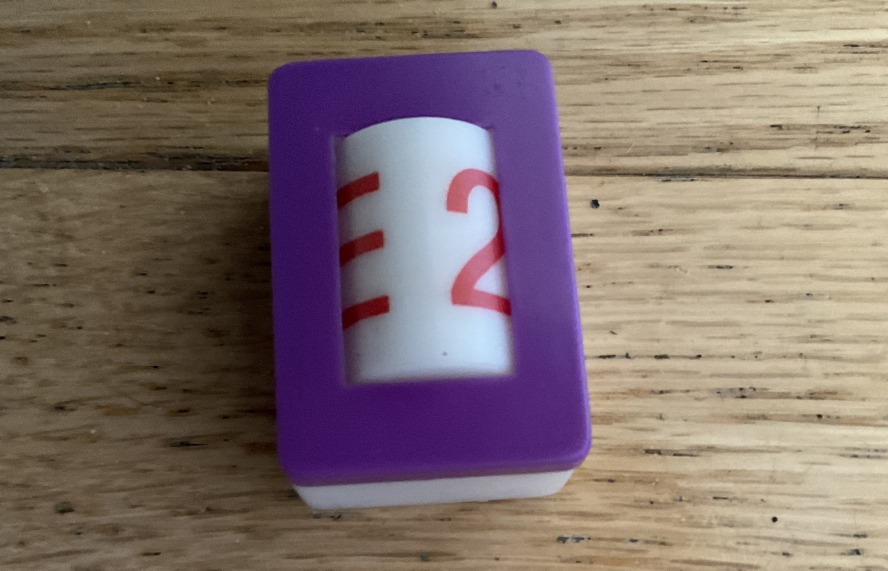
 Perfect! Thanks, Denise! Yes, it's definitely a bettor / wind indicator. In American mah-jongg, the 5th player rotates the cylinder to the number or letter corresponding to the bet-on player's seat at the table. Perfect! Thanks, Denise! Yes, it's definitely a bettor / wind indicator. In American mah-jongg, the 5th player rotates the cylinder to the number or letter corresponding to the bet-on player's seat at the table.
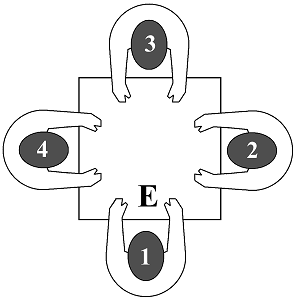
May the tiles be with you.
Tom Sloper
May 18, 2026
The rectangle with E 2 3 4
On Monday, May 18, 2026 at 05:45:12 PM EDT, Denise wrote:
Subject: Mah-Jongg Q+A
My mah-jongg question or comment is:
How is the rectangle with E 2 3 4 used?
Sent from my iPad
囧 Hi, Denise!
Without seeing it, I have to assume it's a "bettor," for use by the 5th player in the process of betting on which player will win. Asian mah-jongg sets often come with a "wind indicator" and when those pieces are in an American set, a "wind indicator" becomes a "bettor." Your piece is intended as a bettor, but could be used as a wind indicator in an Asian mah-jongg game.

Sorry, TMI! (^_^)
The 5th player (confusingly also called a "bettor") walks around the table at the end of the Charleston and decides which hand looks most likely to win, and uses the bettor to indicate and record her bet. Then she stays away from the device until the game is over, so she can't change her bet.
E stands for East, the player who rolled dice to begin the game. Player 2 sits to East's right, and so on around the table. As I say, I can't see your bettor, so I can't be more specific than that. I'd love to see your rectangle, if you can send me a picture. I'll post it in FAQ 7d, the "Bits & Pieces" FAQ.
May the tiles be with you.
Tom Sloper
May 18, 2026
She claimed Mahjongg but questioned if she really had won.
On Sunday, May 17, 2026 at 10:47:58 AM EDT, Kathy S wrote:
Subject: Mah-Jongg Q+A
My mah-jongg question or comment is: yesterday when our group of four met playing Chinese Mahjongg one of the gals had a flush with two four tile kongs. She took her extra tiles for the kongs, she also had a set of three and a pair. She claimed Mahjongg but questioned if she really had won. Another player said she hadn’t since she did not have four sets and the pair. Is that correct or could she have had Mahjongg with just the two kongs?
Thank you?
Sent from my iPhone
Hi, Kathy! She could not declare mah-jongg with two kongs, a pung (or chow) and a pair. The other player was right that she needs four sets and a pair, not three sets and a pair. What confused her was the tile count.
If you count a kong as four tiles, she had 4+4+3+2 - that's only 13, and it takes 14 to win.
But you can't count it that way with kongs in Chinese/Asian/nonAmerican mah-jongg. A kong is just an exalted pung. FAQ 20.d..
Pretend the kong is a set of three. That's why you take a replacement tile. What she needed was a fourth set - a pung, kong, or chow, it doesn't matter (in terms of tile count). Kong, kong, pung, pung, pair - the literal tile count is 16 but you don't count them that way. It's four sets and a pair.
May the tiles be with you.
Tom Sloper
May 17, 2026
Three-player, Babcock style, with triangular wall
On Thursday, May 14, 2026 at 01:18:49 PM EDT, Patricia P wrote:
Subject: Triangular tile wall
Hello! I was reading the 1920 Babcock Mahjong booklet and noticed that it mentions a three player version with some tiles removed and a triangular tile wall. It looks interesting and we might try it in our Chinese mahjong group. My question is this: Have you seen or heard of people playing this version? Thank you for all you do!

On Thursday, May 14, 2026 at 01:20:33 PM EDT, service@paypal wrote:
Subject: Reference: MJ@Sloperama Sloperama Mah-Jongg Answers - Donation from Patricia P
Hello Thomas Sloper,
Donation Received
This email confirms that you have received a donation of $15.00 USD from Patricia Pickens
You can view the transaction details online.
Donation Details
Total amount: $15.00 USD
Currency: U.S. Dollars
Purpose: Sloperama Mah-Jongg Answers
Contributor: Patricia P
Message: Thank you!
PayPal
 囧 Thank you very much for the donation, Patricia, but all I can say in answer to your question is "no, I have not."
May the tiles be with you.
Tom Sloper
May 14, 2026
Mahjong set values, part 2
On Wednesday, May 13, 2026 at 02:32:53 PM EDT, Sandra C wrote:
Subject: Re: Mahjong set values
Thanks very much, Tom. I did find your response.
Most useful.
Sandra
You're welcome, Sandra.
May the tiles be with you.
Tom Sloper
May 13, 2026
Mahjong set values
On Tuesday, May 12, 2026 at 07:19:26 PM EDT, Sandra C wrote:
Subject: Mahjong set values
Hi,
I inherited 2 mahjong sets from my grandmother and my mother, both of whom have passed away. One set has been used a lot and is in really good condition. The other has the tiles stil wrapped in the original packaging along with the racks. I'd really appreciate you giving me your thoughts on their value. I'm not a mahjong player, nor do I intend to become one.
I've tried to follow your request on what information you want in order to give your opinion. Here is the breakdown of what's in each case with photos:
Many thanks,
Sandra C
Black leather-like case
Condition – clean, fine
Coins - 25 each of Blue, Red, Green and White = 100
Racks – 5
2 green
1 yellow
1 red
1 brown
Wind indicator – 1 brown
Tile size- 1” x 1 ½” ’x ½”
Color – black and red color on white tiles
Die - 2
Case - Leather-like materials– Letter B applique near handle – some scratching on the back.
Interior has some wear and tear.
One corner of an interior box has the corner taped
Tiles – Bakelite, excellent, do not know when it was made, inherited from my grandmother who was born in 1904
Dots – 36
Bams – 36
Craks – 36
Winds – 16
Dragons – 12
Jokers ` 8
Blank - 2
Other – 12
Other – 8
Total = 16


Atlas brown – Unused
Condition – As New (tape on one the tile sets – the original plastic wrapping broke when I took it out to photograph it.)
Tiles: 166 – black, red and green coloring
Did not unpack
80 in each set = 160 boxed
Tile size: 1 3/8” x ¾” x ½ “
Blanks - 4
Extra jokers - 2
Die - 3
Cylindrical style wind indicator - 1
I look forward to hearing from you.
Many thanks,
Sandra C


囧 Hi, Sandra. Two sets, hmm?
The Black case set
Before you get your hopes up, this is a fairly ordinary set, in less than optimal condition.
The case is fairly beat up. I see that the interior tile trays are well-worn at the corners. There's a stain in the case's interior bottom surface.
The tiles are not Bakelite but more likely high-density polyethylene. You say the condition of the tiles is "excellent," but the pictures of the tiles are too small for me to verify that. You say there are 20 "other" tiles. I have to assume those are flower tiles, but I can't verify that. Because the set has more than 8 flowers, we know the set was made after 1971.
The brass ends of the racks look tarnished. Because the set has 5 racks, we know the set is older - say, the 1970s, not the 1990s when new sets contained only 4 racks.
Plain white dice, and I can't make out that round brown thing in the first two pictures.
I know you've seen this already, but to review, this is the condition terminology I use:
1) Mint: Item appears to have not been used before (old new stock). Condition is 99%
2) Near Mint: Item has been used before but is close to perfect. There may be slight scratches but is only noticeable upon close scrutiny. Item is 90% upwards.
3) Excellent: Item is still in overall bright condition and maintains 85%-90% of new condition. Will have some wear blemishes or scratches, though light.
4) Very Fine: Item may have chips, dings, dents, cracks or scratches and maintains 80 to 85% of new condition.
5) Fine: Item may have minor repairs or restoration. It may have chips, dings , dents, cracks or scratches and maintains 75 to 80% of new condition.
6) Very Good: Item has clear visible blemishes and scratches and has visible repairs and/or major restoration. It may have plating or gilt loss. Maintains 70%-75% of new condition.
7) Good: Item is well used with dents, dings, chips, cracks or scratches with possible major repairs and missing pieces. Generally maintains less than 70% of new condition.
Based on your pictures and assumptions I have to make,
Case - around 75 to 80% of new condition ("Fine").
Tiles - unknown. You said they're Excellent, but I can't verify it and I have to assume they're Fine like the other parts.
Racks - Fine, 75-80% of new condition
In all, the set is Fine, it looks its age and it looks well used. Value is probably around $160-170.
Atlas case
This is a newer set, could have been made in the 1990s-2020s. Standard stuff, like the older black case set. In the nineties, a set like this would have gone for around $120. That $120 in the nineties would be about $260 today. But new American sets today are still under $200. Call it $180.
By the way, die is the singular of dice. "Roll three dice." "Roll one die."
May the tiles be with you.
Tom Sloper
May 12, 2026
Isn't it first called first gets?
On Thursday, May 7, 2026 at 10:04:28 PM EDT, Anne M wrote:
Subject: Mah-Jongg Q+A
My mah-jongg question or comment is: I called for a tile. Then the person who is next for a turn said no I want that tile and took it. Is that correct? Not first called first gets? Neither of us had mahjong nor started exposing - slamming.
Thank you-
Anne
Sent from my iPhone
That's correct, Anne. It's not a race with the first to speak getting the tile. Take a look at the back of your card. Left panel, the bottom half, "CLAIMING A DISCARD."

Rule 4, "When two players want..." That tells you right there that the player next in turn takes priority. Ya gotta read it.
There are also ifs and excepts. But now you know that it's not first called first gets.
May the tiles be with you.
Tom Sloper
May 7, 2026
She misnamed her joker discard, part 2
On Thursday, May 7, 2026 at 07:33:31 PM EDT, Sheila S wrote:
Subject: Re: Mah-Jongg Q+A
I saw the posting! Thanks! The misnamed tile (2dot) was really a joker.... she called Mahjong on that joker thinking it was a 2dot!
Yes, I knew that. That's what I was talking about.
I was just saying (that there is one scenario in which the misnamer might not have been a misnamer. Discarding a joker, you can say "joker" or you can say the name of the previous discard or you can say "same." If the player before the misnamer discarded a two dot, and then the player before Annie said "two dot" when discarding the joker, That's not a mistake that the "misnamer" gets penalized for - it's permitted under the rules. But if that's what was going on, Annie would have called the first one.
That's what I meant when I said "I am assuming the discard just before the misnamer's turn was NOT a 2-dot."
But (I assume, since I wasn't there) that's not what happened. Why is unknown. That person who threw the joker, maybe she had 2-dots on the mind and blurted that, or maybe she misunderstood the rule about what you can say when discarding a joker - who knows why she said 2-dot when the previous discard wasn't a 2-dot.
As I said, yes she has to pay Annie 4x the value of the hand, precisely because the mistaken thing she said gave mah-jongg to a player and ended the game for everyone.
If (instead of the misnamer paying Annie) ...IF everyone paid Annie normally, the amount Annie would collect on a 25¢ hand (the most common value) would be a dollar (4x the score) - double from the discarder, and single score from the other two players - usually, 50¢ and 25¢ and 25¢.
But the misnamer pays that for everyone.
May the tiles be with you.
Tom Sloper
May 7, 2026
She misnamed her joker discard; does she have to pay for the party?
On Thursday, May 7, 2026 at 05:55:47 PM EDT, Sheila S wrote:
Subject: Mah-Jongg Q+A
My mah-jongg question or comment is:
Thank you so much for being around to help us out. I've been playing Mahjong for around 50 years. Somebody the other night threw a joker and called it a 2-dot. Annie yells Mahjong. Does that person who threw the joker have to pay Annie 4x the value of the hand?
Thanks!!! [heart emoji]
That's exactly right, Sheila.
I am assuming the discard just before the misnamer's turn was NOT a 2-dot. (Annie would have called for that.)
The misnamer pays Annie, and nobody else pays Annie. It's a mistake that costs the mistaker.
The rule is on the back of your 2026 card. Middle panel, right up top. It's also in MJME2023/24, page 16, rule 3. It's also in FAQ 19-AY.1.


May the tiles be with you.
Tom Sloper
May 7, 2026
What if my Pure Shifted Pungs include a Melded Kong, part 2
On Thursday, May 7, 2026 at 12:05:21 AM EDT, lynnandstevep wrote:
Re: Chinese Mahjong question
As always, thank you!!! A kong is an “exalted” pung!!! lynn
May the tiles be with you, Lynn.
Tom Sloper
May 7, 2026
What if my Pure Shifted Pungs include a Melded Kong?
On Wednesday, May 6, 2026 at 08:18:53 PM EDT, <lynnandstevep> wrote:
Subject: Chinese Mahjong question
Hi Tom,
It’s been a very long time since our group has had a question. We are the group from Bishop , CA and have been playing now for 18 years. None of us can remember if this ever came up.
Chinese page 149 #24
Pure Shifted Pungs
Today I had a full flush of Bams in which I also had:
Three 4’s, three 5’s, and a kong of 6’s. Does this still qualify for Pure Shifted Pungs?
As always, we have always used your book and guidance
Everyone new to the game all seem to be learning American. We still prefer Chinese.
Thanks in advance for your answer. Lynn P
Yes, Lynn, you can claim Pure Shifted Pungs if one of your pungs is a kong. Reasoning: see p. 187, fan 59. An exposed/melded dragon kong counts as a Dragon Pung (fan 59) and also as a Melded Kong (fan 74). So if a kong fits as a pung into a combo like Pure Shifted Pungs, the pung combo may be legitimately claimed together with the point for one of the sets being a kong.
Besides, run this against the Principles for Scoring the Hand (p. 194):
1. Prohibition against implied inclusions
The kong is not inherently implied by the description of Pure Shifted Pungs, so no problem there...
2. Prohibition against separation
No separation needed to claim Pure Shifted Pungs. Okay so far...
3. Prohibition against identical patterns
No identical pattern involved.
4. Freedom of choice principle
There's no either-or choice to make. Not applicable.
5. Prohibition against repetitive set usage ("combine-just-once")
It's being combined just once.
So our combining Pure Shifted Pungs with Melded Kong is not kiboshed by the Principles.
Nothing says the two fan can't be combined.
A kong is really just a glorified pung, so a kong may be counted as a pung. Certainly not the other way around!
May the tiles be with you.
Tom Sloper
May 6, 2026
Which rule applies, part 2
On Wednesday, May 6, 2026 at 11:53:29 AM EDT, Leslye G wrote:
Subject: Re: Question
You are just the best! You provide such valuable credibility when trying to share rules and thinking with others. Thank you!! — Leslye
Thank you, Leslye!
May the tiles be with you.
Tom Sloper
May 6, 2026
Which rule applies to this situation?
On Tuesday, May 5, 2026 at 10:31:29 PM EDT, Leslye G wrote:
Subject: Question
Hi Tom,
A player took an incorrect tile from the correct wall, but did not yet rack it. Is the player dead? I assume the following rule applies, but does not explicitly address this question. (Specifically, the tile the player moved from the wall was the next top tile, but the bottom tile under the previous pick was next to be picked).
A: 1. Picking from the wall. After you've lifted or moved the wall tile, you may not change your mind and put it back. (You can reach for it and change your mind. You can even touch it and change your mind. But if you lift it or move it, it's yours and you have committed to taking it.)
Thank you, as always,
Leslye
Hi, Leslye. No, that's the answer to the question "Can I change my mind about picking from the wall?" (FAQ 19-AM).
What we're dealing with here is FAQ 19-AA - "what happens if someone takes an incorrect tile from somewhere in the wall."
The rules in FAQ 19 are all based on League rulings. These rules specifically address picking from the wrong end (MJME 2023/24 p.20, rule 15 (j)) or from the wrong wall segment (p.19, rule 15 (i)), but I believe this rule must apply to taking any incorrect tile from anywhere in the wall.

If you apply the "after you've moved it, it's yours" rule (p. 18, rule 12) to picking a tile from anywhere in the wall, then the player is stuck holding the wrong tile, which is illegal to be taken and can't be put back, you get the same result - player's hand is dead. In a tournament, It's highly likely that the player's hand would be disqualified. Many players in private "friendly" games would likely let the player put it back. Especially when one considers the entirety of rule 15 (i):
If a player picks from the wrong wall and a tile from the wrong wall is racked, the player who picked the tile now has a 'dead' hand."
I added those italics. The italicized words indicate the possibility of a loophole or exception to rule 12 on p. 18 (the "after you've moved it, it's yours" rule). If you pick from the wrong spot on the wall and before racking it you immediately realize the error (and it's not a tournament, which are not governed by the League anyway), maybe you're allowed to put it back. An argument could be made, based on this loophole, that the player can put it back!
May the tiles be with you.
Tom Sloper
May 6, 2026
Typo in FAQ 16, part 2
On Tuesday, May 5, 2026 at 04:59:38 PM EDT, Jim T wrote:
Re: 2026 NMJL Card FAQ typo/misprint
Hi Tom!
Thanks for the response. After I sent that email I went through the rest of the FAQ (https://sloperama.com/mjfaq/2026.html) and I noticed another typo. In the entry for Consecutive Run #4 (the most powerful hand on the card) it states "Any 1 or 3 Suits, Any 3 Consec. Nos." and it should be "Any 1 or 2 Suits, Any 4 Consec. Nos.".
With the help of your FAQ, I think I'm getting the hang of reading the card.
-Jim
Thanks, Jim! Glad to hear the FAQ is helping you. I made the fix.
May the tiles be with you.
Tom Sloper
Cinco de Mayo, 2026
Typo in FAQ 16
On Tuesday, May 5, 2026 at 03:36:21 AM EDT, Jim T wrote:
Subject: 2026 NMJL Card FAQ typo/misprint
Hi Tom,
I just received the 2026 NMJL card purchased directly from them. In
your FAQ, the 2026 #4 entry is printed in two colors (the pair and the
two pungs), yet the parenthetical note specifies Any 3 Suits. Your
description would lead one to believe it's Any 2 Suits and in fact the
NMJL card specifies Any 2 Suits. As someone just getting into Mah
Jongg, I was confused by your FAQ until I looked at the entry in the
NMJL card.
Just thought you might want to know. I'll have to check out your site
more thoroughly - it looks like a lot of good information for a beginner
like me.
-Jim
囧 Hi Jim! Thanks for letting me know about the typo in FAQ 16. You're quite right that the parenthetical is supposed to say 2 suits. I fixed it, thanks to you. By all means, check out the site! If you find any more errors or if you have questions, just let me know.
May the tiles be with you.
Tom Sloper
Cinco de Mayo, 2026
Can I call Mah Jongg if it’s not my turn, part 3
On Monday, May 4, 2026 at 08:14:27 PM EDT, Joanne C wrote:
Subject: Re: Mah-Jongg Q+A
Thanks. I am going to stick with the “general” rule. It’s easier.
Warm regards,
Joanne C
Sounds good, Joanne.
May the tiles be with you.
Tom Sloper
May 4, 2026
Can I call Mah Jongg if it’s not my turn, part 2
On Monday, May 4, 2026 at 03:48:28 PM EDT, Joanne C wrote:
Subject: Mah-Jongg Q+A
My mah-jongg question or comment is:
You recently answered my question about “calling Mah-Jongg out of turn.”
I forgot to mention “the person across me had discarded” and the next person did not call, rack, have Mah-Jongg or exchange a Joker. I did not need the discarded tile to make Mah-Jongg. I already had it but just realized it.
Warm regards,
Joanne
Hi, Joanne!
That was on April 24th, and you asked: "Can I call Mah Jongg if it’s not my turn."
Now new information is added to the question. I love information.
Let's put it all together.
1. The player across the table discarded.
2. You didn't need the discard. You just wanted to call mah-jongg because you already had mah-jongg. It wasn't your turn but you didn't want the next player to call mah-jongg before you, so you called mahj.
In this situation, your hand was dead. If you actually were holding 14 tiles at the time Ms. Across discarded, you were holding too many tiles.
Unless...
Does your group {discard, then pick} instead of {pick, then discard}? That's a table rule called various things: "Picking ahead," "playing with a future tile," "playing with fourteen tiles." If your group plays that way, then your hand wasn't dead but I can't tell you how your group's table rules apply to your question.
In general, you can only declare mah-jongg on a discard or when you pick the 14th needed tile from the wall.
May the tiles be with you.
Tom Sloper
May 4, 2026
Seeking advice on how to dispose of our collection
On Monday, May 4, 2026 at 03:21:35 PM EDT, henryisak wrote:
Subject: Re: mah johgg sets
Tom,
Thank you for the quick response. Greatly appreciated.
Interestingly, we don't play the game. We buy them for the beauty of the tiles or the uniqueness of the tile material or the container.
Our granddaughter is coming for a month this summer. I may hire her to create a catalog of what we have. She also has offered to get us set up as a seller on Ebay. We live in Door County, WI, which is a major tourism area. I will talk to some of the antique malls and dealers once the season starts.
I will let you know how any of that works out.
Thank you for the suggestions!
Henry
That's a great idea about riding the tourism season, but if I were you I wouldn't wait for the season to start. Those conversations should take place before then. Good luck!
May the tiles be with you.
Tom Sloper
May 4, 2026
Seeking advice on how to dispose of our collection
On Monday, May 4, 2026 at 12:48:49 PM EDT, Henry I wrote:
Subject: mah johgg sets
Good morning,
Ran across your website while doing research. If you are no longer active, my apologies.
We have been collecting mah jongg sets and paraphernalia for more than 50 years, and have accumulated 100 or more sets (exact count probably unknown!). All sets are older 144 tile sets, bakelite, bone and bamboo, wood, paper, etc.
We are both 80 years old, and the kids are asking us to please dispose of out collections (needless to say, we have more than mah jongg) so they don't have to deal with them.
I am seeking advice on how to dispose of our collection. Any information or suggestions you may have would be appreciated.
Thank you for your time.
Henry I
囧 My family would surely like me to do the same. See FAQ 7n, Tips For Sellers (of mah-jongg sets) - assuming you want to try to sell them. I donated some of mine to a museum. You can also try talking to the owners of antique shops, pawn shops, see if you can't get some takers that way. Let me know what works for you so I can try the same! Good luck to you.
May the tiles be with you.
Tom Sloper
May 4, 2026
Timing a death challenge
On Saturday, May 2, 2026 at 11:51:16 PM EDT, Phillip K wrote:
Subject: Mah-Jongg Q+A
Hi Tom, My mah-jongg question or comment is: player on her turn discarded a tile prior to drawing a tile. Then picked a tile to self-correct, no one called her dead and she proceeded to later win. Is that a legitimate win? Could I have called her hand dead a few turns after her self-correction, when it dawned on me that she had been short a tile when she dicarded without first picking a tile?
Thanks,
Phil
Hi, Phil!
1. Since nobody called her dead, the win was legitimized when everyone paid her for the win. (Or when she declared a win without objection.)
2. No, you shouldn't call her dead a few turns later. You needed to do it at the time the error occurred and was fresh in everyone's short-term memory. Her error went unchallenged at the time -- your making the challenge later risks not having anyone's support, and you could be stuck owing her 50¢.
May the tiles be with you.
Tom Sloper
May 3, 2026
The 1944 NMJL rules
On Saturday, May 2, 2026 at 03:21:41 PM EDT, Theo P wrote:
Subject: 1944 NMJL card play rules
Hi, Tom!
Please let me know if these questions have been answered. I perused you website and didn't see a lot about the historical play.
My wife and I are avid MJ players. We love to play the older NMJL cards, and I have secured all years from 1937 to 2026 except 1937, 1938, 1939, 1942, 1949 and 1952. We are trying to learn how to play the older cards with the rules in play at the time, understanding that over the years there were a number of changes.
I recently used Claude AI to analyze historical sources to summarize the changes to the cards and rules over the years. That is in the attached file if you're interested in it. There are a few gaps that AI couldn't track down, plus a couple of questions my wife and I came up with while trying to play the 1944 card.
Here are the questions regarding the 1944 card and the other years when only flowers were wildcards and there were no jokers:
* Could flowers be used in singles and pairs?
* If you could use them for a single or pair, could they be taken from a discarded tile from another player if your hand was an exposed hand?
* Could you swap a tile for an exposed flower like you can with jokers now (I think the answer to this question is no)?
Thank you!
-Theo
NMJL Card Transition History - Claude AI - April 2026.docx
20.7 kB
Hi, Theo!
1. Yes. They were truly wild flowers.
2. A discard couldn't be called to expose a pair, but it could for mah-jongg (for an exposed or concealed hand). I'm not certain that I've answered your question - holler if I missed it.
3. I was going to say no, because in tracing history of the rules on the cards, I found no mention of joker redemption until 1963, when I also found that Big Jokers were wild for anything, strengthening my reply #1 above.
But then I read the back of the 1944 card where it mentions "exchanges." Left panel, rule 5. "A tile once discarded cannot be exchanged." I presume that to mean exchanged for an exposed flower so I think the answer to this question is yes after all.
And thanks for the AI analysis. I should mention that I'm in the process of analyzing AI-written books on mah-jongg, continuing what I wrote about in column 813.
May the tiles be with you.
Tom Sloper
May 2, 2026
If I send you pictures, part 3
On Wednesday, April 29, 2026 at 06:36:42 PM EDT, Lisa I wrote:
Subject: Re: Set
Thank you so much for all the info! Here is a picture of how they fit in the boxes.
Also, I have tried to go to your instructions for cleaning these tiles, and it says there is an error for that page. Do you have it somewhere else that I could click on?
Sent from my iPad
On Wednesday, April 29, 2026 at 06:37:08 PM EDT, Lisa I wrote:
Subject: Re: Set

Sent from my iPad
Sorry you found a broken link to FAQ 7-o. If you can remember where that broken link is, I could fix it.
As for your photo, this confirms it. The case was not made for those tiles. An obvious mismatch. This is indeed a Frankenstein. The tiles would be very attractive if the tiles were in trays that fit perfectly like a Chinese wood puzzle. But it's a made-for-export Chinese-style set in an American-made container for a set of American-made tiles.
May the tiles be with you.
Tom Sloper
April 29, 2026
If I send you pictures, part 2
On Wednesday, April 29, 2026 at 02:35:46 PM EDT, Lisa I wrote:
Subject: Re: Set
Hi Tom,
Thank you for your quick response to my question yesterday. I am going to attempt to send you a few pictures of the set that I received. It seems like it’s a combination of different things. There are numbers on the tiles like American, there are 144 tiles like Chinese, and the size of the tiles equals a Japanese set according to your dimensions that you listed. There are no white dragons, just blanks. There are four jokers and eight tiles with people on them. I’m guessing I could use those as the jokers. There is this tiny little box of four dice.
I am interested in knowing what type of set you think this is.
The box is very old and the racks are made of a special material, but no pushers on them.
Thank you!


Hi, Lisa!
You say "It seems like it’s a combination of different things." I agree, but it's different different things than you said. You've got ornately carved bone and bamboo tiles in a trumpet-style case with Catalin racks. Those two things don't usually go together. The tiles could have been made anytime between the 1930s and the 1960s, probably in China. The case and racks could have been made between the 1950s and 1960s, probably in America. So I'm going on the assumption that someone decided to marry this odd couple. I often refer to such sets as "Frankensteins" because they're made of parts of different sets. Note, though, that it's possible the tiles and the case and racks were put together by the manufacturer.
You say there are 144 tiles. But you have 148. You said there are no white dragons. But I say the blanks are your white dragons.
108 suit tiles (36x9), 16 winds (4x4), 12 dragons (4x3), 8 flowers (the tiles with people on them), and 4 jokers. 108+16+12+8+4=148.
You mentioned "pushers" and wanting to use extra tiles as jokers, which tells me you want the set to be used to play American mah-jongg. But for American mah-jongg you need eight jokers (152 tiles in all), and you don't have four extra flowers or blanks that could be put to that use with stickers.
The ornately carved tiles were made to play Chinese mah-jongg variants, and the tiles were made for sale in the U.S. The ornate carving makes the tiles more interesting to collectors. You say the tiles are a little smaller (like Japanese tiles), which makes me wonder how snugly they fit into the case. Are there trays to contain the tiles and keep them from rattling around, and how well do the tiles' dimensions fit in the trays. Stuff like that could clarify whether the set is a Frankenstein or not.
May the tiles be with you. (Oh, wait. They already are. I need a sig that covers this situation...)
Tom Sloper
April 29, 2026
Are the jokers atop a dead player's rack available for exchange/redemption?
On Tuesday, April 28, 2026 at 06:35:04 PM EDT, Sandy M wrote:
Mah-Jongg Q+A
My mah-jongg question or comment is:
If a player Mah-jongs on a concealed hand but had called a tile earlier, so was called dead by another player, are the jokers available to other players as they continue playing?
Thank you.
Sandy M
No, they aren't. Because it's now known that the prior exposure was illegal, the exposure is returned to the sloping front of the rack along with all the other exposed tiles. Out of sight, out of mind. No unattainable jokers taunting from atop that rack anymore! See FAQ 19-P for a detailed explanation.
FAQ 19 answers the most frequently asked questions about American (NMJL) mah-jongg rules. Consider bookmarking it for future reference.
May the tiles be with you.
Tom Sloper
April 28, 2026
If I send you pictures...
On Tuesday, April 28, 2026 at 05:28:49 PM EDT, Lisa I wrote:
Subject: Set
Hi Tom,
I just received a Mahjong set that was found in the top of a closet. The set was my husband‘s parents that we think they bought in Hong Kong yers ago. If I send you pictures, would you be able to tell me more about the tiles and the set. I have the case, racks and everything.
Thank you,
Lisa I
Sent from my iPad
Yes, I can answer questions if you ask specific questions and send clear pictures. Some people send me tiny pictures and/or ask vague questions that require me to work hard. You can see examples below (just scroll down until you see pictures of tiles). If you take a look at FAQ 7 you'll see the kind of questions I can answer, and the kind of information I might need along with your questions.
May the tiles be with you.
Tom Sloper
April 28, 2026
Do you have to announce a joker redemption from your own exposures?
On Monday, April 27, 2026 at 07:52:41 PM EDT, Leslye G wrote:
Mah-Jongg Q+A
Good evening Tom,
My mah-jongg question or comment is:
Is it a rule to declare that you are exchanging a tile for a joker if the joker is part of your own exposure?
I understand a player must announce “exchange, please” or other similar phrase when requesting a tile exchange for a joker sitting on top of another players rack. However, I am unclear if a similar announcement must to made when the joker is sitting atop your own rack.
I very much look forward to your reply.
Regards,
Leslye
Hi, Leslye!
You do not need to verbalize the solo exchange, sayeth the League (in writing, per a Sept. 12, 2022, email from Judi Nachenberg on the Q&A board). You only need to verbalize an exchange from someone else's rack, not your own. But in my opinion, it's kinda sneaky not to, and can have the unintended(?) consequence of getting others mad at you.
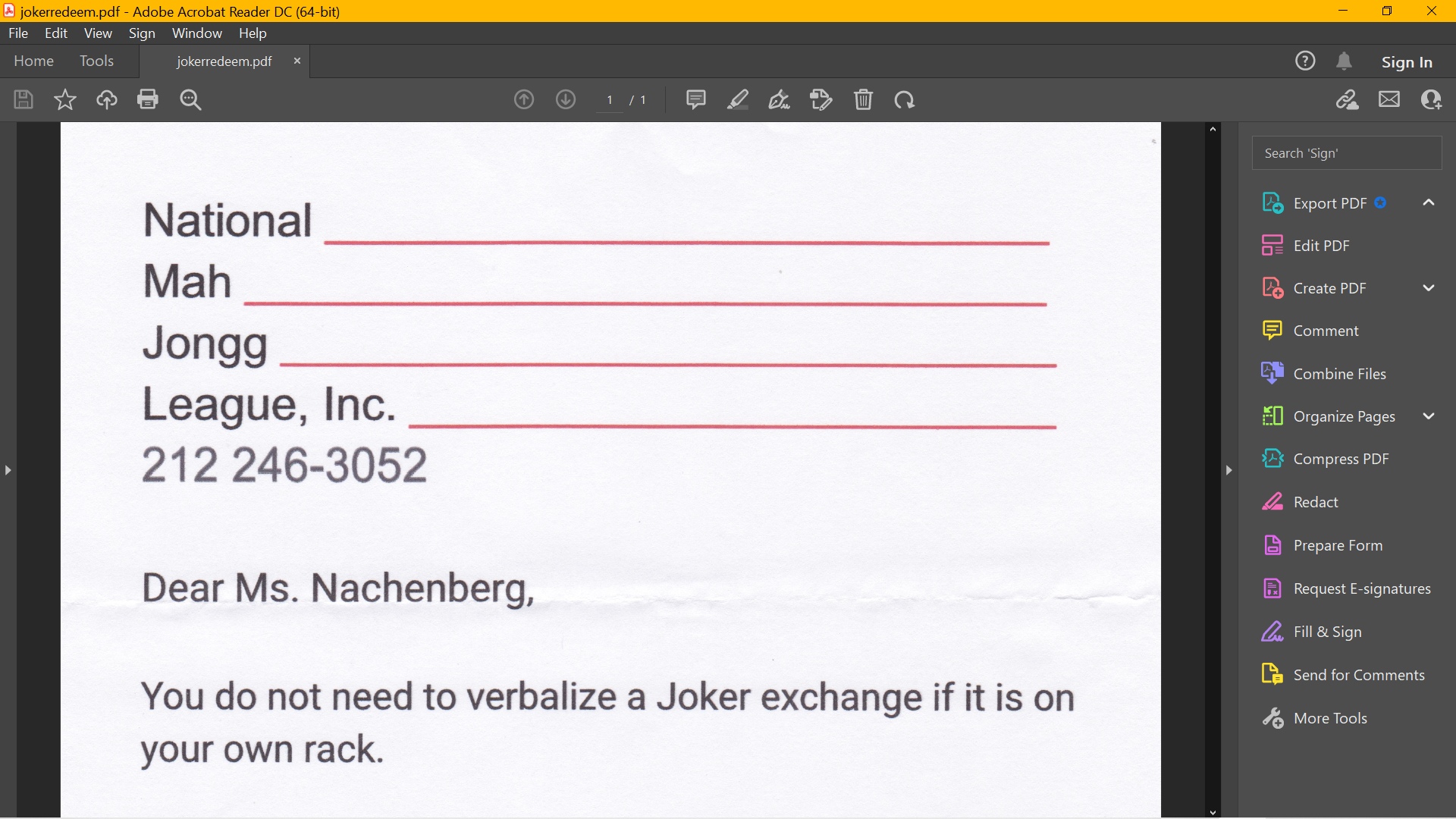
By the way, this is also explained in FAQ 19-M.3.
May the tiles be with you.
Tom Sloper
April 27, 2026
Who made this set, part 2
On Monday, April 27, 2026 at 11:28:41 AM EDT, Patty C wrote:
Re: Mah-Jongg Q A
Thank you, Tom. I don’t know if you remember me, but I was phenolic phenom in the 2000s. Bought and sold a lot of mah-jongg sets.
Patty
囧 Oh! Sorry, Patty, I didn't recognize you! It's been a long time.
I guess you already know all those things I said I know about your set. CHarli's and Gregg's sites are your best bet.
May the tiles be with you.
Tom Sloper
April 27, 2026
Who made this set?
On Sunday, April 26, 2026 at 08:39:29 AM EDT, Patty C wrote:
My mah-jongg question or comment is:
Who made this set? And do you know anything else about it?


Hi, Patty! Sorry for the delay.
I just now found your email - my email provider had hidden it in my spam folder.
1. Sorry again, but I don't know anything about manufacturers. I suggest you check some of the sites linked in FAQ 4a/"Other Excellent Mah-Jongg Sites," especially CHarli's and Gregg's sites. Those two are experts about manufacturers.
2. Yes, I know in general when it was made, what it's made of,
which mah-jongg variants can be played with it, and why it has 5 racks. If any of those tidbits are of interest, you could click the links.
It looks like the set was made with attention to quality. I imagine it was expensive when new (compared to other sets at the time).
May the tiles be with you.
Tom Sloper
April 27, 2026
Can I call Mah Jongg if it’s not my turn.
On Friday, April 24, 2026 at 07:33:01 PM EDT, Joanne C wrote:
Subject: Mah-Jongg Q+A
My mah-jongg question or comment is:
Can I call Mah Jongg if it’s not my turn.
Warm regards,
Joanne C
Sort of, yes. But only when the "window of opportunity" is open (which happens between players' turns). The window opens when a player discards a tile (ending their turn), and closes when the next player racks or discards, declares mah-jongg, or exchanges a joker (new, 2020: or has merely announced a joker exchange).
During the time the window is open, you can call mah-jongg, provided that you have mah-jongg with the live discard. It's your turn 1/4 of the time that the window is open, not that it matters. Any player, including you, can call the discard when the window is open.
The window is also closed by a player claiming the discard and starting to make an exposure. There's lots more information about the window of opportunity in FAQ 19.
May the tiles be with you.
Tom Sloper
April 24, 2026
help with identifying this set, part 2
On Friday, April 24, 2026 at 07:26:36 PM EDT, Linda G wrote:
Re: help with identifying this set.
Thanks so much Tom!
linda
You're welcome.
May the tiles be with you, Linda!
Tom Sloper
April 24, 2026
help with identifying this set.
On Friday, April 24, 2026 at 11:56:33 AM EDT, Linda G wrote:
Subject: help with identifying this set.
Good Afternoon,
I have a MJ set that I have never seen before and cannot ID anywhere. The tiles are small: 3/4x1-1/6x7/16 inches. It is hand engraved. Here is a photo:
From what I can find, it might have been manufactured by MET or A&L Mfg Co.
Any help would be greatly appreciated.
thank you
linda

Hi, Linda! 囧 Sorry, but I'm not knowledgeable about set manufacturers - you know more than I do, dropping those manufacturer names like that. I think I have a set similar to yours. The tile material is unknown. Collectors just call it "Chinese Bakelite" - as opposed to regular Bakelite/Catalin tiles which have rounded corners and edges, Chinese Bakelite tiles can hold an edge. I don’t know what else I can tell you about your set.
In case you might be wondering, the "when was it made" question requires seeing all of the flowers and jokers there may be in the set. Then column 509 can help.
May the tiles be with you.
Tom Sloper
April 24, 2026
What sort of arrangement?
On Wednesday, April 15, 2026 at 09:34:38 PM EDT, debaronstam wrote:
Arrangement of Tiles on Rack
Hi Tom:
Recently I received a recommendation to rearrange racked tiles in several different ways according to the sections. Despite having doubts as to how much this could slow down the game, I understand the logic in moving tiles around so you can see exactly how well they fit in a section. What confused me was the advice to organize tiles first according to like numbers. Arranging tiles according to same suit was mentioned second. I have always arranged tiles from low to high within each suit and honestly, never by like numbers unless I have already picked out a specific hand where like numbers are required. [1]*
Is there something special about this year’s card that when racking tiles, arranging them according to like number is more advantageous than from low to high within suits? I thought I knew how to rack and sort but now I have doubts. [2,3]*
What is your opinion?
Deborah
That's interesting what you said - several different sorting arrangements, according to card section. Interesting idea. *[1] I have always arranged tiles the way you did. Oddly, though, just yesterday I was playing on the computer and was faced with a choice of hands. *[2] I sorted my tiles by number rather than by suit while working on my decision. [3] Rather than beat yourself up because you might've been wrong all these years (you might not have been, I mean, is there a "right" or "wrong" here? Really?), try this other way of sorting (or one of them anyway) when you think it might help. Find out the easy way. By trying it yourself. Nothing like a bit of experimentation to learn a new thing.
May the tiles be with you.
Tom Sloper
April 15, 2026
Is "tapping" allowed?
On Monday, April 13, 2026 at 08:51:14 AM EDT, Sandy W wrote:
Mah-Jongg Q+A
My mah-jongg question or comment is: is “tapping” allowed? Like tapping a tile on your rack after you draw to prevent anyone from calling the last discard? Thanks ??
Sent from my iPad
Hi, Sandy! There's no rule against tapping, no penalty. But the official rules also don't permit it. Here's the official word, in MJME 2023/24:

If you don't have your copy of the official rules yet, you can always check FAQ 19. Specific to THIS rule concept, FAQ 19-AD also says tapping is not racking. In other words, "tapping" does NOT close the window of opportunity on the current live discard.
May the tiles be with you.
Tom Sloper
April 13, 2026
Does the 2026 card change your Four-Step Charleston Strategy, part 2
On Monday, April 13, 2026 at 08:41:34 AM EDT, debaronstam wrote:
Re: Any Changes to Charleston Strategy for 2026 Card
Thank you. I have been using your method for years and although there are other suggestions as to how to manage the Charleston, I have not wavered in supporting and promoting your system.
I miss the weekly puzzles you used to have in your strategy column, but I understand your priorities now lie elsewhere. I was a “newbie” back then, and nothing helped me learn to navigate a new card as well as those puzzles.
Best,
Deborah
Cheers, Deborah!
May the tiles be with you.
Tom Sloper
April 13, 2026
Does the 2026 card change your Four-Step Charleston Strategy?
On Sunday, April 12, 2026 at 10:33:43 AM EDT, debaronstam wrote:
Any Changes to Charleston Strategy for 2026 Card
Hi Tom:
I am wondering if there are any changes to your Four (Five) Step Strategy for the Charleston (Column #725) when playing with the 2026 card.
Best,
Deborah
No changes, Deborah. That strategy from 2019 is non-card-dependent. It's not necessary to create an entirely new Charleston strategy with every new card. As you go through the steps, you refer to the current card, thus taking the current card into consideration.
Sorry it took so long to reply. I just this morning found your email, which my email provider was hiding from me in my Spam folder.
May the tiles be with you.
Tom Sloper
April 13, 2026
What to do?
On Sunday, April 12, 2026 at 01:54:13 PM EDT, Phyllis B wrote:
Mah-Jongg Q+A
My mah-jongg question or comment is:
We have 2 players that continually pick up discards without calling for the tile. This often leads to other players not even noticing that there is a new exposure. It seems the person not calling for the tile should have a penalty even if you are not betting. After polite reminders it continues. What to do?
Sent from my iPad
囧 Well, it's not a certainty that impolite reminders will help, either. I'd stick with polite reminders. I would use the Marge Simpson approach of "gentle nagging."
But what's this about other players not even noticing that there is a new exposure? All eyes are horse-blindered and can only see their own racks and cards?
Seriously. Back to the gentle nagging approach. Since you have your eyes open, you can see when one of those two reaches into the discard floor rather than the wall, and you can speak: "Hillary, do you have something to say?" Or "Camilla, are you calling a discard? Remember, you have to speak the call. It says so right here on the card."
Do that every time it's their turn. There is no penalty under the official rules. If you can get the group to agree that there should be a penalty, you all have to agree what the penalty is. And if any new people join your table, as I wrote in FAQ 14, you have to tell them what the table rules are.
May the tiles be with you.
Tom Sloper
April 12, 2026
The 2026 NMJL card, part 4
On Thursday, April 9, 2026 at 01:33:00 PM EDT, Bev C wrote:
Mah-Jongg Q+A
My mah-jongg question or comment is: second line under consecutive run. Does the singles have to be all the same, class, bams etc?
Yes, Bev, when numbers are printed in one color, those numbers must all belong to the same suit.
Let's take a close look.
FFF 1111 234 5555
-or-
FFF
1111
234
5555
(Any 1 or 2 Suits, Any 5 Consec. Nos.)
The hand can be made in one suit (any suit) or it can be made in two suits.

For the above example, I made the 1-suit version in craks. It could also be made in either dots or bams.

For the second example, I made the 2-suit version in dots and bams. Note that the three consecutive singles are in one suit. And note that the two kongs are one suit. One color=one suit. The 2-suit version of the hand can be made in any two suits (craks and dots, bams and craks...).
I will add this to FAQ 16. FAQ 16 answers the most frequently asked questions about the 2026 National Mah Jongg League card! You might want to bookmark it for future reference.
May the tiles be with you.
Tom Sloper
April 9, 2026
The game would not let me call, part 2
On Wednesday, April 8, 2026 at 02:55:39 PM EDT, Pat H wrote:
Re: Mah-Jongg Q+A
Thank you so much!
Pat H
Sent from my iPad
You're welcome, Pat.
May the tiles be with you.
Tom Sloper
April 8, 2026
The game would not let me call Mah Jongg.
On Wednesday, April 8, 2026 at 11:47:03 AM EDT, Pat H wrote:
Mah-Jongg Q+A
My mah-jongg question or comment is: I was playing online, and had (what I thought was) a winning hand for Consecutive 4 on the 2026 card. I had three flowers, 5-6-7 Bam, 3 8 Dots and a Joker, and 3 9 Craks and a Joker. The game would not let me call Mah Jongg. Did I do something wrong? The 3 flowers were exposed. Thank you!
Pat H.

囧 Pat, that hand is on the 2025 card, not the 2026 card. If you see that hand on your 2026 card, you have a counterfeit card.
May the tiles be with you.
Tom Sloper
April 8, 2026
The 2026 NMJL card, part 3b
On Wednesday, April 8, 2026 at 08:03:32 AM EDT, Sue M wrote:
Re: Mah-Jongg Q+A
Hello Tom, thank you for a quick response. I will check the bulletin. Have a lovely day.
Cheers
Sue M
Mahj on a misnamed Joker, part 2
On Wednesday, April 8, 2026 at 10:21:36 AM EDT, Michelle Nice wrote:
Re: American Mahjong Question
Thank you for your quick response. Yes, that is what I meant...that Player A said 6 bam, when Player D said 5 bam, and Player C called the 6 Bam for Mahjong. So Player A is on the hook, and that makes complete sense...Player A, who misnamed the Joker discard as a 6 bam instead of a 5 bam pays everyone 4 times the value of the hand. What if player C called the misnamed Joker as a 6 Bam for Mahjong and was going to use it in a single or a pair...because Jokers may NEVER be used in a single or a pair...is it still the fault of Player A who misnamed the Joker or is their now some fault on Player C who should not only be playing by ear, but by sight as well-to see that it was indeed a Joker discard and not a 6 bam?
Follow me on IG
Best,
Michelle Nice aka the "Mahj Lady"
Wake-Up N' Mahj Social Club
Wakeupandmahj.com
Wakeupandmahj.com/lessons
North Carolina
954-658-2129
Yes, it's still Player C's win at Player A's expense. The win was based on the technicality of the discarder saying the wrong thing - NOT on taking the joker and using it in a pair. Player C doesn't have to take the joker. She just shows that the hand would be won with a 6B, not with a joker. And it doesn't matter that Player C could see that the misnamed tile is a joker.
May the tiles be with you.
Tom Sloper
April 8, 2026
The 2026 NMJL card, part 3
On Tuesday, April 7, 2026 at 11:39:06 PM EDT, Sue M wrote:
Mah-Jongg Q+A
My mah-jongg question or comment is:
Good evening, in the new 2026 card, under Singles and Pairs, the last hand FF 2026 2026 2026 (any 3 suits)
Question while three different suits, the square or soap dragon would need to be placed within all 3 suits?
Have I understood correctly?
Thank you
Sue M
Yes, Sue! You do indeed have to have three single soaps (which are also called "white dragons") for "the big hand" this year.
May the tiles be with you.
Tom Sloper
April 8, 2026
Mahj on a misnamed Joker
On Tuesday, April 7, 2026 at 09:05:55 PM EDT, Michelle Nice wrote:
American Mahjong Question
If Mahjong is made on an incorrectly named Joker discard, is the tile allowed to be used as it was called in the following example: Player A discards a joker, but calls it a 5 bam, because the discard b4 by player D was a 5 bam, however the joker was incorrectly name and called to make mahjong in either a single or a pair, is the mahjong that was called by player C legit? Does player A pay player C 4 times the amount for the value of the mahjong hand??? Is this the very 1 exception where a joker may show up in a single or a pair because player C called a 5 bam for mahjong, not a joker ( level though it was a joker, but misnamed during the discard)???
Follow me on IG
Best,
Michelle Nice aka the "Mahj Lady"
Wake-Up N' Mahj Social Club
Wakeupandmahj.com
Wakeupandmahj.com/lessons
North Carolina
954-658-2129
On Tuesday, April 7, 2026 at 09:10:25 PM EDT, Michelle Nice wrote:
Re: American Mahjong Question
I do see that on page 24, rule #9 at the top of the 2023 edition of Mah Jongg Made Easy that “(a) At no time may a Joker be used as a replacement for a single tile or as part of a pair.”
When I teach mahjong lessons, I ALWAYS say ‘Jokers may NEVER be used in a single or a pair, never, ever, Eva!!!’
Follow me on IG
Best,
Michelle Nice aka the "Mahj Lady"
Wake-Up N' Mahj Social Club
Wakeupandmahj.com
Wakeupandmahj.com/lessons
North Carolina
954-658-2129
Hi, Michelle! I'm honored to meet the Mahj Lady.
Reading through your example, you said the joker was misnamed. But Jokers may legally be named the same as the previous discard. And you say that's what Player A did. Player D had said "5 bam" and Player A also said "5 bam." That's permissible under the rules (MJME p.24 rule #11), so the joker was not misnamed.
Player C called mahj on Player A's joker instead of Player D's 5 bam. Player C should have called Player D's discard for the win, but missed the chance. Since the joker was not misnamed, the joker is a dead tile and Player C cannot have the win on this discard.
Now if Player A had said "6 bam" after Player D said "5 bam" and 6 bam was Player C's winning tile, that would be game over, and Player A must pay for the party.
May the tiles be with you.
Tom Sloper
April 8, 2026
When can a joker be exchanged, part 2
On Tuesday, April 7, 2026 at 12:28:33 PM EDT, Phyllis G wrote:
Re: Mah-Jongg Q+A
THANK YOU so much for your response and info. Much appreciated.
You're welcome, Phyllis. I saw that you also posted your question on Facebook. (^_^)
May the tiles be with you.
Tom Sloper
April 7, 2026
When can a joker be exchanged? What's the procedure?
On Monday, April 6, 2026 at 06:40:05 PM EDT, Phyllis G wrote:
Mah-Jongg Q+A
My mah-jongg question or comment is:
Player called for a tile to expose. At the same time, is she allowed to exchange a joker from another player’s exposure.
Hi, Phyllis! Not at exactly the same time, but in the same turn, yes. First she makes the call, takes the tile, and exposes a complete set atop the rack. Then she may exchange or redeem jokers from any and all racks, putting the taken jokers into the hand and not atop the rack unless the new joker(s) gave her mah-jongg. If you want to know more about the order of things in joker exchanges, see FAQ 19-M.
And see page 23 in Mah Jongg Made Easy, the official rulebook of the National Mah Jongg League.
May the tiles be with you.
Tom Sloper
April 6, 2026
Thank you
On Monday, April 6, 2026 at 11:36:01 AM EDT, David T wrote:
THANK YOU, Tom!
Hello Mr. Sloper!
I wanted to drop a quick line to say I've enjoyed reading your website for years now. I started playing Mah Jongg in 2017 and the person who first gave me some lessons suggested I review your website Sloperama. Brilliant content! And I've also purchased your book The Red Dragon and the West Wind via Kindle in 2021 and have studied it ever since.
Thank you again!
David
I appreciate your kind words, David. Since you have
The Red Dragon
&
The West Wind, I hope you also have the
errata that lists all changes and corrections.
May the tiles be with you.
Tom Sloper
April 6, 2026
How to score this in MCR
On Saturday, April 4, 2026 at 10:19:12 AM EDT, C, Lauralee wrote:
Mah-Jongg Q+A
My mah-jongg question or comment is:
Is this just a mixed shifted fan (6 point not including wait or melding) or because there are 4 related chows, is it more?
Is this an example of the rule in your book about not using the same sets twice?
Lauralee

On Saturday, April 4, 2026 at 10:32:38 AM EDT, Carbone, Lauralee <lauralee.carbone bellinghamschools.org> wrote: bellinghamschools.org> wrote:
I Teach MCR
I love to teach MCR and use your book! I live in Bellingham WA, Whatcom County.
Please add me to your list.
Lauralee Carbone
Hi, Lauralee! So glad to hear from someone who's read
The Red Dragon
&
The West Wind
!
In the book, it's page 139 (rule 64) where you find the principles governing the Inclusions And Combinations In Scoring. But FAQ 22 covers your question exactly:

This hand is All Chows and All Simples. All of the sets in the hand work together to create these two scoring patterns, and it is permitted to combine them when adding the score.
In addition, the 234B 345C 456D comprises Mixed Shifted Chows. The winner might wish to claim that the remaining chow, 567B, should be combined with the 345C 456D to make a second Mixed Shifted Chows scoring pattern, but the non-identical rule prohibits doing this because it uses one of the sets in the first Mixed Shifted to make a second Mixed Shifted. However, the 567B can be combined with the 234B to make a Short Straight, because the set hasn't been used for Short Straight already.
So let's take a look at your hand.

It's All Chows. It's not All Simples (9C). It's not "all" anything else.
Mixed Shifted Chows, 456C-567D-678B. Just like the example from FAQ 22, you can't make another Mixed Shifted Chows with the 789C, due to a couple of the Principles:
c. Prohibition against identical patterns. Once a set has been used to form a particular two- or three-set pattern, the player may not use the same set to form an identical pattern with another set.
e. Prohibition against repetitive set usage. Once two or three sets have been combined for a scoring pattern, any other remaining sets in the hand may be combined only once with an already-scored set, when creating additional two- or three-set scoring patterns. (RDWW p 139)
And just like the example from FAQ 22, you can combine 456C and 789C to make a Short Straight.
So the hand scores All Chows, Mixed Shifted Chows, and Short Straight, in addition to any other fan the hand might have earned.
And. Per your request, you are now listed as an MCR teacher in FAQ 4a.
May the tiles be with you.
Tom Sloper
April 2, 2026
Help me resolve this, part 2
On Wednesday, April 1, 2026 at 02:03:39 PM EDT, Kelly F wrote:
Re: Mah-Jongg Q+A, Thank You!
Mr. Sloper,
Thank you so much for your quick response. My friend and I were looking at several sources, and I finally found all my old yearly newsletters (that took me a while) and started looking through and found the supporting evidence for not being able to change your mind once it was placed on the top of the rack.
Your further clarification helps as I have used your book as my Mahj “bible” when I teach. I loved mahjong so much when I first played it 17 years ago, that I read as many books as I could as I wanted to understand the rules as written, not always as taught. A Jewish friend taught me and she had played with her Mother and Grandmother, but when this occurs, little things slip into or out of the game over the years, or they just didn’t pay attention to rule changes/clarifications over the years. I was taught a few things incorrectly that I had to change when I started preparing for tournaments. I had to break bad habits. I am adamant about teaching good habits and giving the correct rules/rulings when I teach or when others in my groups ask me for a “ruling”. I have met and played with so many ladies who paid to be taught incorrectly.
My friend I lament that the NMJL does not have a clear concise rule book. Yes they have Mahjong Made Easy, but it is sorely lacking as an overall definitive rule book. Which is why I expect you wrote your book. Even when they do answer questions in the newsletters/bulletin their wording is not always clear and sometimes leaves room for interpretation which is frustrating.
If you have any pull with NMJL, mention a more in depth rule book is wanted by many, and everyone I know laments that NMJL is stuck with no way to contact them except by letter or phone. An email address seems like a minimum these days. I stay loyal to them as they are the ones who standardized the game, but this game is so crazy popular in Dallas, and already people are changing the rules, and I fear it will be further de-standardized by those companies made wealthy and influential because of their products. They don’t just call these other rules “table” rules. When teaching with blanks, they don’t mention that this isn’t “standard NMJL” mahjong, they teach it as a normal part of the game.
I will get out my stationary and a stamp, and write to NMJL myself, but if you have any extra sway, it would be good if they would modernize!
Kind Regards and greetings from Texas,
Kelly F
Glad I could help, Kelly!
May the tiles be with you.
Tom Sloper
April 1, 2026
Help me resolve this discrepancy
On Tuesday, March 31, 2026 at 12:05:11 PM EDT, Kelly F wrote:
Mah-Jongg Q+A
My mah-jongg question or comment is:
I am going to include screen shots from your book (“The Red Dragon & The West Wind) and from your website. This came up playing online (realmahjong) and in a live game last Friday. I first looked up this rule because in the online play other players were allowed to return the tile they had called, and showed up on their rack, as long as they had not exposed tiles from their hand. Playing online is different than in person but I wanted a clarification, and what I read in your book surprised me, because it differed from what I had thought for the last 15+ years. It agreed with what had happened online.
Question: If you call the last tile from the discard pile, and put it on the flat part of your rack and DO NOT expose any of your tiles can you change your mind and put the tile back?
In the book it says you can change your mind, even if you put the tile on the flat part of your rack. It states this in 3 places. On your website it says once it goes onto the flat part of your rack you cannot change your mind (you have crossed the line). The book is almost 20 years old, so maybe the rules have changed? Other sources support the cannot change your mind rule.
Photos included
1. FAQ (website) A:1. Picking from a wall
2. RD& WW p. 65 (110)
3. “ , p. 100, Taking a Discard
4. “ , p 52/53, Claiming a discard for a melded set, on p. 53, 60.c
Kind Regards,
Kelly F

^ 1. From FAQ 19-AM ^

^ 2. From RDWW, p. 65 ^

^ 3. From RDWW, p. 100 ^

^ 4. From RDWW, p. 53 ^
Hi, Kelly!
Impressive background work on the errors and/or inconsistencies that have been plaguing you. Before I address those, let me answer the question you asked.
Your question is: "If you call the last tile from the discard pile, and put it on the flat part of your rack and DO NOT expose any of your tiles can you change your mind and put the tile back?"
The answer is no. The last discard is the same as any other discard. Once a called discard touches the top of your rack, you have committed to making an exposure with it, otherwise your hand is dead.
The rule comes from where all the rules come from: The National Mah Jongg League. They're the authority when it comes to the rules of NMJL mah-jongg. The governing rule (you can't put it back once it's racked*) is on page 18, rule 13 of
Mah Jongg Made Easy (2023/24 printing), which says:

^ 5. From MJME 2023/24, page 18 ^
Which supports part of the wording of FAQ 19-AM.2 (your image #1). Rule 13 doesn't say "you can wave the tile around and still put it back," but that's implied by what's not said in the rule. The thing that locks the commitment is putting it atop the rack (or exposing tiles). It doesn't say moving the tile is permitted, but it doesn't say moving the tile is forbidden, either.
Next: you wrote: "In the book it says you can change your mind, even if you put the tile on the flat part of your rack. It states this in 3 places."
You are correct that the rule stated in
The Red Dragon
&
The West Wind
(twice - your images 3 and 4) is incorrect today. There was no rule I could find anywhere against putting back the discard in 2007. But years after publication, I became aware of
a new ruling, which had not been in print before.
See this 2015 email that contained a reply to an NMJL letter...

^ 6. From snailmail correspondence. ^
Faced with this information, I handwrote this change in my copy of
The Red Dragon
&
The West Wind
, and added the new information to the RDWW
errata, which I make available on the RDWW web page.
I often refer to my copy of
The Red Dragon
&
The West Wind
, so I needed a master copy that had all the corrections and changes. But handwritten notes quickly got out of hand, at least on some pages. I had the errata, which I can always update, and there's no need to handwrite it in a book and publish errata. Duplication of effort. So I took a fresh copy and indicated errata for my own reference. This is what the applicable rules look like in my master copy now (an "E" means "errata"):

^ 7. From RDWW, page 65 ^
So yes, your images 3 and 4 contain errata. But your image 2 is not about calling a discard - it's about picking from the wall. In the January 2018 bulletin, the League wrote this about that:

^ 8. From the 2018 bulletin ^
I assume you'll want to download the errata to keep near your copy of RDWW.
I think I covered everything? Hope I've resolved the inconsistency. If I missed any bases, come back to me. Really. Along with any errata you find in the errata!
May the tiles be with you.
Tom Sloper
March 31, 2026
* That cute way of expressing the rule uses an alternate meaning of the term "racked" - normally that means the sloping front, not the flat top.
The 2026 NMJL card, part 2b
On Tuesday, March 31, 2026 at 11:47:23 AM EDT, Sandy W wrote:
Re: Mah-Jongg Q+A
Thanks Tom!
Sent from my iPad
You're welcome, Sandy.
May the tiles be with you.
Tom Sloper
March 31, 2026
The 2026 NMJL card, part 2
On Tuesday, March 31, 2026 at 09:58:15 AM EDT, Sandy W wrote:
Mah-Jongg Q+A
My mah-jongg question or comment is: in Any Like Numbers #2,
Should the dragons be displayed with like numbers or at the end as separate entities ? Thanks Sandy
Sent from my iPad
囧 Hi, Sandy! I think you're asking which of these is the proper way this hand should be displayed when won:

The answer is B. The card shows a space between the same-number exposure and its associated dragon. Besides, there's no exposable grouping that includes number tiles and dragons ("2026" doesn't count because zero is a number).
If I've misunderstood your question, let me know.
May the tiles be with you.
Tom Sloper
March 31, 2026
"Claiming a Discard" rule 8, part 2
On Monday, March 30, 2026 at 06:09:18 PM EDT, Sally Calder wrote:
Re: Question on Window of Opportunity and Changing an Exposure
I'm sorry Tom, I think I didn't word my question properly. Player called a 7 crak, displayed the one she called with 3 other 7 crak. Then she did a joker exchange for a 3 bam which had nothing to do with the exposure. Before she discarded she wanted to change the four 7 crak to three 7 crak. We felt the window of opportunity was over as she did another operation by doing the joker exchange. Player referred to the rule on the back of the card which said she could change the number of 7 crak in the exposure until discard. Who is right?
Hi, Sally! This is a controversy, as I said. The wording does seem to leave a loophole for your player to do what she did. But the rule in
the 2019 letter that I mentioned (also in this year's January bulletin), involves a principle that applies to your question.
You can do more than one move during a turn.
After you call a discard, you're allowed to redeem a joker. This is a second move, and it puts an end to your first move. No going back to fiddling with the new exposure.
It's a shame that there isn't enough room on the card to cover this situation in more detail.
Sorry if I misinterpreted what you were asking yesterday!
May the tiles be with you.
Tom Sloper
March 30, 2026
Blank Tiles
On Monday, March 30, 2026 at 01:02:28 PM EDT, james wrote:
Blank Tiles
Tom,
A friend of mine moved to Texas and said that they play mah jongg using 2 blank tiles.
Apparently, who ever has the blank tile can on their turn remove a discarded "dead tile" from the center and replace it with the blank.
The chosen tile is placed in their rack.
The blank is placed standing on the short edge and the game continues.
Had you ever heard of this?
Jim M
Hi, Jim! It's been a while!
Yes, I've heard of it. It's very popular these days. And controversial. Blank lovers and mah-jongg purists duke it out on social media, the purists say it dumbs down the game, it's a beginners' crutch. The blank lovers are like, girls just wanna have fun. I'd say it's a genuine war for the soul of the game, slightly akin to what ended the mah-jongg craze a hundred years ago - hardcore vs. enthusiasts. Is that the right word? You get the picture.
May the tiles be with you.
Tom Sloper
March 30, 2026
"Claiming a Discard" rule 8, from the 2026 card
On Sunday, March 29, 2026 at 06:02:54 PM EDT, Sally C wrote:
Question on Window of Opportunity and Changing an Exposure
Our group is having a debate regarding the rule on the back of the 2026 card under claiming a discard # 8. It clearly states that up until discard you may change the number and type of tiles you displayed in an exposure. However, the exception to the rule that you may not do that if you made a joker exchange before your discard is not listed on the card. Some people feel therefore that they are able to change the exposure after a joker exchange. Shouldn't this exception be listed on the card to clarify this?
Sally C
Hi, Sally! This is a controversy, as I wrote in today's Column. I agree that #8 ignores the possibility that a player might redeem a joker after making an exposure - leaving a loophole, it would seem, for someone to make more changes to the exposure just because the player hasn't discarded. But the League closed that loophole in advance. There is a rule that once a joker is redeemed, it may not be added to any of one's exposures. That rule is not in print on the card, nor in MJME 2023/24 - it was written in a 2019 letter to a player, and it's also in this year's January bulletin: "Once an exposure has been made, a player cannot then initiate a Joker exchange and add the Joker to the exposure."
I agree that ideally the loophole would be closed on the card, together with rule 8. But what is not is not.
May the tiles be with you.
Tom Sloper
March 29, 2026
Two people wanted the discard for Mah-Jongg
On Friday, March 27, 2026 at 10:26:03 PM EDT, Alayne M wrote:
Mah-Jongg Q+A
My mah-jongg question or comment is: a tile was discarded, and I was next in line and it gave me a Mahjong, but the person to my right also could make a mah-jongg with that same tile. I know the rule says since I’m next in line it would be mine, but there appear to be some caveats about that. What is the standard way in American mah-jongg of resolving this? Is there one winner or do we share? Thank you it was quite fun and it’s caused conversation well after the game, which is why I’m contacting you.
Sent from my iPhone
Hi, Alayne! The case you described is very straightforward: you and the player at your right both said mah-jongg. The official rules are clear on this: since your turn was next, the mah-jongg was yours, and yours alone. Only one person wins in mah-jongg.
This is the League's official rulebook, Mah Jongg Made Easy.
Beware of misleading similarly-titled AI-written books on Amazon
You mentioned "caveats" -- what there are, are other, less straightforward, situations than the one you described. You can read about all of them in FAQ 19-H and FAQ 19-I.
May the tiles be with you.
Tom Sloper
March 2, 2026
What's the approved nomenclature
On Friday, March 27, 2026 at 09:42:30 AM EDT, Sandy M wrote:
Mah-Jongg Q+A
My mah-jongg question or comment is: what is the proper way to call a 1 BAM? Is it 1 bird BAM or what?
Thank you.
Sandy M
Hi, Sandy!
In America, most people say "one bam." In other English speaking countries, many say "one bamboo." Some people enjoy cutifying ("cute-ifying"?) the names of tiles. And plenty of people get their panties in a bunch if you say "bird" anywhere in there, who knows why. If you find yourself at a table of people laughing it up and saying "bird this" and "bird that," go ahead and say "one bird" or "birdie" or "birdman of Alcatraz." Otherwise, straightforward tile naming is just good communication.
May the tiles be with you.
Tom Sloper
March 27, 2026
Column #815
On Wednesday, March 25, 2026 at 03:49:23 PM EDT, jane wrote:
2026 card
So happy to see this column about the new card. I look forward to it every year. ??
Sent from the all new AOL app for iOS
So glad, Jane! I'll have more to say about this card, and I'm still working on revising FAQ 16.
May the tiles be with you.
Tom Sloper
March 25, 2026
The 2026 NMJL card, part 1
On Tuesday, March 24, 2026 at 01:35:24 PM EDT, Atis P wrote:
Mah-Jongg Q A
My mah-jongg question or comment is:
In the new 2026 card - is this hand in the 13579 series valid ?
The card says that the pair can be any odd number.
So I gave a pair of fives, followed by 3579 and right fives.
Atis P

Hi, Atis!
The pair can be any odd number, and then each of the other odd numbers has to be singled. You have three fives, and no ones. There ought to be a one in there.
This formation is called a "floating pair" - the pair can float from one on up through the ranks.
113579
133579
135579
135779
135799
In each case, the opposite kongs must match the paired number.
113579 1111 1111
133579 3333 3333
135579 5555 5555
135779 7777 7777
135799 9999 9999
By the way, the run with the floating pair does not have to be bams. Any suit can be used. The color-coding on the card does not dictate suit. But you probably already knew that.
May the tiles be with you.
Tom Sloper
March 24, 2026
Column
#813
On Sunday, March 22, 2026 at 11:04:56 AM EDT, Joanne B wrote:
Column #813
Hi Tom,
The book I always recommend because it helped me so much when I was a beginner is the one you wrote the forward for - A Beginner’s Guide to American Mah Jongg: How to Play the Game & Win by Elaine Sandberg. I was surprised it wasn’t on the list.
Joanne

Hi, Joanne! I certainly would have included Elaine's book if I was making a list of good book recommendations. But that's not what that column is about. Column 813 is a review of some new books, that I was interested in reviewing for multiple reasons:
- The title includes or sounds like "Mah Jongg Made Easy," the title of the National Mah Jongg League's official rulebook;
- or the book was mentioned or touted on Facebook;
- several new people were taught wrongly by some new book on Amazon;
- or it is clearly a new book on American mah-jongg that I ought to check out.
That's why Elaine's book wasn't listed. By the way, you might not know that I interviewed Elaine Sandberg in two columns:
May the tiles be with you, Joanne.
Tom Sloper
March 22, 2026
I wanted a Babcock set that could reflect the mahjong craze.
On Monday, March 16, 2026 at 02:10:20 PM EDT, tomas.hawk wrote:
Babcock Shanghai 1921
Hi Tom!
The last time I wrote to you, I had found a game in the Wilkinson–Laufer style from the turn of the century, unfortunately without knowing its history. I have since been searching for a Babcock game that could reflect the mahjong craze. I have now found one, and its history is well worth telling. The set is complete, in very good condition. It is housed in a fully carved, functional puzzle box with traditional Chinese imagery all around. The ivory handles on the drawers were missing, and I have replaced them with period-appropriate replicas in French ivory. I have only seen one similar example online, and that one has a dragon handle that is far more crudely carved. If you know anything more about this box, I would be grateful for information. The tiles are extremely well made, with thick bone and a beautiful patina. They are heavy, over 14 grams each. I wonder whether this is Model No. 10—can the model be definitively established?
With the help of names found in the rulebook included with the set, I was able to trace the first owner. A young woman from a wealthy family in Tulsa in 1922. Right on target, I thought, with the Roaring Twenties and the mahjong craze. I wondered how she had acquired the game and continued my research. I have written down the history as I found it, and I have replaced the names for reasons of privacy. I used AI for searching the databases and sometimes it's hard to find the "original” digitized copy of the documents. I am happy if errors are pointed out and for additions.
With much appreciation,
Tomas H
Sweden
Jack, Joseph P. Babcock, and the Connection to Tulsa
THE INTERNATIONAL CONNECTION: SHANGHAI 1921–1922
In May 1921, the 30-year-old Jack (born 1891) applied for a passport for a 14-month business assignment to China. He was stationed as an Auditor at Standard Oil’s (SOCONY) headquarters at 11–12 Canton Road. At the same office worked Joseph P. Babcock (28 years old), who held the prestigious title of Assistant Manager at Standard Oil.
Jack’s role as an auditor gave him direct contact with Babcock. They were also close in age. Jack acquired a luxury set and carried it home to the United States in September 1922 aboard the S.S. President Madison.
THE FAMILY AND THE GIFT IN TULSA: DECEMBER 1922
Jack returned to Tulsa, the “Oil Capital of the World,” where the family lived at a prestigious address on South Baltimore Avenue. In December 1922, Jack’s sister Clara (born 1901) turned 21. It was most likely as a coming-of-age gift that she received this mahjong set.
Included with it was Babcock’s red rulebook. A second, expanded edition was published in February 1923, and it bears her signature. Both are still with the set today.
THE MAHJONG FEVER IN THE OIL CAPITAL
In 1923, interest in mahjong exploded in Tulsa. The city overflowed with new oil money, Art Deco architecture, and a thirst for international status. The Tulsa World was filled with notices about exclusive mahjong parties where the city’s social elite gathered in settings decorated with oriental lanterns and silk.
Owning a genuine set, imported directly from the source in Shanghai by a family member, likely gave Clara a special status. While local department stores such as Vandever’s struggled to meet demand for simpler sets, Clara owned one of the most “Chinese” and lavish sets—a link between global Shanghai and modern Tulsa.
REFERENCES
U.S. National Archives: Passport Application
Shanghai Hong List (1922): Staff directory for SOCONY, Canton Road 11–12. Lists Babcock as “Asst. Mgr.”
Washington Passenger Manifests: S.S. President Madison (Arrival Seattle, September 4, 1922)
U.S. Federal Census (1910, 1920): Population records
Tulsa World Archive (1922–1923): Articles on mahjong trends and social life in Tulsa


Wow, Torsten, that's some impressive research! And the box is impressive, too. I have no information for you about the box. And I do not know anything about Model No. 10. If that's all you want to know, I'm sorry! 囧
May the tiles be with you.
Tom Sloper
March 16, 2026
One more for your "The Red Dragon & The West Wind" errata
On Sunday, March 15, 2026 at 01:50:33 PM EDT, Phill K wrote:
Re: Error in "The Red Dragon & The West Wind" P. 46 28. b.
Hi Tom,
Re- reading you excellent book as I am teaching American Mah Jongg more frequently these days.
On P. 46 in Paragraoh 28. b. You state that "zero" is "always marked in blue." However in the NMJL Card of 2026 the end of the 4th line of 13579 the zero is marked in red and grouoed with a 1: " 10." Unfortunately, Having the Zero in red here has confused my Mahj Jongg mentees.
I did not see this listed among your listed errata.
Thanks,
Phil
On Sunday, March 15, 2026 at 01:59:36 PM EDT, Phill K wrote:
Re: Error in "The Red Dragon & The West Wind" P. 46 28. b.
Tom,
Oops one of my own errata, I meant the 2025 card, not the 2026 card.
Also just noticed that when zero is used in the year hand when grouped as " 2025" the zero is green and not blue. Your book should read that when zero is not grouped with other numbers it is in blue but when with other #s adapts to the #s it is sandwiched between much like a chameleon. However always remains neutral/pareve and unsuited.
Thanks,
Phil
Good catch, Phill! I've made the addition to the errata, thanks to you. Keep on keepin' on!
May the tiles be with you.
Tom Sloper
March 15, 2026
So pleased to see a column from you
On Saturday, March 14, 2026 at 06:14:46 PM EDT, Paul C wrote:
Mah-Jongg Q&A
I am so pleased to see a column from you after almost a year of no new columns. I did read your previous explanation as to why you were not commenting. However, you are the guru I cite to my Mah Jongg friends and occasional students whom I teach for the love of the game. Thank you, Tom. I have gleaned so much information from your columns over the years!
That's nice to hear, Paul! I am (albeit haltingly) working on another one, and I'll need to do one when I get the 2026 NMJL card. Keep your eyes peeled. (Wow, what a weird expression!)
May the tiles be with you.
Tom Sloper
Pi Day, 2026
Follow-up, March 15: new column, "Rack It!," is now online!
What if I pick up the wrong discard for exposure?
On Tuesday, March 10, 2026 at 07:51:32 PM EDT, Mary Ann C wrote:
Mah-Jongg Q+A
Am I dead if I call for a tile, expose the tiles from my hand, and pick up the wrong tile from the table. I have realized my mistake and took up the correct tile before I have discarded?
As long as all you did was pick it up, you can just put it back down again. I hope you didn't put it on top of your rack! See FAQ 19-AM.2.
A player is committed to a called tile when it is laid on top of their rack.
We all make mistakes, but that's how we learn. The takeaway: watch other people's moves so you don't pick up the wrong tile.
Coincidentally, I saw two people ask this same question on Facebook today. Small world...
May the tiles be with you.
Tom Sloper
March 10, 2026
Books and stuff, part 2
On Wednesday, March 4, 2026 at 11:06:24 AM EST, Jackie T wrote:
Re: Mahj Books
[Thumbs-up emoji]
Books and stuff
On Wednesday, March 4, 2026 at 08:43:30 AM EST, Jackie T wrote:
Mahj Books
Hi Tom,
I'm a big follower of Michele Frizzell. She's a big fan of yours. I have your book The Red Dragon & The West Wind. I also like Michele's books and Elaine Sandberg's books.
I hope you will do a big article or a book more targeted on Strategy by Wall.
I've been playing for only 10 months now but I love the game.
Cheers!
Jackie


Hi, Jackie! I'm delighted that you have
The Red Dragon & The West Wind! Do you also have the errata? Rule changes and corrections.
I am planning a new strategy column, but no plans for a new book. When you say strategy by wall, I guess you mean strategy according to phase of the game. I did discuss the three stages in FAQ 8:
Opening moves: DEVELOP your hand by removing isolated pieces. Keep your options open; much depends on what you draw.
Middle game: ATTACK with your hand by deciding on a goal (choosing one option), and building your hand towards that goal.
Endgame: DEFEND your game by making sure no one else wins. In the last third of the wall, the danger increases that an opponent is ready to pounce on your discard for the win. Your great hand will be useless if someone else wins! Assess the danger based on what's visible on the table to determine where danger might lurk.
The FAQ goes into some detail on those stages. I don't have a lot to add (not a book's worth!). The column I'm planning will mainly address a combination of strategy and harmony-building etiquette. I see a lot of advice on the internet, advising players to play aggressively. I think some people interpret "make sure no one else wins" to mean "play so fast they won't get a chance to call a discard," and I disagree philosophically with that approach. I'll try not to take too long to get around to writing that column. Thanks for writing! Now, march forth and have a great day.
May the tiles be with you.
Tom Sloper
March Forth, 2026
Picking From The Wrong Wall - part 2
On Monday, March 2, 2026 at 10:02:54 PM EST, Leslye G wrote:
Re: Picking From The Wrong Wall - Unusual Circumstance
You are the best! Thank you.
Leslye
MCR: Can I combine Prevalent Wind with Big Three Winds?
On Monday, March 2, 2026 at 09:19:19 PM EST, Susan S wrote:
Big Three Winds
Hi Tom,
In a hand scoring 12 points for Big Three Winds, are you allowed to combine extra points for the wind pungs and/or Prevalent Wind?
Susan S
Sent from my iPhone
Hi, Susan! Use the Principles around the concept of Implied Inclusions in Majiang Competition Rules in FAQ 22. In my book, that's pages 139, 194, and 195.
There are four winds. If you have pungs of all four, it is implied that you also have the seat wind and the round wind - and the score for Big Four Winds already includes the score for those built in. But you only have three. It's possible to have three winds but not the seat wind and not the round wind. Since the score for seat wind and round wind are not built in, they can be combined with (added to) the score for Big Three Winds.
May the tiles be with you.
Tom Sloper
March 2, 2026
Picking From The Wrong Wall - Unusual Circumstance
On Monday, March 2, 2026 at 06:55:52 PM EST, Leslye G wrote:
Picking From The Wrong Wall - Unusual Circumstance
Good evening Tom,
It’s always comforting to know that we have you to turn to for knowledgeable responses regarding the NMJL rules.
I understand the rules below when someone has pushed out the wrong wall. Unfortunately, we didn’t realize this had happened until a few picks from the wall had already been made. Once noticed, we continued playing as noted below. However, the player who won the game, was the same person who pushed out the wrong wall (again, which we did not notice for a bit).
Should we have turned in our hands and stopped playing once it was noticed that we had been picking from the wrong wall?
Should we have paid the winner, even though she was the one who pushed out the wrong wall?
Once noticed, should she have been declared dead, since she was the one who pushed out the wrong wall?
Help, please.
With much appreciation,
Leslye G
From FAQ 19-DM:
  Q: What happens if somebody pushes out the wrong wall? Q: What happens if somebody pushes out the wrong wall?
A: MJME2023 addresses this on page 20, rule 16. There are several scenarios covered.
a. If someone picks from the wrongly pushed-out wall, that player's hand is dead. Play continues on the wrong wall and then proceeds to the correct wall.
b. If someone calls mah jongg while a wrong wall is in play, the winner collects from the player who pushed out the wrong wall (that player "pays for the party"). See answer CR above.
c. If someone pushes out their wall before the previous wall was used up completely, AND someone picks from that newly pushed out wall, both players' hands are dead.
d. The rulebook doesn't say what happens if nobody picks from the wrong wall, but it's reasonable to assume that the wrong wall can be put back, no harm, no foul.
Hi, Leslye! I think first I need to restate your scenario and see if it fits one of the three scenarios in the FAQ, and if not, which one (if any) it might be closest to.
Here's what happened (if I understand correctly):
1. Someone pushed out the wrong wall.
2. It wasn't realized for several turns. Several people (sounds like pretty much everyone) picked from that wrong wall.
3. When it was realized that this had happened, it was also realized who had pushed out the wrong wall. Easy enough: she was sitting right where the wall was pushed out.
4. Discussion resulted in a decision to continue the game. And no penalty was applied to the person who pushed out the wrong wall.
5. The winner was the person who pushed out the wrong wall. A question presented itself: how should the game be scored - i.e. is there a penalty for the pusher?
6. (I assume) Discussion did not arrive at an answer at the time.
Going back to those rule scenarios:
a. "If someone picks from the wrongly pushed-out wall, that player's hand is dead." - This seems to have happened to everyone (everyone picked from the wrong wall). So is everyone dead? The rule continues: "The tile remains with the 'dead' hand. The game continues from the wrong wall and then proceeds from the correct wall." - So the only disqualified player is the first person who picked from the wrong wall (which then lead to everyone doing it, which is the reason for the penalty). And the wrong wall pusher is apparently not penalized, except... (keep on reading)...
b. "If someone calls mah jongg while a wrong wall is in play, the winner collects from the player who pushed out the wrong wall (that player "pays for the party")." - So the pusher would only be punished if someone wins on that wrong wall.
Never mind scenario c. It's not applicable to your case. We found the governing rules. p.20, 16 (a) and (b).
You asked:
1. "Should we have turned in our hands and stopped playing once it was noticed that we had been picking from the wrong wall?" - No. The player (the player to the pusher's right) who first picked a tile from the wrong wall is disqualified. The rest of you continue playing (including the pusher).
2. "Should we have paid the winner, even though she was the one who pushed out the wrong wall?" - Assuming the win occurred on a subsequent wall (not the one that was wrongly pushed out), she is paid as normal. If the win occurred while everyone was still picking from the wrongly pushed wall, she pays herself, in other words, she gets nothing. That's how I interpret the rule.
3. "Once noticed, should she have been declared dead, since she was the one who pushed out the wrong wall?" - It's logical to think that, but no, the rules don't say that.
May the tiles be with you.
Tom Sloper
March 2, 2026
She would appreciate, part 2
On Monday, March 2, 2026 at 10:34:19 AM EST, Julia V. wrote:
Re: Additional Photos of Mahjong Set
Thank you so much! She is not necessarily interested in selling the set. She has recently taken up MJ and is very curious about this set she inherited. You are welcome for the donation. I have enjoyed going down your MJ rabbit hole and learned quite a bit.
She would appreciate anything you could tell about this set.
On Monday, March 2, 2026 at 07:04:10 AM EST, Julia V. wrote:
Mahjong Set
On Monday, March 2, 2026 at 07:08:54 AM EST, Julia V. wrote:
Mahjong Set
Hello,
A Facebook group recommended you as a person who could answer some questions about a Mahjong Set that belongs to a friend. From what I have read on your site, the set looks like it is from after the 1920's. The set appears to be complete but there are no white dragons. It has 8 blank tiles.
I was curious about the flowers and bam birds but I and she would appreciate anything you could tell about this set. Please see attached photos. I will add additional photos in a seperate email. Thank you!
Respectfully,
Julia L
On Monday, March 2, 2026 at 07:10:20 AM EST, Julia V. wrote:
Additional Photos of Mahjong Set
On Monday, March 2, 2026 at 07:15:17 AM EST, service@paypal wrote:
Notification of Donation Received
Hello Thomas Sloper,
Donation Received
This email confirms that you have received a donation of $20.00 USD from Julia L
You can view the transaction details online.
Donation Details
Total amount: $20.00 USD
Currency: U.S. Dollars
Reference: MJ@Sloperama
Purpose: Sloperama Mah-Jongg Answers
Contributor: Julia L
PayPal


Hi, Julia! First off, thank you for the donation.
Here's what I can tell you based on the pictures and what you wrote...
The tiles are all there. There are 4 white dragons and 4 extra blanks. See the "Mystery Tiles" FAQ.
Here is the correct order of the flowers.

See how the four with red writing all go together, and the four with green writing all go together. The red ones in your picture are the season names (see the "Mystery Flowers" FAQ), and the green are the flower names.
In this pic from the FAQ, the green ones are the seasons and the red ones are the flowers...

Your curiosity about the one bam (the bird) is unspecific, so I don't know what to tell you there. The swooping crane design might mean the set was carved in Shanghai, but I wouldn't bet on it.
I agree that the set was probably made in the 1930s or 1940s. This box was apparently designed to be as small as possible and contain all the pieces. I wonder if the tiles are small or regular size.
I can't tell if there are two dice or just one die. I don't know if all four wind discs are in the disc container. So I don't know if the set is really complete.
From what I can see, the condition of the tiles is GOOD (Haversian system lines, paint wear, dirt, poor craftsmanship joining bone to bamboo), and the condition of the box is also GOOD (bumps and scrapes, paint wear).
Assuming it's complete, I'd say this is in the low- to mid-range of values for 1930s/40s bone/bamboo sets. I don't know what that value range would be today, but I don't think many collectors would pay more than $150. And more photos won't change that.
May the tiles be with you.
Tom Sloper
March 2, 2026
Can I make an exposure and redeem a joker and add the joker to my newly exposed tiles?
On Friday, February 27, 2026 at 09:30:31 PM EST, Randy C wrote:
Mah-Jongg Q A
My mah-jongg question or comment is: When a player calls for a discarded tile and exposes their hand and then goes to exchange for a joker from someone else’s rack, can they add that joker and the new exposure?
No, Randy. That is expressly forbidden by Q&A #4 in the 2026 bulletin.
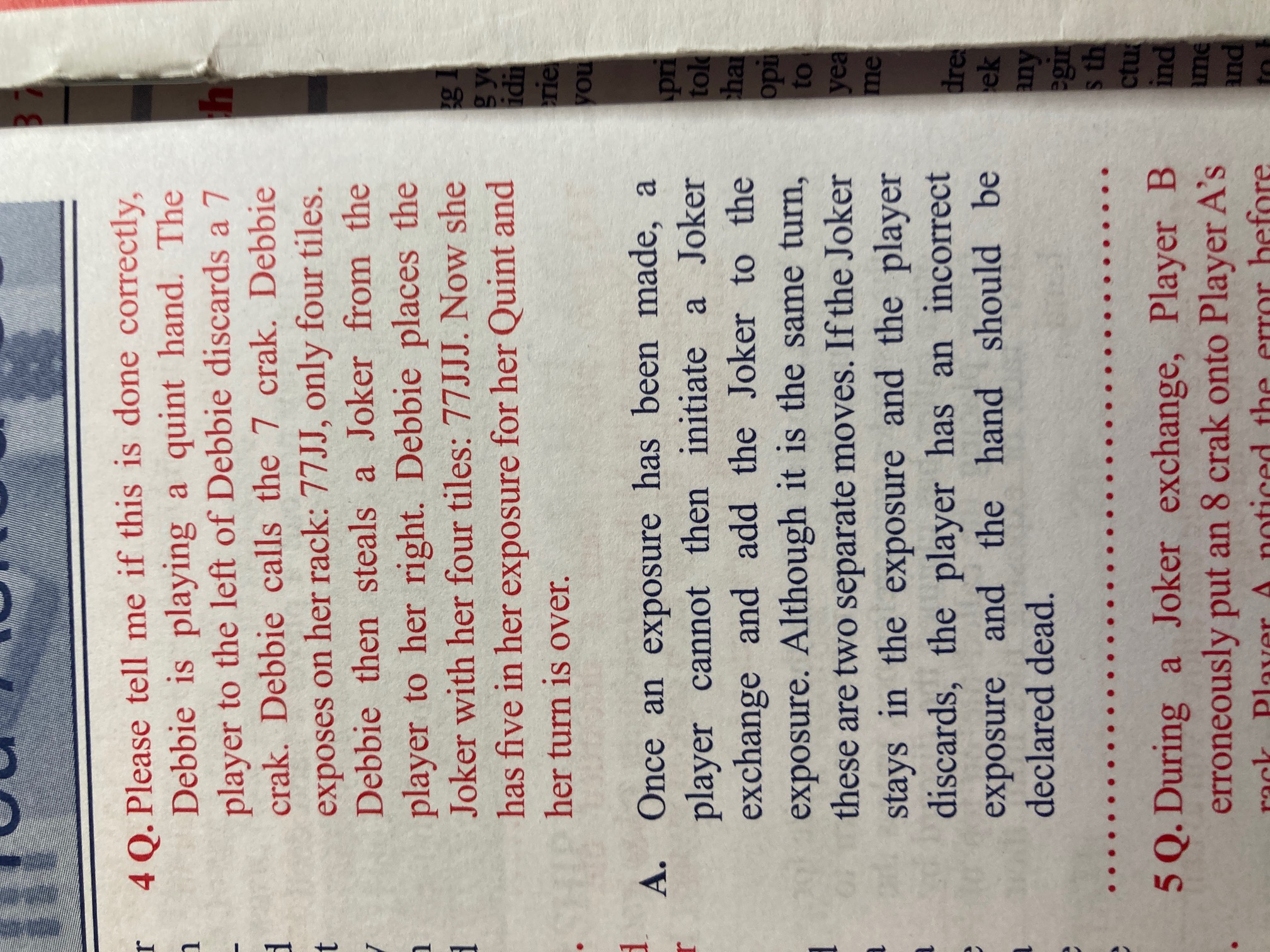
Whether for an exposure or for mah-jongg, it's an illegal move. See also FAQ 19-M1 & M2.
May the tiles be with you.
Tom Sloper
February 27, 2026
New Column
New column is up! The topic: new mah-jongg books, including some that have... ahem... "borrowed" the title of the National Mah Jongg League's official rulebook.*
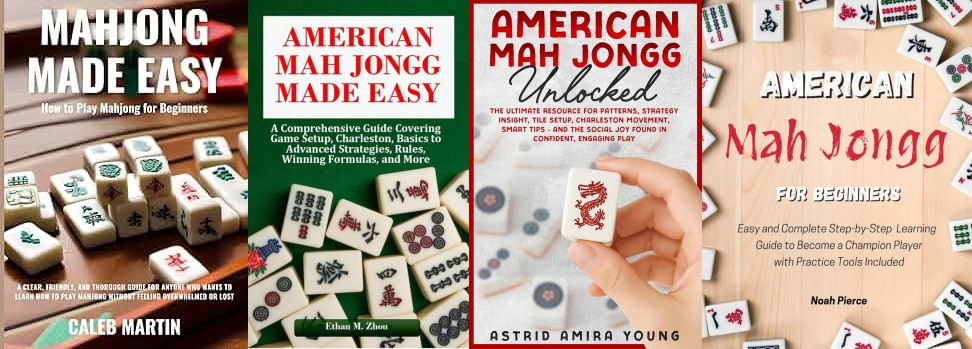 
You can read the column here.
May the tiles be with you.
Tom Sloper
February 22, 2026
* Mah Jongg Made Easy.
Two players want the same tile for Exposure...
Mah-Jongg Q+A
On Saturday, February 21, 2026 at 02:54:28 PM EST, Wendy W wrote:
My mah-jongg question or comment is:
I have a question
Hello, I have a question about discharged tile. I understand a discharge tile for Mahjongg trumps anyone else calling for that tile.
If no one has exposed tiles and a tile is discarded the person next in line gets the tile is 2 people call for it.
If 2 people call for a discarded tile ,the one who has already exposed tiles and the other does not the one either the exposed gets the discarded tile.
Are these correct???????
Hi, Wendy! Let me paint a picture of this scenario:
1. Players play in this order: A, B, C, D. Player A discards a tile. Let's say it's a three bam.
2. Players B and C both say "I want that," but player C exposes a three bam and a joker.
3. Even though player B is next in line, player C has exposed in the course of claiming the discard, so player C gets the tile.
Let's say player B already had an exposure of two bams atop his rack. It makes no difference to the scenario above. The rule you're citing is not about prior exposures.
See FAQ 19.H.3.
May the tiles be with you.
Tom Sloper
February 21, 2026
American mah-jongg rules
On Thursday, February 19, 2026 at 04:01:34 PM EST, sue l wrote:
Mah-Jongg Q+A
My mah-jongg question or comment is:
When it is my turn, and I have in my hand, a tile to replaced a joker…… can I replace the joker before I pick for my turn???? Thank you
Sue L
On Thursday, February 19, 2026 at 04:04:49 PM EST, sue l wrote:
Mah-Jongg Q+A
My mah-jongg question or comment is: do you Charleston in 3 handed MAJONGG?
Hi, Sue!
1. No, you must first start your turn by either picking from the wall (and racking the pick) OR calling a discard and using that to form a complete exposure, before you can redeem a joker. That joker may not be added to an exposure you have made. See FAQ 19-M.
2. No, the game is started by East discarding a tile without a Charleston. See FAQ 13A.
May the tiles be with you.
Tom Sloper
February 19, 2026
I need 4 blank mah-jongg tiles!
Mah-Jongg Q+A
On Wednesday, February 18, 2026 at 11:13:49 AM EST, R & D L wrote:
My mah-jongg question or comment is: Where can I buy 4 blank tiles? Dorene
Hi, Dorene!
You can try asking around on Facebook. Join some mah jongg groups. And see if FAQ 7Q offers any help for you. Good luck!
May the tiles be with you. Literally!
Tom Sloper
February 18, 2026
Recalcitrant chip holders
On Sunday, February 15, 2026 at 11:07:36 AM EST, Elizabeth S wrote:
Question on vintage mahjong rack maintenance
Good Day,
I have a number of mahjong racks from the 60's or early 70's, with the swirly plastic and the money holders with the rotating metal tips. (example attached)
Some of the money stoppers at the top are stiff and difficult to move. Should they be lubricated to make them easier to move and reduce the chance of breakage? I can't find discussion on this anywhere.
Thanks for the wealth of knowlege on Sloperama!
Elizabeth S

Hi, Elizabeth! I haven't lubricated any of mine, but only because they aren't that difficult to move. If I found some that were difficult to move, I would lubricate them. But I'd be careful about excess lubricant. I'd wipe them to be sure they're dry, then I'd check them again a week later, wipe again if necessary. I'll add this to the Cleaning and Restoring FAQ.
May the tiles be with you.
Tom Sloper
February 15, 2026
2 players call for mahj - 1st one is in error
On Friday, February 13, 2026 at 01:31:50 PM EST, Joanne M wrote:
????
A Flower is discarded. Two players call it for mahjong. Both players started to expose their tiles. It was decided that the tile should go to the player next in sequence. But it was subsequently learned that that that player declared mahjong in error. Can the second player who also called the tile for mahjong then claim that tile that is erroneously already on top of the other player's rack and thus declare mahjong?
If not, since her hand was partially exposed, is she also dead, or does play continue with one less player, (the one who made the erroneous mahjong)? The players now all know that she only needs a flower for mah-jong
Thanks
joanne
Yes, Joanne, the second caller can have the discard for mah-jongg. If her call was for exposure, she would have been out of luck. See FAQ 19.H.4.
May the tiles be with you.
Tom Sloper
Friday the Thirteenth, Feb. 2026
The 2025 NMJL card, Any Like #2 (part 3)
On Friday, February 13, 2026 at 09:38:17 AM EST, Carol T wrote:
Re: Mah-Jongg Q+A
Thank you so much!
Carol ??
You're welcome, Carol!
May the tiles be with you.
Tom Sloper
Friday the 13th
P.S. I'm sorry that emojis turn into double question marks on this site.
The 2025 NMJL card, Any Like #2 (part 2)
On Thursday, February 12, 2026 at 09:01:41 PM EST, Carol T wrote:
Re: Mah-Jongg Q+A
My mah-jongg question or comment is:
Thank you for your email but I do not see an answer to my specific question about the 2 pairs of the same tile in the like number hand. My question is when calling mahjong, do the tiles have to be displayed in the correct order meaning one matching pair on each end. The hand was displayed with the 2 pairs as a Kong first, then moved after the whole hand was exposed. Is her hand dead or a good mahjong?
Carol ??
Hi, Carol.
I posted our discussion (your question and my answer) at https://sloperama.com/majexchange/bulletinbd.htm. I think what happened is that you visited the bulletin board before you emailed me, and your browser cached the page. Then, after I posted the Q&A on the board and emailed you, when you returned to the board, your browser just showed you the cached version. Our discussion is right at the top after you scroll down past the boilerplate. If you still aren't seeing our discussion there, you can Refresh the browser (the Refresh icon looks like a circling arrow).
To cut to the chase: I replied that her hand is a good mah-jongg, per the 2019 bulletin from the NMJL. See https://www.sloperama.com/mjfaq/mjfaq19.html#cn.
May the tiles be with you.
Tom Sloper
February 12, 2026
The 2025 NMJL card, Any Like #2
On Thursday, February 12, 2026 at 02:55:35 PM EST, Carol T wrote:
Mah-Jongg Q+A
My mah-jongg question or comment is:
On the 2025 card…Any Like Numbers…2nd hand down…
If mahjong is called and all tiles placed on the rack but the two matching pairs are exposed as a Kong, is the hand called dead. Player said after exposing as explained above, “Oh, this goes this way,” moving the pairs into the correct position. That’s the confusion. Dead or mahjong?
Carol ??
Hi, Carol! The way you described it, the player made her two pairs by exposing them both from the sloping front of the rack, concurrently with declaring mah-jongg. She corrected her initial placement by separating the two pairs and arranging the hand per the card. That's okay. She wins.
See FAQ 19-CN. In the FAQ, I cite the 2019 bulletin as the source of the rule. It has probably been restated since then.
What's not okay with that hand is to call a discard and expose the two pairs as a kong.
May the tiles be with you.
Tom Sloper
February 2, 2026
* #23
Confusing wording on the card
Mah-Jongg Q+A
On Tuesday, February 10, 2026 at 07:50:30 PM EST, Kay B wrote:
My mah-jongg question or comment is:
Please take a look at question #7 on the back of the NMJL card. I caused quite a rukkus when I pointed this rule out. I think it’s a poorly worded sentence and stand by my interpretation. Does it mean that a joker that is part of an exposed meld is available to be swapped even after Mahjongg is declared incorrectly and the hand is called dead? Or is the joker (s) only available until Mahjongg is called and the hand is called dead. Any jokers that are exposed when Maj is called are dead. (I learned to flip the dead jokers over and leave the available ones showing.)
Thanks in advance
Kay
7. Jokers may be exchanged from any and all exposures that were made before a hand is declared "dead."
Hi, Kay! You asked:
Q: Does it mean that a joker that is part of an exposed meld is available to be swapped even after Mahjongg is declared incorrectly and the hand is called dead?
A: Yes, if that exposed meld is ambiguous (does not show conclusively that the hand cannot be made legally) at the time of exposure.
When the hand is declared dead, any and all exposures put up along with the mah-jongg declaration are returned to the slanted front of the rack. Prior exposures remain, so long as they are ambiguous. (MJME 2023/24, page 22 rule 4 (b)).
This is the League's official rulebook.
Beware of erroneous similarly-titled books on Amazon
Q: Or is the joker (s) only available until Mahjongg is called and the hand is called dead. Any jokers that are exposed when Maj is called are dead.
A: Any and all tiles put up along with the faulty mah-jongg declaration are returned to the slanted front of the rack. If the hand is marked Concealed (C) on the card, then all tiles are returned.
Q: (I learned to flip the dead jokers over and leave the available ones showing.)
A: Interesting. But not per the rulebook. Those dead jokers should be put back on the sloping front of the rack. See FAQ 19-P.
May the tiles be with you.
Tom Sloper
February 11, 2026
[Chinese rules] How to win a 13-tile hand, part 2
Thank you for lots of good info!
On Monday, February 9, 2026 at 10:56:22 PM EST, Marian D wrote:
Hi Tom,
Thank you for answering my question about the hypothetical 13 tile hand. I regret that I did not send you a photo. I was relying on my memory when I told you the hypothetical hand was 13 tiles. I was working with my "working memory," which neuroscientist Lisa Genova says is only reliable for 15-30 seconds. It operates in the prefrontal cortex of the brain. She wrote "Still Alice," and "Remember." I'm reading "Remember," now. Regarding my hypothetical 13 tile hand -- which was indeed 13 tiles, not 15, so the hand I wrote out for you was not accurate! -- but I don't remember how the 13 were formed. I can't remember how whether some of the sets were exposed! I think they may have been. Even so, you have presented a thoughtful and analytical set of rules that I wasn't yet familiar with. Thank you so much!
Marian D
You're welcome, Marian.
May the tiles be with you.
Tom Sloper
February 10, 2026
[Chinese rules] How to win a 13-tile hand with a chow, a kong, and some pungs
Question about a strange 13 tile hand
On Monday, February 9, 2026 at 08:42:52 PM EST, Marian D wrote:
A 13 tile hand consists of: 1 Chow, 3 Pungs, and one Kong. The player
needs as pair. What does this player need to do, in order to achieve a
pair, for a 14 tile winning hand? Should the player sacrifice some of
the tiles in the Chow, hoping for a pair for one of those? What
strategy would you suggest for a Win?
Marian D
Hi, Marian. Let's take a look at this hypothetical hand...

The hand you described is the hand at the top.
A chow, three pungs, and a kong is sixteen tiles but count as fifteen.
Fifteen tiles, not thirteen. That's too many tiles. But...
...note that the melded "Concealed" kong counts as three tiles for tile count purposes.
And note that the kong must be melded, otherwise the hand can't be completed. The player must have made the kong without use of a discard, so in order to correct the tile count, the kong is revealed to the other players.
Note that the two outside tiles are turned face down to indicate that the kong is Concealed for extra points.
A replacement tile must be drawn from the back end of the wall (or from the kong box if there is one).
This is how a Concealed kong has to be treated.
So let's look at the hand you actually meant. It could be either:
a chow and 2 pungs and a single tile and a melded Concealed kong (2nd example), needing a mate for the single tile, or
an incomplete chow and 2 pungs and a pair and the melded kong (3rd example above), needing to complete the chow, or
a chow and a pung and two pairs and the melded kong (last example above), needing a match for one of the pairs.
May the tiles be with you.
Tom Sloper
February 9, 2026
[American rules] Two Qs
racking tiles
On Monday, February 9, 2026 at 05:38:44 PM EST, Joanne M wrote:
A player calls for a tile, picks it up and does not display it. Instead she puts it on the sloping part of the rack, thinks about it some more, and then exposes it with other tiles from her sloping rack. Is this acceptable?
Joanne
misnamed tile ---- can it be called for twice????
On Monday, February 9, 2026 at 05:46:01 PM EST, Joanne M wrote:
A 5 bam was discarded. A player called for it. The player displayed two 5 bams from her hand onto her rack. But then, when she saw that it was a 5 dot, she returned her two 5 bam tiles to the sloping rack. Her hand is now dead because she should have seen that it was incorrectly named.
BUT .....
Now another player calls for that 5 dot tile. Is this allowed?
Joanne.
Hi, Joanne!
1. It's against the rules to put a called discard into one's rack before exposing the required set atop the rack. But there is no penalty. In your case, the player eventually got around to making the required exposure, so all has become right with the world. See FAQ 19.k.
2. When the first caller put tiles atop her rack, she committed to that play. I notice you don't say that she took the 5 dot once she realized her mistake. That tile belongs atop her rack, and when someone else calls her dead, the whole exposure has to be returned to the sloping front of the rack, including the called discard. This means the second caller cannot have the tile. Exception: if the second caller wants the tile for mah-jongg, the second caller wins. See FAQ 19.i.
May the tiles be with you.
Tom Sloper
February 9, 2026
[Chinese rules] Can I call a discard to promote an exposed pung, part 2
On Monday, February 9, 2026 at 02:00:37 PM EST, Marian D wrote:
Subject: Clarifying
Hi Tom,
To clarify: is this correct:
Promoting an exposed Pung to a Kong may be done only from a self-pick – not from a discard.
Thanks for answering my question!
Marian D
Yes. You're welcome.
May the tiles be with you.
Tom
[Chinese rules] Can I call a discard to promote an exposed pung to a kong?
On Sunday, February 8, 2026 at 04:02:32 PM EST, Marian D wrote:
Subject: Can an immediately discarded tile be claimed to add a tile to an already revealed Pung to form a Kong?
Hello, Tom,
I hope this question is clear?
Can an immediately discarded tile be claimed to add a tile to an already revealed Pung to form a Kong?
Marian D
No. See FAQ 20.D.3.. Kong promotion can be done only on self-pick.
May the tiles be with you.
Tom Sloper
February 8, 2026
[American rules] If two people call the same tile at the same time
On Thursday, February 5, 2026 at 12:17:26 PM EST, Joy C wrote:
Subject: Mah-Jongg Q+A
My mah-jongg question or comment is:
Sent from my iPhone
If two people call the same tile at the same time, who gets it?
Hi, Joy! This is answered on the back of the card.
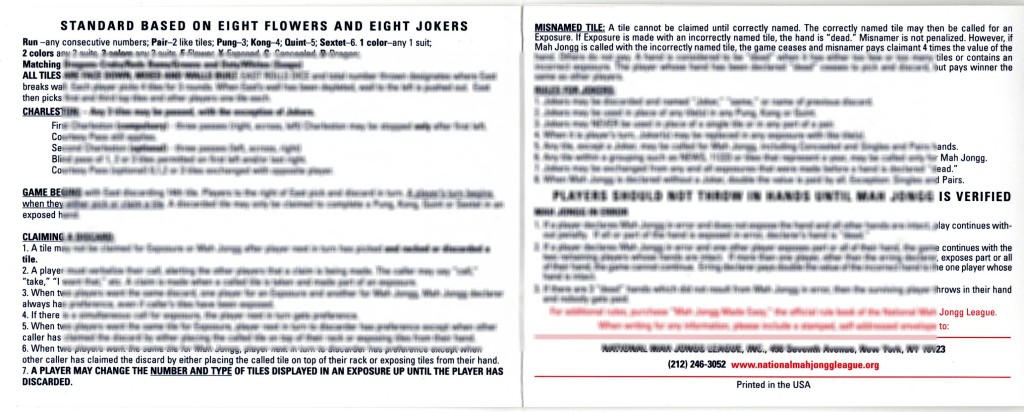
3. When two players want the same discard, one player for an exposure and another for mah-jongg, mah-jongg declarer always has preference, even if caller's tiles have been exposed.
4. If there is a simultaneous call for exposure, the player next in turn gets preference.
5. ... except when other caller has claimed the discard by either placing the called tile on top of their rack or exposing tiles from their hand.
6. When two players want the same tile for mah-jongg, player next in turn ... has preference except when other caller has claimed the discard by either placing the called tile on top of their rack or exposing tiles from their hand.
You can also find this rule in FAQ 19-H.
May the tiles be with you.
Tom Sloper
February 5, 2026
Any ideas on how to turn around, part 2
On Thursday, February 5, 2026 at 09:03:55 AM EST, Linda S wrote:
Subject: Mah-Jongg Q+A
My mah-jongg question or comment is: Turning Around a Failing Program
Thank you for your helpful answers and thoughts. The numbers need to increase because it is a library and I think funding is somehow based on number of participants. After the library provided a beautiful space in a newly acquired building, they expected the numbers to increase. That has not happened.
American Mah Jongg is played. I had 250 characters to explain how the 15-20 core people play so writing they do not play by NMJL rules doesn’t 100% explain the problem. They play in a vacuum year after year. Some will ask to exchange for a displayed joker even after they have completely named their (now dead) tile. HOLD gives a player time (as much as needed) to think how to play their hand while rearranging/counting/comparing their tiles to match possible patterns on the card. Rather than filling a couple pages with this type example, I would just say the I think the Mah Jongg rules and customs are meant to facilitate a smooth, rhythmic transmission from player to player requiring some fast thinking. If an experienced player stopped in one day, they would likely not come back, unless they wanted to start an uproar.
Sadly, some variants to NMJL rules are taught to new players. Again, your answer hit the nail on the head and is a starting point for improvement. Thank you.
So the players are playing slowly and not according to all the rules. The only thing I can think of is to bring in someone who knows how to play at speed and win, and show them by example that playing right can be more fun. But I am not encouraged about the pressure to increase attendance. 15-20 is a big group, in my opinion. Good luck.
May the tiles be with you.
Tom Sloper
February 5, 2026
All Red, part 2
On Wednesday, February 4, 2026 at 08:44:36 PM EST, Marian D wrote:
Subject: Thanks for showing me the All Red winning hand,
Hi Tom,
Thank you for showing me the picture of the all red winning hand, used in Western (Australian/British) mah-jongg called "Red Coral." It's made from pungs or kongs of red dragons and craks, with a pair of craksRed Coral - pungs or kongs of red dragons and craks, with a pair of craks. Exposed --- Limit
I love this one!! We will definitely use this as a Winning Hand/Mahjong in our apartment building game! We won't be starting our weekly Mahjong game until April or May.
Best wishes,
Marian D
--
Not MAGA -- MALPA -- Make America Loving and Peaceful Again
You're welcome, Marian. Have fun!
May the tiles be with you.
Tom Sloper
February 4, 2026
All Red
On Wednesday, February 4, 2026 at 03:41:42 PM EST, Marian D wrote:
Subject: Illustration of all red winning hand in Chinese Mahjong?
Hi Tom,
In the list of Winning Hands, I find "all green." Is there an "all red"
winning hand? Could you please post a picture of that if there is one?
I can't find that.
Thanks for your great help and website.
Marian D
Hi, Marian. My list of Chinese Special Hands has a section called "Jewel Hands." There you will find "Imperial Ruby" (aka "Royal Ruby"), which is made of pungs or kongs of red dragons and "red bams" with a pair of "red bams." Red bams are the bamboo tiles with some red paint on them - 1, 5, 7, and 9.

The Green Bams (2, 3, 4, 6, 8) - The Red Bams (1, 5, 7, 9)

Imperial Ruby (Also called: Royal Ruby).Pungs or Kongs of Red
Dragons and Red Bams, with a pair of Red Bams. Exposed --- Limit
But if you don't like all that green being in the Imperial Ruby hand and want something all red instead, there's a hand used in Western (Australian/British) mah-jongg called "Red Coral." It's made from pungs or kongs of red dragons and craks, with a pair of craks.

Red Coral - pungs or kongs of red dragons and
craks, with a pair of craks. Exposed --- Limit
May the tiles be with you.
Tom Sloper
February 4, 2026
Any ideas on how to turn around a failing MJ program?
On Tuesday, February 3, 2026 at 10:16:17 AM EST, service@paypal wrote:
Subject: lcschreff sent you money
Hello Thomas Sloper,
PayPal
You were sent $50.00 USD from lcschreff
To see all the transaction details, please log into your PayPal account. It may take a few moments for this transaction to appear in your account.
Transaction date
Feb 3, 2026 07:16:12 PST
Buyer information
Linda S
Instructions from buyer
Any ideas on how to turn around a failing MJ program? Volunteers train new players who do not come back after their 4 basic lessons. 15-20 Core players do not play by NMJL rules. No one seems to know how to correct and build.
Description Unit price Qty Amount
Sloperama Mah-Jongg Answers
Item #: MJ@Sloperama $50.00 USD 1 $50.00 USD
Total: $50.00 USD
PayPal
囧 I have mixed feelings, Linda. I appreciate the generous donation very much, thank you! But you've put me on the spot with an eternally impossible question. That's why it took so long for me to post this reply. If I couldn't give you a helpful answer, I wanted to at least give you a thoughtful reply.
I, too, have experienced student body drop-off after the first few lessons. I know of no way to keep students beyond the point where they feel they've learned enough. I've also had students who stuck the whole course and wanted more. The difference is whether the student feels they are making progress with understanding the rules and the strategies.
I gather that your location is a community center or library, where you host games and also lessons. I have never been involved in this kind of situation so unfortunately I can't speak from experience. I have read lots of horror stories in emails and on Facebook, of players who insist on playing with only their group and don't tolerate new players. Of bossy players, slow players, players who always show up late, players who take phone calls at the table... Tables with no patience for new players, players with annoying strategies and habits, like
always stopping the Charleston, picking too quickly, arranging the discards, putting their tiles on the card...
... These stories cause me much anguish because I imagine myself "in charge" and having to peacefully and fairly settle what can easily become explosive.
You say "15-20 Core players do not play by NMJL rules," but that doesn't tell me what they do play, or what problem it results in. Going out on a limb, I assume they play American rules but add in their own table rules (I assume they aren't playing Taiwanese or Filipino rules, for instance). And I assume that they don't want to play the official way. That's what's going on in mah-jongg right now across America...
-They won't give up using blank tiles as superjokers.
-They don't want to build walls.
-They don't want to roll dice.
-They play a 3-player Charleston.
-People who refuse to play with quarters and nickels, people who demand everyone play with coins.
If this is what you're talking about, if this is what you want to "correct," I don't have any magic for you. You also said you want to "build." Does that mean 15-20 core players is too few? Are you running a business, a game café, more players will compensate for or otherwise justify the use of the space? Or it's just a dream, uniting many people and spreading the joy of mah-jongg?
I'm sorry, I shouldn't be demanding answers from you. I'm just as flummoxed as you are by dropout students, but I'm not sure what problem you need to solve and why -- not that I would necessarily have solutions...
How about this. Maybe you have a bulletin board or a spot on the wall where you could post the names and photos of the top mah-jongg players (1st, 2nd, 3rd), as determined by tournament scoring. Players would have to keep score under the official rules to qualify. If your venue has food offerings, if it's a café for instance, then a prize could be a drink or foodstuff. For example, I go to trivia night at a local bar, where the winning team gets a voucher redeemable for drinks or food.
It doesn't have to be cash. It can be framed fame on the wall, until such time as the next mah-jongg winner steps up. Three boxes for gold, silver, bronze (for this week).
Some kind of reward for playing well and playing by the rules. Or at least your entire mah-jongg playership comes together to work out a mutually acceptable scoring method, and you may have to bend a little. The details can be determined by your specific situation.
If/when you've got a winner, start a smattering of applause and present the award. Maybe somebody will think that was fun and will try for it. Just a thought. Sorry that I have nothing more for you. Maybe some readers will offer some ideas. Thank you again.
May the tiles be with you.
Tom Sloper
February 3, 2026
Someone other than East discards, part 2
On Tuesday, February 3, 2026 at 10:08:32 AM EST, Leslye G wrote:
Subject: Re: Mah-Jongg Q+A
Tom, you are amazing! Thank you!
I’m usually pretty good about finding and referring to the rules, but appreciate you taking the time to do what I had not.
Best,
Leslye G
Cheers, Leslye!
May the tiles be with you.
Tom Sloper
February 3, 2026
Someone other than East discards the first tile ...
On Monday, February 2, 2026 at 10:58:58 PM EST, Leslye G wrote:
Subject: Mah-Jongg Q+A
My mah-jongg question or comment is:
My apologies if this question and answer has already been posted. I’ve not been able to find it.
Someone other than East discards the first tile after the Charleston. How do we proceed? Is the player dead for throwing out of turn? Do we start all over? Please advise.
I also want to thank you for all of your work and your time for helping those of us who care to play and understand the rules. Knowing the rules and incorporating them into play is half the fun!
Thank you,
Leslye G
Hi, Leslye!
The rule is in MJME 2023/24, page 14, 9th bullet. She can take the errant discard back and East discards the first tile to begin the game. If she had picked from the wall and discarded, the game would have to be thrown in. Got MJME?
This is the League's official rulebook, Mah Jongg Made Easy (MJME).
Beware of erroneous similarly-titled books on Amazon.
May the tiles be with you.
Tom Sloper
February 2, 2026
Mint c.1967 A&L set, part 2
On Monday, February 2, 2026 at 09:35:01 PM EST, Scott D wrote:
Subject: Re: Asking advice: valuing and selling mint c.1967 A&L set
Thank you for this! (As far as I can tell, I cannot respond directly on the BB site, but if you'd like to add this followup to the thread, you're welcome to.)
Your observation (with which I was inclined to agree) that the wrappings are getting in the way prompted me to inspect the wrappings more closely. The two trays were enclosed in one bag; fortunately that bag was only closed with some aged cellophane tape whose adhesive had mostly given up the ghost. So I was able to inspect the tiles; see attached photo.There are 164 tiles (not 168: the 'extra space' was taken by a pair of dice(!) and a pair of keys for the case), including 10 flowers, 8 jokers, and two blanks.
Anyway, I share this primarily to satisfy curiosity, not necessarily to prompt you to re-value the set.
Thanks again

Good news and bad news, Scott. The eight manufactured Big Jokers boosts the value of the set. But there are discolored tiles, which means the set cannot be called Mint or As New.
The next condition below Mint is FINE or EXCELLENT - "Item has only very minor defects which only a purist or expert would notice or care about."
In my opinion, any normal person (not only a purist or expert) would notice the discolorations. That, in my opinion, drops the set's condition down to
VERY GOOD. So the set's value is probably in the lower part of the range I gave you yesterday.
May the tiles be with you.
Tom Sloper
February 2, 2026
Mint c.1967 A&L set
On Sunday, February 1, 2026 at 03:51:20 PM EST, Scott D wrote:
Asking advice: valuing and selling mint c.1967 A&L set
Dear Mr. Sloper!
I recently found this mahjongg set at an estate sale--I initially intended to use it for play, but when I realized it's essentially in mint condition, I wondered about selling it to a collector. I've read your FAQs; here is my understanding of the situation, and my questions:
This is obviously a catalin set from A&L, manufactured in 1967 or 1968 (the box contains a piece of newspaper dated February 16, 1968, probably intended to keep the racks from sliding around in the case. Maybe this was a Christmas present that never got used?) The tiles in their boxes are still wrapped in plastic, which is why I have not laid out the tiles as you request. It seems very likely there are 168 tiles in the set (4 layers of 21x2 tiles). It also has 5 racks with chip-holders, still wrapped in tissue (though some of the tissue is slightly damaged!). The box appears to be original, mainly because there's a darkened spot on the satin lining that appears to correspond with the small "Royal Depth Control" tag you see in the 3rd photo (the other two documents were in the box. It also has an unopened plastic bag of Chinese-style coins, with a round Bake-lite wind indicator.
The box does have a faint mildew aroma, though that is fading.
My primary question: how would you value this set? And secondarily, am I correct to assume that I should leave all the internal packaging intact for the purposes of a sale?
Thank you very much! Happy to have you post on the bulletin board.
Scott D
Okemos, Michigan


Hi, Scott! Nice acquisition. First, I should say I don't have expertise when it comes to selling mint-quality sets like this. My estimate is what I'd guess a seller would want from it, tempered with what I think a collector would pay.
Assumption: the case is in mint condition on the outside but smelly on the inside You can do more to deodorize the case. See the Cleaning/Restoring FAQ. Used dryer sheets work. Instead of throwing them out when the laundry load is finished, save the fabric softener sheet and put it in the case. I forget what other tips from the FAQ I used to deodorize one of my sets. You should try more than one thing. I might have tried Febreze too. Search the page for "smell" and "odor."
Question mark: The 1967-68 "That's It!" booklet might or might not be contemporary with the set. I can see six Big Jokers in the photo of the case's innards, but I don't know what's beneath those tiles. See column 509, which indicates the number of flowers and jokers required by the National League each year. In 1967-68, the League required 6 jokers and 10 flowers. In the picture I can see 6 jokers and 12 flowers. The manufacturer's pack-in card says there are extra flowers but does not say how many. That picture leads me to believe that under each tile at the left end of the tray is a duplicate of that tile, since a mah-jongg set has four of each suit, wind, and dragon. You didn't take a picture of the other tray of tiles. I assume the bams and dots and winds are in the other tray, or are they? This point is vital to the set's current value. Does it have eight jokers, that's the real question, since today's requirement is for eight jokers. That plastic wrap around the tray, you indicated that there would be destruction if you tried to unwrap, and here we have an eternal quandary. Still having the original wrap seems special, but not knowing the full contents ... maddening! Does the wrap envelop both trays, or are the two trays wrapped separately? Seeing at least the top tiles in each tray would better inform a guess as to how many jokers there are in the set.
It looks like the brass fittings on the case are bright and shiny, but I can't see the brass endpieces on the racks. You didn't mention dice. I don't see dice.
The wrappings are getting in the way. I'd say the wrappings are expendable, especially if you want to play with the set.
Assuming the set has only six jokers, and no dice, and there are flaws on the exterior of the case that you didn't mention and the odor never goes away entirely, we get a value less than the value if the set has eight jokers and dice and a nice smell. I'd imagine a seller would want $600-700 for it, and that a buyer would want its price to be under $300. Somewhere between that low number and that high number is where I guess your set's value lies.
May the tiles be with you.
Tom Sloper
February 1, 2026
Did she win or was she dead?
On Sunday, February 1, 2026 at 08:14:54 AM EST, Joanne M wrote:
Subject: is this a mahjong?
Good morning
A player called for a 6 crak and exposed 2 jokers with it to make a kong. Player then realized that she only needed 1 joker because a 6 crak was on the slanted side of her rack. She replaced that joker with the 6 crak from her rack, and then realized she could not discard because she had a mahjongg. She was told once the tile is exposed on the rack, it cannot be moved around to complete a mahjong. Doesn't mahjong trump all? The hand was thrown in . This was not a tournament.
joanne
Hi, Joanne!
This isn't a case of mah-jongg overriding another rule. It's a case of a player changing an exposure, which she is permitted to do under the rules. See MJME 2023/24, page 15, paragraph 2, last sentence. Or see FAQ 19-AF. "A player may add to or take away from the exposure up until the time the player has discarded." Add that to the "well whaddaya know, that's mah-jongg," and this play would seem a little complicated to the other players in real time, but it's perfectly legal.
May the tiles be with you.
Tom Sloper
February 1, 2026
Error in "The Red Dragon & The West Wind"
On Thursday, January 29, 2026 at 10:47:54 PM EST, Phill K wrote:
Subject: Error in "The Red Dragon & The West Wind"
Tom,
I love your book which I recently purchased. Thorough, precise and clear.
You probably were advised already that there is an incorrect rule on page 53, paragraph 60 c. Contrary to said paragraph, Once a discard is placed atop the rack, player may no longer change her mind as to discard.
Please let me know if you appreciate notice of errata. Especially as the book has not been recently updated and you probably are aware of it.
Thank you.
Respectfully,
Phill
On Thursday, January 29, 2026 at 11:10:47 PM EST, Phill K wrote:
Subject: Errata , my error
Tom,
After I sent the email with the error in your book, I thought Tom must have corrected this somewhere. I then went to your website and found the list of errata posted there including the 1 I send.
Thanks,
Phill

Good work, Phill! I saw the subject line of your first email just as I was heading off to bed. Your second email was waiting to greet me over coffee this morning.
Thanks for reading my book, and thanks for finding the errata. If you find anything else I should address, do let me know.
May the tiles be with you.
Tom Sloper
January 30, 2026
Are these valid hands, part 2
On Thursday, January 29, 2026 at 11:48:49 AM EST, Marian D wrote:
Subject: Re: Possible winning hand in Chinese Mahjong?
Thank you, Tom! This clarifies the situation! I'm going to play our the non-winning hand. I will try for a 7-pair hand. ...
We have not started our building's Chinese Mahjong group yet. That is because I'm moving to another apartment building, and so I won't be able to start our group until April or May 2026. But I play "Mahjong Solitaire" with all open hands, every day, to learn the game better. ...
Best wishes,
Marian D
Have fun, and good luck, Marian!
May the tiles be with you.
Tom Sloper
January 29, 2026
Are these valid hands in Chinese Mahjong?
On Wednesday, January 28, 2026 at 09:12:19 PM EST, Marian D wrote:
Subject: Possible winning hand in Chinese Mahjong?
Hi Tom,
Question about a possible Winning Hand, that I don't see listed anywhere?
We have a 14 tile hand, with 4 pairs, and 3 triples (one Pung, and one
Chow). Can this be a Winning/Mahjong hand in Chinese Mahjong? If so, can
you find a example picture of tiles for this possible Winning hand? Of
course, I will give credit to you for providing it, if it is your or
others' copyright.
Thanks for all your help so far. I hope you don't mind a new question
after a few weeks.
Best wishes,
Marian D
Hi, Marian!
No, there's no such thing as you describe.

If the player's hand is not on the list of special hands, it has to be four groups (pungs, chows, or kongs) and a pair ... or seven pairs. The mixed pairs-and-groups structure is not valid. That's why you couldn't find such a hand listed anywhere.
May the tiles be with you.
Tom Sloper
January 28, 2026
P.S. In Taiwanese mah-jongg, a mah-jongg hand is 17 tiles. Four pairs and three groups, and seven pairs and one group, may be valid hand structures in that variant.
Does Call cancel out Hold?
On Tuesday, January 27, 2026 at 01:55:09 PM EST, Sally C wrote:
Subject: Question on Calling for an exposure while another player has said hold
Player A says "hold" as she contemplates whether she wants a tile. In the meantime Player C who is not next in line says "Call" for an exposure. Is this a correct procedure, or must Player C wait for Player A to make a decision?
Sally C
Hi, Sally! It's okay for Player C to put Player A on notice that she's not the only one considering that discard. I mean, there's no rule against it. But it doesn't help Player C to do that, at least not right at this point, since Player A is ahead of Player C in play order.
I've noticed a lot of new players on Facebook asking how "hold" applies in
conflicting claims for exposure. This diagram is just so we can keep the following scenario in focus.

Player A discards, naming it. Doesn't matter what the tile is. Doesn't matter to us, anyway, but all 3 other players at the table want to call it!
Player C speaks first: "Hold!" (She could just as well say "Call"- it doesn't matter.)
Player D sighs, "Poopy." Player C is ahead of Player D in play order. Although Player D could be reducing her chances of getting the tile, she lets Player C know she'll be unhappy if Player C does take the tile. This is a sharing group.
Player B speaks: "I'm first in line so I'll take it."
(She could just as well say "Call"- it doesn't matter.)
Because there's one reason why her call might not be able to supersede Player C's hold, Player B needs to add:
"Unless you're calling it for mah-jongg."
Player C's turn to sigh: "No, not for mahj."
And so Player B gets the tile and makes an exposure.
I think this scenario covers the bases, but maybe
a reader will want to ask about other scenarios where "hold" might be superseded.
I'm adding this to FAQ 19.
May the tiles be with you.
Tom Sloper
January 27, 2026
I called for a discard but forgot to make the exposure!
On Thursday, January 22, 2026 at 05:09:01 PM EST, Donna H wrote:
Subject: Mah-Jongg Q+A
My mah-jongg question or comment is:
I called for an exposure for a pung, but forgot to expose! “Pure” exposure, no jokers. (I know! I usually put my “call” directly onto the flat part of my rack and then the tiles that go with it!! We were all chatting about something or other\distracted). It wasn’t until several of turns later that I said—hey, I forgot to expose that call. Can I put it up after the fact? I can’t call myself dead. But someone else did. Am I dead?
Sent from my iPad
Hi, Donna! That's pretty funny, that you were all having so much fun together that you forgot to make the exposure. It's an interesting question.
There is no rule governing this situation - imagine rule 1,583.a: "If a player calls for a discard and forgets to take it and make an exposure or mah-jongg..." So since there is no rule, we have to figure it out for ourselves.
I'm going to address your second question first. Problem: your description of the incident omitted important details. There's a gap after you said "call" (step 2 below) and before play continued around the table (step 5 below)...
1. A player discarded.
2. You said "call."
3. Somebody said something and you got drawn into the group dynamic.
4.
5. Play continued around the table for several turns.
6. You said "Hey!"
At step 4, something did or didn't happen (you either took the discard or you didn't).
4.a. What happened to the discard you called? Did you leave it on the discard floor? Or did you take it, and if so: Did you put it atop your rack or did you put it among your concealed tiles?
4.b. Did you discard a tile to end your turn?
4.c. Was there a single tile atop your rack (the taken discard) after your turn ended? If so, yes, your hand was dead.
5. To get the game rolling again, either you discarded to end your turn, or the next player picked from the wall to begin her turn.
6. How many tiles in all were you holding in and on the rack when you said "Hey"? 12, 13, or 14?
6.a. If 12, your hand was dead.
6.b. If 13, assuming it was your turn, had you picked from the wall or taken a discard? If yes, your hand was dead.
6.c.1. If 14, assuming it was your turn, had you picked from the wall or taken a discard? If no, your hand was dead.
6.c.2. If it was not your turn and you were holding 14 tiles, then your hand was dead.
You say it was you who called attention to your error. If you hadn't said anything, you could have continued playing, unless somebody else called you dead.
So I believe you found the answer to your second question in there somewhere. But I wonder what answer you found!
As for your first question: no. It's too late after so many turns have gone by - you can't retroactively make that exposure. Besides, trying to rectify that past error calls everyone's attention to your error, so somebody else can arguably call you dead.
Whew! I worked too hard on that one. Interesting scenario.
May the tiles be with you.
Tom Sloper
January 22, 2026
A player declares mahj and another throws in her tiles...
On Wednesday, January 21, 2026 at 04:09:50 PM EST, Joanne M wrote:
Subject: mahjong in error
We are holding a tournament in February. How should judges rule on this problem?
A player calls mahjong and displays her hand. One player throws in her tiles. Then the other two players notice that it is not a mahjong. Do just the 2 remaining players continue playing, or do all players throw in their hands and begin anew? Is there any penalty for the mahjong claimed in error?
Thanks.
Joanne
Hi, Joanne! Two players are still in the game. They should play on. As for your second question, I don't know what tournament scoring system you're going to use (what you apply penalties for, or what those penalties are), but I'm going with "no." Being dead is probably penalty enough, and the other players benefit.
May the tiles be with you.
Tom Sloper
January 21, 2026
What if everybody wants to blind pass? (FAQ 19-BS)
On Tuesday, January 20, 2026 at 05:10:01 PM EST, Sandy K wrote:
Subject: Mah-Jongg Q A
My mah-jongg question or comment is:
On the last right in the Charleston. What do you do if every player wants to make a blind pass.
Thanks
Hi, Sandy! This is described on page 13 of MJME 2023/24, and in my column #534. Use the IOU paradigm. One player begins by passing whatever she has, and says "I owe you one more," for example. That gets the pass started, and when tiles come around to her again, she can fulfill the IOU.
This is the League's official rulebook, Mah Jongg Made Easy (MJME).
Beware of erroneous similarly-titled books on Amazon.
The player with the greatest number of tiles to pass begins by passing 1 or 2 tiles and says to the next player, "I.O.U." Each player repeats the same thing, with the first player picking up the last pass and making good to the player to whom they owe one or 2 tiles. In the unlikely event that no one has a tile to pass, just skip it and go to the optional Courtesy pass, then start playing. Need more detail? See column #534.
May the tiles be with you.
Tom Sloper
January 20, 2026
Mahjong Party, I think if I see :p
On Wednesday, January 14, 2026 at 08:18:18 PM EST, Mahjong Party wrote:
Subject: mahjong
Hey Tom,
Mona here - I had some links and discussions on the mahjong sloperama site about HK mahjong. My teaching site changed to a different site - here is the link to it https://monastickley.thinkific.com/
in case people want to check out it out - its an online course on how to play mahjong, focused on the HK style of play
Hope you are doing well, thanks for everything that you do :)
Mona Stickley
Hi, Mona! Long time no see! I've changed the link to your old site in FAQ 4b's HKOS section. Thanks for getting back in touch!
May the tiles be with you.
Tom Sloper
January 14, 2026
They didn't say "soap"! (part 3)
On Wednesday, January 14, 2026 at 11:19:42 AM EST, Debbie Barnett wrote:
Subject: White/Soap Zero
Hi Tom,
I was most intrigued by your answer regarding a white/soap being allowed to be named a zero. I was not aware that a white/soap could be discarded and named a zero although technically, a white/soap is a zero only when used in the year grouping of single tiles? Is this anywhere in writing from the NMJL, or is it just assumed to be allowed due to its usage in the single year grouping? I've never personally heard anyone call it a zero, but apparently some do. Very interesting food for thought!
Have a Mahjful Day!
Debbie Barnett
President, MahjCon, Inc. (a 501(c) 3 corporation)
Creator/Owner, School of American Mah Jongg
Author, Unlocking the Secrets of American Mah Jongg
www.mahjcon.com
www.mahjongteacher.com
Debbie, that's an interesting thought, that soap is zero only some of the time. I forgot to mention a fourth name, one that seems to be in vogue with our new generation of players: "dot dragon." (^_^)
May the tiles be with you.
Tom Sloper
January 14, 2026
Your Mah-Jongg Column
On Tuesday, January 13, 2026 at 11:39:30 PM EST, Elaine M wrote:
Subject: Your Mah-Jongg Column
Hi Tom:
I’m new to Mah-Jongg and discovered your awesome web site. Seems your last column for American Mah-Jongg was March of 2025. Will you be writing more?
Thanks!
Elaine
Hi, Elaine!
囧 The column
has become an occasional rather than a regular thing. I am working on one, the topic being defensive vs. offensive strategy. Keep your eyes peeled... (yeech, that's a cringeworthy saying, for one who recently had cataract surgery). Not promising a release date, but yeah.
May the tiles be with you.
Tom Sloper
January 14, 2026
They didn't say "soap"! (part 2)
On Tuesday, January 13, 2026 at 01:13:19 PM EST, Phill K wrote:
Subject: Re: Mah-Jongg Q+A
Tom,
I enjoy your column and thoroughness.
Thanks,
Phil
May the tiles be with you, Phil!
Tom Sloper
January 13, 2026
They didn't say "soap"!
On Tuesday, January 13, 2026 at 12:12:53 PM EST, Phill K wrote:
Subject: Mah-Jongg Q+A
My mah-jongg question or comment is: if a player discards a white dragon ( soap) and names it Zero is it " misnamed"/ " callable" ?
Thanks,
Phil
Hi, Phil!
It's perfectly fine to name that tile "white" or "soap" or "zero." If it's discarded right after its twin, it can be named "same." I admit, one time I named it "white," and another player (who wasn't looking) missed it entirely. But we frequently named it "zero."
May the tiles be with you.
Tom Sloper
January 2, 2026
My group plays with blanks...
On Tuesday, January 13, 2026 at 09:57:40 AM EST, Cheryl R wrote:
Subject: Mah-Jongg Q+A
My mah-jongg question or comment is: My MJ group plays with blanks. A situation came up where one of our players had an exposure on her rack with 3 flowers and 1 joker for a kong. Several turns later, she attempted to use a blank to pick up a flower from the bone pile to replace the joker on her rack. Can you do this? We said no but thought best to confirm.
Hi, Cheryl!
Blanks are praeter regulas, meaning beyond/outside the official rules. Each group who adds blank tiles to their game makes their own rules. Your group said no to this maneuver, thus your group has set their rule. You should formalize the rule (and all your blanks rules) so you can inform any new players who join you. How to say this one, hmmm... "A blank may not be used to take a discarded tile to redeem it for an exposed joker." Does that describe your group's new rule well enough?
May the tiles be with you.
Tom Sloper
January 13, 2026
Chinese Official Scoring
On Monday, January 12, 2026 at 03:02:51 PM EST, Karen W wrote:
Subject: Mah-Jongg Q+A
My Mahjong question or comment is:
Hello Tom, Happy New Year.
A Chinese Mahjong question…first the background.
In a Half Flush you must have at least one set of one suit and any honors.
You get 6 points for the hand itself. You acquire extra points by having sets of dragons (2 pts) or winds (1 pt).
In an All Types hand, you must have at least one dragon and one wind. If you have Pungs of a dragon or a wind, do you receive the extra score for each of them or are they inherent in the hand? If they’re inherent and not scorable, I guess you have to combine with a melded hand, all simples, self drawn, terminal Pungs, all Pungs etc…
As always, thanks for setting us straight.
It’s truly amazing that questions arise even after you played a game for a long time!
Thanks,
Karen W
Sent from my iPad
On Monday, January 12, 2026 at 03:08:06 PM EST, service@paypal wrote:
Subject: kalw... sent you money
Hello Thomas Sloper,
PayPal
You were sent $5.00 USD from kalw...
To see all the transaction details, please log into your PayPal account. It may take a few moments for this transaction to appear in your account.
Transaction date
Jan 12, 2026 12:07:09 PST
Buyer information
Karen W
Instructions from buyer
None provided
Description Unit price Qty Amount
Sloperama Mah-Jongg Answers
Item #: MJ@Sloperama $5.00 USD 1 $5.00 USD
Total: $5.00 USD
PayPal
Thanks for the donation, Karen!
In All Types, your dragons could be a pair (worth 0) or a pung (worth 2). Your winds, likewise, could be a pair (worth 0) or your seat wind (worth 2) or the round wind (worth 2) or neither (worth 0). This tells you that it is not inevitable that the potential extra 2 points have to be built into the 6-point score.

To say it differently: if your All Types includes a pung of your seat wind, you get 6 for All Types plus 2 for seat wind. You could also add points for other aspects of the hand, like Mixed Double Chow or Pung of Terminals for example.
You may claim additional points since these other aspects are not "implied inclusions" as described in FAQ 22.
May the tiles be with you.
Tom Sloper
January 12, 2026
P.S. Happy year of the Horse!
Deleted
Why don't computer game bots follow these two key strategies?
On Sunday, January 11, 2026 at 02:53:13 PM EST, storyc wrote:
Subject: bots
Hello Mr Sloper. I need a not too complicated answer to a question about BOTS.
When humans play mahjong, it is usually a smart move not to grab the first discard. Especially if you have to use 2 jokers to make a kong. Keeping concealed as long as possible is what is recommended by lots of teachers. Several even site you directly when sharing this tip. And of course, exposures help reveal your hand.
So why do BOTs not follow this strategy? I know they play strategically at the end of games because they will discard jokers rather than the tile I need to Mahj.
I am really just curious. But also, when new players play online games, I'd like to tell them why not to copy that BOT strategy and play with patience.
Thanks as always.
Story
PS. I sure do miss those Strategy Columns! WWYD or WWYP.
Hi, Story! Okay, so you're saying that all bots expose too early, and needlessly squander jokers in the process. That's two separate strategies that bots don't follow.
And you're asking why. The not-too-complicated answer is "because they weren't programmed to follow those strategies."
Or were they?
I can't just end it with that not-too-complicated answer. Especially since I don't think your generalization is entirely true.
You're not obligated to continue reading...
It sounds like you play more than one computer game? Which ones? Real Mah Jongg? I Love Mahjong? Mahjong 4 Friends? MahJongg4Fun? American Mahjong Practice? MahjongTime? MyJongg? NMJL Online? JLMahjongg? Mahjongo?
The bots in those games are programmed by different people, and I'm sure that most of them program not only rules but strategies in their bots. To keep in mind:
● The bots in some apps are rated (by their makers) easy/medium/hard, or beginner/intermediate/pro. Each requires some degree of programming difference from the others.
● Strategies can be defensive (to not give the win to another player) or offensive (building one's own hand). Perhaps a programmer employs both for each bot - perhaps not.
I can't speak in detail on how any bot in any game is programmed, except for the bots in the game I produced, NMJL Online. I wrote the initial requirements for the bots (not the code itself).
To restate, the two specific strategies you're writing about are:
1. Don't expose too early*;
2. Be stingy with exposing jokers**.
* The smart player doesn't espouse a strategic principle as a hard and fast rule - there need to be case-by-case exceptions. If the hand is only one or two tiles away from mah-jongg after the Charleston, it would be foolish to ignore a discard that moves the hand forward just because it's what one would normally characterize as "too soon."
** Again, some circumstances warrant throwing out this rule: among them, how many jokers the player is holding, and how close to mah-jongg the hand is.
We did something a little different with our bots; we gave them all different playing styles (essentially, strategic approaches):
Beginner: Does not consider multiple hand options; eager to make exposures***; moves seem random.
Advanced: Tries to play as well as possible.
Cagey: Prefers not to expose jokers.****
HighScorer: Prefers to make hands worth more than 25 points.
Open: Avoids Concealed hands.
Gardener: Prefers to make hands with flowers; is more reluctant to discard flowers.
Defensive: Pays close attention to others' exposures so as not to throw a win.
Well, whaddaya know. When I started this, I didn't think I was going to find what I found...
*** Our Beginner bot is programmed to ignore your rule 1, which means at least some of the other bots are programmed to obey it.
**** Our Cagey bot is programmed to obey your rule 2, which means our Advance bot also does, and I suspect that the Defensive bot (at least) also does.
So is NMJL Online an exception to your rules? I imagine at least some bots from those other games also use your strategy. If not, it's because the programmer simply didn't apply those strategies to their bots.
Thanks for the kind thoughts on the strategy columns. I've been thinking about writing one about Defensive vs. Offensive strategies. No guarantees when it'll go up.
May the tiles be with you.
Tom Sloper
January 11, 2026
how to reattach the backs to two-tone Bakelite tiles?
On Saturday, January 10, 2026 at 07:46:27 PM EST, April V wrote:
bakelite tiles
Hi,
Saw your FAQ 7.0 but doesn't answer my question. Can you advise me (or send me to a link) as to how to reattach plastic wafers to the backs of bakelite mahjong tiles? I have an old set and need to do this. I know not to use superglue, but... A video would help!
thanks.
april
Hi, April!
囧 What's wrong with superglue? If by FAQ 7.0 you mean FAQ 7o, the Cleaning and Restoring FAQ, that's all I've got. Your best bet is probably to ask around in mah-jongg groups on Facebook. Good luck!
May the tiles be with you.
Tom Sloper
January 10, 2026
I'm relearning Mahjong ... part 23
On Saturday, January 10, 2026 at 09:55:44 AM EST, Marian D wrote:
Subject: Re: Mah-Jongg Q+A
Hi Tom, Okay, we're done. Thank you for a major help you have given me to understand Chinese Mahjong terms.
Best wishes, and congratulations on your knowledge.
Marian D
May the tiles be with you, Marian. Good luck with your classes.
Tom Sloper
January 10, 2026
I'm relearning Mahjong ... part 22
On Saturday, January 10, 2026 at 12:04:04 AM EST, Marian D wrote:
Subject: Re: Mah-Jongg Q+A
I found this in an online search, and I do not understand it at all.
Marian D
Yes, the term "fan" is still used in Chinese mahjong even if points are not counted. In Chinese mahjong, "fan" (番) refers to scoring elements or patterns that contribute to a hand's value, and it is a fundamental part of the game's structure regardless of whether the final score is converted into points for payment. The concept of "fan" is used to determine the difficulty and complexity of a winning hand, and many rule sets require a minimum number of fan to win, such as a minimum of 8 points (not including flowers) in Chinese Official Scoring. Even in casual play where points are not tracked, the term "fan" remains central to evaluating the hand's worth and is used to decide whether a hand is valid for winning
Good morning, Marian, I don't think this will satisfy, but in simplified scoring systems such as Hong Kong style, players may or may not add up score - they may just say how many fan the win is worth, and that can be used to directly derive the score. In such systems, it often is not permitted to make a hand that's worth less than one fan, or less than two fan, or even less than three fan. I suggest you don't worry about this system in any more detail than that.
For beginners, I like to use "ooh and aah" scoring. When someone makes a valid hand that isn't a special hand, everybody else say "ooh!" and clap hands for a short time interval before throwing in the tiles and starting the next hand. And when someone wins with a special hand, say "aah!" and clap hands a little longer. The winner gets to be the recipient of applause, and no points need to be written on paper or awarded by using chips. If you do want to award chips, you can say that blue chips are worth one "ooh" and red chips are worth two blue chips or one "aah." (Depending on what colors of chips you have.) Then at the end of play, whoever has the most chips is the overall winner.
I do not want to elaborate further on this matter. Okay? You decide your own scoring system based on the concept that special hands are valued more than regular hands, and I don't need to be involved. At all! Okay? Are we done now? Can we be done, please?
May the tiles be with you.
Tom Sloper
January 10, 2026
I'm relearning Mahjong ... part 21
On Friday, January 9, 2026 at 10:43:11 PM EST, Marian D wrote:
Subject: Re: Mah-Jongg Q+A
Hi Tom,
I'm looking through the examples of Special Hands that you just send on Q&A. What is a fan? I thought a fan was a pair. Here, though, there are not three pairs. What does "3 Doubles, 3 Fan" mean here:

All Honors
Exposed --- 3 Doubles (3 Fan)
Pungs or Kongs and a pair of Winds, Dragons, and Terminals.
There are other examples that say 3 Doubles (3 Fan), also.
I won't be able to understand all these examples, until I know what a fan is.
??
Marian D
Marian,
Under "All Honors," It doesn't say "3 doubles [comma] 3 fan," it says "3 doubles [open paren] 3 fan [close paren]."
Not "3 Doubles, 3 Fan" - but rather "3 Doubles (3 Fan)." In other words, a fan is the same thing as a double. Fan is the Chinese word.
I've already explained twice
(in response to your Thursday, January 1, 2026 08:42:44 PM email and again in response to your Saturday, January 3, 2026 02:16:14 email below) that a double is when you multiply the score by two. I explained on January 3 what "3 doubles" (or 3 fan) means: "first they calculate the score. Then they double that number, then they double it again, then they double it a third time." That's what "3 doubles" means!
May the tiles be with you.
Tom Sloper
January 9, 2026
I'm relearning Mahjong ... part 20
On Friday, January 9, 2026 at 08:56:20 PM EST, Marian D wrote:
Subject: Re: Mah-Jongg Q+A
Thanks, Tom, for your most recent Answer to my Questions about Special Hands, (which I mistakenly though were exanples of "Winning Hands."
I have printed out, for myself only, and to show but not give to my other players in my soon-to-be-formed group in my apartment building the three examples of winning hands that are not Special Hands:
These hands below are Winning Hands, but not Special Hands.
"Copyright 2007 Tom Sloper, used by permission."
Also, already in my Manual, is the following:
All regular four-sets-and-a-Pair hands have to have an "eye." But there are some special hands that are built in a different structure. For example, Thirteen Orphans is 12 singles and a Pair. Nine Gates/Heavenly Gates is two Pungs, plus a run of 2-8 (all in one suit) plus any one tile of that suit. And there are others too, collectively known as "special hands."
Completing Hands above:"Copyright 2013 Tom Sloper, used by permission."
Does all this sound all right to you?
The tiles are more and more with me!
Thanks,
Marian D
Marian, I cannot tell which images you are attaching to what dates. It seems necessary to recap.

The above is © 2013 Tom Sloper, used by permission.

The above is © 2007 Tom Sloper, used by permission.


The above are © 2026 Tom Sloper, used by permission.

The above is © 2026 Tom Sloper, used by permission.


The above are all "Copyright © 1999 Activision, Inc. All rights reserved."
If you are using any other images from my site, I don't know about it.
Lastly, you wrote: 'All regular four-sets-and-a-Pair hands have to have an "eye."'
I'd like to suggest another way of saying that:
-All regular four-sets-and-a-pair hands, by definition, include a pair. Some people call the pair "the eye" or "the pillow."
May the tiles be with you.
Tom Sloper
January 9, 2026
I'm relearning Mahjong ... part 19
On Friday, January 9, 2026 at 11:04:38 AM EST, Marian D wrote:
Subject: Re: Mah-Jongg Q+A
Hi Tom,
I continue playing Chinese Mahjong "Solitaire" with four open hands around the square.
I carefully studied all the images of Winning Hands. Am I correct with this: There are only two Winning Hands that do not require ONLY ONE PAIR. All hands except two require only one Pair. The two that do not require only on pair are: All pairs (14 tiles) and Orphans, which has no pair.
Is this correct?
Thanks again for your enthusiasm and help with my questions!
Sincerely,
Marian D
Good afternoon, Marian!
I don't know why this statistic ("how many SPECIAL HANDS* require only one pair") is so important, but I ran through Special Hands from the Shanghai: Second Dynasty list again, one by one, looking for pairs.
- The seven-pair hands do indeed not require only one pair.
- But Thirteen Orphans (aka Unique Wonders) does require one pair. In addition to one of each honor and terminal, the hand requires a duplicate of any tile in the hand. So except for the seven-pair hands, all the special hands listed require one pair.
*You keep referring to the list as "Winning Hands" but that's not what it's a list of! It's a list of SPECIAL hands - rare combinations of beauty and difficulty: high-scoring hands. Do you agree that these hands below are winning hands but not special?
Sorry to be nitpicky about terminology, but I think words are important. The list of "Winning Hands" has to be renamed "Special Hands," because one can win on a hand that is not special, and it would be silly to try to list every possible winning hand.
May the tiles be with you.
Tom Sloper
January 2, 2026
I inherited this set, part 2
On Thursday, January 8, 2026 at 05:19:42 PM EST, mbish wrote:
Subject: Response
Thank you for your commitment to the Game. I am a beginner and am glad I found you, your books and tutorials. Here are the answers to your questions about my inherited set dated 1/8/2026 about its value. See pictures.
1. The Case is in Very Good Condition for being 70 + years old. No rips or tears inside or put. It has some rubs in a corner. It closes nicely. The original sticker is still intact. The handle is in excellent condition and sturdy.
2. There are 5 Trays in very good condition. The brass token holders have darkened. There are only 18 counter disks in very good condition
3. The Tiles are in excellent condition with vibrant colors. No scratches or discoloration. The Jokers have some stickers on them. The Tiles are thick. The Dragons are Red and Green.
4. There are three Mah- Joong Cards dated 46th, 47th, 48th
Thank you.
Hi again, mbish. Okay, so here's what we have so far:
Case: VG
Tiles: 159, Bakelite/Catalin, F
Racks: 5, assuming Bakelite, colors unknown, G because the brass is tarnished


Left: these are "trays." ----- Right: these are "racks."
Chips: 18, VG
Dice: none
Wind indicator: none
Ephemera: 3 NMJL cards: 1983-84, 1984-85, 1985-86, condition unknown so assume they are G
Overall: VG
Value: $200-350 not including the cards
You should remove the old ugly joker stickers and affix nice new ones.
The NMJL cards can be sold separately. Sellers on eBay are asking as much as $40 each for those. That doesn't mean you can get that much for them. Some 40-something player might pay that much because it's from her birth year, or a collector needing one or more to fill gaps in the collection might or might not be willing to pay that much.
May the tiles be with you.
Tom Sloper
January 8, 2026
On Thursday, January 8, 2026 at 05:30:48 PM EST, mbish wrote:
Re: Response
Here are the pictures.


Oh.
I see that the brass on the racks is very badly tarnished, the few chips don't look VG, and you DO have a wind indicator (AKA "bettor"). And you DO have dice, but I can't tell if they are the originals or were added later. The set's value is still in the range I quoted.
May the tiles be with you.
Tom Sloper
January 8, 2026
I inherited this set.
On Thursday, January 8, 2026 at 10:30:25 AM EST, mbish wrote:
Subject: Mahjong set
I inherited this Set. It has 159 butterscotch color tiles and all racks. The case is textured like alligator (but I don't think it is) and says Empire on the inside.When was the set made. What is it worth? Are the tiles Bakelite? Thanks for taking the time. I have just started learning to play. Thank you for your time.


Hi, mbish!
1. When: judging by the number of flowers, 8+6+9=23, I'm guessing early 1950s (see column 509).
2. How much: mbish, I need more information about the set. See FAQ 7h. I need to know what all the parts are, and what their condition is. Is the carrying case Poor, Fair, Good, Very Good, Fine, or Mint?
Are the tiles Poor, Fair, Good, Very Good, Fine, or Mint?
How many dice are there? Are the dice Poor, Fair, Good, Very Good, Fine, or Mint? How many racks are there? Are the racks Poor, Fair, Good, Very Good, Fine, or Mint? Are there scoring chips? Are the chips Poor, Fair, Good, Very Good, Fine, or Mint? What other materials are there, and are they Poor, Fair, Good, Very Good, Fine, or Mint?
3. Bakelite: yes.
May the tiles be with you.
Tom Sloper
January 8, 2026
I'm relearning Mahjong ... part 18
On Wednesday, January 7, 2026 at 09:56:01 AM EST, Marian D wrote:
Subject: Re: Mah-Jongg Q+A
I've decided not to publish the Possible Winning Hands in my Manual. I have printed out one copy only, which people at my Mahjong table can look at.
Marian D
ic
I'm relearning Mahjong ... part 17
On Wednesday, January 7, 2026 at 09:30:19 AM EST, Marian D wrote:
Subject: Re: Mah-Jongg Q+A
Thank you for your reply about Activision, Inc.
Best wishes,
Marian D
yw
I'm relearning Mahjong ... part 16
On Wednesday, January 7, 2026 at 01:19:09 AM EST, Marian D wrote:
Subject: Re: Mah-Jongg Q+A
Hi Tom,
Thank you for answering my latest query. I do not have the link to the winning hands at
https://sloperama.com/mahjongg/
I have posted that this link is the source of these images. I did a search for Winning Hands at your Index, and didn't find anything there. Could you please provide me with the link to the winning hands if you want me to use it? If they are copyrighted, would you give me permission to use them? I am not going to publish my Manual online. I may give copies of the Manual to people who play in my small Mahjong group in my senior apartment building.
Best wishes always,
Marian D
Marian,
The link to the Chinese Special Hands was in my reply to your very first email to me, on Tuesday, December 30, 2025 at 08:26:45 AM (below).
https://sloperama.com/shanghai/Images/chintile.htm lists the SPECIAL hands in Chinese mah-jongg. Regular hands of four sets and a pair can win too (this page doesn't list all the possible WINNING hands (there's no way to list all of those, since Chinese mah-jongg is freeform like Rummy).
The special hands page is from the instruction manual for one of the last games I produced at Activision in 1999. So although I created those images, the copyright for those images belongs to Activision:
"Copyright © 1999 Activision, Inc. All rights reserved."
Given that you are publishing your manual only to your students / fellow residents, I'd say go ahead, but it's still best to use that copyright language on the last page of your Special Hands section.
Tom
January 7, 2026
I'm relearning Mahjong ... part 15
On Tuesday, January 6, 2026 at 10:00:54 PM EST, Marian D wrote:
Subject: Re: Mah-Jongg Q+A
Hello, Tom,
Thank you for your amazing research for the YouTube videos.
I decided to remove the image of the "Pure One Suit" with the blank tiles, after I watched the video that you recommended. I replaced it with this:
https://www.themahjongproject.com/how-to-play/hands
PURE ONE SUIT: Some authors call that "Pure" and some call it "One Suit.”
My next approach to the board I have set up in my living room is to study all the possible Winning Hands, before playing another solitaire 4-player Round.
As for this question, your Answer 2: "do you want me to give credit directly to sloperama for the Winning Hands page?" - Are there any verbatim quotes from me on that page?
-- No, there are no direct quotes from you on the Winning Hands page images. Are these images copyrighted? Where did you get them? Did you photograph them yourself?
Or any of my copyrighted images?
-- I don't know if the Winning Hands images are copyrighted.
If so, yes. Anything directly from this website should be credited on the spot, using the form "© 2007 Tom Sloper, used by permission" for images (captioned immediately below the image in fine print). You should have already done that for the circular motions diagram and the ESWN player positions diagram.
-- Yes, I did that.
Are you using any other diagrams from my site? Are you using any direct quoted text? If so, I need to know and agree.
-- Here is what I have in my manual for your list of possible winning hands:
[In this section of Winning Hands, the illustrations are above the descriptions, and are found here.]
Source: https://sloperama.com/mahjongg/
Please let me know if this is all right?
Marian
You should assume that any image you copied or downloaded from a website is copyrighted by the owner of that site.
You can usually find copyright notices by scrolling all the way to the bottom of the web page.
May the tiles be with you.
Tom Sloper
January 6, 2026
I'm relearning Mahjong ... part 14
On Tuesday, January 6, 2026 at 05:48:35 PM EST, Marian D wrote:
Subject: Re: Mah-Jongg Q+A
Hi Tom,
I don't understand the blank tiles in this Winning Hand, which is not from sloperama. Should I delete this from my Winning Hands page? Also, do you want me to give credit directly to sloperama for the Winning Hands page? I already gave you credit, as I wrote before, at the beginning of Page 1, "Acknowledgements." We don't have any blank tiles in our Mahjong set. I can of course understand "all one suit."
Marian D

Hi, Marian,
1. In part 3 of our conversation, Thursday, January 1, 2026 at 08:42:44 PM, you sent me that screenshot from "HOW TO PLAY MAHJONG - EPISODE #2: How to Create Melds" - https://www.youtube.com/watch?v=UMB3OrTFQK0&t=130s. I went to YouTube and watched it. Actually, I also watched "EPISODE #1: Get to Know about Mahjong." Your question is answered at https://www.youtube.com/watch?v=vzNwF_wC_GA&t=210s. Do you see how these URLs end with a "&t=" followed by a number and an s? That's YouTube code for "start playing the video at X seconds." So if you follow my two links, you'll see the China Educational Tours lady explain the face-down tiles.
In episode 1, the first-time explanation begins at 3 minutes 30 seconds.
In episode 2, the explanation begins at 2 minutes 10 seconds and the screenshot you took was at 2 minutes 49 seconds.
Note that this way of indicating who you got the 3rd tile from originated with Japanese mah-jongg and was fairly recently (~20 yrs ago) adopted by the Chinese Majiang Competition Rules committee, and is now apparently an accepted feature in other parts of China. This habit is not part of the classical Chinese rules, then. It's a newly adopted feature. You can decide if you want to include it in your manual or not.
2. I don't have enough information to answer your second question, "do you want me to give credit directly to sloperama for the Winning Hands page?" - Are there any verbatim quotes from me on that page? Or any of my copyrighted images? If so, yes. Anything directly from this website should be credited on the spot, using the form "© 2007 Tom Sloper, used by permission" for images (captioned immediately below the image in fine print). You should have already done that for the circular motions diagram and the ESWN player positions diagram. Are you using any other diagrams from my site?
Are you using any direct quoted text? If so, I need to know and agree. To cite a quote, maybe use an asterisk referring to a footnote, or a parenthetical right after the quote, in a format like "Turn all the tiles face down and mix'em all up real good." (Sloper, FAQ 10)
May the tiles be with you.
Tom Sloper
January 6, 2026
I'm relearning Mahjong ... part 13
On Tuesday, January 6, 2026 at 03:27:36 PM EST, Marian D wrote:
Subject: Re: Mah-Jongg Q+A
Hello, Tom,
Thank you for answering my Question #12. I have posted your Faq10 as the source for the amended rules in my manual. That was very helpful. Do you need to give me written permission to use your URLs as sources?
Best wishes,
Marian D
You don't need my permission to cite a URL. I assume you are not using any of my verbatim wording or any additional images.
May the tiles be with you.
Tom Sloper
January 6, 2026
I'm relearning Mahjong ... part 12
On Monday, January 5, 2026 at 11:14:40 PM EST, Marian D wrote:
Subject: Re: PS from Marian Re: Mah-Jongg Q+A
Hi Tom,
 The Mahjong set I have, has four "trays" to hold the tiles for the players' tile hands. In playing my 4-payer open hand Mahjong Solitaire, when someone discards a tile, I set it upright for all to see, so that if someone wants to draw it, they can. The Mahjong set I have, has four "trays" to hold the tiles for the players' tile hands. In playing my 4-payer open hand Mahjong Solitaire, when someone discards a tile, I set it upright for all to see, so that if someone wants to draw it, they can.  (I am not restricting the draw to the person just next to the discarder. I know this is not standard.) (I am not restricting the draw to the person just next to the discarder. I know this is not standard.)
Anyway,  what is the back of this tray called? I did an internet search and this is what I found: what is the back of this tray called? I did an internet search and this is what I found:
No, in Chinese Mahjong, the back of the tray that holds a person's hand is not called a pusher. The pusher is a separate tool used to push tiles across the table, typically used in American Mahjong but not standard in Chinese Mahjong. In Chinese Mahjong, players usually do not use racks or pushers; instead, they rely on their hands to organize and manipulate their tiles. The term "pusher" refers specifically to the device used to move tiles, not the back of a rack.
We are definitely going to use trays. I've seen a video of a "pusher" that is, like, on a hinge of one edge of the tray.

What shall I call the back our our racks? The reason I need to know this for the reason in the first paragraph above.
?
I've played 3-4 rounds now, over the last few days, and each time I play, I find glitches in the Easy Chinese Mahjong manual I'm writing, and have to fix it somehow. Like moving paragraphs around, or deleting whole paragraphs, l've done with the paragraphs that referred to the Dead Wall, which we won't be using, as you have suggested.
Thank you for the good wishes about the tiles being with me! I'm having a blast! Each Round, a different ghost player wins a Mahjong.
Best wishes, and thanks,
Marian D
Good morning, Marian.
From The "Bits & Pieces" FAQ (FAQ 7D):
Left: these are "trays." ----- Right: these are "racks."
Trays are for containing tiles inside the carrying case. They are not used during play.
Racks are usually not used in Chinese play, because Chinese tiles are thicker than American tiles and stand nicely on their own. From FAQ 7A:

From left to right: Japanese, American, Hong Kong, and Vietnamese tiles.
HK-size tiles are now the standard size in China.
Any player except the discarder can call a discard for a pung or kong or mah-jongg. But only the player to the discarder's right can call a discard for a chow. You can NOT allow just any old player to call for a chow - that would make the game MUCH TOO EASY. If the game is too easy, it is not as much fun as regular play.
I know you were previously referred to FAQ 20, but I don't suppose you've read FAQ 10? Even when the game is simplified, chow rules must remain unchanged.
The horizontal top of the rack is called the "top." The back of the rack is called the "back." The sloping front of the rack is called the "sloping front of the rack." I have seen people on Facebook call the front the "slope." For personal reasons, I have not used that term myself.
You can say in your manual that racks and pushers are optional. Note that Chinese players don't angle the walls like American players do. In fact, in some regions (Taiwan for instance), they don't even stack the tiles, and because the whole wall is angled, pushers are unnecessary.
From FAQ 7A:

May the tiles be with you.
Tom Sloper
January 6, 2026
The NMJL has an online game, part 4
On Monday, January 5, 2026 at 06:01:41 PM EST, Dianna S wrote:
Subject: Re: New online game
I just saw your answer I will wait for the Apple App. To come out keep me posted please!
Good!
May the tiles be with you.
Tom Sloper
January 5, 2026
Do you have any info on Marvelous Mah Jongg?
On Sunday, January 4, 2026 at 10:51:38 PM EST, Peggy L wrote:
Marvelous Mahjong?
Hi,
A friend introduced me to a new version of mahjongg called “Marvelous Mahjong.” I know it’s played like America using an annual card which I have seen for 2025 and it looks very complicated to me. Just wondering do you have any information or advice or tutorials on this version if mahjong? I’ve learned a lot from you so far for which I am very grateful. Thanks.
Peggy Larson
Sent from my iPhone

Hi, Peggy!
Marvelous Mah Jongg is Kimberly Powell. She publishes an alternative card for American style mah-jongg. It's not a different version of mah-jongg - it's just a card. I don't buy every alternative card every year, but just now I went to marvelousmahjongg.com/ and looked at the red navigation bar atop her website. There's a page of information in the form of FAQs (frequently asked questions) about her card, going back to the year 2012. Just go to her site and click "Questions?" in the red bar to get answers about the fun ways that her card differs from the National Mah Jongg League's card.
Have fun!
May the tiles be with you.
Tom Sloper
January 5, 2026
I'm relearning Mahjong ... part 11
On Sunday, January 4, 2026 at 11:42:39 PM EST, Marian D wrote:
Subject: Re: PS from Marian Re: Mah-Jongg Q+A
Yay! No guaranties, but I think you've answered every question I had.
I just finished a game of Classical Chinese Solitaire, with all four hands showing. I made myself East, and played each hand they way I would have played it if it had been my own hand. South got declared a Mahjong!
With so much appreciation, Tom!
Marian
You're welcome, Marian.
May the tiles be with you.
Tom Sloper
January 5, 2026
I'm relearning Mahjong ... part 10
On Sunday, January 4, 2026 at 08:48:25 PM EST, Marian D wrote:
Subject: Re: PS from Marian Re: Mah-Jongg Q+A
Hi Tom!
I printed out my simplified rules for Chinese Mahjong, and am now playing "Mahjong solitaire" with all four hands showing. I found a lot of things in my manual that are not clear, or repeats, etc. I'll need to retype the manual with corrections.
(1) I have taken your advice, and eliminated all reference to a Dead wall.
(2) Is it possible to complete a Kong with each of the four Winds tiles?
Thanks again for your assistance!
Marian
1. So now your game more closely matches the game taught by the CET!
2. It is possible (and permissible) to make kongs of each of the winds:
That hand would score a LOT! If you score it per the original scoring.
It is NOT permissible to make "NEWS" in Chinese mah-jongg, and along the same lines, you also can't make "Dragon Chows":
May the tiles be with you.
Tom Sloper
January 4, 2026
I'm relearning Mahjong ... part 9
On Sunday, January 4, 2026 at 06:04:26 PM EST, Marian D wrote:
Subject: Re: PS from Marian Re: Mah-Jongg Q+A
Hi Tom!
Thank you for your permission to use your © 2007 image.
I have considered all the suggestions you have printed in the Q & A page! Thank you very much!
My Manual is now ready. Now I am going to play a 4-player game, alone with myself, with all hands showing. I will continue to play "4-player Mahjong Solitaire" until I know it well enough to start my Mahjong group in February.
Here is the opening paragraph on Page 1:
Acknowledgments: I offer Tom Sloper and his website https://sloperama.com/mahjongg/ a huge amount of thanks and credit for much of the information you read below. Much -- but not all -- of what they read here is influenced by Tom Sloper, but any errors or misinterpretations are my own. I have used multiple sources for my research to find commonalities in various Chinese Mahjong writers’ information online, as well as AI searches.
Have fun!
Marian
Good luck, Marian.
May the tiles be with you.
Tom Sloper
January 4, 2026
What makes this sweet treasure so interesting is its dreidel
Message request
Michelle F Ŧ
?Messages and calls are secured with end-to-end encryption. Only people in this chat can read, listen to, or share them. Learn more
6:47?PM
Edited
Hi there! I am Michelle and my very good friend just found a sweet treasure of a mah jongg set at an unbelievable price. I only have knowledge based on playing with like sets, possible ox bone w/bamboo. No jokers -just 4 extra blanks. (156 tiles total).
What is so interesting is included in the set (in a beautifully several drawer ornate box) was a tiny brass “take put” dreidel.
Can you provide any info?
Thanks so much!
7:47?PM
Michelle
Edit: 148 tiles total
If you accept, Michelle F Ŧ will also be able to call you and may see info like your Active Status and when you’ve read messages. Choose who can message you
Block Delete Accept
Hi, Michelle,
I'm not accepting more Facebook friends, so I hope you come here and find this reply.
If the price is unbelievable, and your friend believes it's a sweet treasure, she should just buy it. If she plays American mah-jongg, she can't play with that set but it sounds like a nice collectible.
The dreidel was not included by the manufacturer. It's not unusual to find a dreidel in an old set. See the Bits and Pieces FAQ, FAQ 7d.
May the tiles be with you.
Tom Sloper
January 3, 2026
I'm relearning Mahjong ... part 8
On Saturday, January 3, 2026 at 08:58:15 PM EST, Marian D wrote:
Subject: Re: PS from Marian Re: Mah-Jongg Q+A
Hey, Tom! Best wishes!
Thank you for answering my January 2, 2026 questions!
1. As for Kong's, I like to have them in the game, even though we are not scoring points.
Actually, in your answer to my very first list of questions, you wrote:
"If you are going to forbid your students/readers from making kongs, then you don't need a Dead Wall at all, since the only purpose of the Dead Wall is to provide those kong replacement tiles. If you are leaving kongs out of your game, you should get rid of the complicated Dead Wall."
Here is what I wrote -- I think this makes a lot of sense, and it goes with some of the illustrations of Winning Hands -- see what you think.
In the game of Mahjong, a player wins by assembling pieces that can be used to form 4 triples (Chow, Pung, Kong) and a Pair. Or, 3 triples and a 4-tile Kong, and a pair, making 14 tiles.
2. Thank you for giving me your official permission to use your illustration of the two circles at the table. Is this also your illustration? If so, would you be also able to give me your permission to cite you as source?
3. Regarding China Educational Tours website, I added this caveat:
However, at the China Educational Tours website, there is some controversy as to the accuracy of her descriptions of official Classical Chinese Mahjong rules.
4. I will use the sloperama link you provided. However, is this URL okay (I use this link in several places in my manual):
Special circumstances: from https://sloperama.com/mjfaq/mjfaq20.html
I think I have addressed all of our concerns in this email.
Looking forward to your next Answer!
Best wishes, and you are amazing!
Marian
Marian,
1. So if you're keeping kongs in the game, a student is bound to ask if you can have more than one kong, and that will lead to the question "what if I can make four kongs?" Even so, you don't necessarily have to have a Dead Wall - the CET video doesn't show one. If you do include a Dead Wall in your rules, the two circles illustration is no good (it does not include a Dead Wall).
Your "4 triples" line doesn't work. A chow is not a triple, it's 3 consecutive tiles. A pung is a triple, I grant you that. A kong is not a triple. For a catch-all term that includes all 3 types of groupings, I use "set" or "group."
"3 triples and a 4-tile Kong, and a pair" is 15 tiles, not 14.
2. Yes, that is also mine. That one is copyright 2007.
3. I don't think you need to throw the CET website under the bus with a "controversy" label. As far as I know, the rules the lady taught just varies slightly from A.D. Millington's Chinese Classical, in that it does not use a Dead Wall. I don't know what other differences there might be.
4. Yes, that URL is OK.
Lastly, I just noticed where you said in the most recent email, "The Dead Wall typically contains however many tiles are to the right of the Break." That's incorrect. The Dead Wall is sixteen tiles, period, per A.D. Millington.
May the tiles be with you.
Tom Sloper
January 3, 2026
The NMJL has an online game, part 3
On Saturday, January 3, 2026 at 04:09:03 PM EST, Dianna S wrote:
Subject: New app
Is there a way to see what format is before purchasing the NMJL online game?

I'm not sure what you mean by "what format," Dianna. If you mean "what does it look like," you can watch the video at https://www.youtube.com/watch?v=VrChTJPkX0I. There are also two other videos, at
https://www.youtube.com/watch?v=y2sCKIetIXo&t
and
https://www.youtube.com/watch?v=Vc3VN66DITI.
Do you plan to play using an iPhone or iPad? The display is arguably too small for iPhone, but there's another problem - we haven't yet released the app for the App Store. The dev team is still fixing bugs, and it will take at least a couple of weeks before the app is available. If I was an Apple user, I would wait before subscribing through the App Store.
May the tiles be with you.
Tom Sloper
January 3, 2026
I'm relearning Mahjong ... part 7
On Saturday, January 3, 2026 at 02:16:14 PM EST, Marian D wrote:
Re: PS from Marian Re: Mah-Jongg Q+A
Hi Tom, Thank you for clarifying a lot of things for me!
I fixed the Snake, etc. as you showed me.
When you define a Pair and a Double, that makes sense. However in this Pure Hand, you say there are 3 doubles. I only see 2 doubles.
Pure Hand
3 Doubles
Tiles of one suit only, with no Winds or Dragons.
I took out the hand of 16 tiles. That's going to be too confusing for my group. I read the entire FAQ you recommended, and found it difficult to understand.
I also decided to remove the images of several Winning Hands where I did not know the source.
Regarding the Dead Wall, here is what I have decided to say. There in the Search I made for Chinese Mahjong Dead Wall, there are quite a few variations. I like this way:
Dealer rolls 2 dice. Since these are simplified rules, we're going to do this the American way. Dealer counts the stacks in his/her Wall, counting from the right to the left. I.e. If s/he rolls 7, count 7 stacks (14 tiles).
2. After the last stack counted, Dealer breaks the Wall. The tiles to the right of the break are the tiles you just counted.
 This is the Dead Wall.
The deal begins from the left of the break. Players take turns counterclockwise, removing tiles clockwise from the Wall. See the picture.

7. In Chinese Mahjong with 144 tiles, the tiles of the Dead Wall are reserved as replacement tiles for Kongs, Flowers, and Seasons, meaning that when a player declares a Kong (four identical tiles), draws a Flower or Season tile, or needs a supplementary tile for any of these reasons, they draw the replacement tile from the Dead Wall instead of the live Wall. The Dead Wall serves as a dedicated pool for these replacement tiles. When a replacement is drawn, the tile is taken from the left end of the Dead Wall, to replenish the Dead Wall new tiles are drawn from the tail end of the live Wall to maintain its size.
The tail end of the Live Wall is the last stack before the Dead Wall.
 From https://sloperama.com/majexchange/bulletinbd.htm
8. Flowers and Seasons are immediately placed face up, and replaced with regular tiles from the Dead Wall, and if additional bonus tiles are drawn during this process, they are also replaced immediately.
In another section, concerning the Dead Wall, I say:
The stacks of tiles to the right of the breaking point constitute the Dead Wall. This section is separated slightly from the remainder of the Wall to distinguish it visually. The Dead Wall is used exclusively to provide replacement tiles for Kongs, Flowers, and Seasons. The Dead Wall typically contains however many tiles are to the right of the Break.
This all makes very good sense to me. What do you think?
Best wishes always,
Marian
Hi, Marian,
1. As I said the other day, a double is when you multiply the score by 2. If someone wins with a Pure Hand, first they calculate the score. Then they double that number, then they double it again, then they double it a third time. But you said in your second email that you "hated" scoring the points, so I guess you're not going to include that info in the manual you're writing.
2. I'll try once more to explain the All Kong hand, which is actually 18 tiles, not just 16 (the four kongs alone are 16 tiles - the pair makes the total 18). You can have four kongs because a kong is an "upgraded" pung. You're allowed to have one extra tile beyond 14 for every kong in the hand. Four pungs and a pair is 14 tiles, right? So four kongs and a pair is 18 tiles, which you are allowed to have because of the way kongs work - you take a Kong Replacement Tile from the Dead Wall to repair the tile count when you meld a kong. J.P. Babcock (the man who introduced mah-jongg to the United States) also thought kongs were too complicated. He left them out of his first edition of his Little Red Book!
3. If you are going to forbid your students/readers from making kongs, then you don't need a Dead Wall at all, since the only purpose of the Dead Wall is to provide those kong replacement tiles. If you are leaving kongs out of your game, you should get rid of the complicated Dead Wall.
4. You are not describing the Dead Wall. You are describing how to break the wall to begin the Deal (the distribution of tiles).
When describing the distribution of tiles (which I have always called The Deal), you should probably avoid the use of the word "Dealer." I adopted that term from card games but have been taking flak online from players who complain that the tiles are not "dealt" by the "dealer" at all, since each player takes their own tiles from the wall.
5. No, since you are leaving out Kongs because they're too complicating, there is no need of a Dead Wall - the tiles to the right of the break are just the back end of the Wall.
6. Under the image of the wall with the inner and outer circles, please place a small-font copyright notice as follows: "Copyright 2013 Tom Sloper, used by permission."
Also, if you look at the diagram, you'll see that there is no Dead Wall in the picture. The last 9 stacks are just the back end of the Wall.
7. Actually, flower replacements are drawn from the back end of the Live Wall, since the Dead Wall is reserved for kong replacements.
8. The Dead Wall is 16 tiles. You shouldn't call the last wall (equivalent to the dice roll) a Dead Wall, if it's not sixteen tiles (eight stacks).
And referring your readers to this bulletin board seems unnecessary to me, especially since you are leaving out kongs and therefore have no need of a Dead Wall, much less an explanation of it, and how is anybody going to know where on this board to find a source for your definition of a Dead Wall that you don't need? If you want to tell your readers to refer to this site, better to give them https://sloperama.com/mahjongg/ instead.
May the tiles be with you.
Tom Sloper
January 3, 2026
The NMJL has an online game, part 2
On Saturday, January 3, 2026 at 08:14 AM EST, Dianna S wrote:
Subject: Re: New online game
Well,then it must be good!
(^_^) Here's hoping people think so!
May the tiles be with you.
Tom Sloper
January 3, 2026
The NMJL has an online game
On Saturday, January 3, 2026 at 07:22:49 AM EST, Dianna Sutphen wrote:
Subject: New online game
So the NMJL has an online game that is different from the real Mahjong app I use. Any thoughts? The real Mahjongg online players aren’t very friendly so I play with bots .Thank you in advance.
Hi, Dianna!
I am well aware of NMJL Online —
I produced it. What kind of thoughts are you looking for? (^_^)
I would say that human players can be a problem in any online game, and bots are never programmed to be unkind.
All the current mah-jongg programs have bots, and they all permit humans to play other humans.
May the tiles be with you.
Tom Sloper
January 3, 2026
I'm relearning Mahjong ... part 6
On Friday, January 2, 2026 at 09:17:30 PM EST, Marian D wrote:
Re: PS from Marian Re: Mah-Jongg Q+A
Hey, Tom --
I found something else that's confusing in your illustrations of Winning Hands:
The Snake
Pungs of Ones and Nines, with a Pair of Twos, Fives, or Eights, and two Chows, all in one suit).
If the pair is Eights, the chows must be 2-3-4 and 5-6-7.
Here the pair is something else -- I can't read it, but it isn't eights. Is it Flowers?
I hope I'm not overwhelming you with all my questions; sorry. I'm trying to do this reasonably well, and I keep finding errors in different sources I find in my research.
Marian
I don't know why you're seeing the Jade Hand in the Snake section. It's supposed to look like this:
Jade Hand
Exposed --- Limit
Pungs (or Kongs) and/or Chows of green Bams with a pair of Green Dragons.
Maybe that makes more sense?
May the tiles be with you.
Tom Sloper
January 2, 2026
I'm relearning Mahjong ... part 5
Hi again, Tom,
I think I am zeroing in on my manual. I think it will be finished soon.
I have examples of Winning Hands from three sources. One is yours, for which I credit you in my manual, one is from
https://www.youtube.com/watch?v=UMB3OrTFQK0&ab_channel=ChinaEducationalTours
and I don't know where I got the other ones.
In your Winning Hands illustrated section, I do not under stand these:
[In this second section of Winning Hands, the illustrations are above the descriptions, and are found here.] https://sloperama.com/shanghai/Images/chintile.htm
Marian says: In this one, the pair is fives.
If the pair is Twos, the Chows must be 3-4-5 and 6-7-8.
If the pair is Fives, the chows must be 2-3-4 and 6-7-8.
Marian says: below, the pair is actually eights.
Marian D
You're right that it's all confusing, so tightly packed without vertical spacing. So I changed it just now:
The Snake
Exposed --- Limit
Pungs of Ones and Nines, with a pair of Twos, Fives, or Eights, and two chows,
all in one suit).

If the pair is Twos, the chows must be 3-4-5 and 6-7-8.
If the pair is Fives, the chows must be 2-3-4 and 6-7-8.
If the pair is Eights, the chows must be 2-3-4 and 5-6-7.
Note: some writers call this hand "The Wriggling Snake," but there is already a
hand of that name in Shanghai: Second Dynasty's Western game, and it is defined
differently. So we call this hand simply "The Snake."
Maybe that makes more sense?
May the tiles be with you.
Tom Sloper
January 2, 2026
I'm relearning Mahjong ... part 4
On Friday, January 2, 2026 at 06:32:30 PM EST, Marian D wrote:
Subject: Re: PS from Marian Re: Mah-Jongg Q+A
Hi again Tom!
In your list/pictures of Winning Hands, you say:
All Kong
(Also called: Four Fours)
Four Kongs of anything plus a pair of anything.
This is 16 tiles. I don't understand this one. Why can't it just be four Kongs, and no Pair? I'm pretty sure that there are some winning hands that do not have a pair?
Marian D
Kongs are explained in FAQ 20, Commonly Misunderstood Rules of Asian Forms of Mah-Jongg (FAQ20.D). I could copy section D on kongs and paste it here, but I really recommend you read the whole FAQ.
As for winning hands, there are two types: the regular hand of four sets and a pair, and special hands. Click the link and see for yourself what hands do or do not have a pair.
May the tiles be with you.
Tom Sloper
January 2, 2026
About FAQ 19-AF, part 4
On Friday, January 2, 2026 at 06:53:05 PM EST, Sue Z wrote:
Subject: adjusting a new exposure redux
Tom – Thanks for your opinion.
I’m inclined to agree with you that the more lenient rule should apply. I strive to interpret the League’s rules with the intent they were made, and to be fair and considerate of all the players.
The intervening Joker exchange has nothing to do with the adjustment Player B wants/needs to make. So I say, absent a specific ruling from the League about this, have a little grace allow the correction before discard. A little grace can go a long way.
Thanks-
Sue
As long as we don't call it "friendly"! (^_^)
May the tiles be with you.
Tom Sloper
January 2, 2026
About FAQ 19-AF, part 3
On Friday, January 2, 2026 at 04:30:39 PM EST, Sue Z wrote:
Subject: adjusting a new exposure after a Joker exchange
My mah-jongg question or comment is:
Tom- Happy New Year.
I am curious about your thoughts for this scenario-
Player B calls a Flower and makes a new pung exposure which erroneously includes a 1 Bam, so 2 Flowers and a 1 Bam. She does not notice this at the time. She then exchanges a 2 Dot for a Joker and places the Joker in her hand with her other tiles. Now she notices that she has exposed a 1 Bam with her 2 Flowers. Since she has not yet discarded, but does have the intervening action of the Joker exchange, can she correct her exposure since she does have another Flower in her hand?
I know that she cannot use the exchanged Joker to adjust her exposure as that intervening action negates that, but that is not what she wants to do.
Part of me says yes (hasn’t discarded yet) , the other part, no (intervening action - Joker exchange).
May you always get the tile you need.
Sue Z
Hi, Sue!
The applicable rule is from the League's January 2025 bulletin: "A player may change the number and type of tiles in that exposure up until the player has discarded. Exception: if a player accidentally exposes more than one pung, kong, quint or sextet at the time a tile is called, the hand is now considered 'dead'."
Now, I'm inclined to agree with your interpretation: on the yes side, she hasn't discarded yet - on the no side, there's that intervening action... Note the 'exception' in the rule: putting up (an) additional exposure(s) disqualifies the hand. But why? Why does that disqualify? The reason might apply to your question, so let's explore it. One explanation might be that, supporting your thinking, the additional exposure(s) constitute an intervening act. Another is that the additional exposure(s) were exposed
praeter regulas*, meaning beyond/outside the rules. (Aside: I saw a question on Facebook just recently asking if there's a penalty for unnecessarily exposing - this rule could be apropos to that question.)
After thinking this through, I'm inclined to think that the League probably would rule that the intervening action closes the window of opportunity to make corrections to the new exposure. But they might not - and I'd prefer the more lenient rule.
By the way, I've changed FAQ 19-AF in the process of answering your question - because that January 2025 rule changed the preexisting 2/20/24 rule (3B on the below):

The preexisting rule, superseded by the 2025 bulletin
I was unhappy with that rule, so I'm pleased with the newer rule that both the number and type of tile may be changed. So ... those are my thoughts. What do you think about my thoughts?
May the tiles be with you.
Tom Sloper
January 2, 2026
* I don't know Latin, but I felt that a Latin phrase fit the sentence. Google gave it to me.
I'm relearning Mahjong ... part 3
On Thursday, January 1, 2026 at 08:10:32 PM EST, Marian D wrote:
Subject: Re: PS from Marian Re: Mah-Jongg Q+A
Hi Tom,
I found this somewhere on the web. I have a question about it:
"When a replacement is drawn, the tile is taken from the left end of the Dead Wall, to replenish the Dead Wall new tiles are drawn from the tail end of the live Wall to maintain its size."
What is the "tail end of the live Wall"?
And by the way, for simplicity, in my manual I am capitalizing many of the words that you do not capitalize.
Marian
On Thursday, January 1, 2026 at 08:42:44 PM EST, Marian D wrote:
Subject: Re: PS from Marian Re: Mah-Jongg Q+A
Hi again, Tom,
I am going through my manual, and the Rosetta Stone page in your website. I'm consistent with the "bottom" term in each list for most of my document.
What is the difference between a "double" and a "pair"?
We're doing the Chinese game, not the American game. That's the way it was played in the MeetUp Mahjong group I went to for a while, and I like it fine.
I found this 13-tile Winning Hand here:
1. PURE ONE SUIT: Question -- how can a winning hand be Pure One Suit and have 14 tiles?
Hi, Marian!
1. Your first question is about the live wall and the dead wall. The website where you found that mention surely defines those terms in the setup section (building the wall and beginning the distribution of tiles). I hope you're being selective and only using source material that describes your chosen Chinese variant. Your screenshot shows a video featuring a lady from China Educational Tours, video #2 in a series of 3. In video #1, that lady says there are around 100 regional variants in China but that she's teaching the "original" Chinese game - presumably the one I call "Chinese Classical." But her Original rules don't match up exactly with the documented Classical rules - her wall in video #1 does not have a Dead Wall. Author A.D. Millington defines the Dead Wall as "the sixteen tiles ... that are set apart from the rest of the Wall at the beginning of the Deal, to be used only as replacement tiles for kongs, and for no other purpose." I'm sure if you just do a Google image search for "dead wall Chinese mah jong" you'll find pictures of a Dead Wall (I did, just now). And then you'll see where the tail end of the Live Wall is (the last stack before the Dead Wall).

2. Your second question: a Pair is two identical mah-jongg tiles. A Double is when you multiply the score by 2. Note that I have not seen those terms used in the same context as you have.
3. Your image does not show a 13-tile winning hand. It shows a 13-tile Ready hand (also called a Waiting hand - the Japanese call it Riichi, for "Reach"). The hand in your screenshot has only 13 tiles. The hand has Reached the point where it's Ready for (or Waiting for) a 14th. Specifically, it needs either a 3B or a 6B. That would create a pair ("Eye") and a chow, completing the 14-tile hand: two pungs, two chows, and a pair. Fourteen tiles. It's all Bams, which your source calls "Pure One Suit." Some authors call that "Pure" and some call it "One Suit."
May the tiles be with you.
Tom Sloper
January 1, 2026
I'm relearning Mahjong ... and writing a manual
On Tuesday, December 30, 2025 at 10:40:46 PM EST, Marian D wrote:
Subject: Re: Mah-Jongg Q+A
Wow, Tom!!!!! Thank you so much!
I'm writing up a manual entitled Chinese Mahjong Made Simple.
I think somewhere on your website you say that every writer writes the Rules differently. So my researches have been useful, but I've had to coordinate a lot of different interpretations to make the manual make sense.
Starting in February 2026, the senior apartment building where I live is going to have me lead a weekly Friday afternoon Mahjong game. I am in the process of relearning the game. I have not played for several years, and I never got really good at Mahjong because different people at different tables all had their own ideas, and none of them were good teachers. Plus, the worst part was, we played for Scoring Points, which I hated. So my manual is going be for Rounds only.
I have copied the Winning Hands you posted at your website, and am putting them into my manual.
I did not know that there was no such thing as a 13 tile winning hand.
I'm playing four hands at once, the entire Chinese Wall and a ghost player at each side of the table. I've played two games so far, and have spent many hours writing and rewriting the manual. Your answers clarified SO MUCH FOR ME/US!!!
It's getting late, and so I will read more of your answers tomorrow or the next day.
More later -- Sincerely, and Happy New Year!
Marian D
Portland, Oregon USA
Hi, Marian,
If you haven't seen it yet, you'll need to read FAQ 20, Commonly Misunderstood Rules of Asian Forms of Mah-Jongg.
And an important part of the rules you're writing is the terminology you use. I implore you to refer to FAQ 6, the Mah-Jongg Rosetta Stone, and I strongly recommend you use the preferred terminology (in each case, the bottom term is the Preferred term).
By the way, how were you thinking 13 tiles could form a legal mah-jongg hand? I'm curious to know what that might look like. And I don't know what playing Rounds means. I agree classic Chinese scoring can get tiresome.
Good luck with your games - I predict people will want to learn the American game, rather than the Chinese. Even though the Chinese game is easier to learn (and just as fun).
May the tiles be with you.
Tom Sloper
December 30, 2025
I'm relearning Mahjong
On Tuesday, December 30, 2025 at 08:26:45 AM EST, Marian D wrote:
Subject: Mah-Jongg Q+A
My mah-jongg question or comment is:
Hello and Best Wishes, Tom!
Thank you for your wonderful MahJong website. I have found answers to
most of my questions there.
I'm relearning Mahjong, and writing simple rules. Here are some
questions I have about Winning Hands. I don't see a category in your
Index on Winning Hands.
1. We play Chinese Mahjong with 144 tiles. Each player after the deal
has 13 tiles in their hand.
2. Can a person draw a 14th tile to have 14 tiles in their Winning Hand?
3. Does there ALWAYS need to be a pair/eye in a winning hand?
4. Can you direct me to the site where 13-tile winning hands a
pictured? I found it once, and printed it out, but I think I lost one
of my pages, and didn't save the link where I found that.
Sincerely, and have a Happy Mahjong New Year!
Marian D
Portland, Oregon USA
Not MAGA -- MALPA -- Make America Loving and Peaceful Again
Hi, Marian! Thanks for numbering your questions.
1. After the tiles are distributed, each player holds 13 tiles, except East, who holds 14.
2. Yes, that's one way to win (by picking the winning 14th tile from the wall). There are two other ways one can get the 14th tile and win: from someone's discard, or from the back end of the wall when replacing a flower or making up for a kong.
3. All regular four-sets-and-a-pair hands have to have an "eye." But there are some special hands that are built in a different structure. For example, Thirteen Orphans is 12 singles and a pair. Nine Gates/Heavenly Gates is two pungs, plus a run of 2-8 (all in one suit) plus any one tile of that suit. And there are others too, collectively known as "special hands."
4. A winning hand contains 14 tiles. There's no such thing as a 13-tile winning hand. Try this link: https://sloperama.com/shanghai/Images/chintile.htm - Is this the illustrated hands page you're looking for?
Note: there's also the Hong Kong Old Style page, https://sloperama.com/mjfaq/mjfaq17.html - another page with winning hand illustrations, but a different variant form of mah-jongg.
May the tiles be with you.
Tom Sloper
December 30, 2025
Seeking second opinion on two rulings from Facebook
On Saturday, December 27, 2025 at 03:37:48 PM EST, Sally C wrote:
Subject: Question regarding claiming a tile
Player A says "Pause, or Wait".. Player B immediately says call and takes the tile although Player A would be first in line for the tile. Can a call be made for this tile without giving Player A a chance to see if she wants the tile?
Player A picks a tile from the wall and without racking it or verbalizing her request, she hands a tile to the player across from her for a joker exchange. During this action, Player B says call on the previous tile. Since it wasn't racked or verbalized can she take it away?
Sally C
Hi, Sally! Pretty sure I saw both of these on Facebook earlier today.
1. Player B violated player A's "wait" request by acting despite the request. If I was a judge in the room I'd tell player B to put the discard back. If it was too late to undo the play, I'd admonish player B not to play so aggressively, to listen, and to pause when someone plays the "hold" card. If player B's hearing is good, this is a case of poor sportsmanship.
2. Just like Michelle Frizzell ruled in the Facebook thread in #MahjLife today, "Extending a hand for a joker exchange after picking a tile from the wall closes the window of opportunity on the last discard."
May the tiles be with you.
Tom Sloper
December 27, 2025
Thanks and Happy Holidays!
On Tuesday, December 23, 2025 at 03:07:00 PM EST, service@paypal wrote:
Reference: MJ@Sloperama Sloperama Mah-Jongg Answers - Donation from Stephen T
Hello Thomas Sloper,
PayPal
Donation Received
This email confirms that you have received a donation of $100.00 USD from Stephen T
You can view the transaction details online.
Donation Details
Total amount: $100.00 USD
Currency: U.S. Dollars
Quantity: 1
Purpose: Sloperama Mah-Jongg Answers
Contributor: Stephen T
Message: Thanks Tom for all the work that you do to help me know more about Mah Jongg. Happy Holidays! Steve T
Thank you, Steve! That's very generous!
May the tiles be with you.
Tom Sloper
December 23, 2025
Thanks, part 2
On Tuesday, December 23, 2025 at 03:35:00 PM EST, theccanat wrote:
Re: Reference: MJ@Sloperama Sloperama Mah-Jongg Answers - Donation from Stephen T
You are welcome and thank you again for your website which is excellent.
Steve
Chow
On Saturday, December 20, 2025 at 11:44:04 AM EST, Debbie Barnett wrote:
Subject: CHOW
Hi Tom, Happy Holiday to you!
My question is in regard to a Chow. I know that Chow is the term used in Asian Mah Jongg and is a run of 3 consecutive numbers that can only be called when the tile you need is discarded from the player on your left. Since it seems that his term is specific to Asian versions, is it appropriate to call 3 consecutive numbers a Chow when referencing American Mah Jongg? I've never heard the term used before the current year's card, in American Mah Jongg and of course it is because we have a couple of single groupings with 3 consecutive numbers. As well, the word Chow has never been used in Mah Jongg Made Easy. Can you share your thoughts?
Thank you.
Have a Mahjful Day!
Debbie
Hi, Debbie!
There was a 123 sequence in the 2024 card as well; I used the term "chow" last year.
Anyway, your question, in brief, is: "Is it appropriate to use the Chinese term Chow in American mah-jongg?"
Let's consider some arguments:
Pro: The terms Pung and Kong come from the foundational Chinese game, so by extension, letting Chow in seems "not inappropriate."
Con: The way the chow is used differs in the two variants, but
Pro: the rules for kongs also differ in the two variants.
Con: The creators of the American game got rid of the chow in favor of same-tile sets. So for years, there were no 3-tile 3-number runs on the yearly NMJL card. This absence was a distinguishing difference between Asian variants and NMJL! Only the 2024 and 2025 cards (so far) include 3-tile 3-number runs. They're probably temporary, so do we even need a name for them?
Pro: There's precedent for newly adopting terms from the classic Chinese game into American. One example: "Heavenly Hand."
● 1984 rulebook: no mention of the rare event, nor its Asian name.
● 2013 rulebook: mention of the rare event, but not its name: "If East, who has 14 tiles, draws a Mah Jongg hand, the Charleston is waived."
● 2018 rulebook: Added "This is called a 'Heavenly Hand'. East wins instantly and gets paid double from all." Heavenly Hand added to the glossary.
● 2020: "Earthly Hand" was added, at least to the glossary.
FWIW, I was involved in that change, beginning in the early 2000s with my asking the League how Heavenly Hand would be handled under American rules. Then-president Ruth Unger herself wrote the reply I got back, and then the term appeared in the book. I like to think it's my fault that Heavenly and Earthly are in the rulebook now.
Pro: non-standard terms get added to the verbal American mah-jongg lexicon all the time. "Bird bam" or "Bam bird," for instance. Someone on Facebook posted that she'd been chastised for not saying "One bam." There are a lot more terms like that, usually cute or humorous. They amuse, they anger. They're not going away. That doesn't mean they have to be in the MJME glossary.
Neither a pro nor a con: sorry but this analysis would be incomplete if I don't say it, so I have to say it... The question "is it appropriate" carries an appearance of possible racism, as if a new old word from China is somehow tainting the American waters. Chow, the illegal immigrant, popping up unwelcome at our American table.
Neither a pro nor a con: it is necessary to teach new players not to call a chow for standalone exposure or to use jokers in one, just like it's necessary as regards to 2025 and NEWS.
So in conclusion:
● It's not inappropriate to refer to a group of tiles by a name borrowed from the foundational "parent" game of mah-jongg.
● It's not necessary to ensconce a particular word in the official rulebook's glossary unless the term is useful in describing a rule. It's not necessary to use the term Chow in MJME.
After all, there's no mention of 135 or 579 or 112345 in the book, nor NEWS or 2025. ... Come to think of it, it would be highly useful if the book did address single-tile groupings.
Starting to meander - I guess I'm done sharing my thoughts.
Ciao!
May the tiles be with you.
Tom Sloper
December 20, 2025
Why wouldn't the computer, part 2
On Wednesday, December 17, 2025 at 09:51:23 AM EST, Diane W wrote:
Subject: Re: Why is this not mahjong according to consecutive 7
Thank you!! No more jokers!!
Sent from my iPhone
You're welcome, Diane!
May the tiles be with you.
Tom Sloper
December 17, 2025
Why wouldn't the computer let me win?
On Wednesday, December 17, 2025 at 06:33:41 AM EST, Diane W wrote:
Subject: Mahjong questions
On Wednesday, December 17, 2025 at 06:35:16 AM EST, Diane W wrote:
Subject: Why is this not mahjong according to consecutive 7
Sent from my iPhone

Hi, Diane! You seem to be using a joker as a single or pair. See the back of the card, joker rule 3...

... and read FAQ 16 and FAQ 19-E2.
May the tiles be with you.
Tom Sloper
December 17, 2025
Of things said and not heard
On Saturday, December 13, 2025 at 11:53:32 AM EST, RPF wrote:
Subject: Mah-Jongg Q+A
My mah-jongg question or comment is:
What is the etiquette when it comes to things said, and not heard by players. Example: A player lays down a tile stating its suit. I in turn pick and rack my next tile. Another player didn't hear the suit of the tile and says so as my picked tile is racked. She is upset that I didn't wait for her to find out the suit as she now sees she needed it. Another situation: I say "wait" for a tile discarded that I might need and another player picks and racks a tile on her turn. I say I asked "wait" and she again says I didn't hear you. This can cause some tension in the game. What do you do?
Hi, RPF. You described two situations.
1. You say the other player spoke her desire for the discard at the same time as you were racking a picked tile from the wall. The rules state that the caller gets the tile in this instance. You should have put your tile back on the wall. This is a rule, not a matter of etiquette. That player doesn't watch people discarding, or she would have seen what suit the discard was. Mah-jongg is a looking and listening game, not just a listening game.
2. Another player didn't hear you say "wait." It's clear to me that people in your game are not speaking loudly enough. I suggest you bring up this issue at your next game. "We all need to speak loudly enough so everyone can hear, and we also need to listen, and we need to watch what's discarded so we don't miss out on misnamed tiles." It's good etiquette to communicate and look and listen in mah-jongg.
May the tiles be with you.
Tom Sloper
December 13, 2025
Backsies, part 2
On Friday, December 12, 2025 at 05:32:30 PM EST, Sheila S wrote:
Re: Mah-Jongg Q+A
You are the best as always!!!!
Aw, shucks. Glad I could help.
May the tiles be with you.
Tom Sloper
December 12, 2025
Backsies!
On Friday, December 12, 2025 at 04:15:58 PM EST, Sheila S wrote:
Mah-Jongg Q+A
My mah-jongg question or comment is:
My daughter actually called me with this question. If you call a tile, like a flower, and place it in the sloped part of your rack can you then decide you don't want it? I told her no once it hits your rack it's yours. Am I correct?
Coincidentally, this is what I told someone on Facebook just before I got your email: it's against the rules to put a taken discard in the sloping front of the rack. Racking the tile as if it was a wall pick shows intent to keep it. It has to go up top. And this is a commitment. No backsies.
May the tiles be with you.
Tom Sloper
December 12, 2025
The 2025 NMJL card, part 22
On Friday, December 12, 2025 at 01:48:14 PM EST, Ron wrote:
Subject: Re: Mah-Jongg Q+A
Thank you for your input. The group still doesn’t agree. For clarification, the dragons can be red green or soap in ANY combination, correct? They believe ANY to believe it is 4 of a kind of ANY of the dragons.
Thanks
Ron(newbie)
Sent from my iPhone
Hi, Ron.
Yes, the hand calls for 4 of a kind of any dragon: red, green, or soap. "4 of a kind" is also called a "kong." Sounds like this calls for a picture. The hand can be made in any of the following three ways:

Jokers may, of course, be used in the pungs or the kong but not the pairs.
But the doubter(s) in your group don't have to take my word for it. The definitive rule can be obtained from the National Mah Jongg League. Their snailmail address (recommended method) and phone number are on the card. I'm adding this to FAQ 16.
May the tiles be with you.
Tom Sloper
December 12, 2025
Next player won by joker exchange, part 2
On Wednesday, December 10, 2025 at 07:57:55 PM EST, Ellyn B wrote:
Subject: Re: MJ question
Back to my question, without the soap being thrown, the next player would have to draw another tile , and without drawing a joker would not have MJ. It just seems to hinge on that discard?
Sent from my iPhone
Hi, Ellyn! Starting over, then:
0. A player discards a tile that is not soap.
1. Next player picks from the wall.
2. Next player is two tiles away from mah-jongg; needs a soap or joker, and has a tile that can be swapped for a joker atop Next Player's rack. If next player redeems their joker before obtaining the last needed tile, it won't be a finesse - it won't be double score from everyone.
May the tiles be with you.
Tom Sloper
December 10, 2025
The 2025 NMJL card, part 21
On Wednesday, December 10, 2025 at 06:11:29 PM EST, Ron wrote:
Subject: Mah-Jongg Q+A
My mah-jongg question or comment is:
On 2025 dragons and winds the last one shows all one suit. The parentheses indicate any pong dragons. Does this mean that you can have any dragon or soap to make the 4. The group I am learning from says no but google says any combination.
Thanks Ron (newbie)
Sent from my iPhone
You're correct, Ron, and the group is wrong. "Any dragon" means any dragon. The dragon kong can be red, green, or white - because the parenthetical says "any."
May the tiles be with you.
Tom Sloper
December 10, 2025
Next player won by joker exchange - is that legal, and how is it scored?
On Wednesday, December 10, 2025 at 06:10:22 PM EST, Ellyn B wrote:
Subject: MJ question
A player, who has a joker included in his exposure of 3 tiles, discards a soap.
The next player picks up the discarded tile,(soap) exposes his 3 of a kind , (soaps). Proceeds to replace the joker on the other players rack , and then calls MJ.
Does the player who called MJ receive double from all the players, or just from the player who threw the soap?
We all paid double but my thinking was without the discard of the soap, the player would not have had MJ.
So only the player who threw the soap would pay double..
Ellyn b
Sent from my iPhone
Hi, Ellyn! Let me make sure I'm understanding what the next player actually did. (In each of these steps, "next player" always refers to the same person.)
1. Next player says "call" and takes the soap and puts it atop the rack.
2. Next player puts up two more soaps, so they now have an exposed pung of soaps.
3. Next player then produces from the rack a redeemable tile - they hand it to "a player" and requests a joker (it doesn't matter what tile it is, except it's not a soap).
4. Next player then puts up the rest of their tiles and declares mah-jongg.
5. Next player announces the score: double score from everyone.
If I've described it correctly, that's a perfectly legal maneuver called a "finesse." Next player didn't call the winning tile from a discarder - they had the redeemable tile in hand, meaning it's regarded and scored as self-pick.
As for your theory, that the discarded soap was the key, the final tile that ought to determine scoring, that's wrong. The key tile was the redeemable tile next player was holding already.
May the tiles be with you.
Tom Sloper
December 10, 2025
When is a discard "down," etcetera, part 2
On Tuesday, December 9, 2025 at 11:08:58 PM EST, Deborah V wrote:
Re: Mah-Jongg Q+A
Dear Tom Sloper/Mahjong Yoda Master,
Thank you so much for that rapid response! Love your site (especially the Star Warsesque sign off)…
Gratefully,
Deborah
Sent from my iPhone
Welcome you are, Deborah.
May the tiles be with you.
Tom Sloper
December 10, 2025
When is a discard "down," and can the discarder call "backsies"?
On Tuesday, December 9, 2025 at 09:19:30 PM EST, Deborah V wrote:
Subject: Mah-Jongg Q+A
My mah-jongg question is:
A player named her discarded tile as she began to place it on the table (but she did not put it on the table). As she named the tile she was discarding, another player called it (for Maj jongg) almost simultaneously to the player discarding tile saying, “no, wait” as she changed her mind.
Is it valid to allow the tile be withdrawn from being discarded, or can it to be claimed for Maj jongg (even though the tile did not reach the table)?
The player discarding was located next to (counterclockwise) the player called it to make Maj jongg.
Thank you!
Deborah
Hi, Deborah!
1. The discarder cannot take back the tile she just discarded. She said its name, and that's enough. See the "Backsies" rules, specifically FAQ 19-B. In fact, while you're at it, see FAQ 19-AM too.
2. It sounds to me like she said "no, wait" only because the other player wanted it for mah-jongg. That's poor sportsmanship. She should have gracefully acknowledged the win. Instead of "no, wait," she should have said "oh, poopies." (That's Official mah-jongg jargon! -jk- )
May the tiles be with you.
Tom Sloper
December 9, 2025
How do u respond to a player who refuses to separate their exposures?
On Friday, December 5, 2025 at 05:53:11 PM EST, Hedy G wrote:
Mah-Jongg Q+A
My mah-jongg question or comment is:
Is there a rule about separating your exposures? If there is not a rule, what is expected of a player requests that another player separate their exposures? How do u respond to a player who refuses to separate their exposures?
Thank you
Hedy G
Sent from my iPad
No, Hedy, there isn't a rule as such. MJME 2023/24 p. 15:
When a player has multiple exposures on the rack it is courteous to leave a space between the exposures.
It is expected when a player asks another player to separate their exposures, that the other player will be courteous and make the space.
The way I respond to a player who refuses is to refuse to play with that player again. But that wouldn't work for everyone.
May the tiles be with you, Hedy.
Tom Sloper
December 5, 2025
Have you ever seen this type of flowers before?
On Tuesday, December 2, 2025 at 06:18:28 PM EST, steven k wrote:
Subject: new set
Hi Tom,
I just acquired a new set sourced from an auction.
They are made of bone and horn with an unusual size of 31x21x15.
Besides cracks design which is not common, I am interested to know if you ever met these type of flowers.
For the 1 dot, it is hard to identify the symbol but based one the 1 bam, I assume it could be a dragon (maybe not positionned properly on the picture).
I am also interested if you could date this set (pretty heavy by the way), considering the size and design of the tiles.
Thanks in advance,
Steven


Hi, Steven,
So these tiles are approximately the same size as typical American and European tiles. Interesting. And they're not Westernized (no indices), and they show Haversian system markings but not like cow shinbone markings. Since the backs are horn (as you say), I'll assume the bone parts are ox bone.
1. Yes, I've seen Singapore-style "animal" flowers before. You haven't visited my "Mystery Flowers" page before this?
2. I don't know what the symbol in the circle represents.
3. Singapore flowers are a later addition to the mah-jongg world. I don't know for certain but I guess your tiles could have been made anytime between the 1930s and the 1960s.
May the tiles be with you.
Tom Sloper
December 2, 2025
The 2025 NMJL card, part 20
On Tuesday, December 2, 2025 at 12:55:36 PM EST, R & D L wrote:
Subject: Question
I’n the second run under Winds-Dragons can I call for a dot number a player discards as part of the 123? ie: 2 dots and use in that 123.
Can I use a Joker as one of the numbers?
Thank you. Dorene L
Hi, Dorene!
1. No, you cannot call a discard to form and expose a group of singles like 123, NEWS, 2025, etc. You can call a discard only to form groups of IDENTICAL tiles, like a pung, kong, quint, or sextet.
2. No, you cannot use a joker to stand in for a single or pair. Jokers can be used only in groups of IDENTICAL tiles, like a pung, kong, quint, or sextet.
May the tiles be with you.
Tom Sloper
December 2, 2025

Questions about the 2025 NMJL card
Mystery tiles, part 4
On Wednesday, November 26, 2025 at 08:07:05 PM EST, Denise W wrote:
Subject: Bakelite Flower/Season Tile Translation
Hi Tom
Denise again. Once again I used Google Gemini AI with a more refined question while providing a photo of the tiles in question.
The second set are also related to the Snake Story.
Attached are the tiles and the detailed AI translation.
Cheers
Denise


Great research, Denise. I hope my readers will be able to handle the PDF file okay. btw, the flowers should be arranged 4321 (they were meant to be read right-to-left).
May the tiles be with you.
Tom Sloper
November 26, 2025
Mystery tiles, part 3
On Wednesday, November 26, 2025 at 07:30:53 PM EST, Denise W wrote:
Subject: Re: Mah-Jongg Q+A l-Denise Snake Story
Hi Tom
On your suggestion of the Snake Story I used Google free Gemini AI to find the translation of the characters, the correct sequence and the 'story'.
See attached result according to AI at the bottom of these emails.
Denise

So it IS the White Snake? The four tiles with the guy with the sword and the guy hiding were part of the White Snake story? The guy hiding is a demon? Did you find anything about the other four? You sent 3 copies of this one image.
May the tiles be with you.
Tom Sloper
November 26, 2025
Mystery tiles, part 2
On Wednesday, November 26, 2025 at 06:29:03 PM EST, Denise W wrote:
Subject: Re: Mah-Jongg Q+A l Denise
Hi Tom
Thankyou so much for your reply and research. You have given me something to continue with.
I guess the red looking rose tiles are flowers and I am missing the white dragons.
The smaller ones were included as substitutes.
I have attached a photo of the whole set as purchased.
I think I will try to find some orphans for the white dragons, same size and royal bluec wafer.
Thanks again. Much appreciated.
Denise

Denise, you're not missing the white dragons. That's what your painted tiles are. I guess a previous owner didn't like blank tile faces. You don't need 12 flowers anyway. 8 is enough. You should move your white dragons to the right, between the Norths and the Greens. You've got your winds arranged WESN, but the Chinese order is ESWN.
btw, your green dragons are upside down. (^_^)
May the tiles be with you.
Tom Sloper
November 26, 2025
Mystery tiles
On Wednesday, November 26, 2025 at 03:01:20 PM EST, Denise W wrote:
Subject: Mah-Jongg Q+A
Hi from New Zealand. I am becoming intrigued with the collections of Mahjong sets and devourd the book 'Art of the Game'. I have recently bought, from a Hospice Shop this bakelite set with royal blue wafer in a worse for wear light satchel box. The tiles are in excellent condition but perhaps missing the white dragon tiles. There are 8 flower/season tiles with figures but also 4 more I cannot identify with my Google research.
I have attached photos. A second lot of photos in 2nd email.
My mah-jongg question or comment is:
1. What is this tile that looks like a red flower on a bakelite tile with royal blue wafer? The set of 144 tiles does not have an apparent white dragon blank tile but has 4 others that are smaller and not Butterscotch colour. I was hoping the red design was a stylised dragon - but probably not. Is it another flower the?
2. I would appreciate any help with the 8 flower tiles with figures, in relation to their sequence and if they reference a story, proverb or such.
Very much appreciate any time you can give me to clarify these questions.
Regards from a budding 'wannabe collector'
Denise
On Wednesday, November 26, 2025 at 03:05:19 PM EST, Denise W wrote:
Subject: Mah-Jongg Q+A l- 2nd email photos attached Denise
Attached second lot of photos for query in first email.


Hi, Denise!
1. It would have helped to see those tiles in context with the whole set. I don't know what your white dragons look like - you say there aren't any? And no blanks original to the set? A previous owner of the set painted those for a reason I can't know since I can't see the whole set.
2. 囧 I'm no expert on Chinese symbolism, mythology or legend. I've got a few books, but I also have the worldwide web. Just now I Googled "chinese tale about a woman attacked by a snake in her bed" and am now reading about the Legend of the White Snake, but I don't think that matches your tiles. After I pressed Google AI by asking "chinese tale about a woman attacked by a snake in her bed - NOT baishezhuan" it came back with "it seems there is no other major Chinese tale about a woman being attacked by a snake in her bed."
I should explain, shouldn't I?
I based that search on the flowers in your set with the Chinese writing at upper right, in blue paint. The #4 tile shows a snake emerging from what might be a painting or it might be a bed (a covered bed like the one on the #2 tile). The #3 tile seems to show a woman running away from the snake. The #2 tile can be construed to represent a snake going into a covered bed. What about the #1 tile, then? Knowing a little about the Legend of the White Snake, my imagination says that's the female snake spirit Bai Suzhen herself. Or maybe it's the goddess Nuwa, another name Google AI mentioned. The writing probably gives some clues. But since it takes a lot of work to try to look up the Chinese writing (which I would have to do via my basic Japanese resources), I don't intend to try.
Another Google or Bing search could be done based on the other flowers, the ones with the Chinese writing at upper left, in green paint. The guy in the #1 tile? I have no idea. In #2 and #3 it looks like a guy is trying to hide from a guy with a sword. No idea which one we're supposed to sympathize with, which one is a good guy. In #4 somebody seems to be sleeping, or maybe it's the guy from #2 and he's been caught and tied up. Maybe there's a Chinese legend that matches, but is the guy in tile #2 at home, a royal, or is he a home invader, a thief or spy... is the guy in tile #3 a guard, a royal, the home owner...?
Am I being helpful? Probably not. So sorry! You might have a look at the Mystery Flowers FAQ, if you're curious to see some other story flower sequences. This exchange will be posted there soon.
May the tiles be with you.
Tom Sloper
November 26, 2025
Your thoughts on my proposed house rules
On Tuesday, November 25, 2025 at 01:43:53 AM EST, Brent M wrote:
Subject: Hybrid HK-Riichi Mahjong
I am coming up with house rules that are based on HK style mahjong but want to incorporate elements of Riichi.
With this goal in mind, what do you think about having a dead wall of 14 tiles where the first 12 tiles are used for flower/kong replacement and tile 13 is a dora indicator and 14 is an ura dora indicator?
If a flower is the dora indicator then all seasons are the dora and vice versa.
We play with a 3 faan minimum. To maintain a focus on strategy and hand value (over speed), I was thinking that the dora can only count toward 3 faan minimum if you already have at least 2 faan for other sources. Faan from ura dora are just a bonus but do not count toward minimum.
Ura dora can only be rewarded if you declare a ready hand ("ting") that is fully concealed prior to mahjong.
If four kongs occurs among multiple player then the game will end. If one player manages to get four kongs they can immediately mahjong even if they do not have a pair.
I would appreciate any insight and/or suggestions.
Brent
Hi, Brent! I shall pretend you numbered your questions:
1. Sure, why not. No kan dora, then. Okay.
2. This idea works if you have clearly-differentiated flowers and seasons. Many sets' flowers and seasons are difficult to distinguish from one another.
3. I think dora should not count towards the minimum faan at all.
4. So "riichi" = "ting" in Cantonese.
If you have melded anything, you cannot declare riichi (ting), and if you win after declaring riichi/ting, you get to see the ura dora also. That's pretty much the way it works in regular Japanese play, is it not? Or am I missing the difference?
5. Sure, why not.
May the tiles be with you.
Tom Sloper
November 25, 2025
Who plays next after someone calls for exposure out of order?
On Monday, November 24, 2025 at 01:39:35 PM EST, ncc1427 wrote:
Subject: Mah-Jongg Q+A
My mah-jongg question or comment is:
Just learning American Mahjong,and would like to know if any player calls pong,after he is done, does play go back to where it left off before pong or begin to the immediate right of the player who called pong?.....Dave
Sent from my Verizon, Samsung Galaxy Tablet
Hi, Dave! Play continues from the player who just made a move. If player D calls player A's discard, player B and player C are skipped. After player D discards, it's player A's turn again.
For your future reference...

FAQ 16 ... FAQ 19
May the tiles be with you.
Tom Sloper
November 24, 2025
She changed her mind
On Tuesday, November 18, 2025 at 08:37:38 AM EST, Carol T wrote:
Subject: Question
Thank you in advance for settling this disagreement.
A player called for a tile and placed that tile on top of her rack but decides she doesn’t want the tile. Can she return the called to the table if she has not exposed any of the tiles from her hand (the sloped part of her rack)? I say she can but was challenged by another player.
Carol ??
Placing a called discard atop the rack is an immutable action. No backsies. See FAQ 19-AM.2 and see
MJME 2023/24 p. 18, rule 13.
May the tiles be with you.
Tom Sloper
November 18, 2025
Can I claim a discarded redeemable tile for exposure?
On Monday, November 17, 2025 at 05:56:51 AM EST, Stephen T wrote:
Re: Could you kindly help me
Hi Tom,
Sorry to bother you again but I searched your site and could not find an answer regarding:
MJME2023 says that the natural tile must not touch the discard floor. If it touches the discard floor before the request for the joker is vocalized, then the natural tile is considered discarded, and may not be exchanged. Page 21, rule 3.
If this occurs and it is considered a discarded tile and not a dead tile, then can any other player call for this tile for an exposure?
Thank you so much.
Steve
Sent from my iPad
Yes. FAQ 19-G.2.
May the tiles be with you.
Tom Sloper
November 17, 2025
The 2025 NMJL card, part 19
On Thursday, November 13, 2025 at 04:45:39 PM EST, Michelle T wrote:
Subject: Question
I recently played a hand that I thought was a legal mah jongg, but my table mates disagreed.
I was playing Consecutive Run # 4. I put up FFF 456 crack and a kong of 2 dots and a kong of 3 bams.
The card says consecutive, but it does not say the kongs have to be ascending.
Can you please clarify if this is legal. Thank you, Michelle Tobin
Hi, Michelle! The kongs have to be ascending. See FAQ 16.
May the tiles be with you.
Tom Sloper
November 2, 2025
FAQ 16 link
Can an exposed kong be split into two pairs? (The 2025 NMJL card, part 18)
On Thursday, November 13, 2025 at 12:14:12 PM EST, Melanie S wrote:
Subject: Mah-Jongg Q+A
My mah-jongg question or comment is:
On the 2025 card, “any like numbers”, if you’ve exposed 4 like numbers (with no jokers), aiming for the first listed hand (FF 1111 D 1111 D 11), can those 4 numbers be separated into two pairs to pivot to the second row hand
(FFFF. 11 111 111 11).
Thanks.
Sent from Melanie's iPhone
No. Once a set has been exposed and the player has discarded (to end the turn), the exposed set is immutable. See FAQ 16.
May the tiles be with you.
Tom Sloper
November 13, 2025
FAQ 16 link
An angel hovers over little Robert
On Tuesday, November 11, 2025 at 09:31:35 PM EST, Diane K wrote:
Subject: Mah-Jongg Q+A
My mah-jongg question or comment is: When playing a chow hand such as Little Robert (half limit Concealed) or Hovering Angel (Limit Concealed) and have two tiles to form a chow can you pick up from your left and expose the three tiles?
Thank you.
Hi, Diane! The answer is built into the names of the hands: Concealed. That means for those hands, you can only call a discard for mah-jongg.
The only kind of hands you can chow are regular hands, not special hands marked Concealed in Thompson & Maloney's The Mah Jong Player's Companion.
Western mah-jongg (Australian/British/etc.) also permits no more than one exposed chow in a regular hand.
But you didn't ask that, so don't read that last sentence. Or two.
May the tiles be with you.
Tom Sloper
11/11/2025
Maj in error with one exposure, part 2
On Saturday, November 8, 2025 at 07:46:42 AM EST, JR D wrote:
Subject: Re: Mah-Jongg Q+A
I need to reword my question
I had exposed four eight dots on a previous turn. Then later I put up what I called a mahjong and it was wrong. Maj in error. My question is: do those tiles go back in my hand or stay on my rack?
Jacqui D
The erroneously exposed tiles go back on the sloped part of the rack. The kong of eights remains atop the rack and you stop playing.
FAQ 19-AA, FAQ 19-CK.
May the tiles be with you.
Tom Sloper
11/8/2025
Maj in error with one exposure
On Friday, November 7, 2025 at 07:19:44 PM EST, Jacqui wrote:
Subject: Mah-Jongg Q+A
My mah-jongg question or comment is:
I declared Maj in error
with one exposure out. Does the new incorrect exposure need to go back into my hand?
Jacqui D
Sent from my iPhone
I have questions about the event, Jacqui. The answer for what should happen depends on the answers.
Did someone else call your hand dead? You're not allowed to call your own hand dead. See FAQ 19-AB.
How was it known that your hand was dead based on one exposure? Was it a "dead giveaway" exposure, like a dragon quint, wind quint, or flower quint? In other words, was the exposure illegal based on what's shown on the card?
How did it happen that you put up only one exposure after you declared mah-jongg? You realized the hand was incorrect, or someone else did and spoke up?
If you yourself realized there was a problem after putting up one exposure, you should have just changed your call from mah-jongg to exposure and continued playing. See FAQ 19-CS.
The rule for what happens to exposures in an erroneous mahj situation is FAQ 19-CK. The rule is also stated in FAQ 19-AA.
May the tiles be with you.
Tom Sloper
11/7/2025
Two of us wanted the tile, but she had erroneous mahj, so...?
On Friday, November 7, 2025 at 01:35:20 PM EST, Jackie D wrote:
Subject: Mah-Jongg Q+A
My mah-jongg question or comment is: In our game yesterday the player opposite me threw a White (soap). I called it but the player on my left called it for mah jongg. When she exposed her hand she had incorrectly called the White to go with an all Bam hand. (The two flowers, 11 222 3333 DDDD hand.) She was dead. Do I then get to call the White?
Thanks,
Jackie
Hi, Jackie. Sorry, but no. If you wanted the tile for exposure, you're out of luck. Now if you'd wanted it for mah-jongg, that's a different story! FAQ 19-H.4.
May the tiles be with you.
Tom Sloper
November 7, 2025
The window of opportunity, part 2
On Wednesday, November 5, 2025 at 11:40:59 AM EST, Karen T wrote:
Subject: Thank you!!
You're welcome!
The window of opportunity
On Wednesday, November 5, 2025 at 10:16:22 AM EST, KAREN T wrote:
Subject: Mah-Jongg Q+A
Hi TOM! Here is my question…If player A discards a tile. Player B picks a tile, holds it in her hand, but does not rack it, 5 seconds later player C calls it. Can player C have that tile or is it ltoo late?Thank you!
It's not too late, Karen. Player B has not closed the window of opportunity on the live discard.
May the tiles be with you.
Tom Sloper
November 5, 2025
It has only 112 tiles
On Saturday, November 1, 2025 at 05:42:51 PM EDT, carolyn f wrote:
Subject: Mah-Jongg Q+A
My mah-jongg question or comment is:
Hello,
I ran across your site while looking for more information on a mahjong set that belonged to my grandparents and has a little booklet with it dated 1923..
My question has to do with what type of set this is. There are 4 drawers with 28 tiles in each and a 5th drawer with three tiny dice and a lot of little sticks. 4 x28 is only 112 tiles...it's my understanding that a standard mahjong set is supposed to have 144 tiles so I am confused unless this is perhaps a "travel set" for just 2 players. I am new to learning mahjong and really have no idea about this.
Thank you for any information you can provide in this regards to this. I look forward to your kind reply.
Carolyn F
Hi, Carolyn!
Those numbers don't tell enough of a story. You say there are 28 in a tray/drawer. I don't know which 28 those are, I mean that's not even a whole suit (should be 36 tiles in a tray). And just 112 tiles in all, but I don't know which tiles are missing. 28 divided by 4 is 7, so are there just 7 different tiles in each tray? Are the ones and nines missing?
I have only questions for you at this point, not answers. It would help me help you if I could see all the tiles, laid out and organized like this:

I need to see ALL the tiles, laid out like this.
It wouldn't be a "travel set" because even those need to have the full complement of tiles. It's possible it's a set made for an alternate version of the game, but that idea is inconsistent with the 1923 date. So if you want me to be more helpful, please send me pictures of all the tiles, organized. Standing by...
May the tiles be with you.
Tom Sloper
November 1, 2025
After rolling dice and serving the wall, where do the dice-roll tiles go?
On Saturday, November 1, 2025 at 11:59:07 AM EDT, JoAnn S wrote:
Subject: position of East wall
when East puts designated amount of tiles from dice roll, in the middle of table, is there a rule that the remaining wall be put to far left or stay on the right in front of rack.
Thanks, JoAnn
Hi, JoAnn! The rule is that the designated amount of tiles from the dice roll will be the last short wall, which goes to East's right end of the rack, so as not to be disconnected from the rest of the wall. This is from pages 10 and 11 of Mah Jongg Made Easy,
the official rulebook of the NMJL:

Right-click to view larger or download
May the tiles be with you.
Tom Sloper
November 1, 2025
Two players call a discard for mah-jongg...
On Saturday, October 25, 2025 at 04:45:30 PM EDT, Barbara W wrote:
Subject: Mah-Jongg Q+A
My mah-jongg question or comment is:
Two players wanted a tile, both for Mah Jongg. Player A discards. Player B, next in line, and Player C both want for Mah Jongg.
Player B takes the discard and only makes that exposure, no other tiles added to the flat top part of the rack. They realize they don't have Mah Jongg. The tiles stays with them even though they basically took away the Mah Jongg of the next player in line. If anyone has anything to the contrary in writing, please let us know! This is a run around the rule and if a player did this often, people wouldn't want to play with them. Where can I find a contrary opinion? Thank you. Barbara W.
Hi, Barbara,
Your story breaks at the point where player B realizes they don't have mahj.
Yes, if they only make one legal exposure rather than exposing the whole hand, the tile can remain and they can continue playing - that's "Mah Jongg In Error" rule 3 at the bottom of MJME2023-24 page 21 - but see "Mah Jongg In Error" rule 6 at the top of page 23.
Because a second player needed the same tile for mahj, rule 3 is trumped by rule 6. The second player gets the tile and the win.
May the tiles be with you.
Tom Sloper
October 26, 2025
Hold vs Call, part 2
On Friday, October 24, 2025 at 07:21:40 PM EDT, Sue Z wrote:
Subject: Re: Hold vs Call
Got it, Tom. Thanks so much,
So if I understand correctly, once Player 3 racks the live discard, even if it's just a Hold rather than a Call, Player 2 is too late to exercise their next it turn privilege, yes?
Am assuming the same is true if Player 3 just snatched (no verbalization of anything) the tile off the table and racked it, or possibly exposed tiles from their hand. Poor etiquette perhaps, but still a legal move? A violation of MJME pg 18 #10(a), a rule with no penalty, so the game continues.
Sue Z
I wouldn't say "a legal move." I'd say "if a knowledgeable mah-jongg judge was asked to settle your situation, they'd likely decide that the exposure sealed the deal, especially since both players erred (non-fatally). Next in line was too late."
May the tiles be with you.
Tom Sloper
October 24, 2025
Hold vs. Call
On Friday, October 24, 2025 at 12:16:18 PM EDT, Sue Z wrote:
Subject: Hold vs Call
Hi Tom. Hope this finds you well. FAQ19/DR does not quite address my question regarding Hold (or similar) vs Call (or similar)
Player 3 says Hold or something similar to indicate a tentative (?) interest in the live discard. They do not say Call or anything else to indicate that they intend to claim the discard. They just rack the discard. Player 2, who is next in turn, says “No, sorry, Player 3, you only said Hold and did not actually Call the discard before you racked, and I want the tile since I am next in turn.”
Can next in turn pre-empt the racked discard because Player 3 never actually verbalized the Call? I am going by MJME 2024 page 18 #10(a). I see roughly 50% of the players in a community group who say Hold but never actually verbalize a Call before racking the live discard. Sometimes they actually expose before verbalizing a Call and then rack the discard. I find this concerning. This may need a written ruling from the NMJL.
Thanks for your thoughts!
Sue Z
Hi, Sue! The written MJME rule you cited does cover this situation. But in this case, both players erred. The rule is that you can say "hold" but you must verbalize the call itself. But next in turn should have spoken before the "holder" racked. Should have spoken up right away. It should have gone like this:
Player 1: "Five bam." [For example]
Player 3: "Hold."
Player 2: "Call. I'm next in line." To player 3: "Are you going for mahj? I'm calling for exposure."
Then player 3 and player 2 can discuss whether or not player 3's call is for mahj, which would trump player 2's call for exposure.
Saying "hold" and never verbalizing the call explicitly is common, but when there's a conflicting call, the "holder" needs to be explicit in calling for the tile.
May the tiles be with you.
Tom Sloper
October 24, 2025
Year and value...?
On Tuesday, October 21, 2025 at 07:16:22 PM EDT, Michael C wrote:
Subject: Year and value...?
Hi Tom, I have a 148 Mah Jong set I inherited and wondering if you might have an idea when it was made?
And possible value? These coins were in the box as well. 25 page manual.
Pics enclosed,
Any help would be much appreciated.
Cheers,
Michael
Albuquerque


Hi, Michael. I'm missing a lot of information here. Without knowledge of the condition beyond what I can see, I have to assume the worst.
These yellow Romanized tiles in leatherette cases are pretty common. Of interest in your set is the Singapore style animal flowers. I can't see the condition of the tiles, but I don't see any chips, stains, or paint flaws, but I can't see the backs. So I'd call the tiles Good.
The leatherette case looks very worn. I see flaws. I don't know if the lock works, so I'll assume it does not, or the case is less than sturdy in some aspect. The condition of the case, then, is somewhere in the Fair to Good range.
The dice and the key and the sticks look to be in reasonable condition, but I see manufacturing flaws on the wind indicator disc. Condition: Good. I don't know what that thing marked "Sing Kee Faotor" is. It was probably put into the set by its prior owner. Same for the actual coins, which are likely not worth much (and have you ever tried to cash in loose change from other countries? Don't get me started).
The paper booklet has some value, perhaps as much as $30. Paper materials are ephemerae, not so much cared about by most set owners but prized by some collectors.
I would guess that the set was made sometime between the 1960s and 1980s. As a Good set with 148 tiles, I'm guessing the set might be worth $70-80.
If I'm wrong about the condition and it's in nicer shape than I assumed, it could be worth as much as $90.
I recommend you do more research yourself. Check out the Other Excellent Mah-Jongg Sites page.
May the tiles be with you.
Tom Sloper
October 21, 2025
German manufacturer, part 2
On Tuesday, October 21, 2025 at 10:16:51 AM EDT, Allan W wrote:
Subject: Re: Mah-Jongg Q A
Hi Tom
Thank you for the swift reply.
Cheers
Allan
You're welcome, Allan.
May the tiles be with you.
Tom Sloper
October 21, 2025
German manufacturer
On Monday, October 20, 2025 at 08:31:04 PM EDT, Allan W wrote:
Subject: Mah-Jongg Q A
My mah-jongg question or comment is: Hello Tom
I am a voice from the past. Recently. I purchased a mah jong set from a lady in Germany Manufactured by Golconda D.R.G.M. My research into this company has not yielded much information other then the company started manufacturing sets and selling them in Germany before Babcock started in the U.S.A. Do you have any knowledge of Golconda?
Cheers
Allan W
Hi, Allan. No, I don't. But I do know that the game was introduced to Germany before the US. https://sloperama.com/majexchange/bulletinbd.htm#germany ("Ma Tsuo Pai by Richter," Friday, August 15, 2025, David H)
May the tiles be with you.
Tom Sloper
October 20, 2025
She had second thoughts. Can she have a do-over?
On Sunday, October 19, 2025 at 07:28:50 PM EDT, Barbara M wrote:
Subject: Mah-Jongg Q A
My mah-jongg question or comment is: One of the players had 47 dots exposed. She wanted to call a seven crack and started to expose and changed her mind. Should we call her dead or can she continue playing and taking it back?
The official rule is that once you've started to expose tiles, you have committed to making an exposure, regardless of the consequences. Putting tiles atop the rack is not a rescindable act.
See FAQ 19-AM.2
May the tiles be with you.
Tom Sloper
October 19, 2025
Was this a legal move, part 2
On Friday, October 17, 2025 at 10:37:27 AM EDT, The Logels wrote:
Subject: Re: Mah Jongg Joker Question
Thanks so much, Tom!
You're welcome, Kimberly.
May the tiles be with you.
Tom Sloper
October 17, 2025
Two people wanted the discard for mah-jongg, part 3
On Friday, October 17, 2025 at 07:45:59 AM EDT, Debbie Barnett wrote:
Subject: Re: Hello!
Thank you Tom for your reply, and yes, I've experienced the same things many times over. With more technical questions I do need the whole story as hard as it might be to do so. There are way too many rules already left open for interpretation...one day maybe...we'll have a more complete rule book and in particular situation the rule will say, "You MUST verbalize your Call for an Exposure or for Mah Jongg, and in the case of a simultaneous call, if one person declares Mah Jongg and the other gets up and dances around the table, the person who declared Mah Jongg gets preference, even if they were not in priority position."
P.S., this might be a good follow up post...LOL
Take Care!

May the tiles be with you, Debbie.
Tom
Was this a legal move?
On Thursday, October 16, 2025 at 03:58:40 PM EDT, The Logels wrote:
Subject: Mah Jongg Joker Question
Hello, Tom!
We are a group of new players and could not figure out how to navigate a situation that happened in our game last night: Toward the very end of our game with only 4 or 5 tiles left on the wall, one player discarded a 6 Crak. Another player, who had an exposure with a 6 Crak and 2 Jokers (so the first player did not exchange for the Joker, but discarded the 6 Crak instead), called for the 6 Crak. She then exchanged the 6 Crak for a Joker in her own exposure to use that Joker to complete another Pung of 2 Craks for Mah Jongg. Is this allowed?
Thanks so much!
Kimberly
No, Kimberly. That's not allowed. It's not legal to call a redeemable tile and use it to exchange for a joker. See FAQ 19-G2. FAQ 19 answers all the most frequently asked questions about American mah-jongg. And you need a copy of
Mah Jongg Made Easy, the official rulebook of the NMJL - see p.23, rule 5. A redeemable tile may be called only for creating an exposed set.
Links: FAQ 19 and MJME
May the tiles be with you.
Tom Sloper
October 16, 2025
Two people wanted the discard for mah-jongg, part 2
On Thursday, October 16, 2025 at 03:27:53 PM EDT, Debbie Barnett wrote:
Subject: Hello!
Hi Tom,
Hope all is well with you. Long time, no email! Was just reading the most recent question by Susan. I thought that according to MJME page 14, The Play, you must verbalize your call, the next in line merely waved her arms in the air.
Let me know and thanks!
Have a Mahjful Day!
Debbie Barnett
Hi, Debbie,
Susan asked me who should have won the hand. The story was missing details I wanted to know but didn't want to ask for. So I gave her the answer I thought would suffice.
Did you also see Susan's sister's post in the Mahjong Community group on Facebook?
Sheila Marshall asked, about 11:20 am today, Thursday, Oct 16:
I have a question about who was entitled to mahjong. My sister was playing, and they were down to the last tile. A one crack was discarded by the person on her left, my sister said mahjong and took the tile for exposure for mahjong. The player to her immediate left, who would have been next in line, also needed the one crack for mahjong but didn't say anything, just threw up her hands. I think my sister was entitled to the game since she said mahjong when the one crack was discarded. Is that correct?
My opinion as to what should have happened is based on what Susan and Sheila didn't say. They both told the story up to Stephanie throwing up her hands, and do not say what happened next. Reading between the lines, I figure what happened next was: non-winners didn't know who to pay. Susan and Stephanie talked, during which Stephanie confirmed that she too needs the tile for mah-jongg.
Weirdly, Stephanie says (per Susan) that "[s]he thinks since she didn't say Mah Jongg she was not entitled to the discard."
Stephanie was wrong. She didn't say it a minute ago, but her words now, moments later, indicate that she does have a valid claim to the tile. (I concede that these words may have been implicit, as opposed to explicit as to claiming the win.) There's no reason for her not to say "I didn't say it a moment ago, but I'm saying it now. Mah-jongg." What was said in that conversation is important to the question.
I assume that at this point money has not been paid by the two non-winners, since who should be paid is still under discussion; moments later (before money has been paid) she's agreeing to split the winnings. So Stephanie must have said it was her mahj tile, just not declaratively.
The story was missing too many details.
Sheila says (above) that Susan "took the tile for exposure for mahjong," but what (if anything) was actually exposed? Susan herself says (below), "Neither of us actually picked up the tile[.]" Doubt about the details. If Susan put anything atop her rack before Stephanie said it was also her mahj tile, then yes, Susan gets the win.
I've found over the years that dragging information out of people can be tedious for me, and annoying for the other person. So yesterday in my reply post, I decided to give her the quick answer, and not try to get into all the details with her.
May the tiles be with you.
Tom Sloper
October 16, 2025
Two people wanted the discard for mah-jongg
On Tuesday, October 14, 2025 at 10:09:14 PM EDT, Susan L wrote:
Subject: Re: Question regarding discards
Hi Tom!
Last night at our weekly Monday Mahj group a fun and interesting thing happened. The last tile was discarded , a 1 crack. I yelled Mah jongg and the person to my left raised her hands in excitement but didn't say anything, she too needed that last tile for Mahj. She was the next person in line for the discard. Stephanie, my friend to the left, is a seasoned player and tournament player but neither of us knew who the correct winner of the tile would be. She thinks since she didn't say Mah Jongg she was not entitled to the discard. Neither of us actually picked up the tile during this debacle to claim it with our exposures. Since we are a friendly social group we ended up splitting the winnings haha. Being a NMJL rule follower the correct winner is still nagging at me. Please help.
Thanks,
Susan
Hi, Susan, long time no see!
The player who sat to your left comes before you in the order of play, so her claim takes priority. It's not a matter of who speaks first.
See FAQ 19-H.
May the tiles be with you.
Tom Sloper
October 15, 2025
Update, Oct. 16: this question has been asked since, on Facebook, by Susan's sister, Sheila. Having read two accounts of the incident, I noted some things:
- The player to the left, Stephanie, who raised her hands. Susan says the hands were raised "in excitement" but Sheila says that Stephanie "just threw up her hands" when Susan called mah-jongg. The way I read that, Stephanie reacted, thwarted that Susan spoke first (and Stephanie seems to have thought that was the end of the conflicting claim).
- I assume that at this point the people at the table were aware that there is a second claim, albeit not explicitly claimed.
-Which raises the question: why did Stephanie not say she also has mah-jongg with that discard? She must have said something, because the two agreed to split the winnings.
I think both Susan and Sheila didn't tell more of the story because they were under the impression that that's all the info that's needed to rule on the incident: one player spoke, the other raised her hands. I don't think that is enough, because at some point, Stephanie would have to have said it was also her mahj tile, and instead of acknowledging her the rightful winner, they split the winnings.
Tom
What if another player exposes before next in line does?
On Tuesday, October 14, 2025 at 04:02:21 PM EDT, judyrm wrote:
Subject: Re:
If two people want to call maj, I know the next one in line gets it -
but what if the other person calls and puts her tiles up quickly before the next one in line does ?
In our friendly game, the next in line always gets it,
but is there a rule about this ?
thank you.
Yes, Judy, there is a rule. I recommend you purchase a copy of Mah Jongg Made Easy,
the official rulebook of the NMJL. The rule (see FAQ 19-H) is: When two players want the same tile for Mah Jongg, player next in turn to discarder has preference, EXCEPT when other caller has started to expose tiles.
That doesn't mean that slamming is okay. Slamming (hurrying to expose tiles, so as to shut out another player) is considered poor sportsmanship. If next in line hasn't said anything and is thinking a long time, another player can call the discard and expose tiles.
May the tiles be with you.
Tom Sloper
October 14, 2025
Is all of the hand dead after 3 exposures?
On Sunday, October 12, 2025 at 06:45:54 PM EDT, Joanne M wrote:
Subject: Is all of the hand dead after 3 exposures, or just part of it?
A player made 2 valid exposures. She then made a third exposure. At this point other players noticed that she had too many tiles. So she put back on her rack the third exposure, but left the previous two exposures where they were. She stopped playing.
Some players said that the first two exposures with redeemable jokers could still be claimed by those still playing. Others said that all the exposures were part of a hand with too many tiles and that the exposed jokers could therefore not be exchanged.
Who is right??
Thanks.
Joanne
Hi, Joanne! In my opinion, the third exposure did not have to go back to the sloping front of the rack. The reason the hand was called dead had nothing to do with the third exposure, but the fact that players noticed that there were too few tiles on the rack. If the three exposures can be read to represent at least one hand on the card, the exposures are all valid, so their jokers remain available for exchange while the player stops playing.
That's how I interpret the rules, anyway. See FAQ 19-AA.
If you have doubts, you can call or write to the League (I recommend writing over calling, but of course that would take time to get the answer).
May the tiles be with you.
Tom Sloper
October 12, 2025
George and the dragon's tail.
On Saturday, October 4, 2025 at 05:41:24 PM EDT, Marilyn M wrote:
Subject: Mah-Jongg Q+A
My mah-jongg question or comment is:
No luck finding this question. Both of my MJ groups, when having only three players, do the Charleston and have the third wall that we have named George. (Not the league rule, we know.) Definite disagreement on which walls come out AFTER the Charleston is over and George is now uninvolved. I’m east, George is to my left but cannot come out when mine is exhausted because we have to complete the Charleston. So, west’s wall comes out after mine. I was taught that we return to George (going against the “to the left” rule) when west’s wall is exhausted, because his wall is done with Charleston involvement. The last wall to come out is the north one, which touches the dragon’s tail. By using George out of the “to the left” rotation, we are going against the proper order. I was told that the walls represent a dragon and that the last wall ALWAYS must be next to the tail, and that doing a Charleston with three players creates the disruption. I assume since doing a Charleston with three people isn’t part of NMJL rules, there is no league rule involved. Thank you for your help; if I’m wrong, no problem!
Sent from my iPad
囧 Hi, Marilyn!
In ALL forms of mah-jongg in every country on Earth, the second wall used in play is to the left of (clockwise from) the first wall used. The tiles are removed from the wall clockwise. Here's one way of looking at it, as if looking down from the ceiling:
And here's the order in which the walls come out (in ALL forms of mah-jongg, although only American mah-jongg pushes out the wall into the middle of the table). Note: clockwise.


I see no reason why this should be any different in a 3-player game of American mah-jongg.
May the tiles be with you.
Tom Sloper
October 2, 2025
What would Tom say?
On Saturday, October 4, 2025 at 12:33:50 PM EDT, Linda S wrote:
Subject: Mah-Jongg Q+A
My mah-jongg question or comment is: Hello Tom, you are playing American MJ and a player discards a 3 Bam, but calls 3 Crak. The other players at your table have not noticed the error. Please tell me what you would say at this point. Thank you. Linda again!
I would say, "That's not a crak." The rules say the discarder has to say the tile's correct name before the game can move on. So I don't say its name myself.
May the tiles be with you.
Tom Sloper
October 4, 2025
The 2025 NMJL card, part 17, cont'd.
On Tuesday, September 30, 2025 at 10:29:12 PM EDT, Hennie B wrote:
Re: Majong question
Thanking for your response I am always thinking ! ????
Sent from AOL on Android
You're welcome, Hennie!
May the tiles be with you.
Tom Sloper
September 30, 2025
The 2025 NMJL card, part 17
On Tuesday, September 30, 2025 at 05:48:34 PM EDT, Hennie B wrote:
Subject: Majong question
In the consecutive run SEQUENCE
FFF 123 4444 5555
Description says any consecutive numbers 3 different suits
Question
Can the majong be
FFF 3333 4444 567 ?
THANKING YOU FOR YOUR RESPONSE.
Hi, Hennie! No, you may not mess with the structure of the hand. It's flexible as to what numbers you need, though - you can make FFF 345 6666 7777 if you want. The 3-number run has to be first, lower than the numbers in the kongs. For future questions about the 2025 NMJL card, I recommend that you bookmark FAQ 16.
FAQ 16 link
May the tiles be with you!
Tom Sloper
September 30, 2025
Did the manufacturer make a mistake? Part 2
On Thursday, September 25, 2025 at 06:41:11 PM EDT, Julia S wrote:
Subject: black tile question
Hello Tom,
I was curious about Junior W's question posted on your website. So I looked on Amazon.
The listing for this set has these pictures:


So the bams aren't green either.
The listing says
"Unique Appearance Design: It breaks through the traditional color limitations of mahjong. With its unique black color, it is both stylish and mysterious, adding a distinctive cool atmosphere to every mahjong game. The characters and patterns are clearly showing on tile which makes it easier for you to recognize."
I wouldn't want to play with these, but it seems to be artistic license rather than a mistake.
Sincerely,
Julia S (who obviously has too much time on her hands)
Very nice, Julia! I have a different interpretation: using only 2 colors of paint saves a bunch of money on the cost of manufacturing, and it is easily justified as "artistic license" as you said. I have to wonder if the manufacturer really understands mah-jongg players' tastes and needs. Junior's confusion about the white green dragon and the red white dragon is totally understandable and even predictable.
May the tiles be with you.
Tom Sloper
September 25, 2025
Did the manufacturer make a mistake?
On Wednesday, September 24, 2025 at 09:19:20 PM EDT, Junior W wrote:
Subject: Re: American Mahjong-White Dragon shown instead of Green
Hello Tom :
I bought your book " The Red Dragon & The West Wind recently.
It's very helpful to me in learning more about American Mahjong.
Please help me with this Question:
I saw a Black Set of American Mahjong on Amazon.
It's in the Azul Home section or just search for Black Tiles.
I like the set very much as I wanted a Black Tile set.
But they made what should be the GREEN Dragon WHITE.
I am not speaking about SOAP - as they are showing the SOAP Tile
correctly. So in effect -this set is showing 2 Sets of WHITE Dragons.
Their WHITE Dragon has the same design as the GREEN Dragon.
So can this White color Dragon be used as Green Dragon when playing American Mahjong ?? or did the Makers make a Mistake in the coloring.
Looking forward to your kind reply.
Thanks & Regards,
Junior W
囧 I can't answer without seeing a picture, Junior. Can't you send me a picture? It's not fair to expect me go hunting through eBay to find a picture to answer your question.
May the tiles be with you.
Tom Sloper
September 25, 2025
Someone declared mahj on a different year card...
On Tuesday, September 23, 2025 at 04:32:34 PM EDT, Barbara W wrote:
Subject: Mah-Jongg Q+A
My mah-jongg question or comment is:
If someone exposes their mj but was playing a different year card, are jokers available for exchange that were exposed before the hand was called dead? Sent from my iPhone
It depends on what you all agreed to when you all chose to play that old card. Did you agree to play by that year's rules, or did you agree to play by this year's rules? This year's ruling on the question you asked are outlined in FAQ 19-P.
I can't say if those rules were the same in that different year.
Or are you saying that just one player was using a card from a different year? If so, every hand that player makes is a dead hand (unless the hand happens to be the same as one on the card being used by everyone else).
May the tiles be with you.
Tom Sloper
September 23, 2025
Cleaning catalin and bakelite mahjong tiles
On Friday, September 19, 2025 at 05:36:13 PM EDT, Andrea O wrote:
Subject: Cleaning catalin and bakelite mahjong tiles
Hello Tom,
I appreciate all the information you have provided and shared on your website. It has been my go to since 2020 for information on sets.
I have adopted sets through the 5 years and I want to ensure their longevity and care in cleaning and maintaining them. I have acquired a variety of mahjong sets focusing on the materials used through the years.
Is it okay to use 70% isopropyl alcohol to clean catalin and bakelite tiles? How about French ivory and pyralin?
If so, do I need to wipe them down with water after using alcohol?
I also made a mistake of soaking my 1st bakelite and had to send it out to Red Coin to repair the most damaged ones.
Thank you for your advise.
Kind regards,
Andiee
囧 Hi, Andiee. I never had Catalin tiles that needed cleaning, so I have not tried the things you suggested. The tips in the Cleaning and Restoring FAQ were written by other people. What I would do is (depending on how dirty the tiles are) try a slightly damp cloth, wiped across the face of the tiles and
not into the carved/imprinted painted details. If I had to test a chemical cleaning agent, I'd do it on the side of a spare tile if I had one. I wish you luck. Sorry I can't answer the isopropyl alcohol questions.
May the tiles be with you.
Tom Sloper
September 19, 2025
A NMJL rules history quiz
On Tuesday, September 16, 2025 at 12:46:42 PM EDT, Martine K wrote:
Subject: A few NMJL historical topics that I'd love to see you address!
(1) In 2015, a group of players collected vintage NMJL cards and analyzed the rules. (https://mahjonggandme.wordpress.com/2015/06/30/4525/)
In their analysis they include this statement for 1960 and 1962: "Jokers may not be replaced in exposures"
I don't see anything on the 1959 - 1963 cards to this effect, but it does have me wondering what the history of the "Joker Exchange" has been over the years.
(2) This is also the era where the NMJL transitioned away from using the Flower as a "wild tile." For example, the 1961 card says "A Flower cannot be used in a Bouquet Hand to replace the required pattern of Numerals, Winds or Dragons, but the BIG JOKER may be used. ... A discarded Flower may be claimed to complete the Pung, Kong, Quint or Sextette of Flowers for Exposure or Mah Jongg in an Exposed Bouquet Hand. ... BIG JOKERS may replace any tiles in any hand, for anything." And within the QUINTS section: "BIG JOKERS ONLY may be used to replace tiles in a Kong. BIG JOKERS or UNLIMITED FLOWERS may be used in both Quints, either concealed or exposed and a DISCARDED FLOWER may be called to expose a Quint of Flowers." This card doesn't contain any Quints of Flowers — so does this mean that a discarded Flower can be claimed to expose a Quint that INCLUDES *a* flower (RRRFR), a quint that includes MULTIPLE flowers (RRRFF), or that to claim a discarded flower to complete RRRRR, you must use all flowers (FFFFF) as wild tiles?
(3) Can you define an NMJL Bouquet Hand vs. Non-Bouquet Hand? (I found the definitions for other mahjong variants on your website, but not a clear simple explanation for NMJL.)
Hi, Martine!
1. Since Big Jokers (today: "Jokers") had just been introduced to the game in 1961, there were probably expectations that wildflower rules now applied to Big Jokers. Did they have flower redemption rules before switching to Big Jokers? Apparently so. I found a mention on page 3 of the 1951 edition of Dorothy S. Meyerson's "That's It" that does mention redeeming a flower from an exposure. That mention also says "Once a flower has been used for a Quint, Sextette, Septette, or Octette, and exposed, it cannot be used a second time even if the ...tile is picked to take the place of the Flower." That wording can be read more than one way, making me unclear on what's the point of redeeming a flower if it can't be used again.
2. Sorry, I don't know, either. Apparently during this year of transition from flowers to jokers as the wild tiles, hands on the card included flowers, which was now pretty much what flowers could be used for.
3. I can't be positive, but I believe a Bouquet hand was any hand that had flowers in it. See this scan of the 1958 card. The whole thing is flower hands (Bouquet Hands). That's my guess, anyway.

Right-click to view larger or download
If you want to study/analyze/comprehend the history of NMJL rules like that 2015 group effort, you need not only the cards but also the yearly or biyearly booklets. The first ones were titled "Maajh" by Viola l. Cecil, and the later ones were titled "That's It" by Dorothy S. Meyerson.


Booklets are sometimes auctioned on eBay, and sometimes they're found inside old used mah-jongg sets.
May the tiles be with you.
Tom Sloper
September 16, 2025
Appraisal cost query, part 4
On Friday, September 12, 2025 at 04:21:03 PM EDT, Farley wrote:
Subject: Re: Mahjong - appraisal cost query
Hi Tom,
I just gifted my BFF the set and she nearly cried. Well, she did cry. It is so beautiful — the tiles are all hand painted. My friend reads and speaks Chinese so she could tell the tiles had been hand painted by someone who didn’t write Chinese!
She’s headed to her Mom’s memorial so we’ll be in touch on down the road with a picture for you.
Again, it’s an exquisite set — she thinks it’s likely been hand painted on porcelain bathroom tiles!
More to come.
Be well!
Thank you kindly!!
Farley
That's nice, Farley. But I haven't done anything, and I haven't even seen the set.
May the tiles be with you.
Tom Sloper
September 13, 2025
A question about jokers, part 2
On Wednesday, September 10, 2025 at 06:02:09 Pm edt, judith b wrote:
Subject: Re: Mah-Jongg Q+A
My mah-jongg question or comment is:
Sorry I wasn’t clear.
If I have a tile to claim an exposed joker, can I call for a discarded tile then use that claimed joker and that discarded tile in my initial meld?
You're asking if you can use both a called discard and a redeemed joker in making a new exposure. No, you may not. As I wrote in FAQ 19M, When it is your turn, you must first bring a 14th tile into the hand. There are two ways to bring a 14th tile into the hand - by picking from the wall OR by taking a discard for exposure. THEN, after picking (or after taking and exposing a COMPLETE exposure), you may redeem jokers from atop anyone's rack (including your own). So you see, you can't both make an exposure from a discard and also redeem a joker and use it in that exposure. The exposure must be complete before you redeem the joker. See page 23 in MJME 2023-24.
May the tiles be with you.
Tom Sloper
September 10, 2025
A question about jokers
On Wednesday, September 10, 2025 at 03:32:38 PM EDT, Judith B wrote:
Subject: Mah-Jongg Q+A
My mah-jongg question or comment is:
If I have a tile to exchange on my turn, can I use that joker in my initial exposure from a discarded tile?
囧 I'm not certain what exactly you're asking, Judith. If you're asking "can I claim a discard and use it to exchange for an exposed joker," the answer is no. If that's not your question, I answered your question in FAQ 19.
May the tiles be with you.
Tom Sloper
September 10, 2025
Another French buy, part 3
On Thursday, September 4, 2025 at 01:19:34 PM EDT, steven k wrote:
Re: Mahjong set question
Hi Tom,
I confirmed that tiles are not carved but « printed » using adapted temperature.
Best regards,
Steven

Thanks, Steven. Good to know. I haven't seen one of those sets until now. Nice find!
May the tiles be with you.
Tom Sloper
September 4, 2025
The 2025 NMJL card, part 16B
On Tuesday, September 2, 2025 at 08:30:51 PM EDT, Steve wrote:
Subject: Re: Could you kindly help me with the 2025 card?
Hi Tom,
Wow! Thanks for your very prompt reply and I found the section you recommended for the answer. Thanks again.
Steve
You're welcome, Steve.
May the tiles be with you.
Tom Sloper
September 2, 2025
The 2025 NMJL card, part 16
On Tuesday, September 2, 2025 at 04:34:33 PM EDT, Stephen T wrote:
Subject: Could you kindly help me with the 2025 card?
Hello Tom,
I just started learning Mahjong about a month ago and I have found your website so helpful. Thank you for providing all that information for us. During a practice session I became confused with:
FF 3333 369 9999 (Any 2 Suits)
(369 #4)
I understand that color changes only signify a different suit but in the above hand I was trying to match the suit for the 3 kong to be the same suit for the 9 kong ( as both have the same color) but then I started to wonder if it states any 2 suits then the kongs don’t have to match so one of the kongs can match any of the suits used for 369 as long as only 2 suits are used. Is this interpretation correct?
Thank you so much.
Steve
No, Stephen. The threes and nines must be the same suit since they are shown in the same color on the card.
You must have:
● A pair of flowers (which are suitless);
● Kongs of threes and nines in one suit;
● 369 (three singles, not a pung) in any other suit.
You don't get to mess around with the color-coding.
I'm going to add your question to FAQ 16. To see your question in the FAQ, wait a while (give me some time), then click that link to go to FAQ 16.
There you will see "Quick jump to the card section of interest:"
Below that there may be a Google Adsense ad.
Then you'll see a horizontal box broken into 3 parts, based on the 3 folds of the NMJL card, each containing the names of the different sections/families of hands. Find "369" in the right hand part, and click it. 369 #4 is right there, questions and answers about the hand.
May the tiles be with you.
Tom Sloper
September 2, 2025
Another French buy, part 2
On Sunday, August 31, 2025 at 01:19:21 PM EDT, steven k wrote:
Re: Mahjong set question
Hi Tom,
Please find the back color of tiles, which confirm the burgundy color.
Thanks again for your information.
Can you confirm if it is Bakelite or other material?
Best regards,
Steven
Téléchargez Outlook pour iOS

They're not Bakelite, in my opinion. Edges too well defined. Bakelite starts as a liquid, resulting in rounded corners and edges. I don't know what the plastic is. Might be Plexiglas, for all I know based on your pictures. And what are the fronts made of - the designs are printed on, yes? Are the fronts plastic, too?
May the tiles be with you.
Tom Sloper
August 31, 2025
Another French buy
On Saturday, August 30, 2025 at 04:12:23 PM EDT, steven k wrote:
Subject: Mahjong set question
Hi Tom,
This in another set I purchased in France. I think the case is partially filled with stanger material but cannot really make sure of it. I am curious to know if you can date the tiles and observe some coherence with the different materials regarding mahjong for western application.
Best regards,
Steven
Téléchargez Outlook pour iOS


囧 I can't tell, Steven: are all the tiles backed with that maroon plastic? The fronts of the tiles look like typical 1920s bone/bam tiles, but if they're all maroon-backed, they're definitely of later manufacture. Everything looks 1920s except those maroon-backed tiles.
May the tiles be with you.
Tom Sloper
August 30, 2025
I called the discard but another said mahj
On Saturday, August 30, 2025 at 02:17:34 PM EDT, Jean D wrote:
Subject: Mah-Jongg Q+A
My mah-jongg question or comment is:
The player on my left drew a tile from the wall. She held the tile in her hand without racking. I called for the discarded tile and then the player to my left who drew but had not racked at the same time said Mahjong. She had not racked nor said anything about the tile she drew. So, do I get the discarded tile or does she get her Mahjong?
Jean
Sent from my iPhone
Mah-jongg wins, Jean. Mah-jongg trumps everything. A claim for exposure rarely supersedes a claim for mah-jongg.*
"Conflicting claims" issues are an important part of NMJL rules, because when playing in person,** the act of claiming a discard gets into personal conflicts when someone else wants to supersede your move.
* Note that in conflicting claims situations, timing is largely unimportant; if one person claims and then another claims, it doesn’t matter who spoke first - these vocalizations can be considered to be simultaneous.
There are a bunch of situations in which someone is trying to claim the live discard, and someone else also wants to take an action:
●
What if a player picks her mahj tile and another player calls the live discard? ("Conflicting self-pick and call")
●
What if a claim for a discard is spoken at the same time that the next-in-turn racks? ("Simultaneous rack and call")
●
Two Players want the same discard - Which player gets the tile? (Conflicting Claims)
●
What if one person calls for the discard but another person says "wait" or "hold"?
●
Tom, what do you mean by "mah-jongg trumps everything?"
**As opposed to conflicting situations in a computer game. The computer handles such conflicts automatically, per the rules. Humans are often unaware of the actual fine points of the rules.
May the tiles be with you.
Tom Sloper
August 30, 2025
The Great Snake Mystery
On Thursday, August 28, 2025 at 02:30:34 PM EDT, Helen T wrote:
Subject: Mah-Jongg Q+A
My mah-jongg question or comment is:
Is the hand The great Snake exposed or concealed?
“Do or do not. There is no try”
Yoda (Star Wars)
囧 Yes, probably? You didn't tell me which variant you play. The "snake" pattern I know is a run from 1 through 9 in any suit. But that leaves 5 more tiles in the hand, and the "Great Snake" hand wants those 5 to be something specific, but I don't know what. There are many different versions, all with different names.

Each author uses his own naming for the special hands, and I don't know the name of the author of your variant's "bible." But in general, special hands with "snake" in the name usually do require the hand to be concealed.
"It's a trap!"
Admiral Ackbar (Star Wars)
May the tiles be with you.
Tom Sloper
August 28, 2025

How old and how much?
On Wednesday, August 27, 2025 at 05:42:56 PM EDT, hilaryc wrote:
Subject: Mah-Jongg Q+A
My question is - How old do you think my set is and what is its value? I have no desire to sell it, just want to know more about it.
Hi, here is my checklist. Thank you in advance for your time and expertise.
1. My set contains 152 tiles, 4 dice, 4 wind disks, rules book and wooden flat box with sliding top.
2. Condition of tiles is very good, not faded or chipped. Chips, dice, and rule book are very good as well. Wooden storage box is good, has some scratches and shrinkage of the wood.
3. I think the tiles are made of bamboo and bone, and they are dovetailed. Based on your guide, maybe Fishbone. Hopefully from the photos you can determine.
4. I don’t know much about the set. I inherited from my Mother In Law, who said she got the set from her aunt. The book has no date or info on the set.
5. Tile dimensions are 1”high, 5/8” wide, 3/8” deep. Bone is 1/8”, Bamboo is 2/8” deep.
6. The basic 136 tile set is complete, dots, bams, craks, winds and dragons. The set has 8 flowers and 4 jokers. 4 blanks For a total of 152 tiles.
7. There are 4 additional blank tiles, that look exactly like the soaps. Question – what were these for?
8. Container is a flat wooden box with sliding top and 4 Chinese Characters engraved and painted into the lid. I took two photos, since the tiles stack two deep.
9. Container is in good condition, some scratches and wood is drying out so it has shrunk a bit.
10. Manual with no useful information about date or manufacturer is very good condition.
11. Older Craks
12, See photo
13. See photo
14. See photo
15. 4 jokers – question - I read that Chinese Sets do not come with jokers, but I am pretty sure this is a Chinese set, if you can clarify if this is Chinese or American Set
Phew, I think I did it correctly! Fingers Crossed!
With Gratitude, Hilary C


Hi, Hilary! You did it correctly. Thank you!
When I saw the box, I assumed the set is a typical bone/bamboo set from anytime from the 1930s to 1960s. But you are right about the tiles looking like fishbone rather than cowbone. The first time I saw fishbone tiles was in the 1990s. The question, then, is whether the box itself is old or new. In the late 1990s in Los Angeles' Chinatown, I saw a lot of fishbone sets on sale, and also "old made new" sets (mud-washed tiles in new colorful boxes with newsprint interiors). Such sets often didn't match up tiles with boxes perfectly (extra space, and/or tiles not arranged in neat 4x9 rows). It's the norm for tiles in the slide-top boxes like yours that they can't be arranged 4x9. It's difficult to say whether the tiles and the box were manufactured at the same time. The set was definitely made for export to the west, and it's not rare. It's not any more attractive than the usual. Some specifics, from your photos:
● This booklet comes with a variety of covers but the same innards: incomprehensible Chinglish that tries to describe an unknown variant of Chinese mah-jongg. The green cover version is older than the 1990s. The booklet itself is practically worthless because it's pretty much useless.
● The photo of the box top shows the top upside-down, and the West wind disc is also upside-down. The plastic wind discs indicate newer manufacture (after the 1940s, maybe after the 1950s). If the top slides nicely into the box's grooves, that's a plus for the set's value.
● It's lucky when the set contains eight blank tiles and eight Singapore-style "animal" flowers and four jokers. Not all Chinese sets come with jokers, but this type of set often does. The presence of jokers indicates later manufacture (not as early as the 1930s-1950s). The four extra blanks are replacement tiles, for a lost tile emergency. One could write on a tile to make it fill in for the lost tile. I say it's "lucky" because not all such sets come with that many tiles, and in case it's desirable to make the set playable with NMJL rules, those can be stickered to go with the horse jokers (surely no one would want to sticker over those pretties). The horse may have been chosen to celebrate the year of manufacture: 1954, 1966, 1978, or 1990. Maybe.
● The photo with the flowers and ruler show the Singapore-style imagery (cat catches rat, cock eats worm, fisherman catches fish, etc.) That indicates later manufacture. I can't say when animal flowers became popular in southeast Asia, nor when they started appearing on bone/bam sets made for export. The thick bone portion looks very white and flawless, which all indicate fishbone rather than cowbone.
You say the tile dimensions are 1”high, 5/8” wide, 3/8” deep. That's small! It's typical of slide-top wooden box sets for the tiles to be small. That is an indicator of earlier manufacture (not as late as the 1980s-1990s).
● The photos showing tiles in box is very useful, but there's not a lot to say about them. The tiles arrange in an 8x10 pattern, so the 9 tiles of a suit cannot be arranged in one line. I'm a bit OCD I guess; I'd feel compelled to arrange them counting from top to bottom. That would leave a horizontal row of 8 at the bottom, which works perfectly. The Chinese do read vertically as well as horizontally.
● If you haven't run across my article that discusses animal flowers, see Mystery Flower Tiles.
If the Year of the Horse connection is correct, I would guess 1966 or 1978 as the year of manufacture, because of the box. If not for the box, I'd say 1990 for the tiles. As for value, I haven't purchased any sets lately but I know they've gone up since I was collecting.
You say:
"Condition of tiles is very good, not faded or chipped. Chips, dice, and rule book are very good as well. Wooden storage box is good, has some scratches and shrinkage of the wood.
Container is in good condition, some scratches and wood is drying out so it has shrunk a bit.
Manual with no useful information about date or manufacturer is very good condition".
Overall, you say the set is "good," with the bits and pieces "very good." The tiles look better than just Good to me, but you've clearly done your homework (thanks for that) so I have to assume that your assessment of condition is correct. Back in the nineties, I would probably have paid $80-90 for it. $85 in 1995 would be worth $180 today, for whatever that's worth. $180 sounds way high to me, but my head is stuck in the past. Price for collectibles like mah-jongg sets rises or fluctuate not just with the value of the dollar but also with the popularity of the game.
I hope you have enjoyment with the set, Hilary.
May the tiles be with you.
Tom Sloper
August 27, 2025
She said I was not allowed to call her dead, part 2
On Monday, August 25, 2025 at 05:18:25 PM EDT, Carolyn S wrote:
Subject: Re: Mahjong question regarding dead hand and counting another player's tiles
Thanks for answering my question so quickly.
Carolyn
You're very welcome, Carolyn!
May the tiles be with you.
Tom Sloper
August 25, 2025
Send me a hard-to-read mah-jongg card.
On Monday, August 25, 2025 at 04:05:14 PM EDT, Ki R wrote:
Subject: No Subject
Please kindly send me a mahjong hard to read card.
Thank you Kimberly
囧 Your request has me scratching my head, Kimberly! I'm not in the business of providing cards, hard to read or otherwise! I assume you want a 2025 National Mah Jongg League card? If that's what you're looking for, you can order one at https://nationalmahjonggleague.org/store.aspx#. If that's not what you're looking for, tell me more. I am interested in hearing more about your request.
May the tiles be with you.
Tom Sloper
August 25, 2025
She said I was not allowed to call her dead.
On Monday, August 25, 2025 at 03:58:00 PM EDT, Carolyn S wrote:
Subject: Mahjong question regarding dead hand and counting another player's tiles
Would you please answer a question for me regarding American Mahjongg?
Here is the scenario:
During a game, I saw that the player to my left had too many tiles and it was not her turn. I told her that she had too many tiles and pointed to each tile, counting 1,2,3,...14 and that she was therefore dead. She said that I could not call her dead because I could not point at her tiles and count them. I did not agree with her but she insisted she was correct. So, is she right or could I call her dead in this situation?
Would it make any difference if we were playing in a tournament or would the rule be the same?
Thank you very much for answering my question.
Carolyn S
There is no rule against pointing at a player's tiles in the course of pointing out that there are too many tiles. That's a strange idea.
There is no rule against counting a player's tiles, especially if you're pointing out that someone has the wrong amount of tiles. Also a strange idea.
There is no rule against calling a player's hand dead. The death challenge rules are spelled out very clearly in Mah Jongg Made Easy,
the official rulebook of the NMJL. In the latest 2023/24 edition, see pages 19-23. If you don't have the rulebook (you really should), see FAQ 19-AA.
The death rules are not different in a tournament.
You were correct: having too many tiles is a fatal error. She's not supposed to challenge your right to call her dead - she's supposed to reply affirmatively or negatively (yes my hand is dead or no my hand is not dead). Since it turns out that you were right, she owes you 50¢ if you play for coins, 50 points if you keep score.
May the tiles be with you.
Tom Sloper
August 25, 2025
Ebonite: when?
On Monday, August 25, 2025 at 03:21:17 PM EDT, steven k wrote:
Subject: Mahjong / ebonite
Hi Tom,
I recently purchased (in France) an incomplete set of mahjong made of ebonite.
I would be interested to know if you can date its production. Unfortunately there was no box.
Thanks for your support.
BR,
Steven
Téléchargez Outlook pour iOS


囧 Bonjour, Steven. I'm going to take a shot in the dark and say 1920s, since the designs of the 1 Bam and flowers look just like typical 1920s tiles. Possibly early 1930s. For another point of view, you might want to try CHarli's websites. They're listed in FAQ 4a. CHarli might have a listing for ebonite. I've never seen one of those before (nor heard of ebonite before now). Good luck!
May the tiles be with you.
Tom Sloper
August 25, 2025
Can I change my mind about a joker exchange? I had a change of heart.
On Monday, August 25, 2025 at 11:41:35 AM EDT, Susan W wrote:
Subject: Mah-Jongg Q+A
My mah-jongg question or comment is:
If a player has exposed three 8 Bams and a joker, and on my turn I exchange my 8 Bam for his joker, then decide I want to do Singles and Pairs so don’t need the joker, can I return his joker and retrieve my 8 Bam? I haven’t discarded yet.
Susan
Sent from my iPad
No, Susan. Once you've handed over the 8 bam, it's too late to change your mind. Actions cannot be undone.
See FAQ 19-AM.4.
May the tiles be with you.
Tom Sloper
August 2, 2025
Interested in learning more about two sets
On Sunday, August 24, 2025 at 05:57:41 PM EDT, Cindy S wrote:
Subject: Mah-Jongg Q+A
My mah-jongg question is:
Hello Tom.
I am interested in learning more about two of my mother’s Mah Jongg sets. She and her friends were avid players.
Would you be able to tell me about the heritage, materials, age, and values of each set?
I’ve attached photos. Any information you could provide would be greatly appreciated.
Thank you.
Cindy


Hi, Cindy! The set with the white tiles was made after 1970. It's a common type of set. The case looks old, probably 1970s or 1980s. I can't tell you a value because you haven't given me enough information (see FAQ 7h). The set with the yellow tiles is older. I can't tell you how old because you haven't given me enough information (see FAQ 7g). And I also need the information requested in FAQ 7h for that set. You should not send me additional photos and information about two sets in one email. Separate emails, please.
You could also try going through CHarli's websites. They're listed in FAQ 4a. She's an expert in American manufacturers, and I'm not. Good luck!
May the tiles be with you.
Tom Sloper
August 24, 2025
No idea!
On Sunday, August 24, 2025 at 06:58:44 AM EDT, Lisa J wrote:
Subject: New Old Tiles
Tom,
Hi! I know these are not MJ tiles, but I was wondering if you have any information on them that you could share.
The size is:
H = 1 1/8
W = 3/4
D = 1/2
They have a really nice dovetail, and they are bone/bamboo. There was a box with it but there was absolutely no writing on it. It was covered in a silky material, and the lid was glass. I spent a lot of time cleaning them with Q-tips. The guy who I bought them from said they might have been used on cruise ships? No idea!
I'm always interested in your opinion.
Thanks, Lisa

Hi, Lisa! Here's literally everything I know about these:
1. They're playing card tiles (I'm sure you already knew that).
2. They're bone and bamboo (as you already said).
3. They're not rare (I have several such sets).
4. They're not new (not made after Y2K).
5. One or more of my sets is made of plastic (Bakelite).
May the tiles be with you.
Tom Sloper
August 24, 2025
Past NMJL yearly bulletins
On Monday, August 18, 2025 at 11:45:44 AM EDT, sue p wrote:
Subject: Mah-Jongg Q+A
My mah-jongg question or comment is:
Good morning I was wondering where to find a copy of all of the past national Mahjong league bulletins. Thanks in advance, Sue.
Sent from my iPad
囧 Sorry, Sue. I have no idea. NMJL bulletins are "ephemera," which are "items of collectible memorabilia, typically written or printed ones, that were originally expected to have only short-term usefulness or popularity" (per Oxford). Most people threw them away. Only serious mah-jongg nerds* like me keep them... well, no, geeks* would keep them too.
*Nerds vs. geeks: geeks often collect memorabilia out of enthusiasm or fandom, while nerds are interested in research on the subject (paraphrased from Google AI), thus they too would likely collect bulletins. So, look for mah-jongg nerds or geeks who've been playing NMJL rules for many years. Seriously, I have no idea where there might be a repository of bulletins. Good luck!
May the tiles be with you.
Tom Sloper
August 18, 2025
This pamphlet said, part 2
On Sunday, August 17, 2025 at 12:59:39 PM EDT, Karen G wrote:
Subject: Re: question
The American Mahgongg League put out the booklet which questioned my knowledge that a joker could not be used for Mahjongg with a singleton pairs combo. See photos of the pages from that document at the bottom of this thread.
Karen


Hi, Karen.
I assume this is the passage that gave you the impression that it said one "could use a joker for a singles and pairs combo, but just for declaring mahjongg" ...

I interpret this wording differently, but I agree that it's worded ambiguously because of the run-on sentence.
I read this as: "[S&Ps are] the hardest hands to make because Jokers are not permitted." Period. "And you may not call a tile to complete a pair or use as a single - unless it's to instantly announce 'Mah Jongg!'"
But I still want to know who wrote this. It looks fairly new. I don't have this one in my library. You say the author is "the American Mah Jongg League," but I can find no reference to any organization by that name. There once was an American Mah Jongg Association, but that quietly faded away some years ago. Today with a Google search for "American Mah Jongg League," I found only an old Reddit thread about the old American Mah Jongg Association, several links to the National Mah Jongg League's site, and a listing for a new business using the name American Mah Jongg Association. No American Mah Jongg League. I'd love to see what the pamphlet's cover looks like, and the copyright and title pages, if possible.
That's just to satisfy my own curiosity. But if I've highlighted the correct paragraph, it doesn't say that a joker can be used for a singleton or in a pair, when declaring mahj. Was there something else I was supposed to look at on the other page? Or did you have a different passage in mind?
May the tiles be with you.
Tom Sloper
August 17, 2025
Will you be doing a 2025 Quandries column?
On Sunday, August 17, 2025 at 07:37:13 AM EDT, Lynne M wrote:
Subject: 2025 Quandries?
Hi - I asked on Mah Jong That’s It fb page for strategy problems like those found in newspaper columns for bridge and chess. Some suggested at look at Sloperama. Great stuff! Will you be doing a 2025 Quandries column? Thanks.
Sincerely,
Lynne M
Sent from Yahoo Mail for iPhone
囧 Thanks for asking, Lynne! I wrote columns weekly for years, then monthly, and I have, sadly, lost enthusiasm for continuing.
If you'd like to give me some tiles for me to analyze, I'd be happy to do that.
May the tiles be with you.
Tom Sloper
August 17, 2025
Ma Tsuo Pai by Richter
On Friday, August 15, 2025 at 06:45:10 PM EDT, David H wrote:
Subject: Early version of Mahjongg called Ma Tsuo Pai, by F. Ad. Richter
I hope I have provided enough details. Below is what I wrote out in a Word document and pasted here. Thanks in advance.
Ma Tsuo Pai details
I would like a realistic value of this set. It seems to be rare enough that there is little about the value, other than one ebay auction where it sold for like $35. Heritage Auctions give me a ballpark of $250 - $500. (I'd also welcome any suggestions about how/where to sell it.)
Preface.
This is an American version of the game by FA Richter, which they called Ma Tsuo Pai. The box was found in a garage. The front of it shows weather wear, but otherwise the set has never been played. Most of the pieces are still in the same position as when it was produced, including the tissue paper used to separate layers of tiles. I would say about 60% of the tiles have never been exposed or seen since production.
I would put as being made between 1919 and 1924. See *notes below with references for the determination.
148 pieces (size (in.): 1-5/32 x 1 x 5/32)
- 4x9 dots
- 4x9 bamboos
- 4x9 numerals
- 12 dragon blocks
- 16 race blocks
- 8 flower blocks
- 4 position blocks
There is a sheet on the inside of the lid with images and names of the pieces.
No other content, from what I can tell.
The set is in a flat, wooden box, painted black, with a side-sliding lid. There are metal braces (shaped like a B or 8) on the corners of the box.
The cover is red, with the title of the game Ma Tsuo Pai, and sub-title Chinese Domino Game. It also says “Manufactured by F. AD. Richter & CIE A.-G. Rudolstadt (Thuringia)” and “Sole distributors: Block House Inc. 43 East 19th Street, New York”
I would describe the tiles mostly As New, with many on the top layer and the box as Good.
The top layer of tiles are dusty, with some showing chipping of the printed (acetate) layer on the face of the tiles. I have not cleaned them. I don’t want to take any chance of damaging them.
The blocks are made from (artificial) stone, as was normal for the company. TheMahjongtileset.co.uk site describes it:
‘Stone‘, or more accurately artificial stone, was the prime material used by the German firm F.Ad. Richter, famous for its Anker building blocks.
Richter used the same material to make Mah Jong tiles, faced with a printed acetate film, then lacquered with shellac which varies in thickness, giving a much darker hue to some tiles. The tiles are an unusual design, featuring ‘races’ for the Wind tiles, and very collectable. The tiles are quite large and heavy, but not thick, however the stone material damages the facing material with use, or even in storage. Very often the tiles were packed before the shellac had dried sufficiently, with consequent adhesion of the acetate film to the reverse of the next layer, which is then ripped off on first usage.
The site also has a photo of a version of the set in Allan and Lila Weitz’ private collection 13 – Flat Wooden Boxes (number 23 of 23).


*Notes about the timeframe of the game
I don’t know when it was purchased, but I do know it was only in production for a short time, from what I know, starting in 1919 according to a book about F Ad. Richter.
“The company continued to add puzzles after W.W.I. In 1919 the company added Mah Jong sets, in varying levels of quality and packaging ranging from cardboard boxes to luxurious leather cases. … Mah Jong sets were priced from M. 0.65 to over M. 100. The company put out a special Mah Jong set price list.”
“Richter’s Anker (Anchor) Stone Building Sets”, George F. Hardy, p. 125
The site Charli.org provides the following info that is consistent:
“A German company, F. Ad. Richter & Co AG, was manufacturing mah jong sets prior to 1920. They sent a man to China to research the game in 1916, and both his studies in China and his work a year later in Germany are documented in both countries.”
The site mahjongmahjong.com has a quote from someone with the British version saying theirs was probably from the 1930s. https://www.mahjongmahjong.com/vintage_mahjong_other/stone_321.htm
The tiles are made of a substance that is a form of natural stone. The fronts of the tiles have a thin layer of paper design that is then lacquered over to seal it on top of the stone surface. The backs of the tiles are a grey/black stone. This game is probably from the late 1930's - it has the simple style character tiles but it does have numerals on the character tiles …
I simply love the design of the one bamboo and winds & dragon tiles. They are so different than any other game I have seen. And check out the NSEW directional tiles for placing on each players wall. These four tiles are a terracotta color stone so they stand out from the rest of the tiles … The box has a sliding lid and on the inside of the lid is a set of game instructions and playing description. … This game comes from … central London, England. The UK sole distributor's … were located in EC2 - EC2 is now the heart of the City and includes the publishing area "Fleet Street".
But another site suggests that it was first introduced in Germany in 1918 and changed the name to Mah-Jongg in 1924.
While the game of Mah-Jongg (Chinese for hemp sparrow) came to America at the turn of the century, it was first introduced to Germany in 1918 as Ma-Tsüo-Pai. At that time, the Richter company secured the corresponding patents, but six years later it got into a patent dispute with a Frankfurt Mahjongg company, which the Rudolstadt-based company won. The dispute at that time was published in the press by Richter in order not to leave the clientele uncertain. The Mah Jongg Museum in Holland has this article.
From 1924, the game was also called Mah-Jongg, patented in Germany.
David J. H
囧 Wow, David, that's an impressive amount of well-researched information! I heard recently about mah-jongg sets having been introduced to Germany before the U.S. You found that out, and lots more!
I think what Heritage Auctions told you is a good valuation. The major considerations for a set like this are: rarity, attractiveness, and condition (not necessarily in that order). If I was collecting and interested in the historical value, I might want to pay $200, but could go $250 if I couldn't get it for $200. My thinking: it's a nice pre-Babcock collectible. Its looks don't appeal to me all that much, though (not like a well-carved Chinese bone/bamboo set on high-quality bone). And as for condition: you said you "would describe the tiles mostly As New, with many on the top layer and the box as Good. The top layer of tiles are dusty, with some showing chipping of the printed (acetate) layer on the face of the tiles." And they need cleaning with great care. To me, that justifies my estimate at the low end of Heritage's suggested range.
But like I said, it's a nice pre-Babcock item. The name Ma Tsuo Pai is truer to the game's Chinese name at the time than Babcock's "Mah-Jongg" with the double G, and I value that. Indiana Jones' words come back to me: "It belongs in a museum."
Sorry, but I can't tell you where to sell it or offer it for auction.
May the tiles be with you.
Tom Sloper
August 15, 2025
Penalty for misnaming a discard?
On Friday, August 15, 2025 at 04:43:22 PM EDT, Sara O wrote:
Subject: Miscalled tile
Dear Sir, what if any is the penalty in this situation. Player A discard a tile but misnames it. Before it is corrected, Player B calls it for exposure thinking it is the misnamed tile. I know player B has a responsibility to both look at the tile and hear it named before calling. She did not. She does not want the tile. And she’s mad that everyone knows what she’s collecting. Is there a penalty to player A for Miss naming the tile? Thank you
Sent from my iPhone
There's no penalty in this situation, Sara. The discarder should say the real name of the tile, and the game continues. I think player B is upset at herself too, not only the discarder. There's a penalty only if the misnamed tile is called for mah-jongg. See FAQ 19-AY for more details.
May the tiles be with you.
Tom Sloper
August 15, 2025
When can I redeem a joker, part 2
On Friday, August 15, 2025 at 08:01:18 AM EDT, Linda M wrote:
Subject: Re: Mah-Jongg Q+A
Thank you.
To clarify, once the player picks up the discarded tile, then exposes can she then claim the joker exposed by the other player and save It on her rack ? Or does she need to wait her turn again to claim the joker ?Isn’t this double dipping? Two plays in one turn?
Linda
Sent from my iPhone
It's not double dipping, Linda. The rule is that one can redeem jokers on one's turn. There are 2 ways to begin one's turn: by picking from the wall or by claiming a discard (and making a complete exposure with it). The rule is not "one can redeem a joker on one's turn but only if the turn begins by picking from the wall." See FAQ 19-M or read the joker rules on page 23 of MJME 2023/2024.
May the tiles be with you.
Tom Sloper
August 15, 2025
When can I redeem a joker? What's the procedure?
On Thursday, August 14, 2025 at 09:57:03 PM EDT, Linda M wrote:
Subject: Mah-Jongg Q+A
My mah-jongg question or comment is:
Can a player pick up a thrown out tile and then simultaneously try to take an exposed joker on someone else’s rack?
Linda
Sent from my iPad
No, Linda, those two things may not happen simultaneously. First the called discard must be exposed atop the rack with other tiles in order to make a complete exposure. Then, the player may redeem a joker, but that new joker may not be added to the newly exposed tiles. The player must have the full "price" of the exposure in order to claim a discard, before calling the discard and making the exposure.
See FAQ 19-M: all about the joker redemption rules. In MJME2023/2024 (Mah Jongg Made Easy, the latest edition), see the joker rules on page 23.
May the tiles be with you.
Tom Sloper
August 15, 2025
This pamphlet said ...
On Thursday, August 14, 2025 at 05:05:29 PM EDT, Karen G wrote:
Subject: question
I am teaching mahjongg to a group of people and this came up:
A person was completing a singles and pairs combination.
FF 2468DD 2468DD
She only needed a 6 bam. She received a joker and declared mahjongg. She had with her a mahjongg pamphlet (not written by the NMJL) that said one could use a joker for a singles and pairs combo, but just for declaring mahjongg. I did not think this was correct. Someone else also said she read you could do so. My thinking is that this goes against making a singles and pairs combination.
Please advise.
Karen G
Hi, Karen!
This is simple. Show your student rule 9 atop page 24 in MJME2023/2024. Since you're teaching, you surely must have a copy of the official rulebook from the League. Regardless, your students themselves have the rule, right on the back of the card.
So now there's the question of which to believe: the back of the 2025 card from the League, or a pamphlet written by some other party (or what someone tweeted on Facebook*). See if the pamphlet has a date in it. If that date is older than 2025, then the rule from the League on the 2025 card outdates the rule in the pamphlet
I'd dearly like to see this pamphlet. A photo of its cover, or at least the name of its author, and a page number where I can look up this rule in my copy of the pamphlet. (I have copies of most pamphlets in my library.) If there's no author's name, then that further erodes that pamphlet's trustworthiness.
May the tiles be with you.
Tom Sloper
August 14, 2025
* Yes, it's technically incorrect to say "tweet" in regards to Facebook, but I think it's a perfectly cromulent turn of phrase.
Errata erratum
On Thursday, August 14, 2025 at 11:37:10 AM EDT, Terri B wrote:
Subject: Errata2024 Rule 86.h
Dear Mr. Sloper,
First and foremost I want to send you well wishes and to thank you for the vast MahJong (camel case must be yet another spelling by now, I imagine) resource that you have made available at sloperama.com for free! As a complete novice to the game this summer, I was relieved to find your website, entertained by your writing style, and appreciative of your thoroughness.
So, of course, I bought your book _The Red Dragon & The West Wind_ and was thrilled to find that it also includes rules for Chinese Official play. I also was tickled to imagine that I now understand the title of the book, given the eastern and western rule sets (it took me a while to catch on).
Beyond thanking you, the primary reason for writing to you is to point out one item in your Errata2024 at sloperama.com. On page 3 of the Errata, fourth item from the bottom references P.58 then goes on to add Rule 86.h. related to taking a discard to create a new set. Since Rule 86 in the book is all about redeeming jokers, I wonder if the Errata Rule 86.h. might be misplaced. Perhaps this rule belongs on page 52 under Rule 58d? Of course, you may already be aware of this detail and I simply may be misunderstanding some context related to Rule 86.h.
In any case, I am grateful for the care you have taken in keeping your book up to date. I hope that this message is of some use to you in clarifying the Errata on this one point.
All the best to you,
Terri
Hi, Terri! Wow, good eye! You're right that rule 86.h belongs at 59.e instead. But in moving it, I realized its pertinence to rule 86: it concerns jokers in that a redeemable tile can't be called in order to redeem it for a joker. So I amended rule 86.h and added rule 59.e. I've uploaded a new errata file, RDWW_errata250814.rtf*, at sloperama.com/mjfaq/rdww.html. Thanks for the tip, and thanks for your kind comments.
May the tiles be with you.
Tom Sloper
August 14, 2025
* tldr: I had to save the errata as an rtf this time because I missed a typo when I started to convert it to pdf but even though I didn't save the pdf that time, after I fixed that typo, Adobe wants me to pay $13 every month for the privilege of re-converting one file today. Maybe before the next revision I'll make the errata a pdf, but most devices can probably handle rtfs just fine too. I think.
Is there a limit to how long you can think about what tile to discard? What's the cutoff?
Facebook / Messenger
Gwen B
New messages and calls are secured with end-to-end encryption. Only people in this chat can read, listen to, or share them. Learn more
11:05?AM
Gwen
Good Morning
How much time is allowed before you discard a tile?
Thank You??
If you accept, Gwen B will also be able to call you and may see info like your Active Status and when you’ve read messages. Choose who can message you
Block Delete Accept
Hi, Gwen! There is no rule on this. It's more a question of etiquette. Etiquette and patience. And it depends on the group, and how the group rolls. There are different types of groups: chatty, beginner, intermediate, advanced, speedy, mixed, and cutthroat. Each group would have different ideas about how long one should take to discard.
Chatty group: Since the focus is on socializing, there's time between turns. Chat all you want, but be ready to discard when someone points out that you should discard.
Beginners group: Everyone is still learning the card. A common factor that slows things down is when a beginner is hellbent on winning over learning. Pride can slow down a game.
When I was learning, I played with experienced players, so I decided to just keep up with the flow... for the time being. The more I played and lost, the more I absorbed, and eventually I was able to not just keep up but win once in a while. I learned that if all things are equal, I could win about 1/5 of the time (the other players too, and the wall wins the last 1/5 of the time). Winning will come when you have managed to keep up with everyone's flow. Yes, that means discarding a tile without being 100% sure you will need it, when you see signs of impatience in the other players. You'll get there in due time.
Intermediate group: Everyone has become comfortable with the card and the rhythm of the game. If one player interrupts the flow with long thinks, it actually interferes with not just the rhythm but also the other players' thought processes.
Advanced group: These players play a bit more focused and faster than the intermediate group. Shorter time to think about what to discard. If you run into a sticky decision, apologize for taking more time: "I need to think a second, sorry." Or "please give me a minute." Don't do that too often.
Speedy group: Speedy players have probably created table rules that force quick play. They might even "pick ahead" or not build walls, anything to facilitate fast play. Keep up.
Mixed group: In a mixed group of one or more beginners, intermediate, advanced, and speedy players, the speedy ones may grouse about it, but they need to graciously go with a slower speed than they'd like.
Cutthroat group: Abandon hope, ye who enter here, unless you're super-competitive yourself. Go with the flow if you know what's good for you.
Gwen, I know you were hoping for a more concise answer, like "twenty seconds" or something like that. If so, you might well get some little sand timers ("hourglasses"). They’re available in short intervals just for game players. Just now I found an Amazon listing for 30 second, 1 minute, and 2 minute sand timers. Personally, I think 30 seconds is a long time to think about what to discard, even though I know there have been times when I exceeded that limit.
May the tiles be with you.
Tom Sloper
August 12, 2025
When can an exposure be corrected? Special circumstance if any.
On Friday, August 8, 2025 at 07:01:10 PM EDT, Dalia H wrote:
Subject: Mah-Jongg Q+A When can an exposure be corrected? Special circumstance if any.
My mah-jongg question is:
If I call for a tile and I need it to make a Kong BUT I expose it on the tray as a Pong and after I throw the discard I realize that I left the 4th tile on the OR the joker on the tray….AND later on I earn the 14th tile to get Mah Jongg …..can I make correction to the intended original Kong (which is represented erroneously by three) with the 4th tile remaining on the rack (or a joker that may be remaining on the rack).
Example: WWW is exposed where WWWW should have been exposed…..I throw out a discard…..then
I look at the rack and I see that the 4th remaining W was supposed to have been exposed is still on the rack …….(missed it by not looking correctly at the card or noticing that I was too hasty and left the 4th tile behind….or getting old and not concentrating.)
Now I pick the tile that can give me Mah Jongg ….can I correct the three WWW with the remaining forgotten tile or joker that is in my tray.
Can I correct the Pong to a Kong before I discard? Can I correct the Pong to a Kong after I discard? OR am I dead because I cannot correct the original line with the tile on the tray that I forgot.
Thank you.
Dalia H
Hi, Dalia!
You asked:
Q: When can an exposure be corrected?
A: On the turn when you make the exposure, before you discard and end the turn.
Q: after I throw the discard I realize that I left the 4th tile on the OR the joker on the tray
A: You mean the rack. Now that you've discarded, it's too late. You have a pung, not a kong, and that's that. Oops! Shoulda coulda woulda!
Trays are open-top containers for storing tiles neatly inside the carrying case.
Q: Now I pick the tile that can give me Mah Jongg ….can I correct the three WWW with the remaining forgotten tile or joker that is in my tray.
A: You mean the rack. No. It's too late. You can't change a pung to a kong after the turn when you initially exposed the pung. See FAQ 19-AF.
May the tiles be with you.
Tom Sloper
August 9, 2025
Bombshell UK MJ
On Friday, August 8, 2025 at 12:05:01 PM EDT, Jerry S wrote:
Subject: Mah-Jongg Q+A
My mah-jongg question or comment is:
What constitutes a Bombshell?
Is there more than one way to achieve that?
Regards,
Jerry.
From my iPhone
On Friday, August 8, 2025 at 01:24:52 PM EDT, Jerry S wrote:
Subject: Mah-Jongg Q+A
My mah-jongg question or comment is: what is the best source of getting to know all the special hands playable in the UK.
Regards,
Jerry.
From my iPhone
Jerry, I took your first email as some sort of spam, but I still looked at your second email anyway. I can answer your second question but I'm flummoxed by your first.
To get to know ALL the special hands playable in British/Australian/Western mah-jongg, there are two parts: one easy and one not.
1. Get every book about Western style mah-jongg and compile a list of the special hands in each book. You can find books in
FAQ 3 and FAQ 2b. All books that I know of anyway. To save you the trouble: get the mah-jongg books by authors Strauser & Evans, Thompson & Maloney, Whitney, Carkner, Robertson, Pritchard, Glass, and Headley & Seeley. If you can find any other authors who wrote about Western mah-jongg, add those.
That gets you all of the published special hands. But there are probably custom hands in use at some tables. Thus:
2. Find and interview all players in the U.K. and Australia and New Zealand and India and other English-speaking countries that were formerly part of the British Empire. Add any new finds to the list of published hands.
OK? Now as to your first email: Is that really a mah-jongg question? And where did it come from? What put that question in your head? I never heard of a "bombshell" in mah-jongg. If you heard it used in a sentence, can you tell me the context? I'd love to know more.
May the tiles be with you.
Tom Sloper
August 8, 2025
Appraisal cost query, part 3
On Thursday, August 7, 2025 at 02:46:33 PM EDT, <farley wrote:
Subject: PS Re: Mahjong - appraisal cost query
Hi Tom,
I just wanted to thank you again for your responsiveness. I haven’t had a chance to follow up on my end — the mother of my Mah-Jongg playing friend just died (expectedly), so my plan of giving my friend this beautiful vintage set I found has been put aside until she returns.
Again, thanks!
Farley
You're welcome, Farley.
May the tiles be with you.
Tom Sloper
August 7, 2025
Can you tell me anything about this unusual old set, part 3
On Wednesday, August 6, 2025 at 07:00:49 PM EDT, Todd M wrote:
Subject: Re: Unusual Mahjong Tile Set
Thank you very much!
Todd
You're welcome, Todd. If the Googlebot is right, I learned something!
May the tiles be with you.
Tom Sloper
August 6, 2025
Can you tell me anything about this unusual old set, part 2
On Wednesday, August 6, 2025 at 05:56:06 PM EDT, todd@ wrote:
Re: Unusual Mahjong Tile Set
Thank you for taking a look at this.
Here are some pictures. I too thought I might have two sets of cracks, but the detail on one set is slightly different. And I am missing one tile as you can see.
image4.jpegimage5.jpegimage6.jpegimage2.jpeg
There is one additional picture that I’ll send separately.
Todd
On Wednesday, August 6, 2025 at 05:57:48 PM EDT, todd@ wrote:
Re: Unusual Mahjong Tile Set
Here is that additional picture.
Todd


Hi, Todd. Okay, so it is unusual. Two sets of craks. I think it's a Frankenstein: somebody put a second set of craks in the case and removed the flowers, red fives, dragons, and winds. The thing in that last picture (video) is also unusual. I think it's a scoring calculator for Japanese mah-jongg, but the video is small and not clear.
Correction? I asked Google AI if there's a Japanese mahjong variant that uses two sets of craks, and no winds or dragons. Here's the answer I got:
AI Overview
Yes, there is a Japanese Mahjong variant called Tanyao (or All Simples) that uses two sets of cracks (the "cracks" suit, also known as "dots" or "circles" in some rules) and excludes all wind and dragon tiles. The core rule of Tanyao is that the hand must only contain numbered tiles from 2 through 8, with no 1s, 9s, winds, or dragons.
Here's a more detailed breakdown:
Two Sets of Cracks:
In this variant, players focus on building sets (chow, pung, or kong) and a pair using only the "cracks" suit (also called "dots" or "circles").
Exclusion of Winds and Dragons:
All wind and dragon tiles are completely removed from the game when playing Tanyao.
Tanyao as a Yaku:
Tanyao is a yaku (scoring hand) in Japanese Mahjong. It's a relatively easy yaku to achieve, particularly for beginners, as it simplifies the hand composition considerably.
Open or Closed:
In some rulesets, Tanyao can only be achieved with a closed hand (all sets concealed), while in others, it can be achieved even if some sets are formed by claiming discards (open hand).
There's at least one major flaw in what Google AI said: craks are NOT also called dots or circles. But we learn from this that your set could have been either manufactured or cobbled together to play this "tanyao" variant. I've long been aware of Tanyao as the name of a yaku (scoring combination) but I had not run across it as a variant of the game. So maybe that's the deal with your set, if Google AI isn't totally wrong about everything.
May the tiles be with you.
Tom Sloper
August 6, 2025
Can you tell me anything about this unusual old set?
On Wednesday, August 6, 2025 at 03:37:50 PM EDT, Todd M wrote:
Subject: Unusual Mahjong Tile Set
I have an old Mahjong set that was purchased at a yard sale. It differs from the standard American set that I have in that it has no flowers, dragons, winds or jokers. It is comprised of 144 tiles in these four suits. Here’s a picture.
Can you tell me anything about this set?
Thank you very much.
Todd M

Hi, Todd. It doesn't look unusual to me (based on the photo). I can't tell you much, because you didn't show me much. All I can say is that the tiles look like plastic. You say it's 144 tiles, four suits, without any winds, dragons, flowers, or jokers. My guess is that it does have winds and dragons, and possibly even some flowers, if it's 144 tiles. There is no fourth suit, so either you have two trays of craks, or one of the trays has winds, dragons, and some flowers (and maybe some red fives). Compare your set to this picture:

If you really want to know more about your set, I need more than just the picture of four tiles. I need to see all the tiles, and the tiles need to be organized by suit and numerically. And I also need to see the carrying case the tiles come in. I'm standing by...
May the tiles be with you.
Tom Sloper
August 6, 2025
Is it inappropriate to discard a hot tile?
On Saturday, August 2, 2025 at 11:59:47 AM EDT, Denise M wrote:
Subject: Question About Defense vs. Winning
I play with a group that get's very upset if you discard a tile that allows someone to win. Unfortunately, I find myself in situations where I need 1 tile for Mahjong. If based on other's exposures, I feel like my discard would allow them to win, is it always expected of me to break up my winning hand? Is it inappropriate to take a chance?
Hi, Denise! This strategic decision requires more than just a "feeling." If, after seeing exposures go up and discards go out, you can tell that the probability is high that a tile is dangerous to throw, consider what it would cost if the other player wins on your discard, and know that the other players are going to come down on you like a ton of bricks to boot. In the words of the immortal Clint Eastwood, "do you feel lucky, punk?"
You are free to discard that tile if you are feeling lucky. There's no rule against it. Some groups set a table rule of "paying for the party," making the discarder of a winning tile pay four times the score, and nobody else pays.
And yes, apparently your group does expect you to break up your hand rather than give somebody the win, making them also pay. I suppose they believe that they themselves would break up their hands rather than give the winning tile. They were probably taught that way. That doesn't mean you should never throw to a dangerous table - sometimes the dangerous player isn't one away from the win (they were bluffing). It's not "inappropriate" to take that chance, except maybe in the eyes of your group.
May the tiles be with you.
Tom Sloper
August 2, 2025
The wall hadn't been pushed out yet
On Saturday, August 2, 2025 at 09:35:04 AM EDT, Susan R wrote:
Subject: Mah-Jongg Q+A
My mah-jongg question or comment is:
It would be Player C’s turn to play…but…Player B had not yet pushed out her wall.
Player C picked up the ‘would be appropriate tile’ from Players B’s wall —> while B’s wall has yet been pushed out.
Is Player C’s hand considered dead bc she picked from a wall that hadn’t yet been pushed out?
Is it considered ‘picking out of turn’?
Thank you.
Hi, Susan! Player C took the next tile that was rightly hers to take. It doesn't matter that the wall hadn't yet been served by player B. Pushing walls out is just to put the tiles-to-be-taken into the middle of the table. Picking from the wrong wall is a penalty error - picking from the correct wall is not. And it's not "picking out of turn" because player B had finished her turn and it was player C's rightful turn.
May the tiles be with you.
Tom Sloper
August 2, 2025
The controversial "misnamed joker" rule
On Monday, July 28, 2025 at 11:44:16 PM EDT, Jan K wrote:
Subject: Mah-Jongg Q+A
My mah-jongg question or comment is: can a misnamed joker be called for mah-Jongg
The NMJL seems to be saying yes this one time only and the player that made the mistake pays for everyone.
Jan k
Yes, that's exactly what the League is saying. See FAQ 19-AY.1 (the rule about misnamed discards) and see FAQ 19-G.3 (the rule about naming a joker when discarding). These two rules come together in your question.
If player A is waiting for a 7 dot for mah-jongg, and player D discards a joker and names it 7 dot (let's say the previous discard by player C was a 7 bam, not a 7 dot, thus it's a misnamed joker), player A can rightly claim mah-jongg, and player D pays for everyone. But player A is not winning on a joker exactly - player A is winning on what player D SAID the tile was. Same with any misnamed tile, not only a joker.
For more on this quirky rule, scroll down to Monday, March 10, 2025 to the post by Sheila S, titled "Something I [myself] was [not really] told today that's hard to believe...". And then scroll down to the previous post, dated Thursday, March 6, 2025 from Carolyn G, titled "A discard was misnamed and somebody said 'mahj'..."
May the tiles be with you.
Tom Sloper
July 29, 2025
What are they made of, part 4
On Monday, July 28, 2025 at 04:17:20 AM EDT, SCIENCEofDUB !!! wrote:
Re: Mahjong set
Hi Tom,
Many thanks for taking the time looking at my set and give some more definite conclusions!
Greetings,
Mark
You're welcome, Mark.
Tom Sloper
July 28, 2025
Rack repair
On Saturday, July 26, 2025 at 12:27:47 PM EDT, mary sf f wrote:
Subject: Mah-Jongg Q+A
My mah-jongg question or comment is:
I’ve just discovered your site. Thank -you.
I just ordered and received a set from e-bay. A piece came broken. The piece from the rack. Pictures attached. What is the best way to repair it?
I appreciate your help.
Mary
囧 No picture was attached, Mary. I assume the rack is plastic, but which plastic? Because some plastics are impervious to some glues. I assume superglue (cyanoacrylate) is the best bet, but I can't guarantee it. Take a look at FAQ 7-o and search the page for "glue" - maybe you'll find a helpful hint there. It might still be a good idea to send me the pic.
May the tiles be with you.
Tom Sloper
July 26, 2025
What are they made of, part 3
On Friday, July 25, 2025 at 07:07:46 AM EDT, SCIENCEofDUB !!! wrote:
Subject: Fwd: Mahjong set
Hi Tom,
Please reply tot this (my private) e-mailadress from now on.Tnx.
I made some foto's of the set laid out, and some more.
The box is very dry. It smells like old wooden objects usually smell. It falls apart here and there and there have been made some adjustments.
If you need more or better foto's, please let me know.
Mark


Thanks, Mark. I really only wanted the pic of the tiles, but I thought the pic of the box was interesting so I'm posting that too.
We've already established that the tiles are bone and bamboo; the main remaining question was its origin.
The absence of flowers is an indication of a possible Japanese set, but the clincher for me is the circles in the peacock's tail - very consistent with Japanese one bam tiles. So the set most likely is Japanese after all.
Greetz,
Tom Sloper
July 25, 2025
What are they made of, part 2
On Thursday, July 24, 2025 at 03:58:06 AM EDT, Mark K wrote:
Subject: Re: Mah-Jongg Q+A
Hi Tom,
Thanks for your quick response.
I made some more close up foto’s of some tiles. And the box they are in.
If you might come to a more definite conclusion wether it is bone or not I’d like to hear that.
Thanks again!
Mark


Hi, Mark.
The tiles are clearly bone and bamboo. Would you please do me a favor? I want to see all the tiles, laid out properly, like this:


That will help me determine if the tiles are (as I now suspect) actually Chinese rather than Japanese. I've never seen Japanese bone and bamboo tiles, only plastic. That box is really weird, and it looks like the tiles and the box were soaked in mud to make them look older than they actually are.
Greetz,
Tom Sloper
July 2, 2025
Appraisal cost query, part 2
On Wednesday, July 23, 2025 at 11:23:57 PM EDT, <farley wrote:
Subject: Re: Mahjong - appraisal cost query
Hi Tom,
Thank you! Thank you!
Appraisal cost query
On Wednesday, July 23, 2025 at 07:24:06 PM EDT, Farley Z wrote:
Subject: Mahjong - appraisal cost query
Dear Tom,
I just read your “About Tom Sloper” — neato! I’m writing you from Los Angeles. I’m not in your field(s) of gaming, but my colleague, Tim Jenison, invented the VideoToaster way back when, and I like to think the streams your respective and collective tech knowledge resonate a little.
I’m writing because I’d appreciate knowing how much you charge for a Mahjong set appraisal.
I was at a thrift store just now, and happened on a vintage Mahjong set that's inside a converted cigar box — a cigar box onto which someone lovingly hand-stitched a leather covering. Resting atop the tiles there’s a handwritten note (early 1900s?) with score-keeping notes — that handwriting is so evocative. The two dice are green bakelite. All of the tiles have a slightly raised “B” on the back (that is, the “B” has no color, it’s just slightly raised, on the back of the white-ish tiles.)
I don’t play Mahjong and have no idea what the tiles are made of etc… However, one of my BFFs plays, and she’s going through a hard time so I thought I’d gift it to her. However, before I do, I’d so appreciate determining the details.
Thanks for letting me know what you'd charge for an appraisal. It is not an super antique bone set — but again, just judging from the handwriting — I’m guessing early 1900s.
Many thanks for getting back to me at your convenience.
All best,
Farley
Hi, Farley. I do public appraisals for free, here on my bulletin board. I don't do paid private appraisals unless I can touch and thoroughly examine the set. And I'd rather not do paid private appraisals anyway, because it can happen that my price exceeds the value of the set. With you in California and me in New York, a paid appraisal would be a pain in the butt for both of us.
You can just email me the details specified in FAQ 7h and good photos (at least 1 megapixel please) and email me. I'll post the appraisal here. The one thing most people don't do is tell me the condition of the parts of the set (see FAQ 7h for how to describe condition; there are specific terms to use), so keep that in mind. Scroll down to see some previous appraisals.
May the tiles be with you.
Tom Sloper
July 23, 2025
What are they made of?
On Wednesday, July 23, 2025 at 05:31:01 AM EDT, Mark K wrote:
Subject: Mah-Jongg Q+A
My mah-jongg question or comment is:
Hi Tom,
My name is Mark and I’m from The Netherlands.
I recently bought an old Mahjong set on catawiki, from Japan. It is said to be from de Meiji-era.
The seller says it’s bone. The scoring sticks definitely are, but I’m not sure about the tiles.
I tried to figure it out with the help of the extensive information on your nice website. But I keep having doubts.
De tiles differ so much from the scoring sticks. They look more like plastic. They are very discoloured, they are very smouth and quite shiny. And have rounded sides. They feel more like plastic.
And I don’t really see the cracks or nerves that are typical for bone, maybe a little bit on the sides of the tiles.
Still they don’t look like they are made from bakelite, caseine etc.
I’m confused. And I’d rather not do a hot needle test or something.
Can you please take a look at the pictures and maybe give some clues?
Thanks for yout time.
Mark


Hi, Mark! I really can't tell from the photos whether they're plastic. But I can tell you some things that may possibly help:
1. They do look more Japanese than Chinese.
2. Early Japanese sets were made of thick plastic backed by what looks like bamboo but might not be. Those sets usually were packaged in vinyl briefcase-style cases. Newer Japanese tiles are solid (albeit two-tone) plastic, without the faux bamboo look.
3. A common "antiquing" trick used by some sellers is to bury the tiles in mud to give them an "aged" look. It looks like your tiles have been treated that way. Burial in mud should, I imagine, be more effective with bone than with plastic.
4. The rounded edges are not common with bone.
5. One of your six bams (the one overlaid with a corner of a one bam) has vertical streaks. You can test those streaks with a fingernail, to see if those are just dirt, or are depressed into the surface. If depressions, that is a sign of Haversian streaks, indicating probable bone rather than plastic. You say there are depressed streaks on the sides of some tiles? That's unusual. Cracks between the tops and the backs would indicate possible bone and bamboo.
6. Japanese tiles are typically made of denser plastic than Bakelite/Catalin or Casein. Polystyrene: harder, denser; reminiscent of ceramics.
That's all I can think of.
Greetz.
May the tiles be with you.
Tom Sloper
July 23, 2025
The 2025 NMJL card, part 15b
On Tuesday, July 22, 2025 at 08:33:00 PM EDT, <iowapaw wrote:
Subject: Thank you
Tom,
Thank you for your prompt reply. I have shared your answer with some of the gals I play with every Friday.
Pat
You're welcome, Pat.
May the tiles be with you.
Tom Sloper
July 22, 2025
The 2025 NMJL card, part 15
On Tuesday, July 22, 2025 at 06:41:10 PM EDT, <iowapaw wrote:
Subject: 2025 MJ question for winds-dragons, line 2 (FF 123 DD DDD DDDD)
Hello Tom,
I understand when playing Winds-Dragons, Line 2 (FF 123 DD DDD DDDD) that the single run can be any 3 consecutive numbers in one suit. I must have 3 dragon suits, a pair, a Pung and a Kong. I understand the suit of consecutive run does not have to match the Kong.
My questions to you are:
Can I call for a dragon for the Pung and/or the Kong before I have Mah Jongg? My thinking is I can but will you please clarify for me?
Am I correct in that I can call for a tile to complete my consecutive run but ONLY if I have Mah Jongg?
Thank you,
Pat W
Hi, Pat!
1. Yes, because the hand is marked X (for eXposed) and not C (for Closed/Concealed), you may call for a discarded dragon for the pung or kong. If the hand was marked C, you may not call a discard (except for mah-jongg).
2. Yes, you may call for a single or pair for mah-jongg.
I'm adding this to
FAQ 16. Please check FAQ 16 first, whenever you have a question about the NMJL card.
May the tiles be with you.
Tom Sloper
July 22, 2025
Age and value estimate
On Monday, July 21, 2025 at 10:54:16 PM EDT, JS W wrote:
Subject: Mah-Jongg Set Age and Value estimate
Hey Tom!
I am hoping you can help me out with this Mah Jong set that I recently inherited. I recently retired, and my group of friends are starting to learn the game.
Thanks!
Julie W.
Mah-Jongg set information
Set includes
2 dice (½”)
Chip rack with a Bakelite base and 5 posts, includes 35 red chips, 25 blue chips, 24 yellow chips, and 20 green chips. Chips are smooth and have a round hole. They are approx. 7/8” diameter x 1/16” thick.
5 Cowens No. 33 racks (burgundy swirly)
Tiles included:
The basic 136-tile set is complete. Plus there are 8 flowers and 2 stickered jokers
Condition of tiles is very good to excellent. No color loss or damage. There are some very fine scratches from normal play. They appear to be hand carved, with very fine linework. I have spent hours looking on the internet for a similar 1 bam. I have not found one.
I am on the hunt for matching tiles that I can add stickers to for jokers.
Material:
Material seems to be “Chinese Bakelite” with a very flat matte surface (not radiused edges, just the vertical edges are radiused)
Color:
See Sherwin Williams SW6677 Goldenrod
This set belonged to my grandmother, who lived from 1906 - 1975. I’m pretty sure that she did not buy it new, as she never bought anything new. Probably from a garage sale.
Tile dimensions:
1 3/16” x 55/64” x ½” (1 3/16” x 7/8” x ½”)
Case:
19 ¾” x *9” x 3 5/8” (*9 5/8” with handle) Faux alligator cover, has some minor damage to the corners, consistent with the age. Inside is brown felt under the top and at the bottom. Sides and trays are faux alligator and in good condition, with no obvious damage.
On Monday, July 21, 2025 at 10:53:21 PM EDT, service@paypal.com wrote:
Subject: Reference: MJ@Sloperama Sloperama Mah-Jongg Answers - Donation from Julie W
Hello Thomas Sloper,
PayPal
Donation Received
This email confirms that you have received a donation of $15.00 USD from Julie W
You can view the transaction details online.
Donation Details
Total amount: $15.00 USD
Currency: U.S. Dollars
Purpose: Sloperama Mah-Jongg Answers
Contributor: Julie W
Message: Thank you, Tom, for all your work! Julie W.
PayPal


Hey Julie! Thanks for the donation, but you didn't really need to do that.
The condition of the tiles is a huge plus. The flower tiles are nice. Even the brass rack ends look amazingly untarnished. The main problem with the set (for resale purposes) is the lack of enough jokers. The number of flowers and jokers in a set isn't necessarily a reliable indicator of the exact date of manufacture of an American set, but since it has no manufactured jokers, my guess is that it was made during WWII (early forties), if not before.
The value is probably somewhere in the $200s because of the set's great condition, despite the lack of jokers to make the set playable with NMJL rules. If it had 8 jokers (even stickered) I imagine it would go for around $400 (because it's in such great condition for its age). Good luck finding joker-suitable tiles for it.
May the tiles be with you.
Tom Sloper
July 22, 2025
Old NMJL cards
On Friday, July 18, 2025 at 05:07:00 PM EDT, Patty Mc wrote:
Subject: Vintage Mahjongg cards
Would you happen to know of a source to buy vintage cards from certain years? I happened to see a post that someone bought one from the year of their birth and piqued my interest to see my year and buy a little gift for my group. Example: 1954 Thanks, Patty Mc
P.S. I happen to have some cards that my mother saved from the 70s, 80s, 90s, that I would sell or trade.
Hi, Patty!
1. 囧 No, sorry, I don't. If I did, my collection would be more complete than it is!
2. You could try selling them on eBay, or OfferUp, Facebook Marketplace, Poshmark, Mercari, Etsy...
Good luck!
May the tiles be with you.
Tom Sloper
Rochester, New York, USA
July 18, 2025
Author of "The Red Dragon & The West Wind"
The 2025 NMJL card, part 14
On Thursday, July 17, 2025 at 09:17:30 PM EDT, Pat W wrote:
Subject: Mah-Jongg Q+A
My mah-jongg question or comment is:on the 2025 card,, quint section, first line shows 3 consecutive numbers with the quint as the last number. Does the quint have to be the last of the consecutive numbers?
Sent from my iPad.
Yes, it does. Look at the structure: 2 tiles, 3 tiles, 4 tiles, 5 tiles. A rising number of tiles in each portion of the hand. Together with a 3-number consecutive run, the quint definitely has to be the high number.
I'm adding this to
FAQ 16
May the tiles be with you, Pat!
Tom Sloper
Rochester, New York, USA
July 17, 2025
Author of "The Red Dragon & The West Wind"
The 2025 NMJL card, part 13
On Thursday, July 17, 2025 at 11:39:24 AM EDT, Arlene T wrote:
Subject: Like numbers (#2)
Hi Tom:
Where it says, (pairs must be the same) is that considered a Kong.
Arlene T
No, Arlene. It's two pairs. I answered questions about Any Like Nos. #2 in FAQ 16.
May the tiles be with you.
Tom Sloper
Rochester, New York, USA
July 17, 2025
Author of "The Red Dragon & The West Wind"
Do you still valuate older sets
On Wednesday, July 16, 2025 at 10:51:22 PM EDT, Matthew R wrote:
Subject: 1923? Piroxloid Mah-Jongg Set Inquiry
Hey Tom,
I’m reaching out to see if you still valuate older sets if I send you some photos and info about it?
I believe it’s a 1923 Piroxloid set.
Thanks for your help
Matt
Hi, Matthew. With a Piroxloid set, I wouldn't "valuate" so much as "guessuate." I'll see if I think it's a low-range, medium-range, or high-range set. And I'll guess at a value based on its desirability for collectors. I'll need good photos (not 320x240 pixels, postage-stamp size - at least 1 megapixel). And the completed checklist from FAQ 7h. You need to be clear about the condition of all the parts, noting all flaws.
Standing by.
May the tiles be with you.
Tom Sloper
Rochester, New York, USA
July 16, 2025
Author of "The Red Dragon & The West Wind"
Estimate on my set's value, part 2
On Sunday, July 13, 2025 at 11:13:05 PM EDT, Sorah B wrote:
Subject: Re: Estimate on my set's value please
Thank you!
Estimate on my set's value please
On Sunday, July 13, 2025 at 09:47:21 PM EDT, Sorah Broder wrote:
Subject: Estimate on my set's value please
Dear Tom,
I have a set that I purchased on ebay about 7 years ago. I am hoping you can give me an estimate on what it is worth, and if you know the manufacturer. The reason I am at a loss is because the set is not only complete, but the tiles (with the exception of 3) are in excellent, almost pristine condition. Based on the number of flowers, and that it is the exact set my mother had, I’m quite sure that it was made in the early fifties and was purchased in New York City. I have attached pictures of all the components I am listing, following your guidelines on how to describe the condition of each item:
· 1 brown fake alligator case with keys in good condition. The brass is all there, works, but is somewhat stained, so I’d say the case is in good condition
· 5 Bakelite racks (red, blue, green, yellow, cream). The Bakelite is in excellent condition, the brass coin holders only good condition, because they have little stains
· 134 round coins w/square holes: 10 yellow, 22 white, 29 green, 34 blue, 39 red all in excellent or mint condition
· 1 Bettor and 2 red dice in excellent condition
· 164 Bakelite tiles in excellent or mint (I can’t tell) condition except for 3 tiles (a 5 dot, a 6 dot, and a 7 dot are worn or just not printed well, so are only in good condition)
· Dimensions of the tiles are 2cm x 3 cm x 1 cm
And I think that’s it. Pictures attached. And I thank you in advance for your time and consideration.
Warm Regards,
Sorah


Hi, Sorah! Nice job with the description and pictures. I imagine you could get $250-350 for the set. Those 28 flowers indicate that the set was probably made in the 1950s. And your set avoided being plundered of flowers for other people's use. See column 509.
May the tiles be with you.
Tom Sloper
Rochester, New York, USA
July 13, 2025
Author of "The Red Dragon & The West Wind"
What happens when someone declares, part 2
On Sunday, July 13, 2025 at 05:35:16 PM EDT, Joanne C wrote:
Subject: RE: Dead Hand
Thank you so much, Tom. I’ll let me friends know!
Best,
Joanne C
You're welcome, Joanne!
May the tiles be with you.
Tom Sloper
Rochester, New York, USA
July 13, 2025
Author of "The Red Dragon & The West Wind"
What happens when someone declares an opponent dead?
On Sunday, July 13, 2025 at 12:21:57 PM EDT, Joanne C wrote:
Subject: Dead Hand
Hello Tom,
We were wondering what happens when someone racks one or two series and another player declares that opponent dead.
Does that change anything? Do we just keep playing?
All best,
Joanne
Hi, Joanne!
See FAQ 19-AA and AB.
When someone issues a death challenge, whether it's phrased as a statement, a guess, or a question, the player who is on the receiving end of the death challenge must either acknowledge that she is indeed dead, or she may deny it (without explaining what hand she is making). Then the game continues, either with or without that player, depending on her reply to the challenge.
If the player acknowledges that her hand is dead, she stops playing. If she denies that her hand is dead, she keeps playing. At the end of the hand, her tiles are checked to see if her hand was rightly challenged. Whoever was wrong pays the other player 50 points (or 50¢ if using coins).
May the tiles be with you.
Tom Sloper
Rochester, New York, USA
July 13, 2025
Author of "The Red Dragon & The West Wind"
Would you mind please answering or confirming, part 2
On Friday, July 11, 2025 at 08:38:00 PM EDT, Caleb B wrote:
Subject: Re: Mah-Jongg Q A
Thanks very much for your reply, Tom. I'm eager to share your assessments with my players and the set's donor.
Though the box is quite glossy, I'm certain it's simply shiny wood. A metal skin certainly would be interesting, I can see that appearance in my last photos for sure.
I can't make my mind up about the backs. While there are some very small gaps on some of the tiles at the interface (they can be felt with a nail and photographed with the right light), the opaque specks in the green of what looks like the yellow tile face material (again, depending on the light), combined with instances of the green appearing to follow uneven moulding of the face, makes me guess that it's conceivable that the two materials were poured twice rather than married later. Then again, for all I know that's exactly what indicates glued tiles!
Caleb B
Hi, Caleb!
Okay, so the box is carved, not embossed sheet metal. That's pretty fancy. Indicative of an earlier time in the life cycle of Japanese-style briefcase sets. Over time, a manufacturer usually looks for ways to cost-reduce a product line. We may be talking as early as the 1950s, but the jokers must have been engraved in the 1960s or 1970s.
As for the green tile backs, it's interesting that you can't tell by examining the seams if the backs were glued on or poured separately from the fronts. Both methods are viable, and were used before modern seamless two- and three-toned tiles were developed.
Something I didn't mention the first time is that the yellow part of your tiles has a name collectors use: "Chinese Bakelite." They're not really Bakelite or Catalin, because their edges and corners are sharper than the edges and corners of Bakelite/Catalin tiles.
May the tiles be with you.
Tom Sloper
Rochester, New York, USA
July 11, 2025
Author of "The Red Dragon & The West Wind"
I recently read something you wrote...
On Friday, July 11, 2025 at 09:34:30 AM EDT, Susan D wrote:
Subject: Misnamed Tile
Tom, I recently read something you wrote about a misnamed discarded tile. It started like this: American Mah Jongg. The ladies are having their weekly game, when, all of a sudden, an unexpected thing happens, and they don't know what to do about it. it goes on to describe a situation where a player discards a south but calls it a flower and so on. Can you direct me back to that? I can't seem to find it, and I desperately need to share it with a group. Thank you, Susan
Starting with "American Mah Jongg" sounds like the beginning of a column, so I searched my columns. Finally Google found it for me: column 472. From 15 years ago, October 31, 2010.
Maybe you really just need the rule on misnamed discards? See FAQ 19-AY.
May the tiles be with you.
Tom Sloper
Rochester, New York, USA
July 11, 2025
Author of "The Red Dragon & The West Wind"
Would you mind please answering or confirming the following points?
On Thursday, July 10, 2025 at 04:57:42 PM EDT, Caleb B wrote:
Subject: Mah-Jongg Q A
My mah-jongg question or comment is:
Hello Tom, and I have to say thank you after reading through many pages of your exchange bulletin. I've found the whole thing very stimulating, it's an excellent public resource.
I'm writing to you because I've taken a few photos of a set I received recently, and while I have some questions about it, I think I've been able to answer the most important ones already using other examples on the bulletin. In the hopes that someone else might be able to do the same—if it's not an imposition—I'd like to submit them to you and get your opinion. I'm not bothered about the value, since my intention is to keep the set and play with it (I leave whether it would be useful to include for a future traveller to your judgement).
I'm in Ireland, and this set belonged to the late husband (born 1952) of a friend of mine. His mother spent a lot of time working in Hong Kong, which as far as we know is where this set would've originally been obtained. [a] It contains what I would think of as a full set of tiles for riichi mahjong, plus eight flower tiles, and four jokers. [b] Tiles measure 23.8x30.9x15.3 WxHxD. [c] The green backing appears to be cast in the same mould as the faces, and has some thickness variation across the tiles. No arabic numerals are present, though the joker is written in English, simply as "JOKER." Included in the box are three dice that make a lovely sound when rolled, and feel good in the hand (though their crude shape and manufacture brings into question their fairness), a number of point counting discs, and what looks to be a round wind indicator. There is also a lock with a very elegant mechanism.
Would you mind please answering or confirming the following points?
1. The date range I've seen you estimate for similar sets has been 1930-1950, are there any characteristics here that would point to one end or the other of that range?
2. The wooden trays don't seem to be quite the right size for the tiles, there's *almost* a tile's worth of space on the long side. The four jokers won't fit into the racks, and need to be placed in the center tray. Is this something you've encountered before? Could it be that someone transplanted the set into this box? The four jokers won't fit into the racks, and need to be placed in the center tray.
3. Racks are absent, but jokers are present, and there are no arabic numerals. This was obviously a domestic Chinese set, but is that a strange combination of features?
4. Four of the flower tiles had the numerals 1-4 written on in permanent marker; does that indicate a particular style of play?
Thank you very much again for your consideration.
-Caleb


Hi, Caleb!
[a] I would think of this set as a regular Chinese set plus four Americanized jokers (rather than a "set of tiles for riichi mahjong, plus eight flower tiles, and four jokers").
[b] Those dimensions are helpful. Thanks. Per FAQ 7A, and as I suspected from the photos, your tiles are about the same height as typical American tiles, but a bit wider and deeper. Certainly they're not as large as typical Hong Kong tiles.
[c] It sounds, reading between the lines, that the green backs are glued on? Not made in the same mold as the tops? I'm assuming the answer is yes.
1. I'm thinking this set may have been made in the 1950s-1970s, more likely the 1960s. The main reason is the box. That "briefcase" form factor probably originated in Japan after WWII, and the box and its interior don't look particularly old. If the green tile backs are glued on, not made in the same mold, that suggests old plastic technology, pre-1970s. So the green backs are also a clue. The box is interesting, with its embossed metal skin. Typically, that sort of box is covered in embroidered cloth, or padded vinyl fabric. This again makes me think 1960s-70s. But I'm not an expert. For further research on this type of set, see CHarli's websites, linked to in FAQ 4a.
2. Yes, I've often encountered not-quite-fitting trays. Yes, a "transplant," as you say, is very possible here. (I usually call that "Frankensteining.") It's typical that the usual four extra blanks (here, jokers) have to reside in the center tray. Each tray is only going to hold 36 tiles in a 4x9 configuration, and that's the norm for "briefcase" type cases. No room for one extra tile per tray.
Frankensteining is big business and has been since the nineties; small companies (I assume) collect used sets of tiles and repackage them in lookalike boxes, with some sets not-quite-fitting in the trays. If there are a lot of sets out there with that embossed sheet metal skin, then we might have a Frankenstein here. But I'm leaning toward the 1960s because of the tiles; and the box could be contemporary to the tiles.
3. Yes, it's unusual, but the only unusual element is the jokers. It's not unheard of for Chinese sets (without Western indices) to include jokers, but those are marked in Chinese, not English. Someone clearly engraved "JOKER" on the set's four extra blanks. Chinese sets in briefcases almost always contain Chinese jokers. And no racks, because it's a briefcase, not a "trumpet" case.
4. Yes. Numerals are for the way flowers are used in Chinese styles of play. But there were no numerals on the flowers in the photos. Did you clean them off? I'm assuming yes. The odd thing is to have markered-on the numerals to make the flowers usable in Chinese play in the first place. It's unusual that there were no numbers in the first place, and it's unusual that a person who wants jokers in the set also wants numerals on the flowers. Minor mystery: why "JOKER" is engraved but the numerals were markered.
This was fun, Caleb!
May the tiles be with you.
Tom Sloper
Rochester, New York, USA
July 10, 2025
Author of "The Red Dragon & The West Wind"
Conflicting claim and pick, part 2
On Wednesday, July 9, 2025 at 09:32:50 AM EDT, Debbie Barnett wrote:
Subject: July 8, Kathie D's question
Hi Tom, hope this email finds you well. The question asked by Kathie was, "Player to my left discards. Player to my right calls it for MJ. as I've picked a tile and upon looking at it I call MJ. Who gets the MJ?"
The letter you posted by the League states that if there is a simultaneous rack and call, the caller gets the tile and I agree that it would make sense to follow suit if player A picks and racks a tile and says Mah Jongg at the same time another players calls the previous discard for Mah Jongg.
The poster's question states that the player picked and looked at the tile but did not actually rack it. If this were the case then wouldn't then the rule noted in the 2020 bulletin, answer #4, "Yes, when there is a simultaneous rack and call, the tile goes to the player who called the tile," apply?
A few weeks back someone asked in my group, what happens if a player picks and racks and says Mah Jongg at the same time another player calls the previous discard for Mah Jongg? Since there was no reference to this scenario with two calls for Mah Jongg, I called the League and spoke to Robin who said, wow, I've never been asked this so let me put you on hold with and confer with the rules expert. After doing so, she came back on the phone and said, interesting question, we don't know the answer but please write a letter recapping our conversation and we will take it to the committee.
I know that "Mahj always trumps" and in the case of a simultaneous pick from the wall "and rack," and a call for Mah Jongg, with Mah Jongg trumping all, it might be a tie win. Just my thoughts and maybe the winners split the payout.
Anyhow, once the letter I sent gets reviewed and brought to the committee in September, I'll keep everyone posted.
Have a Mahjful Day!
Warm regards,
Debbie Barnett
Thanks, Debbie! You're right, there is a clash between question and answer. I look forward to learning the answer from the League rules committee. But I doubt the win is split. That would be a departure from the "only one winner" principle.
May the tiles be with you.
Tom Sloper
Rochester, New York, USA
July 9, 2025
Author of "The Red Dragon & The West Wind"
Conflicting claim and pick
On Tuesday, July 8, 2025 at 06:00:48 AM EDT, Kathie D wrote:
Subject: Mah-Jongg Q+A
My mah-jongg question or comment is:
Player to my left discards. Player to my right calls it for MJ. as I've picked a tile and upon looking at it I call MJ.
Who gets the MJ?
Kathie
Hi, Kathie! In the case of simultaneous call for mahj on discard and mahj call on wall pick, it would seem* that the caller gets the tile.
See FAQ 19-CL which says if a call for a discard is spoken at the exact precise instant that the next-in-turn racks her picked tile from the wall (or if nobody can tell which came first), the caller gets the tile. This is based on a 2016 letter from the League about "simultaneous rack and call."

* But what was the question the League's letter answered? Did the question posit a case where the caller wanted the discard for mahj, while the next in line picked her mahj tile? Or a case where the next in line was racking (and not claiming mahj) and the caller needed the discard for exposure? It may well be that your case (simultaneous call for mahj on discard and mahj call on wall pick) would be ruled differently: that since both were claiming the same end result (mah-jongg), and since next-in-line was not just racking the pick, that the next-in-line rule holds sway.
It's too bad the League's letter did not include the question that was being answered, since it makes their answer ambiguous. My belief is that the next-in-line should get the mahj, since both claims were mahj claims.
May the tiles be with you.
Tom Sloper
Rochester, New York, USA
July 8, 2025
Author of "The Red Dragon & The West Wind"
Does having a nice custom case made devalue my set?
On Sunday, July 6, 2025 at 04:45:25 PM EDT, Carla Jean Pugh wrote:
Subject: Mah-Jongg Q+A
My mah-jongg question or comment is:
I got my set in the 60’s directly from China. I had a woodworker make a nice case for it and included my four wood racks. Does not having the original case devalue the set?
Thank you.
Carla Jean Pugh
I rather doubt it, Carla Jean. The new custom made case is nice, after all.
May the tiles be with you.
Tom Sloper
Rochester, New York, USA
July 2, 2025
Author of "The Red Dragon & The West Wind"
You have to be quick, you know!
On Saturday, July 5, 2025 at 12:49:37 PM EDT, Maureen M wrote:
Subject: Mah-Jongg Q+A
My mah-jongg question or comment is:
I have been playing Mahjong for a few years with three small groups. But I started with a much larger group this week and they have a curious rule re. picking tiles. For example:
Player A has discarded a tile.. player B quickly picks a new tile from the wall and immediately, even before looking at this tile, taps it loudly a time or two on the tabletop or against her rack so as to declare the most recently discarded tile “dead”, thereby closing the 'window of opportunity’ almost instantly. I argued that her tile should be racked before the window closes, but the ladies all said that they had been taught this way. (And that when they play tournaments, this is part of the play). To me , this almost takes away any chance of another player calling a discard. Their response was, that “you have to be quick, you know!”
Then it carries on, player C picks her tile from the wall, and immediately taps the table or rack also, before she even decides whether to keep or discard her new tile and so on.
I have read your book, The Red dragon and The West Wind back and forth, and cannot see this as a legitimate thing anywhere. I hope I’m right, but can you clarify this for me?
Many thanks, I bought two of your books for myself and my friend, and we love it!
Maureen Mulder,
Delaware, Ontario, Canada.
Hi, Maureen!
1. Your larger group plays with a "tapping" table rule. Tapping is not a feature of the official rules. See rule 8 on page 17 of MJME2024: "Tapping or clicking the rack with the tile is not considered racking."
2. They were taught wrong. Sounds like nobody in that group has, or has read, the official rulebook, Mah Jongg Made Easy.
3. Tapping is not a tournament rule. It was not permitted in any tournament I've attended.
4. I agree with you. Their "shut out others from calling the discard" way of playing is aggressive and unfriendly to newcomers. I guess they like aggressive play.
5. Since you have my 2007 book, you also need the errata. Download the PDF from sloperama.com/mjfaq/rdww.html. I recommend you make a mark in the book wherever the errata file lists a correction or addition. Then when you look something up in the book, if you see a mark, you'll know to check the errata.
Although the answer to your question is that your new group uses an unofficial table rule, it's likely that if you tell the group and show them the official rule, they won't change, and they might take your words as fighting words.
May the tiles be with you.
Tom Sloper
Rochester, New York, USA
July 5, 2025
Author of "The Red Dragon & The West Wind"
Donation
On Friday, July 4, 2025 at 11:11:07 AM EDT, service@paypal wrote:
Subject: Reference: MJ@Sloperama Sloperama Mah-Jongg Answers - Donation from Melissa S
Hello Thomas Sloper,
PayPal
Donation Received
This email confirms that you have received a donation of $20.00 USD from Melissa S
You can view the transaction details online.
Donation Details
Total amount: $20.00 USD
Currency: U.S. Dollars
Purpose: Sloperama Mah-Jongg Answers
Contributor: Melissa S
PayPal
Melissa, thank you very much!
May the tiles be with you.
Tom Sloper
Rochester, New York, USA
July 4, 2025
Author of "The Red Dragon & The West Wind"
Why wouldn't the computer let me win?
On Friday, July 4, 2025 at 12:13:49 AM EDT, bevd54 wrote:
Subject: Conservative Run #7
Can you tell me why I could not call mahjong on this game.
The 9 dot came up and I needed it for mahjong but the computer gave it to player 3. My next turn I picked up a joker but it still wouldn’t let me call mahjong.
Thank you
Sent from my iPhone

Read the parenthetical on CR #7, bevd. You properly have a pair in the 5-number run, but "Kongs Match Pair." Your pair is fours but your kongs are nines. If your pair is fours, your kongs are also supposed to be fours. Matching.
See FAQ 19-CV, and see also FAQ 16, which answers the most frequently asked questions about the hands on the 2025 NMJL card.
FAQ 16 ... FAQ 19
May the tiles be with you.
Tom Sloper
Rochester, New York, USA
July 4, 2025
Author of "The Red Dragon & The West Wind"
The origin of the wall game points?
On Tuesday, July 1, 2025 at 08:18:09 PM EDT, Susan D wrote:
Subject: Wall Game
I was taught over twelve years ago that when there is a wall game players receive 10 points. Is that a NMJL rule, or is it a carry-over from tournament play that is now being used in home games? I hate to admit that I have never given it much thought, but now I have reason to research it, and I cannot find it written anywhere.
Thanks, Susan D
Hi, Susan! It's not an NMJL rule. I was going to say it's a table rule, but your suggestion that it's a tournament rule is a forehead-slapper. That's the best guess. A tournament rule that became a table rule.
May the tiles be with you.
Tom Sloper
Rochester, New York, USA
July 1, 2025
Author of "The Red Dragon & The West Wind"
Looking for an older post? Just click the link below!
When the board grows too large, older postings are archived so as to keep this bulletin board lean and quicker to load. The archive goes back several years, and it's real easy to access older questions and answers!
WANNA SEE MORE MAH-JONGG Q&A?
 CLICK HERE to go back in time and read older Mah-Jongg Q&A postings! CLICK HERE to go back in time and read older Mah-Jongg Q&A postings!
 CLICK HERE to return to the present and see the latest Mah-Jongg Q&A postings! CLICK HERE to return to the present and see the latest Mah-Jongg Q&A postings!
Color key
• Green = a happy email from a grateful reader.
• DarkBlue = an FAQ, a question that's been asked and answered frequently.
• Purple = a less-than-happy email from a reader with a complaint.
• Red = a forbidden question, such as, for example, a technical support question about a computer game.
• Orange = an out-of-the-ordinary question or comment.
• Black = none of the above. A question or comment about mah-jongg that is not an FAQ, neither happy nor unhappy.

|


