
 . Somebody redeemed a joker but replaced it with the wrong tile. What's the penalty?
A: If the error is spotted before the redeemer discards, no problem - just fix it. But once the redeemer has discarded, the incorrect tile remains atop the rack. The player who has the incorrect exposure atop their rack is dead. No penalty to the redeemer who gave the dead player the wrong tile in exchange for the joker. It's every player's responsibility to have no illegal exposures atop their own rack.
Sources:
MJME2020 p. 20 rule 14, MJME2023 p.19 rule 15 (c), January 2024 newsletter, rule 10.
An incorrect exposure makes the player's hand dead.
 Q: Can I redeem more than one joker in a turn?
A: Yes. You are permitted to redeem multiple jokers (from any number of racks) during your turn (after taking a 14th tile into the hand, either by picking or calling - and before discarding). You can redeem as many as 8 jokers (since there are no more than 8 jokers in the mah-jongg set) in one turn! It's legal! Unlikely, perhaps, but permissible.
For further reading:
RDWW - p. 58 (rule 86e), p. 91
NMJL - p.21 (2018 ed.), p. 24 (2020 ed.) 2007, 2015 newsletters
 Q: Do I have to expose when I redeem a joker? If I'm playing a hand that must be concealed, am I prohibited from redeeming a joker?
A: No. Redeeming a joker is not the same as claiming a discard - you are not required to make an exposure when redeeming a joker. So of course you can redeem a joker if your hand is marked "C" (concealed) on the card. (By the way, have you also read answer AR below?)
For further reading:
RDWW - p. 58 (rule 86f), p. 91
 Q: Can I redeem a joker from a dead player's rack?
A: When a dead player has jokers exposed on her rack, some of her jokers might be redeemable, and some might not, depending on whether the joker was exposed properly or not.
The General Rule on Joker Availability
- Jokers which were exposed properly are valid for redemption. If you make a kong, nobody has enough information about which hand you're making, so you can't be declared dead on the basis of that ambiguous exposure alone. Any jokers in that kong are live, and stay alive even if you are declared dead later, unless the hand is marked "C" on the card.
- Jokers which were exposed improperly are not available for redemption.
All portions of the hand exposed erroneously are to be returned to the sloping front of the rack, including and especially the jokers. If the hand is on the card and marked "C" for Concealed, all exposures must be withdrawn. (MJME 2023, page 22 rule 4 (b).)
The Specifics, In Case the General Rule Isn't Clear Enough
In addition to proper/improper exposure, joker validity can also depend on the player's cause of death. (Causes for death are detailed in AA, below.)
- No Such Hand - It usually takes multiple exposures before players can discern that the player is playing an erroneous hand. After making a first exposure, the hand's rescue is still within the realm of possibility. In such cases, any jokers exposed prior to the discovery of the error are alive for redemption. When subsequent exposures reveal that the hand is not valid, any jokers in those subsequent exposures are dead - and those subsequent exposures should be returned to the rack.
Occasionally a hand's non-validity can be determined upon the first exposure. For instance, if the player's first exposure is a quint of dragons and if the current card does not have any hand with a dragon quint. In such an instance, all the exposed tiles are returned to the rack (including jokers).
- Unwinnable -
It can happen that a hand requires one or more pairs which cannot be made because the needed tiles have been discarded or used in an exposure. The hand has become unwinnable, and a death challenge is issued.
Jokers exposed prior to the death declaration remain alive for redemption. If jokers are exposed concurrently with the discovery of the hand's unwinnability, those jokers are dead and should be returned to the rack (together with any other tiles which were in the act of being exposed at that time).
- Too Many/Few Tiles - Jokers exposed prior to the discovery and announcement of the error remain alive for redemption, if it cannot be determined when the error occurred. Jokers exposed concurrently with the discovery and announcement of the error are not redeemable, and should be returned to the rack (together with other tiles which were in the act of being exposed at that time).
- Exposed Concealed Hand - Upon death declaration due
a hand that was supposed to be concealed, all
exposures must be returned to the sloping front of the rack.
(MJME 2023, page 22 rule 4 (b).)
- Rule Violation - Jokers exposed prior to the death challenge for a rule violation remain alive for redemption, so long as the exposed sets do not indicate an unwinnable hand or a nonexistent hand ("no such hand") or a concealed hand.
Q: What if the player is dead but nobody has said so?
A: See FAQ 19-DG, below.
For further reading on death and joker redemption:
RDWW - p. 58 (rule 87), p. 64 (rules 106, 107), p. 91, pp. 101-103
NMJL - 2022 #7, MJME2023 p.22 rule 4(b).
 Q: Counterclockwise, clockwise? It's so confusing!
A: Beginners are often confused by the sequence of picking tiles from the wall, and also selecting tiles in turn. Players take turns in a counterclockwise manner (to the right), but tiles come off the wall in a clockwise manner (to the left).

Here's another way of looking at it: those two directions in one illustration:
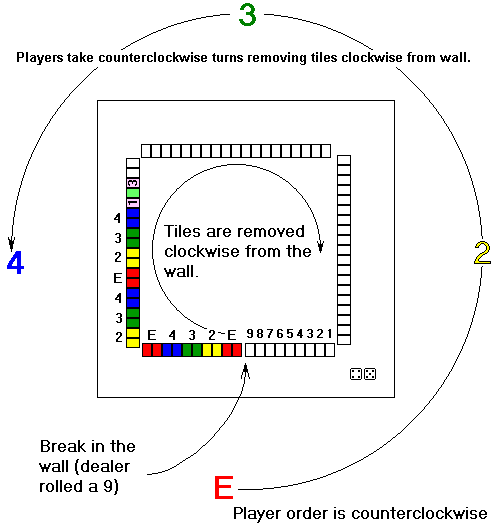
There are two directions happening simultaneously - counterclockwise (the players taking tiles in turn) and clockwise (the tiles disappearing from the wall). During the course of play, players always take turns counterclockwise (even during the distribution of tiles) - and tiles are always removed clockwise from the wall (even during the distribution of tiles). And in American mah-jongg, players serve the wall diagonally into the center of the table as the wall is used up.


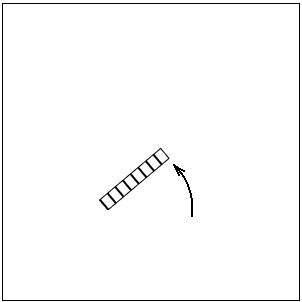
East's left wall is served out first, then when that's depleted, player 4's wall swings out,
then player 3's wall, and then you guessed it, player 2's wall.
Then East's last remaining wall comes out, if somebody hasn't yet won the game.
The part of the wall that's in the middle of the table is where the next pick comes from.
For further reading:
RDWW - p. 44 (rule 19), pp. 68-70
NMJL - pp. 9-10
If you appreciate the free information on this site, your donation would be gratefully accepted, and would help keep this site running as a free service.
Thank you!
 DONATE!

 Q: My group plays with the fourteenth tile, and a rules question came up... Oh, and I also have a question about the past history of playing with a future tile. Answer them one at a time, please.
A: I cannot answer any questions that arise from the use of illegal rules like "picking ahead" or "playing with a future." You are using an unofficial table rule, and you have to figure out the answers to questions arising from your table rule. Read FAQ 14. I have only seen two rulings from the League about this style of play: (1) rule #1 on the back of the NMJL card says, in all caps, "NO PICKING OR LOOKING AHEAD." That rule has been on the back of the National Mah Jongg League card since 1956! (2) In the January 2014 newsletter, the League said, "NO... The fourteenth tile does NOT belong to the Player picking ahead...it only becomes their tile when it is their turn."
For further reading:
RDWW - p. 121
NMJL - back of card, and the 2014 newsletter, page 5.
Q: I played long ago. We used to play futures all the time back then. When were futures outlawed?
A: "Picking Ahead" (aka "Playing With A Future," sometimes called "Playing with 14 tiles") has been against the official NMJL rules since 1956. As far back as 1947, the yearly card said "No looking ahead." As I noted in FAQ 11H, the phrase "No picking or looking ahead" first appeared on the NMJL card in 1956, and it has stayed there ever since.
On October 15, 2015 I answered a bulletin board question from Barbara B, who needed convincing that there never had been any official rule permitting "futures." So I dug deeply into Viola Cecil's early rulebooks, "Maajh, The American Version of the Ancient Chinese Game" (1938) and "Maajh or Mah Chiang; 1940 Rules."
I also checked Dorothy S. Meyerson's 1946 rulebook, "That's It." Although I did find some odd wording in Cecil's books about the order of play, there was nothing that remotely suggested that a player could pick a tile from the wall before the start of her own turn. Picking the tile before your turn has always been, and still is, against the official rules. If you pick ahead in a tournament (if you pick from the wall during another player's turn -- before she has discarded), you'll be declared "dead."
 Q: Two historical questions about jokers...
Q1: When were jokers introduced? Was it always eight jokers?
A1: Before 1961, there were no jokers. Flowers were wild, and the number of flowers fluctuated between 8 and 24. Joker tiles were introduced into the American game in 1961. The number of flowers and jokers fluctuated for several years, finally stabilizing at 8F/8J ten years later, in the 1971-72 card. See answer AI below, and column 509 for more on this.
For further reading:
RDWW - p. 14, pp. 92-93
Q2: I played long ago, and we could use jokers for anything. When exactly were jokers outlawed in pairs?
A2: As far as I can tell by checking the old NMJL cards in my collection, the rule that jokers could not be used for singles or pairs may have been introduced in 1984. But if you want to know for sure when that rule was introduced, you could ask the League.
 Q: Why are so many players of American mah-jongg Jewish?
A: I don't have any hard facts on this, but I can make some educated guesses. From what I've been able to learn, some (but not all) of the founders of the NMJL were Jewish. Many of the women who joined the League and stayed with it and supported it were mainly Jewish women (or perhaps the Jewish acceptance of the game grew) throughout World War II. The League contributes a portion of its earnings to numerous charities (including Jewish charities).
As far as I know, the Jewish-mahjongg connection (the prevalence of Jewish players) is primarily an American phenomenon. Sure, there are Jewish mah-jongg players outside the U.S., but in my opinion the sizeable Jewish demographic among mah-jongg players is something one sees only in the U.S., where American-style mah-jongg seems to be the dominant variant. In other countries, where other forms of mah-jongg are played, the demographics are a bit more diverse.
In the 1920s the game became a fad in general. Eddie Cantor sang a hit song about mah-jongg ("Since Ma Is Playing Mah Jong") at that time. He was Jewish, if I recall correctly. So perhaps the Jewish connection to mah-jongg began as early as the 1920s.
It might have happened in China, when Jews left Russia during the 1917 revolution and migrated in large numbers to Shanghai and Hong Kong, or during the holocaust and diaspora of the 1930s and 1940s, when more Jews found refuge in China.
On August 2, 2016, I got an email from Karen D., who suggested that Jewish women played mah-jongg as an alternative to country club membership, since so many country clubs were restricted.
And, perhaps, as Bill H. suggested on Feb. 1, 2011, the Jewish/mah-jongg connection began on Manhattan's Lower East Side, where many Jewish folk lived near New York's Chinatown in the early 20th century. Right across the East River is Brooklyn. Even today, and even here in Los Angeles where I live, it's not unusual to hear Brooklyn accents among mah-jongg players. And, as Supreme Court Judge Elena Kagan famously noted, Jewish folk frequent Chinese restaurants, paralleling the Jewish/mah-jongg connection. Perhaps both predilections (Chinese food and mah-jongg) took hold in the Jewish community around the same time.
The modern American style of mah-jongg (regulated by a central organization who issues a yearly card) did not yet exist in the 1920s. It seems likely that the Jewish connection really took hold with the popularity of the NMJL in the late 1930s and into WWII.
Author Gregg Swain has looked into the Jewish Mah-Jongg connection. Her website is MahJongTreasures.com.
 Q: Why are so many players of American mah-jongg female?
A: The majority of American players are female because the American game was designed by women, to be enjoyed by women. American mah-jongg is completely different from all other forms of mah-jongg because of changes that female players made in the game during the 1930s (and made official when the National Mah Jongg League was formed in 1937). The female players threw out "chows," restricted the hands to groups of similar tiles as listed on a card, changed the use of the flowers, and the NMJL issued a new card every year.
For further reading:
RDWW - p. 14
 Q: Why are so few players under 30?
A: It used to be that daughters picked up the game from their mothers, but there was a gap during the 1960s. Daughters decided then that they'd rather burn their bras than play a game their mothers and grandmothers played. After those daughters grew up, had kids, and their kids left the "nest," then they needed something to do. So we're seeing a resurgence of the game among baby boomers. The majority of players of the American game do seem to be over 40, but a lot of thirtysomethings are picking up the game too. I guess the twentysomethings have lots of other things to do with their spare time, and don't see a good reason to socialize with the older generations.
For further reading:
RDWW - p. 15
 Q: 1. How does payment work?
2. What is "pie"?
3. How do we use these plastic "coin" things?
4. How does "betting" work?
5. What if the winner asks for less than she's due?
6. Can I claim a Bonus double with one joker in Quints? Can I claim a Bonus double in Singles & Pairs?
1: Most American players play for actual money, in the form of coins exchanged immediately upon a win. Some people keep score on paper instead (no money involved). The hand values given on the NMJL card range from 25 to 50. That equates to 25¢ and 50¢. The score is double for the discarder (non-discarders pay single value). The score is doubled again if the hand has no jokers (not including the hands in the singles and pairs section of the card) at the time mah-jongg is declared.
For the novices, here is an example: Charlotte discards green and David wins on it, a 25-point hand. Charlotte announces the score: "That's it. Mahj! David discarded it, so he owes me 50¢. The rest of you owe me 25."
Here's another example: Alice discards red. Betty says "mahj." Betty shows her tiles, and it's a hand comprised of pungs, kongs, and/or quints, with or without pairs (it is not a hand from the singles and pairs section of the card), and it doesn't have any jokers. Betty announces her score. "It's a 25-point hand, and it's jokerless. So it's 50 cents all, but Alice owes me a dollar since she threw it." Charlene and Delores both pay 50¢, and Alice pays $1.00. If Esther bet on Betty, everybody (except Betty, of course) also pays Esther (exactly the same amount they each paid Betty) - for more on betting, see #4 below.
A lot of people ask if it's really true that 25 cents, doubled twice, really equals a whole dollar. At first blush it would seem that these people can't do math. But I do not believe that that many people truly are that math-challenged. So there must be some other reason for the frequency of this question. I think it's connected to the same reason why many stores show their prices as being a penny under a dollar, so they don't have to cross a "dollar boundary." American mah-jongg players don't mind playing for cents, but as soon as we start talking about dollars, then we enter a whole different dimension. The upshot?... Yes, of course a quarter doubled twice is a whole dollar. It's not difficult math. You didn't think mah-jongg was a gambling game? Well, guess what: it is! Get used to it. In Asia, lots of people gamble for much higher stakes! We're really talking peanuts. Many people like to limit the gamble by using the widely common "pie" rule (below).
For further reading:
RDWW - p. 56 (rule 76a), pp. 93-94
NMJL - back of card
2. A "pie" is a table rule that limits the amount that a player can lose during an evening's play. Players here in Los Angeles mostly play with a $5 pie - which means that each player brings a coin purse with exactly $5 in coins. When the player's coins are all gone, she continues to play - at no additional risk.
She's "pie"
When she wins, people pay her, then when she loses again, she pays again. But when playing with a pie, nobody ever loses more money than she brought in her coin purse. Several people have asked me if some penalties should be paid with money from the pocket or purse (rather than from the pie purse). The answer is no -- that would defeat the whole purpose for having a pie in the first place.
If you play in a pie game, just don't bring any other money to the game except your pie money. That's all the money you can lose in the game, period.
Read FAQ 14 for more about table rules.
The pie amount is whatever the group agrees to. I've heard of people playing with a $3 pie, I've heard that rich east coast ladies play with a $10 pie, some people refuse to play for any money at all, and some players play without a pie (sky's the limit).
As for the etymology of the term, have you ever seen a pie chart? That's a circular representation of something that can be broken down into percentages. So in American mah-jongg, the term means "I have this much pie to go aROUND, and when it's gone, nobody eats any more pie." I read on Facebook that it stands for "Purse Is Empty." But I like my crusty juicy confection metaphor better.
For further reading:
RDWW - p. 56 (rule 76b), p. 94
3. The colorful plastic chips (like antique Chinese coins with a square hole) that come with many mah-jongg sets are chips - exactly as is done with casino chips or poker chips, they are used in lieu of money for scorekeeping. If you are playing somewhere where it wouldn't be kosher to let people see you paying each other with money after each hand (gambling is frowned upon in many places, you know), you can use the plastic chips instead. Then if you want to play for real money, settle up at the end of the entire play session. For details about how to use chips, see FAQ 7d.
For further reading:
RDWW - p. 56 (rule 75), pp. 94-95
4. Betting is an optional way to enjoy a five-player game in which one player rotates out each hand. The fifth player looks at each player's hand after the Charleston is complete and makes a note of the name of the player whom she thinks will win the hand (or if she thinks it will be a wall game). If she bet correctly, the losing players all have to pay not only the winner but also the bettor. If she bet wrongly, she pays exactly what the "bet-on" player pays to any or all other players. If it's a wall game and the bettor correctly bet on a wall game, the players all pay her 25¢.
If she bet on the wall and a player wins by self-pick, she pays double amount (same as any other non-winner). If she bet on the wall and a player wins by discard, she pays single amount (same as any other non-discarder).
New rule, 2024: the League recognizes that some people play for cash (coins), and possibly for a limited purse ("Pie"). To make sure payment is fair, the League "recommends that all monies due are given to the declarer, in the event that one or more players may be Pie or short of the payment required.
The declarer now gives half of all they have collected to the Bettor." (Source: NMJL FAQs, 2024.)
The bettor is not allowed to say anything until after all players have made payment. If after payment is made, the bettor announces that the win was in error, it's too late to undo the payment. Nobody gives any money back. FOUR people erred (not one). When people err, they sometimes have to pay a penalty. Read FAQ 9 for more about how to handle errors.
For further reading:
RDWW - pp. 66-67 (rules 118-130), pp. 124-125
NMJL - pp. 20-21, 2014
5.
What if the winner's hand is jokerless but she doesn't request double payment? Do we pay her double anyway?
A: The winner is required to score her hand and tell each player how much to pay. The players are required to pay only what the winner asks for, unless the winner asks for too much and the non-winners dispute her claim. From the January 2014 newsletter:
If a player declares Mah Jongg without jokers, she/he must announce it as jokerless. If not announced, the player would NOT be entitled to the bonus.
Source:
NMJL - 2014
6. Can I claim a Bonus double with one joker in Quints? Can I claim a Bonus double in Singles & Pairs?
A: No. The bonus doubles your score only if you have no jokers, and your hand is not in the Singles & Pairs section of the card. The jokerless bonus does not apply in Quints. You have to use a joker in Quints; the difficulty is already factored into the score.
But it's impossible to make a quint without at least one joker. And the name of the Bonus double isn't "jokerless," it's "Bonus."
 None of that matters. The name of the scoring attribute doesn't matter. The fact that a joker is required to make a quint doesn't matter. The difficulty of making the hand is pre-built into the score on the card. The (jokerless) Bonus cannot apply in Quints.
 Q: I hear Chinese mah-jongg is harder!
A: When you say "Chinese mah-jongg," I assume you mean "any kind of mah-jongg other than American." Because there are, in fact, around forty known mah-jongg variants - and more than a dozen Chinese variants! See FAQ 2B. Oh, and no. Those other variants are not harder to learn than American mah-jongg. American is the hardest to learn of them all. I should know - I've learned several variants.
American mah-jongg is hard because you can only play the hands listed on the card. It's quite a challenge to find possibilities for hands from among a random 13 or 14 tiles. ONLY American mah-jongg uses a card! All the other forms of mah-jongg are free-form (very much akin to Rummy).
American mah-jongg is the oddball variant of the mah-jongg world. Once you learn any... um... "un-American" (^_^) variant, it's easy to learn any other variant (including American), but there's something about the American variant that "spoils" you, apparently making it a huge mental leap to learn about stuff like chows and the use of flowers (not to mention the scoring). Or so it seems, anyway (I've often found it a challenge to teach non-American forms to players of the American game). Read FAQ 10 and FAQ 20 if you care to learn the basics of, uh, "un-American" (^_^) kinds of mah-jongg.
For further reading:
RDWW - pp. 39-41, 127-129
 Q: Is there a special prohibition against, or penalty for, throwing the winning tile when the wall is short and/or the winner had exposures showing? Is there a special prohibition against claiming a discard for mere exposure on East's wall (the last short wall)?
A: No. There is no "hot wall" or "cold wall" or "pay for the party" rule in the official NMJL rules.
The official rules do not change when the wall reaches some arbitrary number. The last short wall in front of East is just "the wall" - there are no official special rules that suddenly kick in when the game comes down to the last short wall. Throwing to three exposures incurs a penalty in tournaments, but not in the official NMJL rules.
The official rules do not penalize throwing into exposures. Under the official rules, the discarder of the winning tile always pays twice what the other two non-winners pay the winner (the scoring rules are clearly stated on the back of the yearly card).
Many groups adopt a "table rule" to stipulate a penalty for discarding the winning tile during the final stage of a hand. Invariably, these table rules are called "cold wall" or "hot wall" or "paying for the party." Many tournaments penalize throwing the winning tile into two or three exposures; but these penalties are not part of the official rules.
Other than the discarder double payment, the official NMJL rules do not stipulate any prohibition against, nor penalty for, throwing the winning tile, under any circumstances, no matter the number of exposures or the length of the remaining wall.
Q: What is a "cold wall"? And what is a "hot wall"? What's "paying for the party?"
A: See above. These are not part of the official rules. "Cold wall" is a table rule that prohibits either discarding or calling a "hot tile." "Hot wall" is a table rule that penalizes discarding a "hot tile." The rules vary. The definition of "hot tile" and "safe tile" vary, depending on the table rule. In some table rules, the term "hot tiles"
(which has a strategic meaning - hot tiles are "tiles that another player clearly needs, or tiles that are otherwise dangerous to discard")
is also applied to those that come from the last short wall remaining in front of East, but there are various table rules (again: all unofficial).
"Paying for the party" means that the non-winners who didn't discard the winning tile don't have to pay anything (the discarder takes on that debt, and pays on their behalf). These are all table rules. That means these rules are NOT part of the official rules as governed by the NMJL. Read FAQ 14 to learn more about table rules. And read FAQ 21 to learn about how some tournament organizers set their rules (which necessarily differ somewhat from the official NMJL rules, since playing for points in a competitive tournament setting is different from paying for coins between a foursome playing for fun).
For further reading:
RDWW - pp. 118-119
NMJL - 2007, 2014, 2015
 Q: Must exposures be in card order?
A: It depends on whether the game is in progress or you have declared mah-jongg.
During play, experienced players don't need to see exposures to be shown in card order. It's standard practice to put exposures in order made (first one at player's left, next one to the right of that one, and so on), with spaces between each exposed grouping.
In fact, there is a good defensive reason for not displaying exposures in card order during play - while a newbie might wish to have the visual hint, the player who's exposed part of her hand wishes her opponents won't figure out exactly what hand she is making. Sometimes two exposures can be ambiguous, and that is an important part of mah-jongg strategy. So newbie players just have to "put up" with the fact that exposures are displayed in chronological order rather than card order.
Upon completion of the hand (having won), however, it is standard practice to organize the groupings in card order to aid the others in reading your winning hand. When declaring mah-jongg, just re-arrange your exposures the way they're arranged on the card. The 2018 rulebook even says the exposures should be re-arranged.
Q: Can a player call another player dead? What are the rules regarding death challenges?
A: In American mah-jongg, there is a rule that permits any player to call another player's hand "dead" at any time (a player does not have to wait for her turn to call someone dead).
A player may make such a "death challenge" based on a number of circumstances that make a player's hand dead:
- No Such Hand - Player's exposures do not match any hand on the card. MJME 2023/24 p.19 rule 15.d.
- Unwinnable - Player's exposures indicate that player needs to make a pair, for example, and three or more of the needed tiles are dead on the table (visible to all, either among the discards or as part of an exposure). Or player needs to make a single, and all four of that tile are already used up. Or player needs a flower pair, and seven flowers are visible. MJME 2023/24 p.19 rule 15.e.
- Exposed Concealed Hand - Player's exposures indicate that player's hand must be concealed. MJME 2023/24 p. 19, rule 15.f.
- Too Many/Few Tiles - Player is holding 12 or fewer tiles (13 or fewer after picking) - or player is holding 15 or more tiles (14 or more between turns). MJME2023/24 p.19, rule 15.a.
- Playing Out of Turn, Picking Ahead, Picking From Wrong End or Wrong Wall - These are all death penalties. If a player pushes out the wrong wall and another player picks from that wall, the player who picked is disqualified but the game continues with the wrong wall and when it's exhausted, play continues with the correct wall. MJME 2023/24 p.19-20.
- Incorrect Exposure - MJME2023/24 defines "incorrect exposure" as a group of tiles that is not a pung, kong, quint, or sextet. Those are all correct groups of identical tiles.
Let's say player made a 1B kong but one of the tiles is a flower, or player illegally exposed a pair, or a NEWS or a 202x (regardless of jokers) - and then discarded. MJME2023 p. 19, rule 19 (c). See also answer M.4 on this page.
- Redemption Out of Turn - Player redeemed a joker when she could not account for 14 tiles. As per FAQ 19M, a player must have 14 tiles on her rack before she may redeem a joker. This ruling comes from the 2020 NMJL newsletter. (You get the yearly newsletter if you bought your card directly from the League the preceding year. Tom Sloper's recommendation: always buy your card directly from the League so you can get the newsletter, with updated rules.) The rule was later added to MJME2023/24. P.19 rule 15.b.
- Pushing Out the Next Wall Prematurely - If a player pushes out their wall before the prior wall was exhausted, and another player picks from that wall, both players' hands are disqualified. MJME 2023/34 p.20 rule 16.c.
When a player is called dead due to an erroneous exposure, the tiles in the erring exposure should be returned to the rack. This removes any jokers from "temptation." The taken discard (if one was used to make the erroneous exposure) also goes to the sloping front of the rack, unless another player wants it for mah-jongg and this mahj claim is being spoken before another turn occurs after the erroneous exposure was made.
When someone issues a death challenge, whether it's phrased as a statement, a guess, or a question*, the player who is on the receiving end of the death challenge must either acknowledge that she is indeed dead, or she may deny it (without explaining what hand she is making). Then the game continues, either with or without that player, depending on her reply to the challenge.
If the player acknowledges that her hand is dead, she stops playing. If she denies that her hand is dead, she keeps playing. At the end of the hand, her tiles are checked to see if her hand was rightly challenged. Whoever was wrong pays the other player 50 points (or 50¢ if using coins).
* A lot of players try to weasel their way out of actually making a challenge outright, out of fear of being wrong and being penalized. So they phrase it as a question rather than a death challenge. It still counts. Even just mentioning in the vaguest way that a player might be dead is still tantamount to issuing the challenge, because the mention does call everyone's attention to the challengee's hand. Therefore, if somebody asks you if you're dead (or asks anybody else at the table or in the room if you're dead), that is a death challenge - and you can reply accordingly. "Yes, you got me, I'm dead," or "No, I deny that I'm dead - according to the rules, you'll owe me 50¢ when you see that I'm right." (See AB, below.)
For further reading:
RDWW - pp. 63-65 (rules 101-108), pp. 100-101
NMJL - MJME2020 p. 21-22, MJME2023 p. 19 and p.21 - also newsletters/bulletins of 2005, 2009, 2013, 2018
 Q: Someone called me dead (pursuant to AA above) but I'm not dead. What now?
A: If a player has erroneously issued a death challenge, or if a player has erroneously denied a death challenge (which can be determined at the end of the hand), the erring player must pay 50 cents (double the value of the cheapest hand on the card) to the other player.
After denying the death challenge, the game continues with both the challenger and the challenged continuing to play. Then at the end the challenged player's tiles are examined to determine who pays whom.
So. If you call me dead and I deny it, and at the end of the hand we see that you were wrong, you owe me 50¢. Conversely, if you call me dead and I deny it, and at the end of the hand we see that I was wrong, I owe you 50¢.
For further reading:
RDWW - p. 64 (rules 103, 104), p. 101
NMJL - 2001, 2005, 2008. 50¢ rule displayed November 2019 on NMJL's FAQs page.
 Q: Can I call myself dead? If I know I'm dead, do I have to call myself dead?
A: No, and no. You are not supposed to call yourself dead. You are supposed to play defensively until someone else calls you dead (and this is the wisest course, strategically speaking). However, I sometimes wish someone would hurry up and call me dead so I could do something less frustrating, like go get something to nibble on for a minute. (So I sympathize with those who would want to call themselves dead.) Video game players have a term: "rage quitting" is when a player is frustrated and turns the game off or throws the game controller down and walks away. When I get frustrated in a mah-jongg game, I might sometimes think about making a really obviously wrong exposure so someone will call me dead so I can take a break and cool off. But I have never actually done that.
If you happen to blurt out that you are dead, you aren't officially dead unless other players can confirm that you are dead, based on tiles visible to all on the table. If the others can't see that you are dead, you keep playing.
For further reading:
RDWW - p. 64 (rule 105), p. 101
NMJL - p.19 (rule 14), 2005

 Where to find computer mah-jongg games?


 Can I use a joker in an S&P hand?

 Can I claim a discarded joker?
 Can I redeem a joker atop my own rack?
 Can I exchange a joker for a non-joker tile (reverse redemption)?
 What is a 'super joker'?
 After breaking the wall, where do the leftover tiles go?
 What if I'm East and I have a complete hand before the Charleston? ("Heavenly Hand")
 What can we do about a player who stops the Charleston too often?
 What if the word "any" is not used?
 Can't find the answer?


 Ask. The people you play with might know if their rule is official or made up by them (or by the person who taught them) (then again, there are those who teach made-up rules as if they were official*).
 Look in the rulebook (if the rule isn't in there, it probably isn't a rule - see

 (I lied when I said there were two ways.) It's very likely that others have already asked me about that rule, and I've answered it somewhere here in FAQ 19. To find it among the dozens of frequently asked questions here, you can scan the categories and the index of questions atop this page, or you can search this page for key words.
 You can also ask me. The answer will be posted on


 You want to use the rack to push out a nice straight wall, so you slide the rack to the left (image below).

 Push the rack up into contact with the tiles (image above).
 Place your left hand on the rack so that your index finger is at X and your thumb is at Y.
 Put your right hand on the rack at Z, and push out with your right hand.
 Put the rack back where it started. The tiles to the right of the break stay at the right end of the rack (see image below). The deal now begins (see


 Very nice, Donna!


